 Add to Chrome
 Add to Firefox
 Add to Edge
Learning Action and Reasoning-Centric Image Editing from Videos and Simulations
Jul 03, 2024
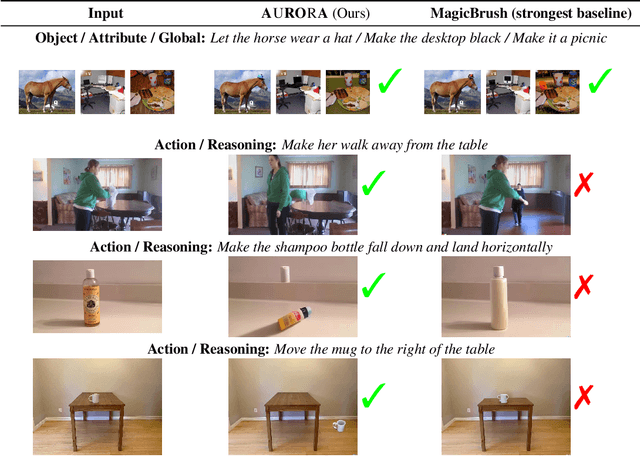
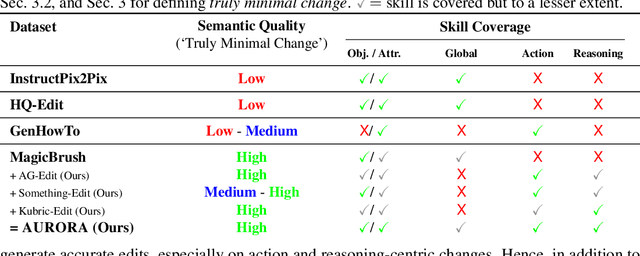
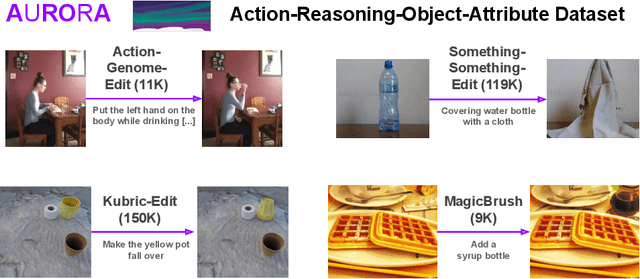

An image editing model should be able to perform diverse edits, ranging from object replacement, changing attributes or style, to performing actions or movement, which require many forms of reasoning. Current general instruction-guided editing models have significant shortcomings with action and reasoning-centric edits. Object, attribute or stylistic changes can be learned from visually static datasets. On the other hand, high-quality data for action and reasoning-centric edits is scarce and has to come from entirely different sources that cover e.g. physical dynamics, temporality and spatial reasoning. To this end, we meticulously curate the AURORA Dataset (Action-Reasoning-Object-Attribute), a collection of high-quality training data, human-annotated and curated from videos and simulation engines. We focus on a key aspect of quality training data: triplets (source image, prompt, target image) contain a single meaningful visual change described by the prompt, i.e., truly minimal changes between source and target images. To demonstrate the value of our dataset, we evaluate an AURORA-finetuned model on a new expert-curated benchmark (AURORA-Bench) covering 8 diverse editing tasks. Our model significantly outperforms previous editing models as judged by human raters. For automatic evaluations, we find important flaws in previous metrics and caution their use for semantically hard editing tasks. Instead, we propose a new automatic metric that focuses on discriminative understanding. We hope that our efforts : (1) curating a quality training dataset and an evaluation benchmark, (2) developing critical evaluations, and (3) releasing a state-of-the-art model, will fuel further progress on general image editing.

Reframing linguistic bootstrapping as joint inference using visually-grounded grammar induction models
Jun 17, 2024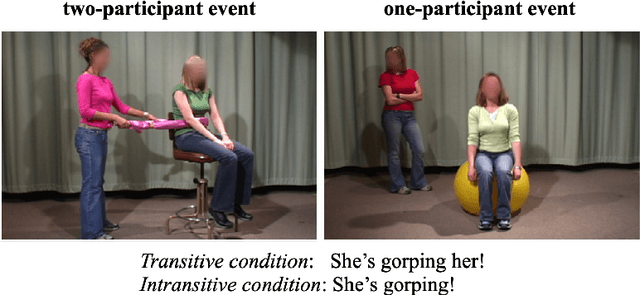
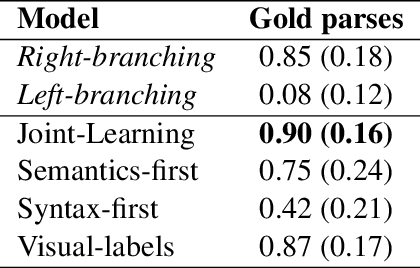

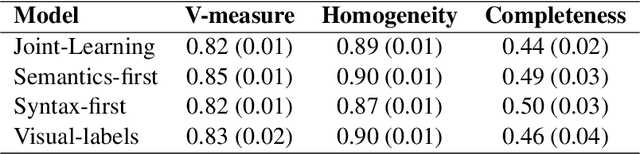
Semantic and syntactic bootstrapping posit that children use their prior knowledge of one linguistic domain, say syntactic relations, to help later acquire another, such as the meanings of new words. Empirical results supporting both theories may tempt us to believe that these are different learning strategies, where one may precede the other. Here, we argue that they are instead both contingent on a more general learning strategy for language acquisition: joint learning. Using a series of neural visually-grounded grammar induction models, we demonstrate that both syntactic and semantic bootstrapping effects are strongest when syntax and semantics are learnt simultaneously. Joint learning results in better grammar induction, realistic lexical category learning, and better interpretations of novel sentence and verb meanings. Joint learning makes language acquisition easier for learners by mutually constraining the hypotheses spaces for both syntax and semantics. Studying the dynamics of joint inference over many input sources and modalities represents an important new direction for language modeling and learning research in both cognitive sciences and AI, as it may help us explain how language can be acquired in more constrained learning settings.
Interpretability Needs a New Paradigm
May 08, 2024Interpretability is the study of explaining models in understandable terms to humans. At present, interpretability is divided into two paradigms: the intrinsic paradigm, which believes that only models designed to be explained can be explained, and the post-hoc paradigm, which believes that black-box models can be explained. At the core of this debate is how each paradigm ensures its explanations are faithful, i.e., true to the model's behavior. This is important, as false but convincing explanations lead to unsupported confidence in artificial intelligence (AI), which can be dangerous. This paper's position is that we should think about new paradigms while staying vigilant regarding faithfulness. First, by examining the history of paradigms in science, we see that paradigms are constantly evolving. Then, by examining the current paradigms, we can understand their underlying beliefs, the value they bring, and their limitations. Finally, this paper presents 3 emerging paradigms for interpretability. The first paradigm designs models such that faithfulness can be easily measured. Another optimizes models such that explanations become faithful. The last paradigm proposes to develop models that produce both a prediction and an explanation.
Universal Adversarial Triggers Are Not Universal
Apr 24, 2024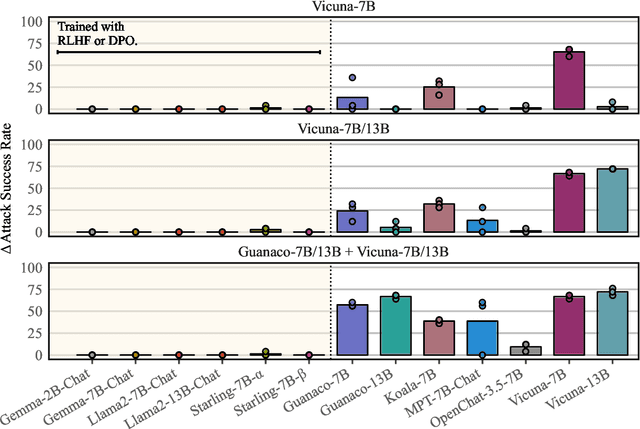
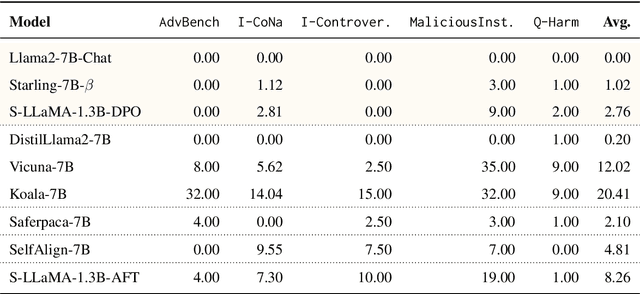
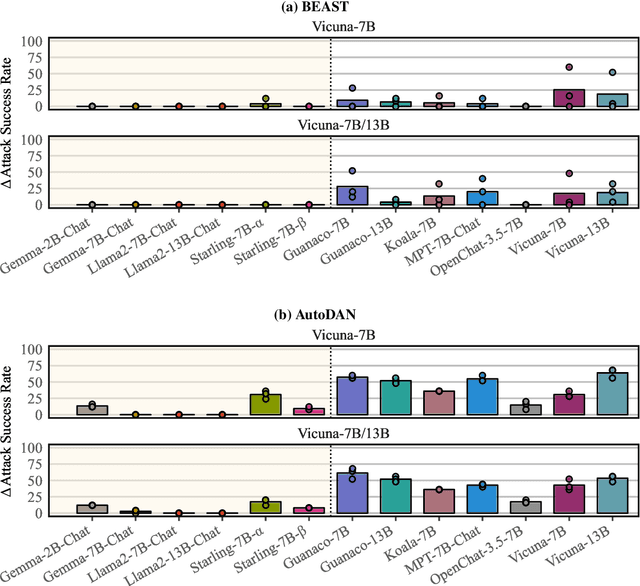
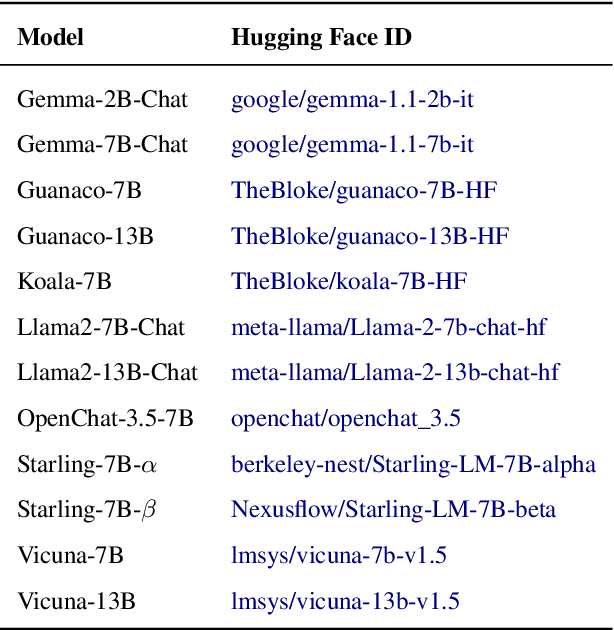
Recent work has developed optimization procedures to find token sequences, called adversarial triggers, which can elicit unsafe responses from aligned language models. These triggers are believed to be universally transferable, i.e., a trigger optimized on one model can jailbreak other models. In this paper, we concretely show that such adversarial triggers are not universal. We extensively investigate trigger transfer amongst 13 open models and observe inconsistent transfer. Our experiments further reveal a significant difference in robustness to adversarial triggers between models Aligned by Preference Optimization (APO) and models Aligned by Fine-Tuning (AFT). We find that APO models are extremely hard to jailbreak even when the trigger is optimized directly on the model. On the other hand, while AFT models may appear safe on the surface, exhibiting refusals to a range of unsafe instructions, we show that they are highly susceptible to adversarial triggers. Lastly, we observe that most triggers optimized on AFT models also generalize to new unsafe instructions from five diverse domains, further emphasizing their vulnerability. Overall, our work highlights the need for more comprehensive safety evaluations for aligned language models.
LLM2Vec: Large Language Models Are Secretly Powerful Text Encoders
Apr 09, 2024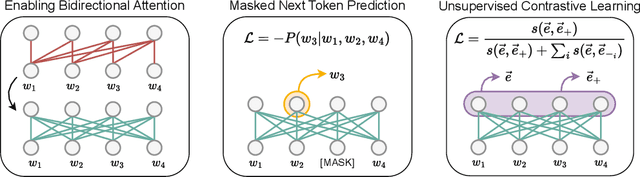
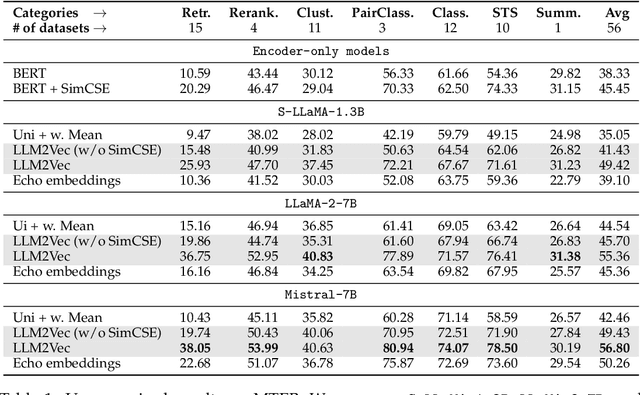
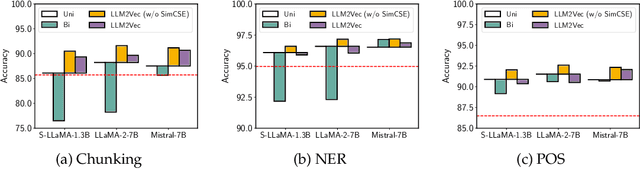
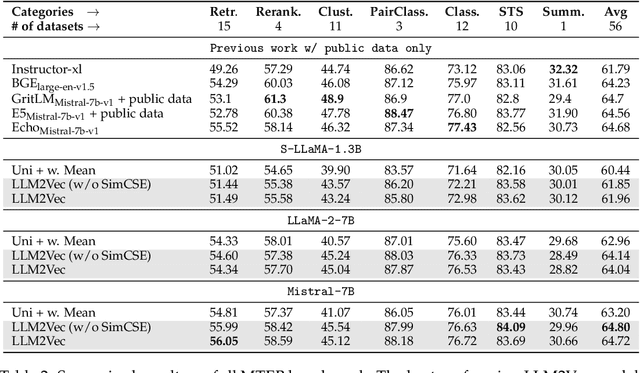
Large decoder-only language models (LLMs) are the state-of-the-art models on most of today's NLP tasks and benchmarks. Yet, the community is only slowly adopting these models for text embedding tasks, which require rich contextualized representations. In this work, we introduce LLM2Vec, a simple unsupervised approach that can transform any decoder-only LLM into a strong text encoder. LLM2Vec consists of three simple steps: 1) enabling bidirectional attention, 2) masked next token prediction, and 3) unsupervised contrastive learning. We demonstrate the effectiveness of LLM2Vec by applying it to 3 popular LLMs ranging from 1.3B to 7B parameters and evaluate the transformed models on English word- and sequence-level tasks. We outperform encoder-only models by a large margin on word-level tasks and reach a new unsupervised state-of-the-art performance on the Massive Text Embeddings Benchmark (MTEB). Moreover, when combining LLM2Vec with supervised contrastive learning, we achieve state-of-the-art performance on MTEB among models that train only on publicly available data. Our strong empirical results and extensive analysis demonstrate that LLMs can be effectively transformed into universal text encoders in a parameter-efficient manner without the need for expensive adaptation or synthetic GPT-4 generated data.
Scope Ambiguities in Large Language Models
Apr 05, 2024Sentences containing multiple semantic operators with overlapping scope often create ambiguities in interpretation, known as scope ambiguities. These ambiguities offer rich insights into the interaction between semantic structure and world knowledge in language processing. Despite this, there has been little research into how modern large language models treat them. In this paper, we investigate how different versions of certain autoregressive language models -- GPT-2, GPT-3/3.5, Llama 2 and GPT-4 -- treat scope ambiguous sentences, and compare this with human judgments. We introduce novel datasets that contain a joint total of almost 1,000 unique scope-ambiguous sentences, containing interactions between a range of semantic operators, and annotated for human judgments. Using these datasets, we find evidence that several models (i) are sensitive to the meaning ambiguity in these sentences, in a way that patterns well with human judgments, and (ii) can successfully identify human-preferred readings at a high level of accuracy (over 90% in some cases).
A Compositional Typed Semantics for Universal Dependencies
Mar 02, 2024Languages may encode similar meanings using different sentence structures. This makes it a challenge to provide a single set of formal rules that can derive meanings from sentences in many languages at once. To overcome the challenge, we can take advantage of language-general connections between meaning and syntax, and build on cross-linguistically parallel syntactic structures. We introduce UD Type Calculus, a compositional, principled, and language-independent system of semantic types and logical forms for lexical items which builds on a widely-used language-general dependency syntax framework. We explain the essential features of UD Type Calculus, which all involve giving dependency relations denotations just like those of words. These allow UD-TC to derive correct meanings for sentences with a wide range of syntactic structures by making use of dependency labels. Finally, we present evaluation results on a large existing corpus of sentences and their logical forms, showing that UD-TC can produce meanings comparable with our baseline.
When does word order matter and when doesn't it?
Mar 01, 2024Language models (LMs) may appear insensitive to word order changes in natural language understanding (NLU) tasks. In this paper, we propose that linguistic redundancy can explain this phenomenon, whereby word order and other linguistic cues such as case markers provide overlapping and thus redundant information. Our hypothesis is that models exhibit insensitivity to word order when the order provides redundant information, and the degree of insensitivity varies across tasks. We quantify how informative word order is using mutual information (MI) between unscrambled and scrambled sentences. Our results show the effect that the less informative word order is, the more consistent the model's predictions are between unscrambled and scrambled sentences. We also find that the effect varies across tasks: for some tasks, like SST-2, LMs' prediction is almost always consistent with the original one even if the Pointwise-MI (PMI) changes, while for others, like RTE, the consistency is near random when the PMI gets lower, i.e., word order is really important.
WebLINX: Real-World Website Navigation with Multi-Turn Dialogue
Feb 08, 2024We propose the problem of conversational web navigation, where a digital agent controls a web browser and follows user instructions to solve real-world tasks in a multi-turn dialogue fashion. To support this problem, we introduce WEBLINX - a large-scale benchmark of 100K interactions across 2300 expert demonstrations of conversational web navigation. Our benchmark covers a broad range of patterns on over 150 real-world websites and can be used to train and evaluate agents in diverse scenarios. Due to the magnitude of information present, Large Language Models (LLMs) cannot process entire web pages in real-time. To solve this bottleneck, we design a retrieval-inspired model that efficiently prunes HTML pages by ranking relevant elements. We use the selected elements, along with screenshots and action history, to assess a variety of models for their ability to replicate human behavior when navigating the web. Our experiments span from small text-only to proprietary multimodal LLMs. We find that smaller finetuned decoders surpass the best zero-shot LLMs (including GPT-4V), but also larger finetuned multimodal models which were explicitly pretrained on screenshots. However, all finetuned models struggle to generalize to unseen websites. Our findings highlight the need for large multimodal models that can generalize to novel settings. Our code, data and models are available for research: https://mcgill-nlp.github.io/weblinx
Are self-explanations from Large Language Models faithful?
Jan 17, 2024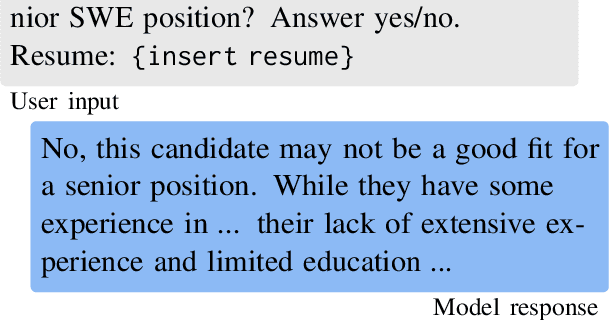
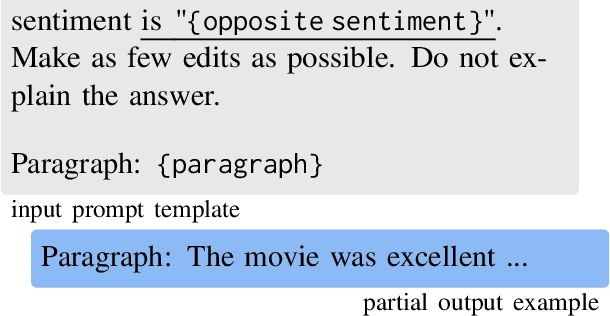
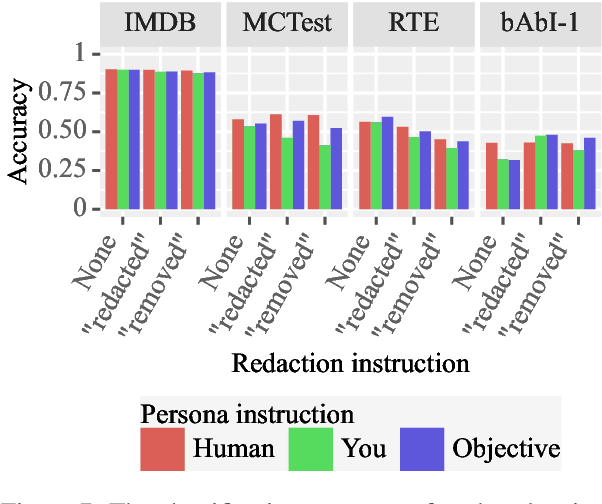
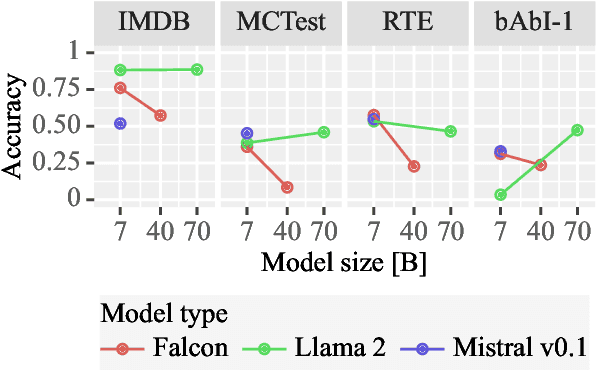
Instruction-tuned large language models (LLMs) excel at many tasks, and will even provide explanations for their behavior. Since these models are directly accessible to the public, there is a risk that convincing and wrong explanations can lead to unsupported confidence in LLMs. Therefore, interpretability-faithfulness of self-explanations is an important consideration for AI Safety. Assessing the interpretability-faithfulness of these explanations, termed self-explanations, is challenging as the models are too complex for humans to annotate what is a correct explanation. To address this, we propose employing self-consistency checks as a measure of faithfulness. For example, if an LLM says a set of words is important for making a prediction, then it should not be able to make the same prediction without these words. While self-consistency checks are a common approach to faithfulness, they have not previously been applied to LLM's self-explanations. We apply self-consistency checks to three types of self-explanations: counterfactuals, importance measures, and redactions. Our work demonstrate that faithfulness is both task and model dependent, e.g., for sentiment classification, counterfactual explanations are more faithful for Llama2, importance measures for Mistral, and redaction for Falcon 40B. Finally, our findings are robust to prompt-variations.