 Add to Chrome
 Add to Firefox
 Add to Edge
Reasoning over mathematical objects: on-policy reward modeling and test time aggregation
Mar 19, 2026
The ability to precisely derive mathematical objects is a core requirement for downstream STEM applications, including mathematics, physics, and chemistry, where reasoning must culminate in formally structured expressions. Yet, current LM evaluations of mathematical and scientific reasoning rely heavily on simplified answer formats such as numerical values or multiple choice options due to the convenience of automated assessment. In this paper we provide three contributions for improving reasoning over mathematical objects: (i) we build and release training data and benchmarks for deriving mathematical objects, the Principia suite; (ii) we provide training recipes with strong LLM-judges and verifiers, where we show that on-policy judge training boosts performance; (iii) we show how on-policy training can also be used to scale test-time compute via aggregation. We find that strong LMs such as Qwen3-235B and o3 struggle on Principia, while our training recipes can bring significant improvements over different LLM backbones, while simultaneously improving results on existing numerical and MCQA tasks, demonstrating cross-format generalization of reasoning abilities.

Beg to Differ: Understanding Reasoning-Answer Misalignment Across Languages
Dec 27, 2025Large language models demonstrate strong reasoning capabilities through chain-of-thought prompting, but whether this reasoning quality transfers across languages remains underexplored. We introduce a human-validated framework to evaluate whether model-generated reasoning traces logically support their conclusions across languages. Analyzing 65k reasoning traces from GlobalMMLU questions across 6 languages and 6 frontier models, we uncover a critical blind spot: while models achieve high task accuracy, their reasoning can fail to support their conclusions. Reasoning traces in non-Latin scripts show at least twice as much misalignment between their reasoning and conclusions than those in Latin scripts. We develop an error taxonomy through human annotation to characterize these failures, finding they stem primarily from evidential errors (unsupported claims, ambiguous facts) followed by illogical reasoning steps. Our findings demonstrate that current multilingual evaluation practices provide an incomplete picture of model reasoning capabilities and highlight the need for reasoning-aware evaluation frameworks.
Calibrating LLM Judges: Linear Probes for Fast and Reliable Uncertainty Estimation
Dec 23, 2025As LLM-based judges become integral to industry applications, obtaining well-calibrated uncertainty estimates efficiently has become critical for production deployment. However, existing techniques, such as verbalized confidence and multi-generation methods, are often either poorly calibrated or computationally expensive. We introduce linear probes trained with a Brier score-based loss to provide calibrated uncertainty estimates from reasoning judges' hidden states, requiring no additional model training. We evaluate our approach on both objective tasks (reasoning, mathematics, factuality, coding) and subjective human preference judgments. Our results demonstrate that probes achieve superior calibration compared to existing methods with $\approx10$x computational savings, generalize robustly to unseen evaluation domains, and deliver higher accuracy on high-confidence predictions. However, probes produce conservative estimates that underperform on easier datasets but may benefit safety-critical deployments prioritizing low false-positive rates. Overall, our work demonstrates that interpretability-based uncertainty estimation provides a practical and scalable plug-and-play solution for LLM judges in production.
What's in Common? Multimodal Models Hallucinate When Reasoning Across Scenes
Nov 05, 2025Multimodal language models possess a remarkable ability to handle an open-vocabulary's worth of objects. Yet the best models still suffer from hallucinations when reasoning about scenes in the real world, revealing a gap between their seemingly strong performance on existing perception benchmarks that are saturating and their reasoning in the real world. To address this gap, we build a novel benchmark of in-the-wild scenes that we call Common-O. With more than 10.5k examples using exclusively new images not found in web training data to avoid contamination, Common-O goes beyond just perception, inspired by cognitive tests for humans, to probe reasoning across scenes by asking "what's in common?". We evaluate leading multimodal language models, including models specifically trained to perform chain-of-thought reasoning. We find that perceiving objects in single images is tractable for most models, yet reasoning across scenes is very challenging even for the best models, including reasoning models. Despite saturating many leaderboards focusing on perception, the best performing model only achieves 35% on Common-O -- and on Common-O Complex, consisting of more complex scenes, the best model achieves only 1%. Curiously, we find models are more prone to hallucinate when similar objects are present in the scene, suggesting models may be relying on object co-occurrence seen during training. Among the models we evaluated, we found scale can provide modest improvements while models explicitly trained with multi-image inputs show bigger improvements, suggesting scaled multi-image training may offer promise. We make our benchmark publicly available to spur research into the challenge of hallucination when reasoning across scenes.
FACTORY: A Challenging Human-Verified Prompt Set for Long-Form Factuality
Jul 31, 2025Long-form factuality evaluation assesses the ability of models to generate accurate, comprehensive responses to short prompts. Existing benchmarks often lack human verification, leading to potential quality issues. To address this limitation, we introduce FACTORY, a large-scale, human-verified prompt set. Developed using a model-in-the-loop approach and refined by humans, FACTORY includes challenging prompts that are fact-seeking, answerable, and unambiguous. We conduct human evaluations on 6 state-of-the-art language models using FACTORY and existing datasets. Our results show that FACTORY is a challenging benchmark: approximately 40% of the claims made in the responses of SOTA models are not factual, compared to only 10% for other datasets. Our analysis identifies the strengths of FACTORY over prior benchmarks, emphasizing its reliability and the necessity for models to reason across long-tailed facts.
IntPhys 2: Benchmarking Intuitive Physics Understanding In Complex Synthetic Environments
Jun 11, 2025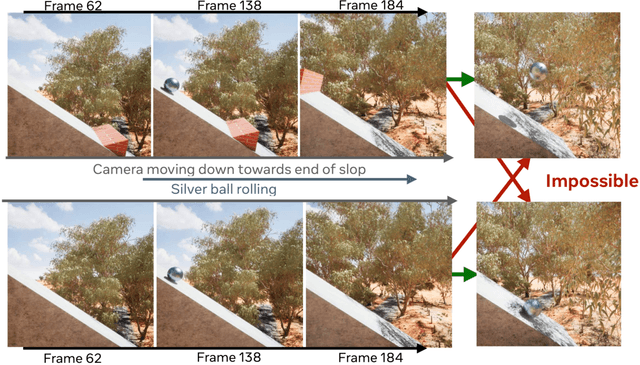
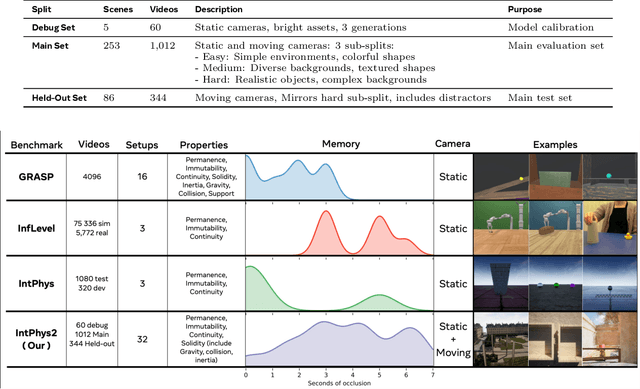

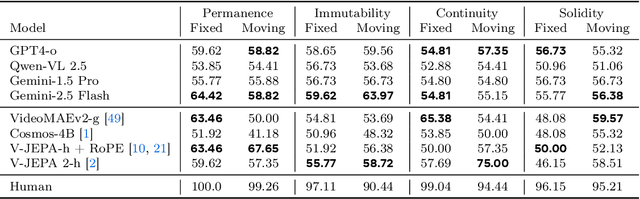
We present IntPhys 2, a video benchmark designed to evaluate the intuitive physics understanding of deep learning models. Building on the original IntPhys benchmark, IntPhys 2 focuses on four core principles related to macroscopic objects: Permanence, Immutability, Spatio-Temporal Continuity, and Solidity. These conditions are inspired by research into intuitive physical understanding emerging during early childhood. IntPhys 2 offers a comprehensive suite of tests, based on the violation of expectation framework, that challenge models to differentiate between possible and impossible events within controlled and diverse virtual environments. Alongside the benchmark, we provide performance evaluations of several state-of-the-art models. Our findings indicate that while these models demonstrate basic visual understanding, they face significant challenges in grasping intuitive physics across the four principles in complex scenes, with most models performing at chance levels (50%), in stark contrast to human performance, which achieves near-perfect accuracy. This underscores the gap between current models and human-like intuitive physics understanding, highlighting the need for advancements in model architectures and training methodologies.
Arbiters of Ambivalence: Challenges of Using LLMs in No-Consensus Tasks
May 28, 2025The increasing use of LLMs as substitutes for humans in ``aligning'' LLMs has raised questions about their ability to replicate human judgments and preferences, especially in ambivalent scenarios where humans disagree. This study examines the biases and limitations of LLMs in three roles: answer generator, judge, and debater. These roles loosely correspond to previously described alignment frameworks: preference alignment (judge) and scalable oversight (debater), with the answer generator reflecting the typical setting with user interactions. We develop a ``no-consensus'' benchmark by curating examples that encompass a variety of a priori ambivalent scenarios, each presenting two possible stances. Our results show that while LLMs can provide nuanced assessments when generating open-ended answers, they tend to take a stance on no-consensus topics when employed as judges or debaters. These findings underscore the necessity for more sophisticated methods for aligning LLMs without human oversight, highlighting that LLMs cannot fully capture human disagreement even on topics where humans themselves are divided.
Do different prompting methods yield a common task representation in language models?
May 17, 2025Demonstrations and instructions are two primary approaches for prompting language models to perform in-context learning (ICL) tasks. Do identical tasks elicited in different ways result in similar representations of the task? An improved understanding of task representation mechanisms would offer interpretability insights and may aid in steering models. We study this through function vectors, recently proposed as a mechanism to extract few-shot ICL task representations. We generalize function vectors to alternative task presentations, focusing on short textual instruction prompts, and successfully extract instruction function vectors that promote zero-shot task accuracy. We find evidence that demonstration- and instruction-based function vectors leverage different model components, and offer several controls to dissociate their contributions to task performance. Our results suggest that different task presentations do not induce a common task representation but elicit different, partly overlapping mechanisms. Our findings offer principled support to the practice of combining textual instructions and task demonstrations, imply challenges in universally monitoring task inference across presentation forms, and encourage further examinations of LLM task inference mechanisms.
Domain Regeneration: How well do LLMs match syntactic properties of text domains?
May 12, 2025Recent improvement in large language model performance have, in all likelihood, been accompanied by improvement in how well they can approximate the distribution of their training data. In this work, we explore the following question: which properties of text domains do LLMs faithfully approximate, and how well do they do so? Applying observational approaches familiar from corpus linguistics, we prompt a commonly used, opensource LLM to regenerate text from two domains of permissively licensed English text which are often contained in LLM training data -- Wikipedia and news text. This regeneration paradigm allows us to investigate whether LLMs can faithfully match the original human text domains in a fairly semantically-controlled setting. We investigate varying levels of syntactic abstraction, from more simple properties like sentence length, and article readability, to more complex and higher order properties such as dependency tag distribution, parse depth, and parse complexity. We find that the majority of the regenerated distributions show a shifted mean, a lower standard deviation, and a reduction of the long tail, as compared to the human originals.
Findings of the BabyLM Challenge: Sample-Efficient Pretraining on Developmentally Plausible Corpora
Apr 10, 2025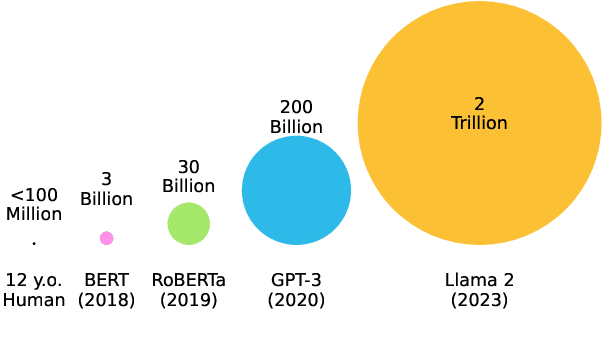
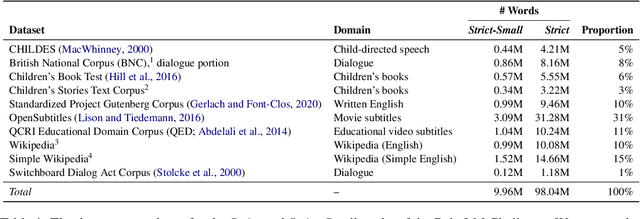
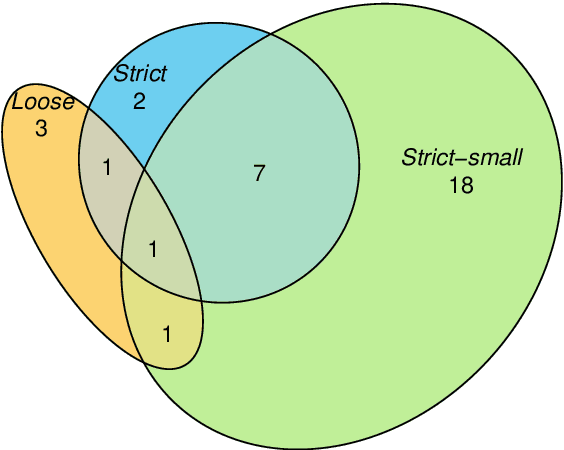
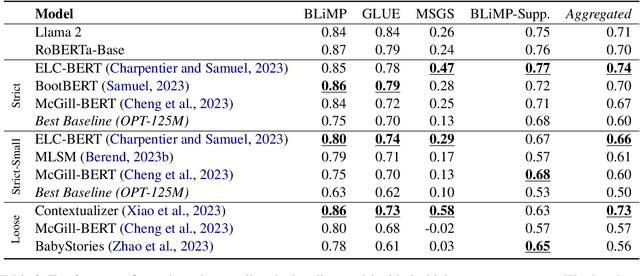
Children can acquire language from less than 100 million words of input. Large language models are far less data-efficient: they typically require 3 or 4 orders of magnitude more data and still do not perform as well as humans on many evaluations. These intensive resource demands limit the ability of researchers to train new models and use existing models as developmentally plausible cognitive models. The BabyLM Challenge is a communal effort in which participants compete to optimize language model training on a fixed data budget. Submissions are compared on various evaluation tasks targeting grammatical ability, downstream task performance, and generalization. Participants can submit to up to three tracks with progressively looser data restrictions. From over 30 submissions, we extract concrete recommendations on how best to train data-efficient language models, and on where future efforts should (and perhaps should not) focus. The winning submissions using the LTG-BERT architecture (Samuel et al., 2023) outperformed models trained on trillions of words. Other submissions achieved strong results through training on shorter input sequences or training a student model on a pretrained teacher. Curriculum learning attempts, which accounted for a large number of submissions, were largely unsuccessful, though some showed modest improvements.
* Published in Proceedings of BabyLM. Please cite the published version on ACL anthology: http://aclanthology.org/2023.conll-babylm.1/