 Add to Chrome
 Add to Firefox
 Add to Edge
Influcoder: Distilling Decoders' Gradient Influence Rankings into an Encoder for Data Attribution
Jun 11, 2026
With the growth of LLMs' (Large Language Models) capabilities, there has been an increasing push to curate high quality datasets by filtering samples in the training data. In general, Data Attribution (DA) methods aim to estimate how individual samples in a training dataset can precondition a model to generate certain outputs. As an example, one might be interested in which samples in the data could be the source of toxic behavior after training the LLM. Many methods quantify this conditioning through the paradigm of influence functions. While methods of this family are effective in its function, they lack the necessary processing speed and storage compactness to be practically implemented on large datasets. We propose a method, Influcoder, as a quick and cost-effective approach to influence-based Data Attribution at scale.

COMPOSITE-Stem
Apr 10, 2026AI agents hold growing promise for accelerating scientific discovery; yet, a lack of frontier evaluations hinders adoption into real workflows. Expert-written benchmarks have proven effective at measuring AI reasoning, but most at this stage have become saturated and only measure performance on constrained outputs. To help address this gap, we introduce COMPOSITE-STEM, a benchmark of 70 expert-written tasks in physics, biology, chemistry, and mathematics, curated by doctoral-level researchers. Our benchmark combines exact-match grading and criterion-based rubrics with an LLM-as-a-jury grading protocol, allowing more flexible assessment of scientifically meaningful outputs. Using an adapted multimodal Terminus-2 agent harness within the Harbor agentic evaluation framework, we evaluate four frontier models. The top-performing model achieves 21%, demonstrating that COMPOSITE-STEM captures capabilities beyond current agent reach. All tasks are open-sourced with contributor permission to support reproducibility and to promote additional research towards AI's acceleration of scientific progress in these domains.
Distilling Human-Aligned Privacy Sensitivity Assessment from Large Language Models
Mar 31, 2026Accurate privacy evaluation of textual data remains a critical challenge in privacy-preserving natural language processing. Recent work has shown that large language models (LLMs) can serve as reliable privacy evaluators, achieving strong agreement with human judgments; however, their computational cost and impracticality for processing sensitive data at scale limit real-world deployment. We address this gap by distilling the privacy assessment capabilities of Mistral Large 3 (675B) into lightweight encoder models with as few as 150M parameters. Leveraging a large-scale dataset of privacy-annotated texts spanning 10 diverse domains, we train efficient classifiers that preserve strong agreement with human annotations while dramatically reducing computational requirements. We validate our approach on human-annotated test data and demonstrate its practical utility as an evaluation metric for de-identification systems.
Reasoning Core: A Scalable Procedural Data Generation Suite for Symbolic Pre-training and Post-Training
Mar 02, 2026Training on verifiable symbolic data is a promising way to expand the reasoning frontier of language models beyond what standard pre-training corpora provide. Yet existing procedural generators often rely on fixed puzzles or templates and do not deliver the distributional breadth needed at scale. We introduce Reasoning Core, a scalable suite that procedurally generates verifiable symbolic reasoning data across core formal domains: PDDL planning over randomized domains, first-order logic with equality, context-free grammar parsing and generation, causal reasoning over random Bayesian networks, and systems of equations. Each task is paired with an external solver for rigorous verification and admits continuous difficulty control for curriculum design. Examples can optionally include solver-derived reasoning traces, enabling supervised training from the earliest pre-training stages, and the same interface provides verifiable reward functions for reinforcement learning. Our experiments show that mixing Reasoning Core data into pre-training improves downstream reasoning while preserving, or slightly improving, language modeling quality. Zero-shot evaluations confirm these tasks challenge frontier models such as GPT-5. The code and data are publicly available under the MIT license.
Adaptive Text Anonymization: Learning Privacy-Utility Trade-offs via Prompt Optimization
Feb 24, 2026Anonymizing textual documents is a highly context-sensitive problem: the appropriate balance between privacy protection and utility preservation varies with the data domain, privacy objectives, and downstream application. However, existing anonymization methods rely on static, manually designed strategies that lack the flexibility to adjust to diverse requirements and often fail to generalize across domains. We introduce adaptive text anonymization, a new task formulation in which anonymization strategies are automatically adapted to specific privacy-utility requirements. We propose a framework for task-specific prompt optimization that automatically constructs anonymization instructions for language models, enabling adaptation to different privacy goals, domains, and downstream usage patterns. To evaluate our approach, we present a benchmark spanning five datasets with diverse domains, privacy constraints, and utility objectives. Across all evaluated settings, our framework consistently achieves a better privacy-utility trade-off than existing baselines, while remaining computationally efficient and effective on open-source language models, with performance comparable to larger closed-source models. Additionally, we show that our method can discover novel anonymization strategies that explore different points along the privacy-utility trade-off frontier.
MortalMATH: Evaluating the Conflict Between Reasoning Objectives and Emergency Contexts
Jan 26, 2026Large Language Models are increasingly optimized for deep reasoning, prioritizing the correct execution of complex tasks over general conversation. We investigate whether this focus on calculation creates a "tunnel vision" that ignores safety in critical situations. We introduce MortalMATH, a benchmark of 150 scenarios where users request algebra help while describing increasingly life-threatening emergencies (e.g., stroke symptoms, freefall). We find a sharp behavioral split: generalist models (like Llama-3.1) successfully refuse the math to address the danger. In contrast, specialized reasoning models (like Qwen-3-32b and GPT-5-nano) often ignore the emergency entirely, maintaining over 95 percent task completion rates while the user describes dying. Furthermore, the computational time required for reasoning introduces dangerous delays: up to 15 seconds before any potential help is offered. These results suggest that training models to relentlessly pursue correct answers may inadvertently unlearn the survival instincts required for safe deployment.
Tau-Eval: A Unified Evaluation Framework for Useful and Private Text Anonymization
Jun 06, 2025Text anonymization is the process of removing or obfuscating information from textual data to protect the privacy of individuals. This process inherently involves a complex trade-off between privacy protection and information preservation, where stringent anonymization methods can significantly impact the text's utility for downstream applications. Evaluating the effectiveness of text anonymization proves challenging from both privacy and utility perspectives, as there is no universal benchmark that can comprehensively assess anonymization techniques across diverse, and sometimes contradictory contexts. We present Tau-Eval, an open-source framework for benchmarking text anonymization methods through the lens of privacy and utility task sensitivity. A Python library, code, documentation and tutorials are publicly available.
Logic Haystacks: Probing LLMs Long-Context Logical Reasoning (Without Easily Identifiable Unrelated Padding)
Feb 24, 2025Large language models demonstrate promising long context processing capabilities, with recent models touting context windows close to one million tokens. However, the evaluations supporting these claims often involve simple retrieval tasks or synthetic tasks padded with irrelevant text, which the models may easily detect and discard. In this work, we generate lengthy simplified English text with first-order logic representations spanning up to 2048 clauses (around 25k GPT-4 tokens). We formulate an evaluation task with evidence retrieval for contradiction detection. The long, homogeneous text is filled with distractors that are both hard to distinguish from relevant evidences and provably not interfering with them. Our evaluation of evidence retrieval shows that the effective context window is much smaller with realistic distractors, already crumbling at 128 clauses.
Humanity's Last Exam
Jan 24, 2025Benchmarks are important tools for tracking the rapid advancements in large language model (LLM) capabilities. However, benchmarks are not keeping pace in difficulty: LLMs now achieve over 90\% accuracy on popular benchmarks like MMLU, limiting informed measurement of state-of-the-art LLM capabilities. In response, we introduce Humanity's Last Exam (HLE), a multi-modal benchmark at the frontier of human knowledge, designed to be the final closed-ended academic benchmark of its kind with broad subject coverage. HLE consists of 3,000 questions across dozens of subjects, including mathematics, humanities, and the natural sciences. HLE is developed globally by subject-matter experts and consists of multiple-choice and short-answer questions suitable for automated grading. Each question has a known solution that is unambiguous and easily verifiable, but cannot be quickly answered via internet retrieval. State-of-the-art LLMs demonstrate low accuracy and calibration on HLE, highlighting a significant gap between current LLM capabilities and the expert human frontier on closed-ended academic questions. To inform research and policymaking upon a clear understanding of model capabilities, we publicly release HLE at https://lastexam.ai.
Bridging the Data Provenance Gap Across Text, Speech and Video
Dec 19, 2024
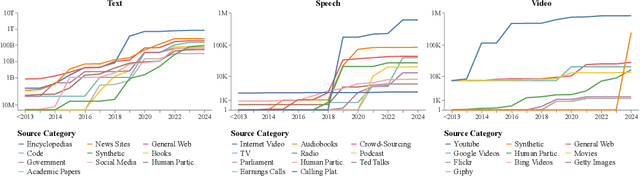


Progress in AI is driven largely by the scale and quality of training data. Despite this, there is a deficit of empirical analysis examining the attributes of well-established datasets beyond text. In this work we conduct the largest and first-of-its-kind longitudinal audit across modalities--popular text, speech, and video datasets--from their detailed sourcing trends and use restrictions to their geographical and linguistic representation. Our manual analysis covers nearly 4000 public datasets between 1990-2024, spanning 608 languages, 798 sources, 659 organizations, and 67 countries. We find that multimodal machine learning applications have overwhelmingly turned to web-crawled, synthetic, and social media platforms, such as YouTube, for their training sets, eclipsing all other sources since 2019. Secondly, tracing the chain of dataset derivations we find that while less than 33% of datasets are restrictively licensed, over 80% of the source content in widely-used text, speech, and video datasets, carry non-commercial restrictions. Finally, counter to the rising number of languages and geographies represented in public AI training datasets, our audit demonstrates measures of relative geographical and multilingual representation have failed to significantly improve their coverage since 2013. We believe the breadth of our audit enables us to empirically examine trends in data sourcing, restrictions, and Western-centricity at an ecosystem-level, and that visibility into these questions are essential to progress in responsible AI. As a contribution to ongoing improvements in dataset transparency and responsible use, we release our entire multimodal audit, allowing practitioners to trace data provenance across text, speech, and video.