 Add to Chrome
 Add to Firefox
 Add to Edge
Many-Shot CoT-ICL: Making In-Context Learning Truly Learn
May 13, 2026
In-context learning (ICL) adapts large language models (LLMs) to new tasks by conditioning on demonstrations in the prompt without parameter updates. With long-context models, many-shot ICL can use dozens to hundreds of examples and achieve performance comparable to fine-tuning, yet current understanding of its scaling behavior is largely derived from non-reasoning tasks. We study many-shot chain-of-thought in-context learning (CoT-ICL) for reasoning and show that standard many-shot rules do not transfer. Across non-reasoning and reasoning-oriented LLMs and across non-reasoning and reasoning tasks, we find: (i) a setting-dependent scaling effect, where increasing the number of CoT demonstrations is unstable for non-reasoning LLMs and benefits mainly reasoning-oriented LLMs; (ii) similarity-based retrieval helps on non-reasoning tasks but fails on reasoning, since semantic similarity poorly predicts procedural (i.e., CoT) compatibility; and (iii) an order-scaling effect, where performance variance grows with more CoT demonstrations. We interpret these behaviors by viewing many-shot CoT-ICL as in-context test-time learning rather than scaled pattern matching, and suggests two principles: (i) demonstrations should be easy for the target model to understand, and (ii) they should be ordered to support a smooth conceptual progression. Guided by the principle, we propose Curvilinear Demonstration Selection (CDS), a simple ordering method that yields up to a 5.42 percentage-point gain on geometry with 64 demonstrations. Overall, our results reframe the long context window from a retrieval buffer into a structured curriculum for in-context test-time learning.

MiA-Signature: Approximating Global Activation for Long-Context Understanding
May 07, 2026A growing body of work in cognitive science suggests that reportable conscious access is associated with \emph{global ignition} over distributed memory systems, while such activation is only partially accessible as individuals cannot directly access or enumerate all activated contents. This tension suggests a plausible mechanism that cognition may rely on a compact representation that approximates the global influence of activation on downstream processing. Inspired by this idea, we introduce the concept of \textbf{Mindscape Activation Signature (MiA-Signature)}, a compressed representation of the global activation pattern induced by a query. In LLM systems, this is instantiated via submodular-based selection of high-level concepts that cover the activated context space, optionally refined through lightweight iterative updates using working memory. The resulting MiA-Signature serves as a conditioning signal that approximates the effect of the full activation state while remaining computationally tractable. Integrating MiA-Signatures into both RAG and agentic systems yields consistent performance gains across multiple long-context understanding tasks.
Judge Like Human Examiners: A Weighted Importance Multi-Point Evaluation Framework for Generative Tasks with Long-form Answers
Apr 14, 2026Evaluating the quality of model responses remains challenging in generative tasks with long-form answers, as the expected answers usually contain multiple semantically distinct yet complementary factors that should be factorized for fine-grained assessment. Recent evaluation methods resort to relying on either task-level rubrics or question-aware checklists. However, they still 1) struggle to assess whether a response is genuinely grounded in provided contexts; 2) fail to capture the heterogeneous importance of different aspects of reference answers. Inspired by human examiners, we propose a Weighted Importance Multi-Point Evaluation (WIMPE) framework, which factorizes each reference answer into weighted context-bound scoring points. Two complementary metrics, namely Weighted Point-wise Alignment (WPA) and Point-wise Conflict Penalty (PCP), are designed to measure the alignment and contradiction between model responses and reference answers. Extensive experiments on 10 generative tasks demonstrate that WIMPE achieves higher correlations with human annotations.
Query-focused and Memory-aware Reranker for Long Context Processing
Feb 12, 2026Built upon the existing analysis of retrieval heads in large language models, we propose an alternative reranking framework that trains models to estimate passage-query relevance using the attention scores of selected heads. This approach provides a listwise solution that leverages holistic information within the entire candidate shortlist during ranking. At the same time, it naturally produces continuous relevance scores, enabling training on arbitrary retrieval datasets without requiring Likert-scale supervision. Our framework is lightweight and effective, requiring only small-scale models (e.g., 4B parameters) to achieve strong performance. Extensive experiments demonstrate that our method outperforms existing state-of-the-art pointwise and listwise rerankers across multiple domains, including Wikipedia and long narrative datasets. It further establishes a new state-of-the-art on the LoCoMo benchmark that assesses the capabilities of dialogue understanding and memory usage. We further demonstrate that our framework supports flexible extensions. For example, augmenting candidate passages with contextual information further improves ranking accuracy, while training attention heads from middle layers enhances efficiency without sacrificing performance.
No Global Plan in Chain-of-Thought: Uncover the Latent Planning Horizon of LLMs
Feb 02, 2026This work stems from prior complementary observations on the dynamics of Chain-of-Thought (CoT): Large Language Models (LLMs) is shown latent planning of subsequent reasoning prior to CoT emergence, thereby diminishing the significance of explicit CoT; whereas CoT remains critical for tasks requiring multi-step reasoning. To deepen the understanding between LLM's internal states and its verbalized reasoning trajectories, we investigate the latent planning strength of LLMs, through our probing method, Tele-Lens, applying to hidden states across diverse task domains. Our empirical results indicate that LLMs exhibit a myopic horizon, primarily conducting incremental transitions without precise global planning. Leveraging this characteristic, we propose a hypothesis on enhancing uncertainty estimation of CoT, which we validate that a small subset of CoT positions can effectively represent the uncertainty of the entire path. We further underscore the significance of exploiting CoT dynamics, and demonstrate that automatic recognition of CoT bypass can be achieved without performance degradation. Our code, data and models are released at https://github.com/lxucs/tele-lens.
Improving Multi-step RAG with Hypergraph-based Memory for Long-Context Complex Relational Modeling
Dec 30, 2025Multi-step retrieval-augmented generation (RAG) has become a widely adopted strategy for enhancing large language models (LLMs) on tasks that demand global comprehension and intensive reasoning. Many RAG systems incorporate a working memory module to consolidate retrieved information. However, existing memory designs function primarily as passive storage that accumulates isolated facts for the purpose of condensing the lengthy inputs and generating new sub-queries through deduction. This static nature overlooks the crucial high-order correlations among primitive facts, the compositions of which can often provide stronger guidance for subsequent steps. Therefore, their representational strength and impact on multi-step reasoning and knowledge evolution are limited, resulting in fragmented reasoning and weak global sense-making capacity in extended contexts. We introduce HGMem, a hypergraph-based memory mechanism that extends the concept of memory beyond simple storage into a dynamic, expressive structure for complex reasoning and global understanding. In our approach, memory is represented as a hypergraph whose hyperedges correspond to distinct memory units, enabling the progressive formation of higher-order interactions within memory. This mechanism connects facts and thoughts around the focal problem, evolving into an integrated and situated knowledge structure that provides strong propositions for deeper reasoning in subsequent steps. We evaluate HGMem on several challenging datasets designed for global sense-making. Extensive experiments and in-depth analyses show that our method consistently improves multi-step RAG and substantially outperforms strong baseline systems across diverse tasks.
Mindscape-Aware Retrieval Augmented Generation for Improved Long Context Understanding
Dec 19, 2025Humans understand long and complex texts by relying on a holistic semantic representation of the content. This global view helps organize prior knowledge, interpret new information, and integrate evidence dispersed across a document, as revealed by the Mindscape-Aware Capability of humans in psychology. Current Retrieval-Augmented Generation (RAG) systems lack such guidance and therefore struggle with long-context tasks. In this paper, we propose Mindscape-Aware RAG (MiA-RAG), the first approach that equips LLM-based RAG systems with explicit global context awareness. MiA-RAG builds a mindscape through hierarchical summarization and conditions both retrieval and generation on this global semantic representation. This enables the retriever to form enriched query embeddings and the generator to reason over retrieved evidence within a coherent global context. We evaluate MiA-RAG across diverse long-context and bilingual benchmarks for evidence-based understanding and global sense-making. It consistently surpasses baselines, and further analysis shows that it aligns local details with a coherent global representation, enabling more human-like long-context retrieval and reasoning.
DivLogicEval: A Framework for Benchmarking Logical Reasoning Evaluation in Large Language Models
Sep 19, 2025Logic reasoning in natural language has been recognized as an important measure of human intelligence for Large Language Models (LLMs). Popular benchmarks may entangle multiple reasoning skills and thus provide unfaithful evaluations on the logic reasoning skill. Meanwhile, existing logic reasoning benchmarks are limited in language diversity and their distributions are deviated from the distribution of an ideal logic reasoning benchmark, which may lead to biased evaluation results. This paper thereby proposes a new classical logic benchmark DivLogicEval, consisting of natural sentences composed of diverse statements in a counterintuitive way. To ensure a more reliable evaluation, we also introduce a new evaluation metric that mitigates the influence of bias and randomness inherent in LLMs. Through experiments, we demonstrate the extent to which logical reasoning is required to answer the questions in DivLogicEval and compare the performance of different popular LLMs in conducting logical reasoning.
ComoRAG: A Cognitive-Inspired Memory-Organized RAG for Stateful Long Narrative Reasoning
Aug 14, 2025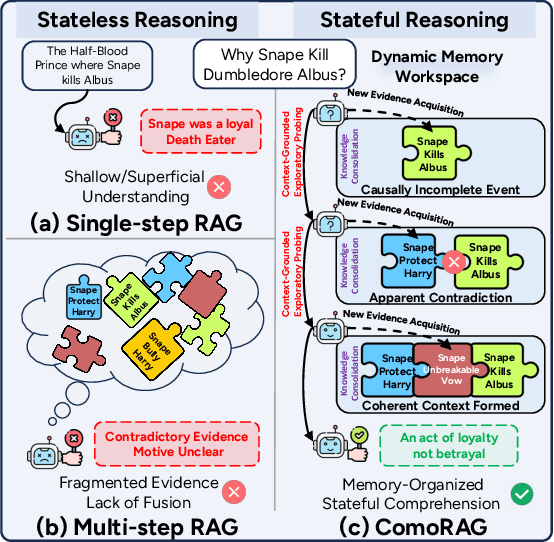
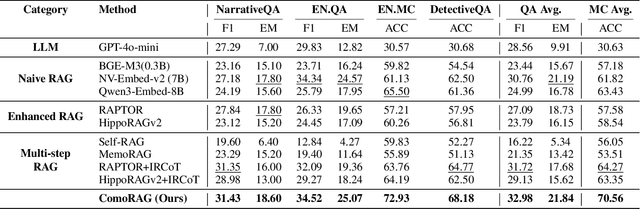
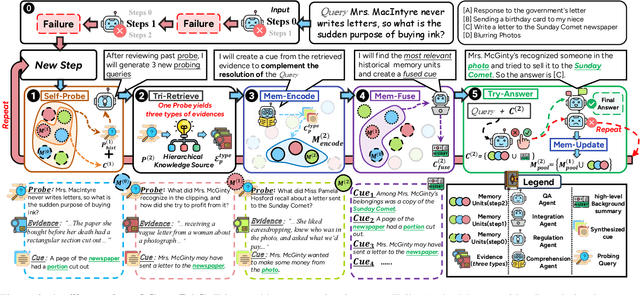
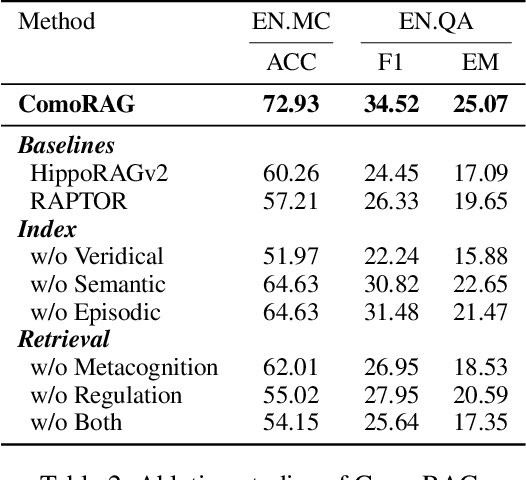
Narrative comprehension on long stories and novels has been a challenging domain attributed to their intricate plotlines and entangled, often evolving relations among characters and entities. Given the LLM's diminished reasoning over extended context and high computational cost, retrieval-based approaches remain a pivotal role in practice. However, traditional RAG methods can fall short due to their stateless, single-step retrieval process, which often overlooks the dynamic nature of capturing interconnected relations within long-range context. In this work, we propose ComoRAG, holding the principle that narrative reasoning is not a one-shot process, but a dynamic, evolving interplay between new evidence acquisition and past knowledge consolidation, analogous to human cognition when reasoning with memory-related signals in the brain. Specifically, when encountering a reasoning impasse, ComoRAG undergoes iterative reasoning cycles while interacting with a dynamic memory workspace. In each cycle, it generates probing queries to devise new exploratory paths, then integrates the retrieved evidence of new aspects into a global memory pool, thereby supporting the emergence of a coherent context for the query resolution. Across four challenging long-context narrative benchmarks (200K+ tokens), ComoRAG outperforms strong RAG baselines with consistent relative gains up to 11% compared to the strongest baseline. Further analysis reveals that ComoRAG is particularly advantageous for complex queries requiring global comprehension, offering a principled, cognitively motivated paradigm for retrieval-based long context comprehension towards stateful reasoning. Our code is publicly released at https://github.com/EternityJune25/ComoRAG
Dense Retrievers Can Fail on Simple Queries: Revealing The Granularity Dilemma of Embeddings
Jun 10, 2025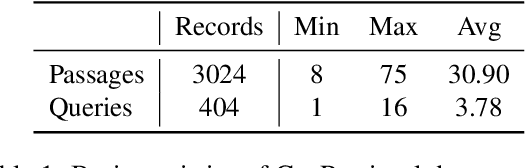
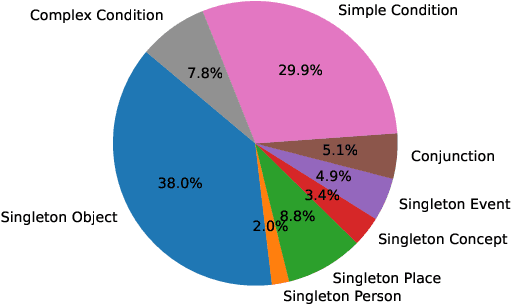
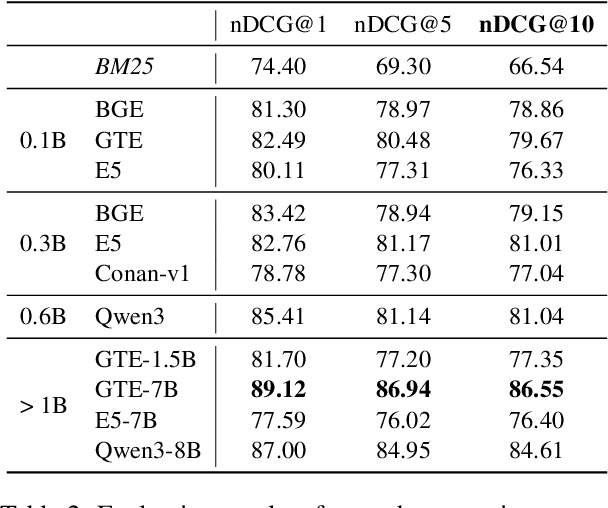
This work focuses on an observed limitation of text encoders: embeddings may not be able to recognize fine-grained entities or events within the semantics, resulting in failed dense retrieval on even simple cases. To examine such behaviors, we first introduce a new evaluation dataset in Chinese, named CapRetrieval, whose passages are image captions, and queries are phrases inquiring entities or events in various forms. Zero-shot evaluation suggests that encoders may fail on these fine-grained matching, regardless of training sources or model sizes. Aiming for enhancement, we proceed to finetune encoders with our proposed data generation strategies, which obtains the best performance on CapRetrieval. Within this process, we further identify an issue of granularity dilemma, a challenge for embeddings to express fine-grained salience while aligning with overall semantics. Our dataset, code and models in this work are publicly released at https://github.com/lxucs/CapRetrieval.