 Add to Chrome
 Add to Firefox
 Add to Edge
Pandora's AI Model Routing Box: Efficient Allocation with Costly Value Estimation
Aug 20, 2026
Heterogeneous AI systems composed of multiple models, architectures, harnesses, or inference-time settings can improve quality and efficiency by routing queries to the specialist who can answer most effectively at the lowest cost. Routing requires estimating each specialist's expected return, but this value estimation has a cost. Cheap estimators (e.g., embedding-based predictors) are fast but noisy, while accurate estimators (e.g., fine-tuned models with access to retrieval results or partial reasoning traces) are expensive. We formalize this tradeoff as an instance of Pandora's Box, the classical problem of optimal search with costly inspection. Under a Gaussian signal model, the resulting policies have closed-form value-of-information expressions that determine, for each specialist and input, whether refining the value estimate is worth its cost. We call the centralized policy Pandora's Router. We extend this to a decentralized setting, Pandora's Bidder, where specialists independently decide whether to invest in self-assessment before accepting an offered price to claim a query. Experiments across three domains---a standard multi-LLM benchmark, retrieval-augmented specialists, and LLMs with variable inference-time reasoning---show that Pandora's Router matches the routing quality of exhaustive estimation, while querying the expensive estimator far less often. In the decentralized setting, value-of-information reasoning improves allocative efficiency when competing estimates are accurate; when competing estimates are noisy, however, it can increase the strategic specialist's utility at the expense of others.

CollabEval: Statistically Efficient Collaborative Model Evaluation via Matrix Completion
Jul 06, 2026Evaluating generative AI models is a routine, but resource-intensive, process that is conducted over and over again during the course of model development. In this work, we propose Collaborative Evaluation (CollabEval), a simple, effective, and principled method for exploiting dependencies between historical runs of different models on the same tasks to improve statistical efficiency. Specifically, our approach treats model evaluation as a matrix completion problem over an $M \times N$ matrix of evaluation scores, where $M$ is the total number of models and $N$ is the total number of evaluation prompts. We assume that a subset of these $M$ models are targeted for evaluation. For these target models only a small fraction, $p$, of prompts has been annotated with evaluation scores. Leveraging recent results in prediction-powered inference, we build a low-rank approximation of the score matrix, and use the reconstructed values as control variates in a manner that guarantees unbiased estimates of the true evaluation metric mean, in addition to statistically valid confidence intervals. Empirically, across a wide range of datasets, models, and sparsity levels $p$, we find that CollabEval substantially reduces the mean confidence interval size, and the mean squared error of the point estimate, compared to baseline methods at the same annotation budget.
Multiple-Prediction-Powered Inference
Mar 28, 2026Statistical estimation often involves tradeoffs between expensive, high-quality measurements and a variety of lower-quality proxies. We introduce Multiple-Prediction-Powered Inference (MultiPPI): a general framework for constructing statistically efficient estimates by optimally allocating resources across these diverse data sources. This work provides theoretical guarantees about the minimax optimality, finite-sample performance, and asymptotic normality of the MultiPPI estimator. Through experiments across three diverse large language model (LLM) evaluation scenarios, we show that MultiPPI consistently achieves lower estimation error than existing baselines. This advantage stems from its budget-adaptive allocation strategy, which strategically combines subsets of models by learning their complex cost and correlation structures.
Rich Insights from Cheap Signals: Efficient Evaluations via Tensor Factorization
Mar 04, 2026Moving beyond evaluations that collapse performance across heterogeneous prompts toward fine-grained evaluation at the prompt level, or within relatively homogeneous subsets, is necessary to diagnose generative models' strengths and weaknesses. Such fine-grained evaluations, however, suffer from a data bottleneck: human gold-standard labels are too costly at this scale, while automated ratings are often misaligned with human judgment. To resolve this challenge, we propose a novel statistical model based on tensor factorization that merges cheap autorater data with a limited set of human gold-standard labels. Specifically, our approach uses autorater scores to pretrain latent representations of prompts and generative models, and then aligns those pretrained representations to human preferences using a small calibration set. This sample-efficient methodology is robust to autorater quality, more accurately predicts human preferences on a per-prompt basis than standard baselines, and provides tight confidence intervals for key statistical parameters of interest. We also showcase the practical utility of our method by constructing granular leaderboards based on prompt qualities and by estimating model performance solely from autorater scores, eliminating the need for additional human annotations.
MT-PingEval: Evaluating Multi-Turn Collaboration with Private Information Games
Feb 27, 2026We present a scalable methodology for evaluating language models in multi-turn interactions, using a suite of collaborative games that require effective communication about private information. This enables an interactive scaling analysis, in which a fixed token budget is divided over a variable number of turns. We find that in many cases, language models are unable to use interactive collaboration to improve over the non-interactive baseline scenario in which one agent attempts to summarize its information and the other agent immediately acts -- despite substantial headroom. This suggests that state-of-the-art models still suffer from significant weaknesses in planning and executing multi-turn collaborative conversations. We analyze the linguistic features of these dialogues, assessing the roles of sycophancy, information density, and discourse coherence. While there is no single linguistic explanation for the collaborative weaknesses of contemporary language models, we note that humans achieve comparable task success at superior token efficiency by producing dialogues that are more coherent than those produced by most language models. The proactive management of private information is a defining feature of real-world communication, and we hope that MT-PingEval will drive further work towards improving this capability.
Cost-Optimal Active AI Model Evaluation
Jun 09, 2025The development lifecycle of generative AI systems requires continual evaluation, data acquisition, and annotation, which is costly in both resources and time. In practice, rapid iteration often makes it necessary to rely on synthetic annotation data because of the low cost, despite the potential for substantial bias. In this paper, we develop novel, cost-aware methods for actively balancing the use of a cheap, but often inaccurate, weak rater -- such as a model-based autorater that is designed to automatically assess the quality of generated content -- with a more expensive, but also more accurate, strong rater alternative such as a human. More specifically, the goal of our approach is to produce a low variance, unbiased estimate of the mean of the target "strong" rating, subject to some total annotation budget. Building on recent work in active and prediction-powered statistical inference, we derive a family of cost-optimal policies for allocating a given annotation budget between weak and strong raters so as to maximize statistical efficiency. Using synthetic and real-world data, we empirically characterize the conditions under which these policies yield improvements over prior methods. We find that, especially in tasks where there is high variability in the difficulty of examples, our policies can achieve the same estimation precision at a far lower total annotation budget than standard evaluation methods.
Don't lie to your friends: Learning what you know from collaborative self-play
Mar 18, 2025To be helpful assistants, AI agents must be aware of their own capabilities and limitations. This includes knowing when to answer from parametric knowledge versus using tools, when to trust tool outputs, and when to abstain or hedge. Such capabilities are hard to teach through supervised fine-tuning because they require constructing examples that reflect the agent's specific capabilities. We therefore propose a radically new approach to teaching agents what they know: \emph{collaborative self-play}. We construct multi-agent collaborations in which the group is rewarded for collectively arriving at correct answers. The desired meta-knowledge emerges from the incentives built into the structure of the interaction. We focus on small societies of agents that have access to heterogeneous tools (corpus-specific retrieval), and therefore must collaborate to maximize their success while minimizing their effort. Experiments show that group-level rewards for multi-agent communities can induce policies that \emph{transfer} to improve tool use and selective prediction in settings where individual agents are deployed in isolation.
Mitigating Preference Hacking in Policy Optimization with Pessimism
Mar 10, 2025This work tackles the problem of overoptimization in reinforcement learning from human feedback (RLHF), a prevalent technique for aligning models with human preferences. RLHF relies on reward or preference models trained on \emph{fixed preference datasets}, and these models are unreliable when evaluated outside the support of this preference data, leading to the common reward or preference hacking phenomenon. We propose novel, pessimistic objectives for RLHF which are provably robust to overoptimization through the use of pessimism in the face of uncertainty, and design practical algorithms, P3O and PRPO, to optimize these objectives. Our approach is derived for the general preference optimization setting, but can be used with reward models as well. We evaluate P3O and PRPO on the tasks of fine-tuning language models for document summarization and creating helpful assistants, demonstrating remarkable resilience to overoptimization.
Relaxed Recursive Transformers: Effective Parameter Sharing with Layer-wise LoRA
Oct 28, 2024

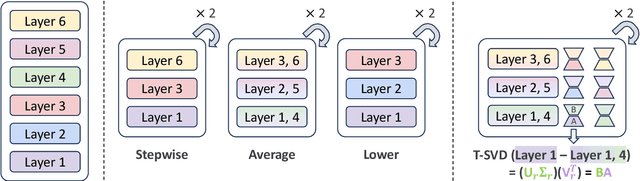

Large language models (LLMs) are expensive to deploy. Parameter sharing offers a possible path towards reducing their size and cost, but its effectiveness in modern LLMs remains fairly limited. In this work, we revisit "layer tying" as form of parameter sharing in Transformers, and introduce novel methods for converting existing LLMs into smaller "Recursive Transformers" that share parameters across layers, with minimal loss of performance. Here, our Recursive Transformers are efficiently initialized from standard pretrained Transformers, but only use a single block of unique layers that is then repeated multiple times in a loop. We further improve performance by introducing Relaxed Recursive Transformers that add flexibility to the layer tying constraint via depth-wise low-rank adaptation (LoRA) modules, yet still preserve the compactness of the overall model. We show that our recursive models (e.g., recursive Gemma 1B) outperform both similar-sized vanilla pretrained models (such as TinyLlama 1.1B and Pythia 1B) and knowledge distillation baselines -- and can even recover most of the performance of the original "full-size" model (e.g., Gemma 2B with no shared parameters). Finally, we propose Continuous Depth-wise Batching, a promising new inference paradigm enabled by the Recursive Transformer when paired with early exiting. In a theoretical analysis, we show that this has the potential to lead to significant (2-3x) gains in inference throughput.
Rewarding Progress: Scaling Automated Process Verifiers for LLM Reasoning
Oct 10, 2024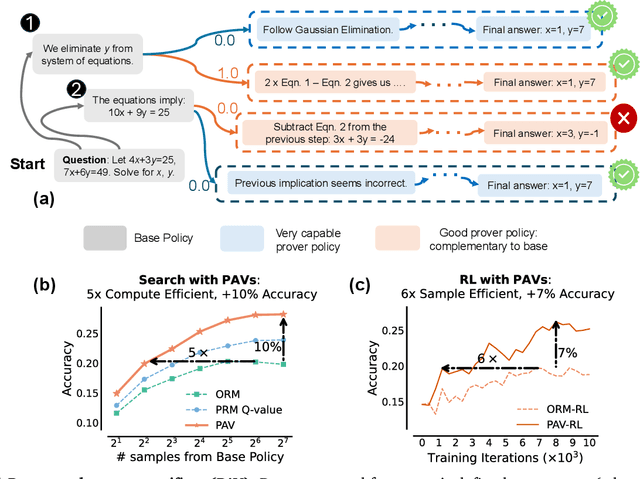

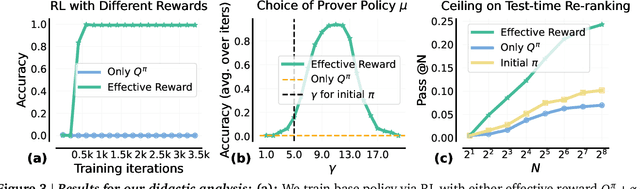
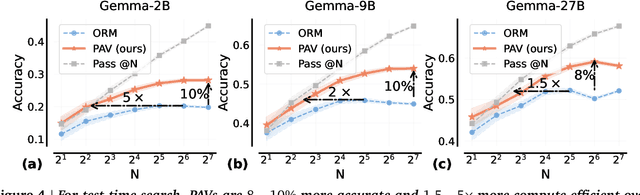
A promising approach for improving reasoning in large language models is to use process reward models (PRMs). PRMs provide feedback at each step of a multi-step reasoning trace, potentially improving credit assignment over outcome reward models (ORMs) that only provide feedback at the final step. However, collecting dense, per-step human labels is not scalable, and training PRMs from automatically-labeled data has thus far led to limited gains. To improve a base policy by running search against a PRM or using it as dense rewards for reinforcement learning (RL), we ask: "How should we design process rewards?". Our key insight is that, to be effective, the process reward for a step should measure progress: a change in the likelihood of producing a correct response in the future, before and after taking the step, corresponding to the notion of step-level advantages in RL. Crucially, this progress should be measured under a prover policy distinct from the base policy. We theoretically characterize the set of good provers and our results show that optimizing process rewards from such provers improves exploration during test-time search and online RL. In fact, our characterization shows that weak prover policies can substantially improve a stronger base policy, which we also observe empirically. We validate our claims by training process advantage verifiers (PAVs) to predict progress under such provers, and show that compared to ORMs, test-time search against PAVs is $>8\%$ more accurate, and $1.5-5\times$ more compute-efficient. Online RL with dense rewards from PAVs enables one of the first results with $5-6\times$ gain in sample efficiency, and $>6\%$ gain in accuracy, over ORMs.