 Add to Chrome
 Add to Firefox
 Add to Edge
CalcSeg: Confidence-aware 3D Latent Context Curriculum Learning For Myocardial Scar Segmentation From Single-Stack LGE-CMRs
Aug 20, 2026
Myocardial scar segmentation from single-stack late gadolinium-enhanced cardiac magnetic resonance (LGE-CMR) imaging has been a longstanding and clinically important challenge, particularly in the presence of low tissue contrast, diffuse, and small scar regions. These challenges are further intensified by the limited availability of 3D spatial context. This paper presents CalcSeg, a Confidence-aware latent context curriculum learning framework that leverages fused 3D feature representations from single-stack 2D LGE-CMR images for robust scar segmentation. Specifically, we introduce a dynamic semi-supervised curriculum learning strategy that progressively expands training from easier to more challenging scar cases using a learned confidence-aware scoring function. Such a function integrates errors in the predicted scar maps with quantified epistemic uncertainty and scar burden estimation to automatically assess sample difficulty without requiring manual labels. To compensate for the limited spatial context in single-stack acquisitions, we then develop a latent slice-wise self-attention to capture inter-slice dependencies and infer 3D spatial representations from sparse 2D inputs. We evaluate CalcSeg on multi-center clinical LGE-CMR datasets and benchmark against existing scar segmentation networks. Experimental results show that CalcSeg consistently outperforms all competing methods, particularly with substantial improvements on clinically challenging cases. Our code is released on Github.

Blue Data Intelligence Layer: Streaming Data and Agents for Multi-source Multi-modal Data-Centric Applications
Apr 16, 2026NL2SQL systems aim to address the growing need for natural language interaction with data. However, real-world information rarely maps to a single SQL query because (1) users express queries iteratively (2) questions often span multiple data sources beyond the closed-world assumption of a single database, and (3) queries frequently rely on commonsense or external knowledge. Consequently, satisfying realistic data needs require integrating heterogeneous sources, modalities, and contextual data. In this paper, we present Blue's Data Intelligence Layer (DIL) designed to support multi-source, multi-modal, and data-centric applications. Blue is a compound AI system that orchestrates agents and data for enterprise settings. DIL serves as the data intelligence layer for agentic data processing, to bridge the semantic gap between user intent and available information by unifying structured enterprise data, world knowledge accessible through LLMs, and personal context obtained through interaction. At the core of DIL is a data registry that stores metadata for diverse data sources and modalities to enable both native and natural language queries. DIL treats LLMs, the Web, and the User as source 'databases', each with their own query interface, elevating them to first-class data sources. DIL relies on data planners to transform user queries into executable query plans. These plans are declarative abstractions that unify relational operators with other operators spanning multiple modalities. DIL planners support decomposition of complex requests into subqueries, retrieval from diverse sources, and finally reasoning and integration to produce final results. We demonstrate DIL through two interactive scenarios in which user queries dynamically trigger multi-source retrieval, cross-modal reasoning, and result synthesis, illustrating how compound AI systems can move beyond single database NL2SQL.
Cross-Modal State-Space Graph Reasoning for Structured Summarization
Mar 26, 2025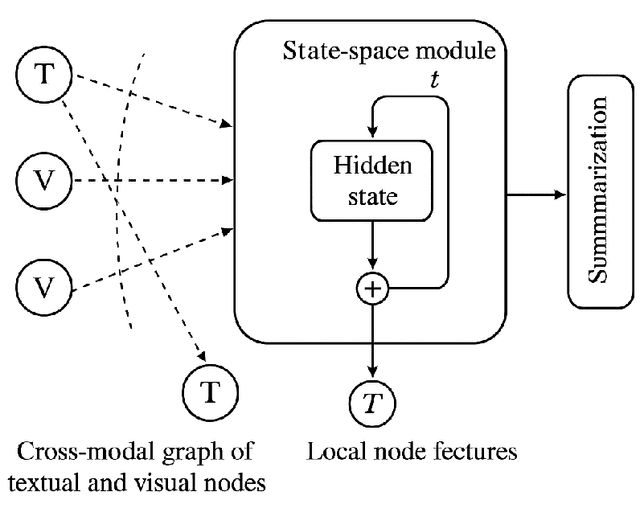
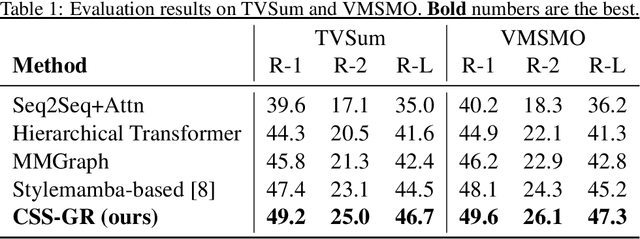
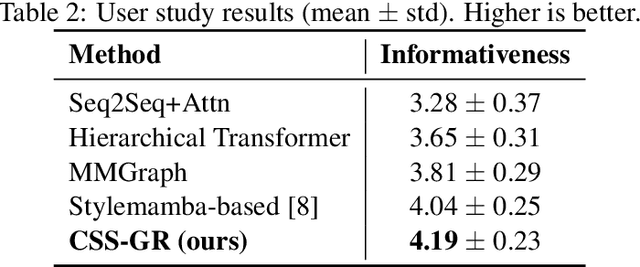
The ability to extract compact, meaningful summaries from large-scale and multimodal data is critical for numerous applications, ranging from video analytics to medical reports. Prior methods in cross-modal summarization have often suffered from high computational overheads and limited interpretability. In this paper, we propose a \textit{Cross-Modal State-Space Graph Reasoning} (\textbf{CSS-GR}) framework that incorporates a state-space model with graph-based message passing, inspired by prior work on efficient state-space models. Unlike existing approaches relying on purely sequential models, our method constructs a graph that captures inter- and intra-modal relationships, allowing more holistic reasoning over both textual and visual streams. We demonstrate that our approach significantly improves summarization quality and interpretability while maintaining computational efficiency, as validated on standard multimodal summarization benchmarks. We also provide a thorough ablation study to highlight the contributions of each component.
VeriLA: A Human-Centered Evaluation Framework for Interpretable Verification of LLM Agent Failures
Mar 16, 2025AI practitioners increasingly use large language model (LLM) agents in compound AI systems to solve complex reasoning tasks, these agent executions often fail to meet human standards, leading to errors that compromise the system's overall performance. Addressing these failures through human intervention is challenging due to the agents' opaque reasoning processes, misalignment with human expectations, the complexity of agent dependencies, and the high cost of manual inspection. This paper thus introduces a human-centered evaluation framework for Verifying LLM Agent failures (VeriLA), which systematically assesses agent failures to reduce human effort and make these agent failures interpretable to humans. The framework first defines clear expectations of each agent by curating human-designed agent criteria. Then, it develops a human-aligned agent verifier module, trained with human gold standards, to assess each agent's execution output. This approach enables granular evaluation of each agent's performance by revealing failures from a human standard, offering clear guidelines for revision, and reducing human cognitive load. Our case study results show that VeriLA is both interpretable and efficient in helping practitioners interact more effectively with the system. By upholding accountability in human-agent collaboration, VeriLA paves the way for more trustworthy and human-aligned compound AI systems.
Snippet-based Conversational Recommender System
Nov 09, 2024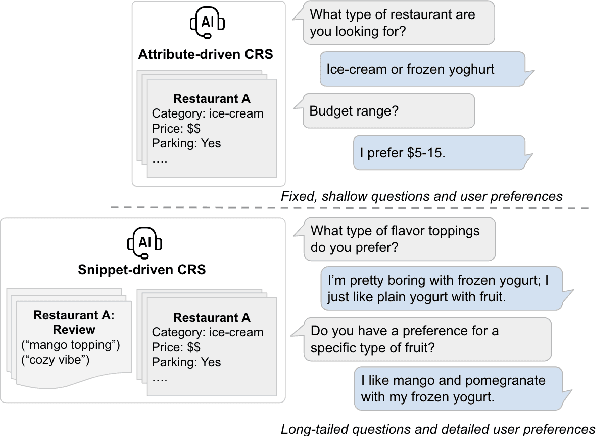
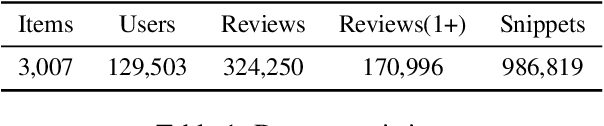
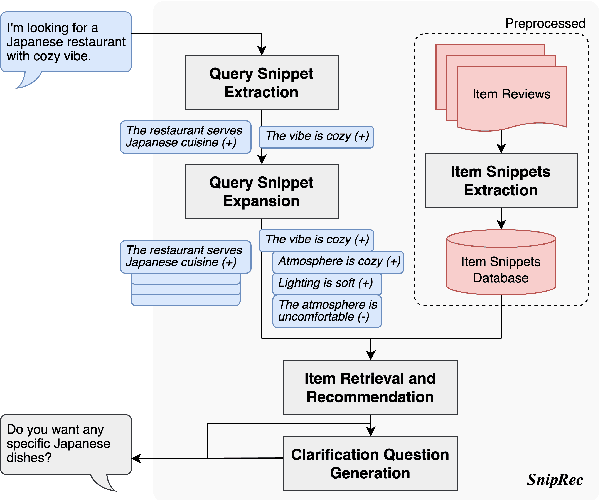
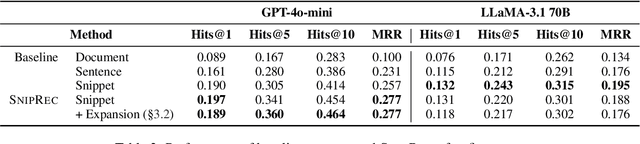
Conversational Recommender Systems (CRS) engage users in interactive dialogues to gather preferences and provide personalized recommendations. Traditionally, CRS rely on pre-defined attributes or expensive, domain-specific annotated datasets to guide conversations, which limits flexibility and adaptability across domains. In this work, we introduce SnipRec, a novel CRS that enhances dialogues and recommendations by extracting diverse expressions and preferences from user-generated content (UGC) like customer reviews. Using large language models, SnipRec maps user responses and UGC to concise snippets, which are used to generate clarification questions and retrieve relevant items. Our approach eliminates the need for domain-specific training, making it adaptable to new domains and effective without prior knowledge of user preferences. Extensive experiments on the Yelp dataset demonstrate the effectiveness of snippet-based representations against document and sentence-based representations. Additionally, SnipRec is able to improve Hits@10 by 0.25 over the course of five conversational turns, underscoring the efficiency of SnipRec in capturing user preferences through multi-turn conversations.
A Blueprint Architecture of Compound AI Systems for Enterprise
Jun 02, 2024

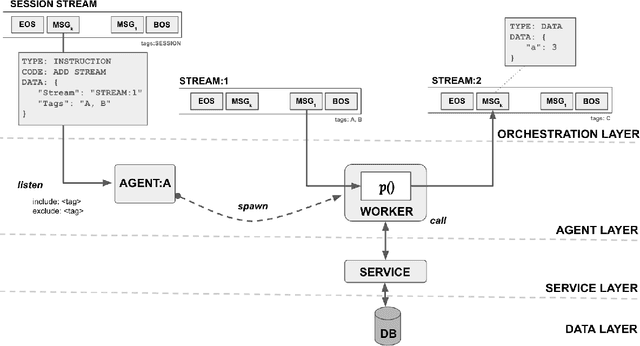
Large Language Models (LLMs) have showcased remarkable capabilities surpassing conventional NLP challenges, creating opportunities for use in production use cases. Towards this goal, there is a notable shift to building compound AI systems, wherein LLMs are integrated into an expansive software infrastructure with many components like models, retrievers, databases and tools. In this paper, we introduce a blueprint architecture for compound AI systems to operate in enterprise settings cost-effectively and feasibly. Our proposed architecture aims for seamless integration with existing compute and data infrastructure, with ``stream'' serving as the key orchestration concept to coordinate data and instructions among agents and other components. Task and data planners, respectively, break down, map, and optimize tasks and data to available agents and data sources defined in respective registries, given production constraints such as accuracy and latency.
MEGAnno+: A Human-LLM Collaborative Annotation System
Feb 28, 2024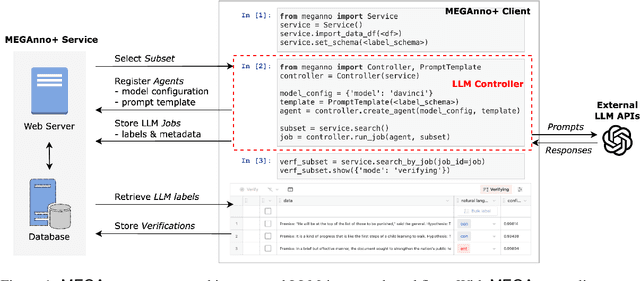
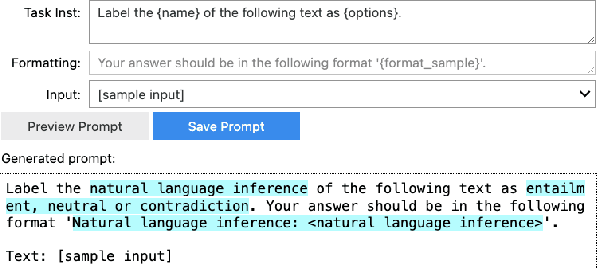
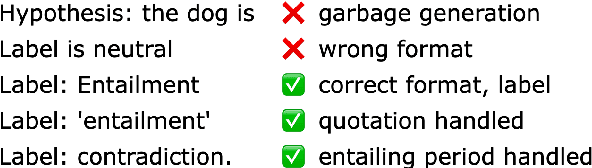
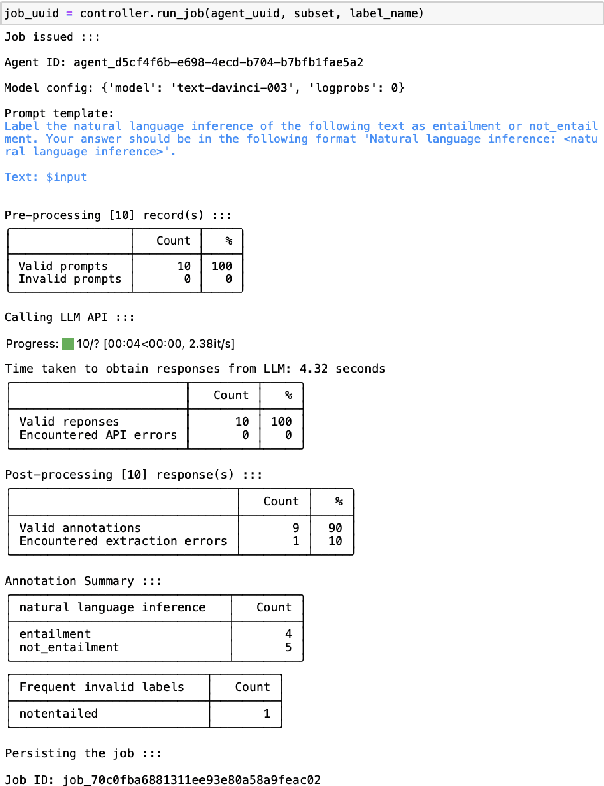
Large language models (LLMs) can label data faster and cheaper than humans for various NLP tasks. Despite their prowess, LLMs may fall short in understanding of complex, sociocultural, or domain-specific context, potentially leading to incorrect annotations. Therefore, we advocate a collaborative approach where humans and LLMs work together to produce reliable and high-quality labels. We present MEGAnno+, a human-LLM collaborative annotation system that offers effective LLM agent and annotation management, convenient and robust LLM annotation, and exploratory verification of LLM labels by humans.
Characterizing Large Language Models as Rationalizers of Knowledge-intensive Tasks
Nov 09, 2023
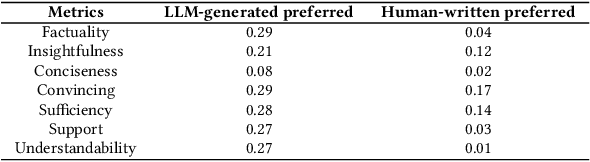

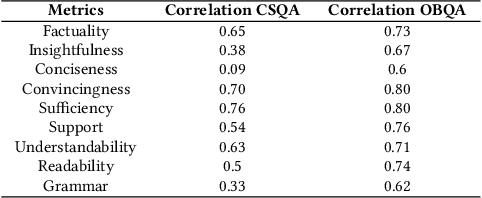
Large language models (LLMs) are proficient at generating fluent text with minimal task-specific supervision. Yet, their ability to provide well-grounded rationalizations for knowledge-intensive tasks remains under-explored. Such tasks, like commonsense multiple-choice questions, require rationales based on world knowledge to support predictions and refute alternate options. We consider the task of generating knowledge-guided rationalization in natural language by using expert-written examples in a few-shot manner. Surprisingly, crowd-workers preferred knowledge-grounded rationales over crowdsourced rationalizations, citing their factuality, sufficiency, and comprehensive refutations. Although LLMs-generated rationales were preferable, further improvements in conciseness and novelty are required. In another study, we show how rationalization of incorrect model predictions erodes humans' trust in LLM-generated rationales. Motivated by these observations, we create a two-stage pipeline to review task predictions and eliminate potential incorrect decisions before rationalization, enabling trustworthy rationale generation.
SemARFlow: Injecting Semantics into Unsupervised Optical Flow Estimation for Autonomous Driving
Mar 10, 2023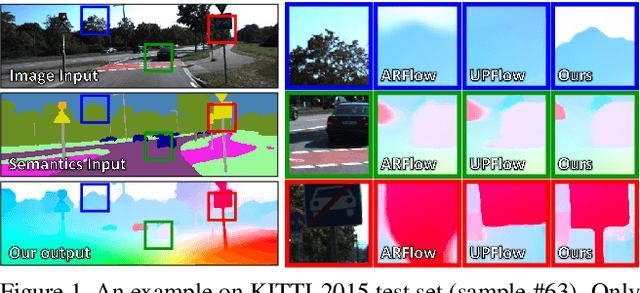
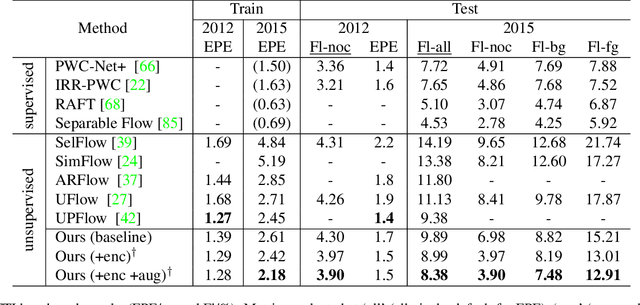
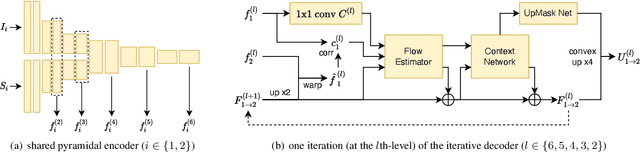
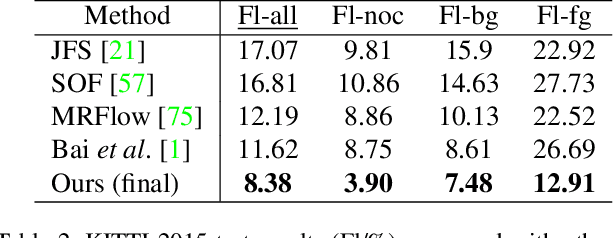
Unsupervised optical flow estimation is especially hard near occlusions and motion boundaries and in low-texture regions. We show that additional information such as semantics and domain knowledge can help better constrain this problem. We introduce SemARFlow, an unsupervised optical flow network designed for autonomous driving data that takes estimated semantic segmentation masks as additional inputs. This additional information is injected into the encoder and into a learned upsampler that refines the flow output. In addition, a simple yet effective semantic augmentation module provides self-supervision when learning flow and its boundaries for vehicles, poles, and sky. Together, these injections of semantic information improve the KITTI-2015 optical flow test error rate from 11.80% to 8.38%. We also show visible improvements around object boundaries as well as a greater ability to generalize across datasets. Code will be made available.
Towards Multifaceted Human-Centered AI
Jan 09, 2023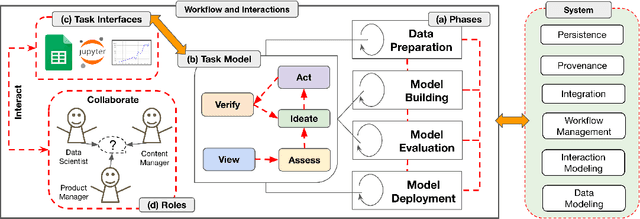
Human-centered AI workflows involve stakeholders with multiple roles interacting with each other and automated agents to accomplish diverse tasks. In this paper, we call for a holistic view when designing support mechanisms, such as interaction paradigms, interfaces, and systems, for these multifaceted workflows.