 Add to Chrome
 Add to Firefox
 Add to Edge
Agents' Last Exam
Jun 03, 2026
Recent AI systems have achieved strong results on a wide range of benchmarks, yet these gains have not translated into economically meaningful deployment across many professional domains. We argue that this gap is largely an evaluation problem: widely used benchmarks lack sustained performance measurement on real and economically valuable workflows. This paper introduces Agents' Last Exam (ALE), a benchmark designed to evaluate AI agents on long-horizon, economically valuable, real-world tasks with verifiable outcomes. Developed in collaboration with 250+ industry experts, ALE covers non-physical industries defined with reference to O*NET / SOC 2018 (the U.S. federal occupational taxonomy). It is organized around a task taxonomy with 55 subfields grouped into 13 industry clusters covering 1K+ tasks. Current results show that the hardest tier remains far from saturated: across mainstream harness and backbone configurations, the average full pass rate is 2.6%. ALE is designed as a living benchmark: its task pool grows continuously as new workflows and industries are onboarded. More broadly, ALE is intended not merely as another leaderboard, but as an instrument for closing the gap between benchmark success and GDP-relevant impact.

RIFT: A RubrIc Failure Mode Taxonomy and Automated Diagnostics
Apr 01, 2026Rubric-based evaluation is widely used in LLM benchmarks and training pipelines for open-ended, less verifiable tasks. While prior work has demonstrated the effectiveness of rubrics using downstream signals such as reinforcement learning outcomes, there remains no principled way to diagnose rubric quality issues from such aggregated or downstream signals alone. To address this gap, we introduce RIFT: RubrIc Failure mode Taxonomy, a taxonomy for systematically characterizing failure modes in rubric composition and design. RIFT consists of eight failure modes organized into three high-level categories: Reliability Failures, Content Validity Failures, and Consequential Validity Failures. RIFT is developed using grounded theory by iteratively annotating rubrics drawn from five diverse benchmarks spanning general instruction following, code generation, creative writing, and expert-level deep research, until no new failure modes are identified. We evaluate the consistency of the taxonomy by measuring agreement among independent human annotators, observing fair agreement overall (87% pairwise agreement and 0.64 average Cohen's kappa). Finally, to support scalable diagnosis, we propose automated rubric quality metrics and show that they align with human failure-mode annotations, achieving up to 0.86 F1.
Benchmarking Agents in Insurance Underwriting Environments
Jan 31, 2026As AI agents integrate into enterprise applications, their evaluation demands benchmarks that reflect the complexity of real-world operations. Instead, existing benchmarks overemphasize open-domains such as code, use narrow accuracy metrics, and lack authentic complexity. We present UNDERWRITE, an expert-first, multi-turn insurance underwriting benchmark designed in close collaboration with domain experts to capture real-world enterprise challenges. UNDERWRITE introduces critical realism factors often absent in current benchmarks: proprietary business knowledge, noisy tool interfaces, and imperfect simulated users requiring careful information gathering. Evaluating 13 frontier models, we uncover significant gaps between research lab performance and enterprise readiness: the most accurate models are not the most efficient, models hallucinate domain knowledge despite tool access, and pass^k results show a 20% drop in performance. The results from UNDERWRITE demonstrate that expert involvement in benchmark design is essential for realistic agent evaluation, common agentic frameworks exhibit brittleness that skews performance reporting, and hallucination detection in specialized domains demands compositional approaches. Our work provides insights for developing benchmarks that better align with enterprise deployment requirements.
Evaluating Language Model Context Windows: A "Working Memory" Test and Inference-time Correction
Jul 04, 2024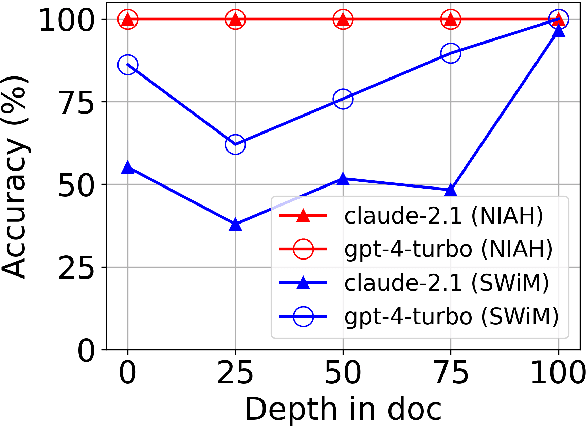
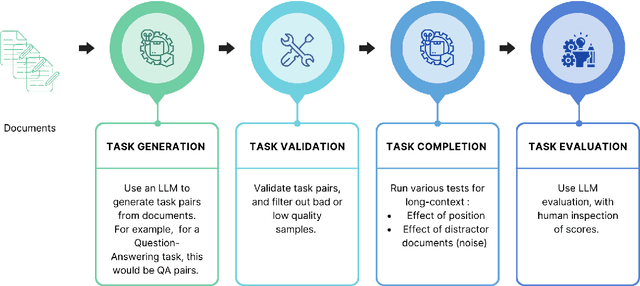
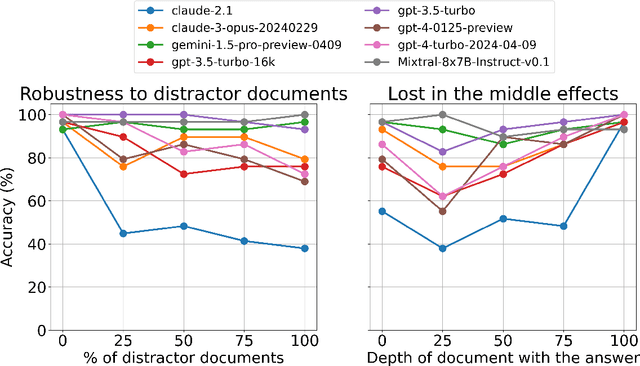

Large language models are prominently used in real-world applications, often tasked with reasoning over large volumes of documents. An exciting development in this space is models boasting extended context capabilities, with some accommodating over 2 million tokens. Such long context model capabilities remain uncertain in production systems, motivating the need to benchmark their performance on real world use cases. We address this challenge by proposing SWiM, an evaluation framework that addresses the limitations of standard tests. Testing the framework on eight long context models, we find that even strong models such as GPT-4 and Claude 3 Opus degrade in performance when information is present in the middle of the context window (lost-in-the-middle effect). Next, in addition to our benchmark, we propose medoid voting, a simple, but effective training-free approach that helps alleviate this effect, by generating responses a few times, each time randomly permuting documents in the context, and selecting the medoid answer. We evaluate medoid voting on single document QA tasks, achieving up to a 24% lift in accuracy.
Beyond the Imitation Game: Quantifying and extrapolating the capabilities of language models
Jun 10, 2022Language models demonstrate both quantitative improvement and new qualitative capabilities with increasing scale. Despite their potentially transformative impact, these new capabilities are as yet poorly characterized. In order to inform future research, prepare for disruptive new model capabilities, and ameliorate socially harmful effects, it is vital that we understand the present and near-future capabilities and limitations of language models. To address this challenge, we introduce the Beyond the Imitation Game benchmark (BIG-bench). BIG-bench currently consists of 204 tasks, contributed by 442 authors across 132 institutions. Task topics are diverse, drawing problems from linguistics, childhood development, math, common-sense reasoning, biology, physics, social bias, software development, and beyond. BIG-bench focuses on tasks that are believed to be beyond the capabilities of current language models. We evaluate the behavior of OpenAI's GPT models, Google-internal dense transformer architectures, and Switch-style sparse transformers on BIG-bench, across model sizes spanning millions to hundreds of billions of parameters. In addition, a team of human expert raters performed all tasks in order to provide a strong baseline. Findings include: model performance and calibration both improve with scale, but are poor in absolute terms (and when compared with rater performance); performance is remarkably similar across model classes, though with benefits from sparsity; tasks that improve gradually and predictably commonly involve a large knowledge or memorization component, whereas tasks that exhibit "breakthrough" behavior at a critical scale often involve multiple steps or components, or brittle metrics; social bias typically increases with scale in settings with ambiguous context, but this can be improved with prompting.