 Add to Chrome
 Add to Firefox
 Add to Edge
Understanding the Challenges in Iterative Generative Optimization with LLMs
Mar 25, 2026
Generative optimization uses large language models (LLMs) to iteratively improve artifacts (such as code, workflows or prompts) using execution feedback. It is a promising approach to building self-improving agents, yet in practice remains brittle: despite active research, only 9% of surveyed agents used any automated optimization. We argue that this brittleness arises because, to set up a learning loop, an engineer must make ``hidden'' design choices: What can the optimizer edit and what is the "right" learning evidence to provide at each update? We investigate three factors that affect most applications: the starting artifact, the credit horizon for execution traces, and batching trials and errors into learning evidence. Through case studies in MLAgentBench, Atari, and BigBench Extra Hard, we find that these design decisions can determine whether generative optimization succeeds, yet they are rarely made explicit in prior work. Different starting artifacts determine which solutions are reachable in MLAgentBench, truncated traces can still improve Atari agents, and larger minibatches do not monotonically improve generalization on BBEH. We conclude that the lack of a simple, universal way to set up learning loops across domains is a major hurdle for productionization and adoption. We provide practical guidance for making these choices.

POLCA: Stochastic Generative Optimization with LLM
Mar 16, 2026Optimizing complex systems, ranging from LLM prompts to multi-turn agents, traditionally requires labor-intensive manual iteration. We formalize this challenge as a stochastic generative optimization problem where a generative language model acts as the optimizer, guided by numerical rewards and text feedback to discover the best system. We introduce Prioritized Optimization with Local Contextual Aggregation (POLCA), a scalable framework designed to handle stochasticity in optimization -- such as noisy feedback, sampling minibatches, and stochastic system behaviors -- while effectively managing the unconstrained expansion of solution space. POLCA maintains a priority queue to manage the exploration-exploitation tradeoff, systematically tracking candidate solutions and their evaluation histories. To enhance efficiency, we integrate an $\varepsilon$-Net mechanism to maintain parameter diversity and an LLM Summarizer to perform meta-learning across historical trials. We theoretically prove that POLCA converges to near-optimal candidate solutions under stochasticity. We evaluate our framework on diverse benchmarks, including $τ$-bench, HotpotQA (agent optimization), VeriBench (code translation) and KernelBench (CUDA kernel generation). Experimental results demonstrate that POLCA achieves robust, sample and time-efficient performance, consistently outperforming state-of-the-art algorithms in both deterministic and stochastic problems. The codebase for this work is publicly available at https://github.com/rlx-lab/POLCA.
ReSyn: Autonomously Scaling Synthetic Environments for Reasoning Models
Feb 23, 2026Reinforcement learning with verifiable rewards (RLVR) has emerged as a promising approach for training reasoning language models (RLMs) by leveraging supervision from verifiers. Although verifier implementation is easier than solution annotation for many tasks, existing synthetic data generation methods remain largely solution-centric, while verifier-based methods rely on a few hand-crafted procedural environments. In this work, we scale RLVR by introducing ReSyn, a pipeline that generates diverse reasoning environments equipped with instance generators and verifiers, covering tasks such as constraint satisfaction, algorithmic puzzles, and spatial reasoning. A Qwen2.5-7B-Instruct model trained with RL on ReSyn data achieves consistent gains across reasoning benchmarks and out-of-domain math benchmarks, including a 27\% relative improvement on the challenging BBEH benchmark. Ablations show that verifier-based supervision and increased task diversity both contribute significantly, providing empirical evidence that generating reasoning environments at scale can enhance reasoning abilities in RLMs
Learning Game-Playing Agents with Generative Code Optimization
Aug 27, 2025We present a generative optimization approach for learning game-playing agents, where policies are represented as Python programs and refined using large language models (LLMs). Our method treats decision-making policies as self-evolving code, with current observation as input and an in-game action as output, enabling agents to self-improve through execution traces and natural language feedback with minimal human intervention. Applied to Atari games, our game-playing Python program achieves performance competitive with deep reinforcement learning (RL) baselines while using significantly less training time and much fewer environment interactions. This work highlights the promise of programmatic policy representations for building efficient, adaptable agents capable of complex, long-horizon reasoning.
Provably Learning from Language Feedback
Jun 12, 2025Interactively learning from observation and language feedback is an increasingly studied area driven by the emergence of large language model (LLM) agents. While impressive empirical demonstrations have been shown, so far a principled framing of these decision problems remains lacking. In this paper, we formalize the Learning from Language Feedback (LLF) problem, assert sufficient assumptions to enable learning despite latent rewards, and introduce $\textit{transfer eluder dimension}$ as a complexity measure to characterize the hardness of LLF problems. We show that transfer eluder dimension captures the intuition that information in the feedback changes the learning complexity of the LLF problem. We demonstrate cases where learning from rich language feedback can be exponentially faster than learning from reward. We develop a no-regret algorithm, called $\texttt{HELiX}$, that provably solves LLF problems through sequential interactions, with performance guarantees that scale with the transfer eluder dimension of the problem. Across several empirical domains, we show that $\texttt{HELiX}$ performs well even when repeatedly prompting LLMs does not work reliably. Our contributions mark a first step towards designing principled interactive learning algorithms from generic language feedback.
Teaching Large Language Models to Reason through Learning and Forgetting
Apr 15, 2025Leveraging inference-time search in large language models has proven effective in further enhancing a trained model's capability to solve complex mathematical and reasoning problems. However, this approach significantly increases computational costs and inference time, as the model must generate and evaluate multiple candidate solutions to identify a viable reasoning path. To address this, we propose an effective approach that integrates search capabilities directly into the model by fine-tuning it using both successful (learning) and failed reasoning paths (forgetting) derived from diverse search methods. While fine-tuning the model with these data might seem straightforward, we identify a critical issue: the model's search capability tends to degrade rapidly if fine-tuning is performed naively. We show that this degradation can be substantially mitigated by employing a smaller learning rate. Extensive experiments on the challenging Game-of-24 and Countdown mathematical reasoning benchmarks show that our approach not only outperforms both standard fine-tuning and inference-time search baselines but also significantly reduces inference time by 180$\times$.
Predicting Long Term Sequential Policy Value Using Softer Surrogates
Dec 30, 2024Performing policy evaluation in education, healthcare and online commerce can be challenging, because it can require waiting substantial amounts of time to observe outcomes over the desired horizon of interest. While offline evaluation methods can be used to estimate the performance of a new decision policy from historical data in some cases, such methods struggle when the new policy involves novel actions or is being run in a new decision process with potentially different dynamics. Here we consider how to estimate the full-horizon value of a new decision policy using only short-horizon data from the new policy, and historical full-horizon data from a different behavior policy. We introduce two new estimators for this setting, including a doubly robust estimator, and provide formal analysis of their properties. Our empirical results on two realistic simulators, of HIV treatment and sepsis treatment, show that our methods can often provide informative estimates of a new decision policy ten times faster than waiting for the full horizon, highlighting that it may be possible to quickly identify if a new decision policy, involving new actions, is better or worse than existing past policies.
Improving Parallel Program Performance Through DSL-Driven Code Generation with LLM Optimizers
Oct 21, 2024Mapping computations to processors and assigning data to memory are critical for maximizing performance in parallel programming. These mapping decisions are managed through the development of specialized low-level system code, called mappers, crafted by performance engineers. Each mapper is tailored to a specific application and optimized for the underlying machine architecture, a process that requires days of refinement and tuning from an expert. Despite advances in system research, automating mapper generation remains a challenge due to the complexity of making millions of decisions to find the optimal solution and generate the solution as code. We introduce an approach that leverages recent advances in LLM-based optimizers for mapper design. In under ten minutes, our method automatically discovers mappers that surpass human expert designs in scientific applications by up to 1.34X speedup. For parallel matrix multiplication algorithms, our mapper achieves up to 1.31X of the expert-designed solution. To achieve this, we simplify the complexity of low-level code generation by introducing a domain-specific language (DSL) that abstracts the low-level system programming details and defines a structured search space for LLMs to explore. To maximize the application performance, we use an LLM optimizer to improve an agentic system that generates the mapper code. As a result, this approach significantly reduces the workload for performance engineers while achieving substantial performance gains across diverse applications. Finally, our results demonstrate the effectiveness of LLM-based optimization in system design and suggest its potential for addressing other complex system challenges.
EVOLvE: Evaluating and Optimizing LLMs For Exploration
Oct 08, 2024
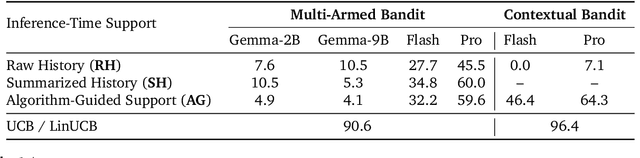


Despite their success in many domains, large language models (LLMs) remain under-studied in scenarios requiring optimal decision-making under uncertainty. This is crucial as many real-world applications, ranging from personalized recommendations to healthcare interventions, demand that LLMs not only predict but also actively learn to make optimal decisions through exploration. In this work, we measure LLMs' (in)ability to make optimal decisions in bandits, a state-less reinforcement learning setting relevant to many applications. We develop a comprehensive suite of environments, including both context-free and contextual bandits with varying task difficulties, to benchmark LLMs' performance. Motivated by the existence of optimal exploration algorithms, we propose efficient ways to integrate this algorithmic knowledge into LLMs: by providing explicit algorithm-guided support during inference; and through algorithm distillation via in-context demonstrations and fine-tuning, using synthetic data generated from these algorithms. Impressively, these techniques allow us to achieve superior exploration performance with smaller models, surpassing larger models on various tasks. We conducted an extensive ablation study to shed light on various factors, such as task difficulty and data representation, that influence the efficiency of LLM exploration. Additionally, we conduct a rigorous analysis of the LLM's exploration efficiency using the concept of regret, linking its ability to explore to the model size and underlying algorithm.
Trace is the New AutoDiff -- Unlocking Efficient Optimization of Computational Workflows
Jun 23, 2024



We study a class of optimization problems motivated by automating the design and update of AI systems like coding assistants, robots, and copilots. We propose an end-to-end optimization framework, Trace, which treats the computational workflow of an AI system as a graph akin to neural networks, based on a generalization of back-propagation. Optimization of computational workflows often involves rich feedback (e.g. console output or user's responses), heterogeneous parameters (e.g. prompts, hyper-parameters, codes), and intricate objectives (beyond maximizing a score). Moreover, its computation graph can change dynamically with the inputs and parameters. We frame a new mathematical setup of iterative optimization, Optimization with Trace Oracle (OPTO), to capture and abstract these properties so as to design optimizers that work across many domains. In OPTO, an optimizer receives an execution trace along with feedback on the computed output and updates parameters iteratively. Trace is the tool to implement OPTO in practice. Trace has a Python interface that efficiently converts a computational workflow into an OPTO instance using a PyTorch-like interface. Using Trace, we develop a general-purpose LLM-based optimizer called OptoPrime that can effectively solve OPTO problems. In empirical studies, we find that OptoPrime is capable of first-order numerical optimization, prompt optimization, hyper-parameter tuning, robot controller design, code debugging, etc., and is often competitive with specialized optimizers for each domain. We believe that Trace, OptoPrime and the OPTO framework will enable the next generation of interactive agents that automatically adapt using various kinds of feedback. Website: https://microsoft.github.io/Trace