 Add to Chrome
 Add to Firefox
 Add to Edge
A game theory for foundation models shows new paths to rational cooperation through similarity inference
Aug 04, 2026
As autonomous agents powered by foundation models are increasingly integrated into social and economic systems, understanding the principles governing their collective behavior is essential for ensuring safety and cooperation. Classical game theory, the dominant framework for modeling rational interaction, is built upon the assumption of `decoupled agency,' where agents treat their own decision-making as independent of the environment and other actors. Modern AI agents, however, jointly predict their own future actions alongside external observations. Here, we report a striking finding: when interacting in stylized social dilemmas, foundation model agents engaging in optimal planning consistently converge to stable cooperation, directly contradicting classical game-theoretic predictions of mutual defection. To understand this phenomenon, we introduce the `embedded Bayesian agent,' a theoretical model for foundation model agents. By shifting from decoupled to embedded agency, these agents model themselves as part of the universe they inhabit, maintaining epistemic uncertainty about their own decision-making algorithms. We show that by inferring whether others are behaviorally similar, an embedded agent treats its own deliberation during planning as evidence: a decision to cooperate predicts a similar decision by a similar partner. We formalize this mechanism of similarity inference through the `embedded equilibrium,' a novel solution concept replacing the Nash equilibrium to provide a foundational game theory for the social behavior of modern AI agents.

Co-evolution of self-replication and function in a digital primordial soup
Jul 10, 2026While traditional evolutionary algorithms hard-code reproduction, self-replication can emerge spontaneously within digital ``primordial soups''. This paper investigates the co-evolution of this emergent self-replication alongside problem-solving capabilities. We initialize a population of random 32-byte Z80 assembly programs, requiring self-replication to arise purely through random assembly-level mutations and pairwise program interactions. To link these behaviors, we introduce a task-based validation step: correctly evaluating a polynomial raises a program's interaction probability above a baseline rate. Our experiments yield four primary findings. First, self-replication and mathematical problem-solving successfully co-evolve from initial randomness. Second, the pressure to compute accelerates the emergence of compact, robust reproductive architectures that preserve memory for task execution. Third, applying metabolic constraints increases the likelihood that programs evolve conditional halting, terminating early during validation while bypassing the halt during interaction to execute block-copy replication. Finally, when programs are partitioned into spatial task niches, spontaneous self-replication generates an emergent learning curriculum, utilizing simple solutions as stepping stones toward complex polynomials. Altogether, these results demonstrate an interactive feedback loop: environmental task demands actively shape the physical architecture of self-replication, while spontaneous replication alters the evolutionary trajectory of functional problem-solving.
BFF: Simple explanations for complex phenomena
Jul 01, 2026The ''Computational Life'' paper (Agüera y Arcas et al., 2024) argues that paired interactions in a computational soup are an effective way to find self-replicators. In this work, aided by recent developments in self-replicator detection, we explore the alternate hypothesis that self-replicators can be found at least as easily using simple mutation random walks in program space. We also explore the claim that capping the maximum ''depth'' and ''width'' of the ancestry tree stops self-replicators from emerging, showing instead that it merely stops self-replicators from taking over the soup.
Can In-Context Learning Support Intrinsic Curiosity?
Jun 17, 2026Effective machine learning depends not only on how we model data, but also on what data we choose to collect. While large sequence models have revolutionized data modeling, the problem of automated data selection, or "intrinsic curiosity", remains a significant challenge. Classic approaches incentivize exploration by rewarding an agent based on its "learning progress", which measures how much a newly acquired observation improves a world model's predictive ability. However, evaluating these rewards traditionally requires expensive inner loops of gradient descent updates within each trajectory, rendering them computationally impractical at scale. In this work, we investigate whether the emergent in-context learning (ICL) capabilities of sequence models can eliminate this bottleneck by serving as immediate, update-free world models. Specifically, we evaluate whether an exploration policy can be trained to maximize learning progress, using solely the prediction errors and counterfactual context manipulations of an in-context learner. We first prove that in general Markov decision processes, this is in fact impossible in an unbiased way: the resulting intrinsic rewards either suffer from nuisance terms that bias their estimation of true learning progress, or they cannot be implemented using an in-context learner's prediction errors. Conversely, we prove a positive result for a broad subclass of non-temporal settings, encompassing active learning and Bayesian Experimental Design: here, ICL-derived rewards successfully bound and asymptotically converge to the true learning progress. We corroborate our theory with controlled experiments across continuous and symbolic environments, demonstrating that our ICL-driven framework successfully trains curious data-collection policies that explore optimally.
Multi-agent cooperation through in-context co-player inference
Feb 18, 2026Achieving cooperation among self-interested agents remains a fundamental challenge in multi-agent reinforcement learning. Recent work showed that mutual cooperation can be induced between "learning-aware" agents that account for and shape the learning dynamics of their co-players. However, existing approaches typically rely on hardcoded, often inconsistent, assumptions about co-player learning rules or enforce a strict separation between "naive learners" updating on fast timescales and "meta-learners" observing these updates. Here, we demonstrate that the in-context learning capabilities of sequence models allow for co-player learning awareness without requiring hardcoded assumptions or explicit timescale separation. We show that training sequence model agents against a diverse distribution of co-players naturally induces in-context best-response strategies, effectively functioning as learning algorithms on the fast intra-episode timescale. We find that the cooperative mechanism identified in prior work-where vulnerability to extortion drives mutual shaping-emerges naturally in this setting: in-context adaptation renders agents vulnerable to extortion, and the resulting mutual pressure to shape the opponent's in-context learning dynamics resolves into the learning of cooperative behavior. Our results suggest that standard decentralized reinforcement learning on sequence models combined with co-player diversity provides a scalable path to learning cooperative behaviors.
Emergent temporal abstractions in autoregressive models enable hierarchical reinforcement learning
Dec 24, 2025Large-scale autoregressive models pretrained on next-token prediction and finetuned with reinforcement learning (RL) have achieved unprecedented success on many problem domains. During RL, these models explore by generating new outputs, one token at a time. However, sampling actions token-by-token can result in highly inefficient learning, particularly when rewards are sparse. Here, we show that it is possible to overcome this problem by acting and exploring within the internal representations of an autoregressive model. Specifically, to discover temporally-abstract actions, we introduce a higher-order, non-causal sequence model whose outputs control the residual stream activations of a base autoregressive model. On grid world and MuJoCo-based tasks with hierarchical structure, we find that the higher-order model learns to compress long activation sequence chunks onto internal controllers. Critically, each controller executes a sequence of behaviorally meaningful actions that unfold over long timescales and are accompanied with a learned termination condition, such that composing multiple controllers over time leads to efficient exploration on novel tasks. We show that direct internal controller reinforcement, a process we term "internal RL", enables learning from sparse rewards in cases where standard RL finetuning fails. Our results demonstrate the benefits of latent action generation and reinforcement in autoregressive models, suggesting internal RL as a promising avenue for realizing hierarchical RL within foundation models.
MesaNet: Sequence Modeling by Locally Optimal Test-Time Training
Jun 05, 2025Sequence modeling is currently dominated by causal transformer architectures that use softmax self-attention. Although widely adopted, transformers require scaling memory and compute linearly during inference. A recent stream of work linearized the softmax operation, resulting in powerful recurrent neural network (RNN) models with constant memory and compute costs such as DeltaNet, Mamba or xLSTM. These models can be unified by noting that their recurrent layer dynamics can all be derived from an in-context regression objective, approximately optimized through an online learning rule. Here, we join this line of work and introduce a numerically stable, chunkwise parallelizable version of the recently proposed Mesa layer (von Oswald et al., 2024), and study it in language modeling at the billion-parameter scale. This layer again stems from an in-context loss, but which is now minimized to optimality at every time point using a fast conjugate gradient solver. Through an extensive suite of experiments, we show that optimal test-time training enables reaching lower language modeling perplexity and higher downstream benchmark performance than previous RNNs, especially on tasks requiring long context understanding. This performance gain comes at the cost of additional flops spent during inference time. Our results are therefore intriguingly related to recent trends of increasing test-time compute to improve performance -- here by spending compute to solve sequential optimization problems within the neural network itself.
All Random Features Representations are Equivalent
Jun 27, 2024Random features are an important technique that make it possible to rewrite positive-definite kernels as infinite-dimensional dot products. Over time, increasingly elaborate random feature representations have been developed in pursuit of finite approximations with ever lower error. We resolve this arms race by deriving an optimal sampling policy, and show that under this policy all random features representations have the same approximation error. This establishes a lower bound that holds across all random feature representations, and shows that we are free to choose whatever representation we please, provided we sample optimally.
Scalable Spatiotemporal Prediction with Bayesian Neural Fields
Mar 12, 2024Spatiotemporal datasets, which consist of spatially-referenced time series, are ubiquitous in many scientific and business-intelligence applications, such as air pollution monitoring, disease tracking, and cloud-demand forecasting. As modern datasets continue to increase in size and complexity, there is a growing need for new statistical methods that are flexible enough to capture complex spatiotemporal dynamics and scalable enough to handle large prediction problems. This work presents the Bayesian Neural Field (BayesNF), a domain-general statistical model for inferring rich probability distributions over a spatiotemporal domain, which can be used for data-analysis tasks including forecasting, interpolation, and variography. BayesNF integrates a novel deep neural network architecture for high-capacity function estimation with hierarchical Bayesian inference for robust uncertainty quantification. By defining the prior through a sequence of smooth differentiable transforms, posterior inference is conducted on large-scale data using variationally learned surrogates trained via stochastic gradient descent. We evaluate BayesNF against prominent statistical and machine-learning baselines, showing considerable improvements on diverse prediction problems from climate and public health datasets that contain tens to hundreds of thousands of measurements. The paper is accompanied with an open-source software package (https://github.com/google/bayesnf) that is easy-to-use and compatible with modern GPU and TPU accelerators on the JAX machine learning platform.
Robust Inverse Graphics via Probabilistic Inference
Feb 02, 2024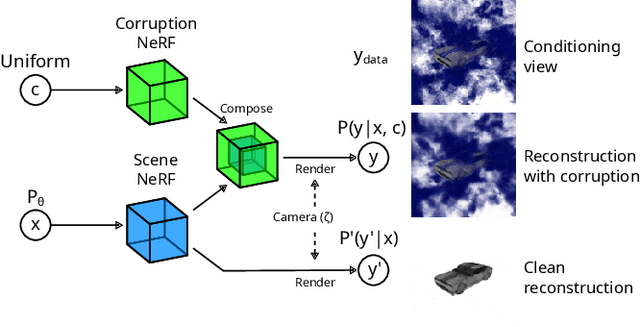
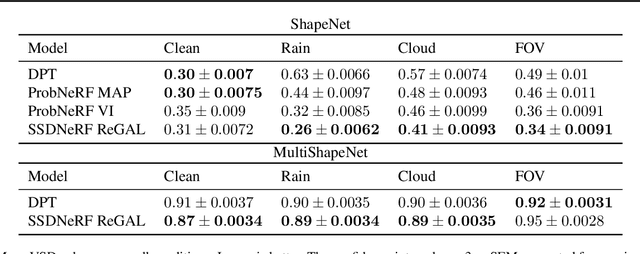
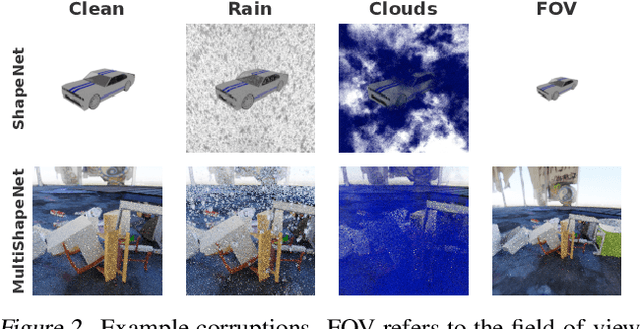
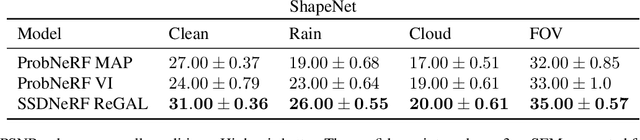
How do we infer a 3D scene from a single image in the presence of corruptions like rain, snow or fog? Straightforward domain randomization relies on knowing the family of corruptions ahead of time. Here, we propose a Bayesian approach-dubbed robust inverse graphics (RIG)-that relies on a strong scene prior and an uninformative uniform corruption prior, making it applicable to a wide range of corruptions. Given a single image, RIG performs posterior inference jointly over the scene and the corruption. We demonstrate this idea by training a neural radiance field (NeRF) scene prior and using a secondary NeRF to represent the corruptions over which we place an uninformative prior. RIG, trained only on clean data, outperforms depth estimators and alternative NeRF approaches that perform point estimation instead of full inference. The results hold for a number of scene prior architectures based on normalizing flows and diffusion models. For the latter, we develop reconstruction-guidance with auxiliary latents (ReGAL)-a diffusion conditioning algorithm that is applicable in the presence of auxiliary latent variables such as the corruption. RIG demonstrates how scene priors can be used beyond generation tasks.