 Add to Chrome
 Add to Firefox
 Add to Edge
BeyondMasks: Evaluating Causal and Physical Consistency in Video Object Removal
Aug 20, 2026
Recent advances in generative video models have significantly improved visual realism in video object removal, yet evaluation protocols still focus on masked region fidelity, treating removal as local inpainting. In real scenes, object removal is a causal intervention: eliminating an object also requires removing its induced physical effects, such as shadows, reflections, illumination changes, translucency, and dynamic traces. Existing benchmarks lack aligned clean references or remain limited to simplified synthetic settings, preventing systematic evaluation of causal consistency. We introduce BeyondMasks, a paired benchmark for causally consistent video object removal, consisting of temporally aligned synthetic and real world video pairs with clean background references. The dataset spans diverse photometric, geometric, volumetric, and dynamic interactions, and supports both mask based and instruction driven editing. We further propose CORE, a structured vision language model based evaluation protocol that jointly measures object disappearance and after effect consistency, aligning more closely with human judgments than existing metrics. Benchmarking state of the art methods reveals systematic failures in removing secondary physical effects despite high masked region fidelity, exposing a gap between visual plausibility and causal correctness. BeyondMasks reframes video object removal as causal scene consistency rather than local reconstruction and provides a unified framework for its evaluation.

EeveeDark: A Binary Neural Framework for Low-Light Video Enhancement via Event-Guided Sensor-Level Fusion
Jul 07, 2026Enhancing videos under extreme low-light conditions remains challenging due to the difficulty of balancing restoration quality and computational efficiency in resource-constrained settings. This paper introduces EeveeDark, a low-light video enhancement framework that combines the spatial richness of sensor-level RAW data with the temporal precision of event streams. Central to our model is a Binary Neural Network (BNN) architecture that reduces computational overhead by quantizing weights and activations while preserving detail. EeveeDark incorporates (i) modality-specific binary encoders for processing RAW frames and event data, (ii) a lightweight fusion block for integrating spatial and temporal cues, and (iii) an event-guided skip gating mechanism for dynamic spatiotemporal refinement. Experiments on synthetic and real-world datasets show that EeveeDark outperforms prior BNN-based methods and offers a favorable performance-efficiency trade-off compared to full-precision models. The project page is available at https://cyberiada.github.io/EeveeDark.
Auteur: Language-Driven Cinematographic Framing for Human-Centric Video Generation
Jun 01, 2026Generative video models have achieved remarkable visual fidelity and temporal coherence, yet intentional camera control remains elusive. Existing frameworks treat camera motion as a byproduct of pixel synthesis, producing trajectories that are stochastic, spatially inconsistent, and indifferent to the human subject driving the scene. In this work, we present Auteur, a method for language-driven, human-centric camera framing in generative video. Our core insight is that professional filmmakers conceive shots not as world-space trajectories but as framings defined relative to the actor, encoding shot size, angle, and composition as functions of human pose and motion. We formalize this intuition as a human-centric camera parameterization and introduce a Domain-Specific Language (DSL) that is convertible to standard 6-DoF camera parameters. A fine-tuned multimodal large language model then acts as a virtual director, mapping natural language descriptions and coarse human motion to sparse DSL keyframes that are deterministically interpolated into continuous camera trajectories, which are then provided as input to video generators. We train and evaluate Auteur on a new dataset of 34K aligned text, human motion, and DSL-annotated camera trajectories drawn from procedural synthesis and real-world movie footage from the CondensedMovies dataset. Auteur enables cinematographic framing of human-centered scenes, a capability largely absent in prior generative models. To assess this behavior, we propose new framing-focused metrics, and our experiments show that Auteur consistently outperforms existing methods
Learning to Think Like a Cartoon Captionist: Incongruity-Resolution Supervision for Multimodal Humor Understanding
Apr 16, 2026Humor is one of the few cognitive tasks where getting the reasoning right matters as much as getting the answer right. While recent work evaluates humor understanding on benchmarks such as the New Yorker Cartoon Caption Contest (NYCC), it largely treats it as black-box prediction, overlooking the structured reasoning processes underlying humor comprehension. We introduce IRS (Incongruity-Resolution Supervision), a framework that decomposes humor understanding into three components: incongruity modeling, which identifies mismatches in the visual scene; resolution modeling, which constructs coherent reinterpretations of these mismatches; and preference alignment, which evaluates candidate interpretations under human judgments. Grounded in incongruity-resolution theory and expert captionist practice, IRS supervises intermediate reasoning process through structured traces that make the path from visual perception to humorous interpretation explicit and learnable. Across 7B, 32B, and 72B models on NYCC, IRS outperforms strong open and closed multimodal baselines across caption matching and ranking tasks, with our largest model approaching expert-level performance on ranking. Zero-shot transfer to external benchmarks shows that IRS learns generalizable reasoning patterns. Our results suggest that supervising reasoning structure, rather than scale alone, is key for reasoning-centric tasks.
FewMMBench: A Benchmark for Multimodal Few-Shot Learning
Feb 25, 2026As multimodal large language models (MLLMs) advance in handling interleaved image-text data, assessing their few-shot learning capabilities remains an open challenge. In this paper, we introduce FewMMBench, a comprehensive benchmark designed to evaluate MLLMs under few-shot conditions, with a focus on In-Context Learning (ICL) and Chain-of-Thought (CoT) prompting. Covering a diverse suite of multimodal understanding tasks, from attribute recognition to temporal reasoning, FewMMBench enables systematic analysis across task types, model families, and prompting strategies. We evaluate 26 open-weight MLLMs from six model families across zero-shot, few-shot, and CoT-augmented few-shot settings. Our findings reveal that instruction-tuned models exhibit strong zero-shot performance but benefit minimally, or even regress, with additional demonstrations or CoT reasoning. Retrieval-based demonstrations and increased context size also yield limited gains. These results highlight FewMMBench as a rigorous testbed for diagnosing and advancing few-shot capabilities in multimodal LLMs. The data is available at: https://huggingface.co/datasets/mustafaa/FewMMBench
DeVisE: Behavioral Testing of Medical Large Language Models
Jun 18, 2025Large language models (LLMs) are increasingly used in clinical decision support, yet current evaluation methods often fail to distinguish genuine medical reasoning from superficial patterns. We introduce DeVisE (Demographics and Vital signs Evaluation), a behavioral testing framework for probing fine-grained clinical understanding. We construct a dataset of ICU discharge notes from MIMIC-IV, generating both raw (real-world) and template-based (synthetic) versions with controlled single-variable counterfactuals targeting demographic (age, gender, ethnicity) and vital sign attributes. We evaluate five LLMs spanning general-purpose and medically fine-tuned variants, under both zero-shot and fine-tuned settings. We assess model behavior via (1) input-level sensitivity - how counterfactuals alter the likelihood of a note; and (2) downstream reasoning - how they affect predicted hospital length-of-stay. Our results show that zero-shot models exhibit more coherent counterfactual reasoning patterns, while fine-tuned models tend to be more stable yet less responsive to clinically meaningful changes. Notably, demographic factors subtly but consistently influence outputs, emphasizing the importance of fairness-aware evaluation. This work highlights the utility of behavioral testing in exposing the reasoning strategies of clinical LLMs and informing the design of safer, more transparent medical AI systems.
A Vision-Language Framework for Multispectral Scene Representation Using Language-Grounded Features
Jan 17, 2025Scene understanding in remote sensing often faces challenges in generating accurate representations for complex environments such as various land use areas or coastal regions, which may also include snow, clouds, or haze. To address this, we present a vision-language framework named Spectral LLaVA, which integrates multispectral data with vision-language alignment techniques to enhance scene representation and description. Using the BigEarthNet v2 dataset from Sentinel-2, we establish a baseline with RGB-based scene descriptions and further demonstrate substantial improvements through the incorporation of multispectral information. Our framework optimizes a lightweight linear projection layer for alignment while keeping the vision backbone of SpectralGPT frozen. Our experiments encompass scene classification using linear probing and language modeling for jointly performing scene classification and description generation. Our results highlight Spectral LLaVA's ability to produce detailed and accurate descriptions, particularly for scenarios where RGB data alone proves inadequate, while also enhancing classification performance by refining SpectralGPT features into semantically meaningful representations.
GaussianVideo: Efficient Video Representation via Hierarchical Gaussian Splatting
Jan 08, 2025Efficient neural representations for dynamic video scenes are critical for applications ranging from video compression to interactive simulations. Yet, existing methods often face challenges related to high memory usage, lengthy training times, and temporal consistency. To address these issues, we introduce a novel neural video representation that combines 3D Gaussian splatting with continuous camera motion modeling. By leveraging Neural ODEs, our approach learns smooth camera trajectories while maintaining an explicit 3D scene representation through Gaussians. Additionally, we introduce a spatiotemporal hierarchical learning strategy, progressively refining spatial and temporal features to enhance reconstruction quality and accelerate convergence. This memory-efficient approach achieves high-quality rendering at impressive speeds. Experimental results show that our hierarchical learning, combined with robust camera motion modeling, captures complex dynamic scenes with strong temporal consistency, achieving state-of-the-art performance across diverse video datasets in both high- and low-motion scenarios.
HyperGAN-CLIP: A Unified Framework for Domain Adaptation, Image Synthesis and Manipulation
Nov 19, 2024
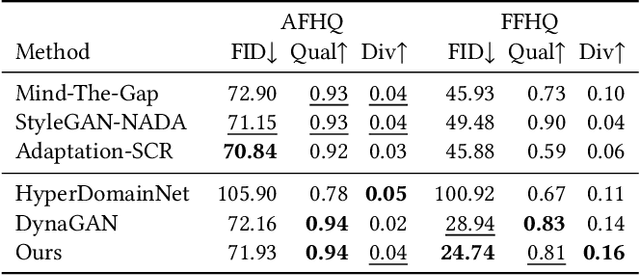
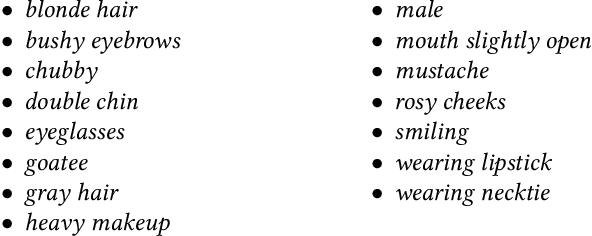
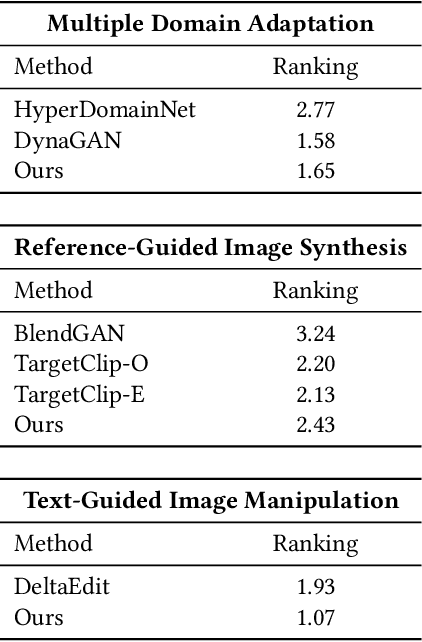
Generative Adversarial Networks (GANs), particularly StyleGAN and its variants, have demonstrated remarkable capabilities in generating highly realistic images. Despite their success, adapting these models to diverse tasks such as domain adaptation, reference-guided synthesis, and text-guided manipulation with limited training data remains challenging. Towards this end, in this study, we present a novel framework that significantly extends the capabilities of a pre-trained StyleGAN by integrating CLIP space via hypernetworks. This integration allows dynamic adaptation of StyleGAN to new domains defined by reference images or textual descriptions. Additionally, we introduce a CLIP-guided discriminator that enhances the alignment between generated images and target domains, ensuring superior image quality. Our approach demonstrates unprecedented flexibility, enabling text-guided image manipulation without the need for text-specific training data and facilitating seamless style transfer. Comprehensive qualitative and quantitative evaluations confirm the robustness and superior performance of our framework compared to existing methods.
HUE Dataset: High-Resolution Event and Frame Sequences for Low-Light Vision
Oct 24, 2024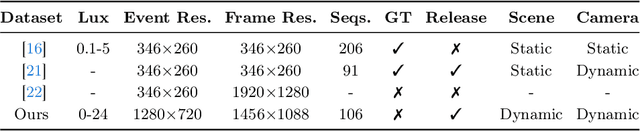
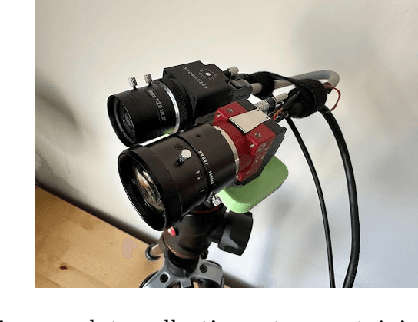
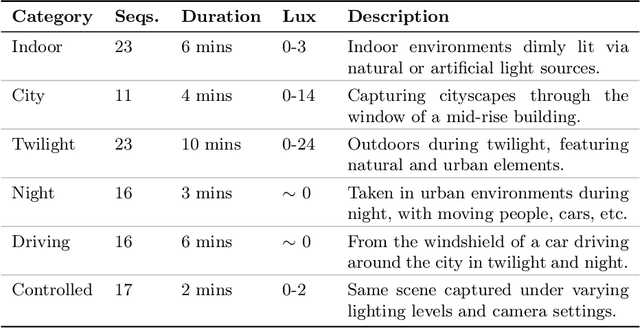
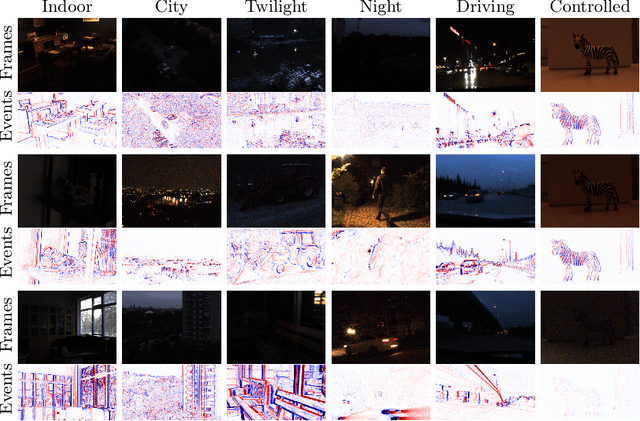
Low-light environments pose significant challenges for image enhancement methods. To address these challenges, in this work, we introduce the HUE dataset, a comprehensive collection of high-resolution event and frame sequences captured in diverse and challenging low-light conditions. Our dataset includes 106 sequences, encompassing indoor, cityscape, twilight, night, driving, and controlled scenarios, each carefully recorded to address various illumination levels and dynamic ranges. Utilizing a hybrid RGB and event camera setup. we collect a dataset that combines high-resolution event data with complementary frame data. We employ both qualitative and quantitative evaluations using no-reference metrics to assess state-of-the-art low-light enhancement and event-based image reconstruction methods. Additionally, we evaluate these methods on a downstream object detection task. Our findings reveal that while event-based methods perform well in specific metrics, they may produce false positives in practical applications. This dataset and our comprehensive analysis provide valuable insights for future research in low-light vision and hybrid camera systems.