 Add to Chrome
 Add to Firefox
 Add to Edge
Fast Forwarding Low-Rank Training
Sep 06, 2024
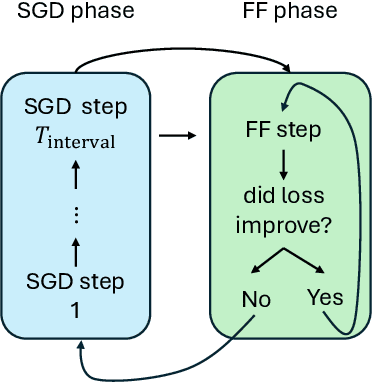
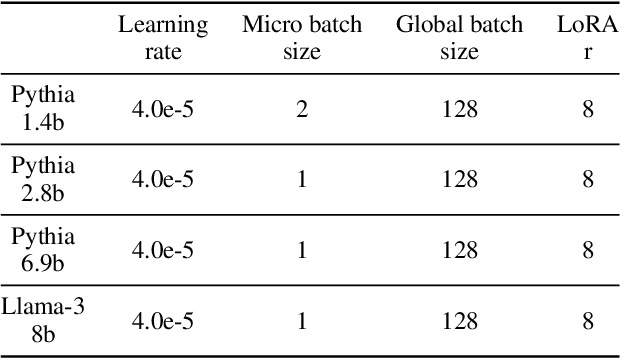
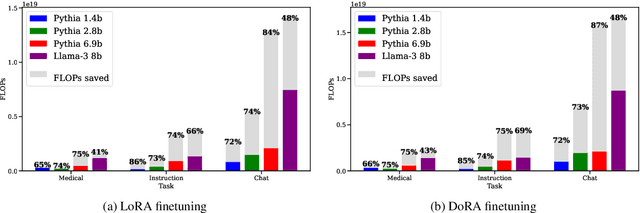
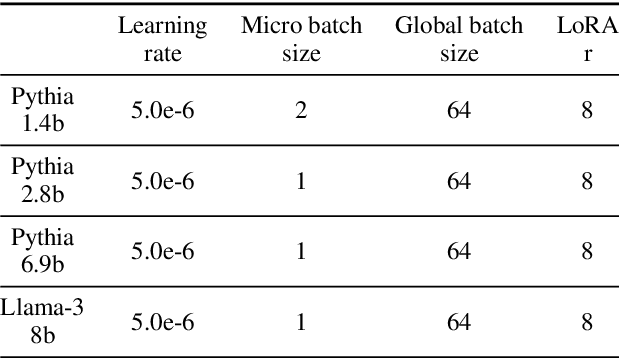
Parameter efficient finetuning methods like low-rank adaptation (LoRA) aim to reduce the computational costs of finetuning pretrained Language Models (LMs). Enabled by these low-rank settings, we propose an even more efficient optimization strategy: Fast Forward, a simple and effective approach to accelerate large segments of training. In a Fast Forward stage, we repeat the most recent optimizer step until the loss stops improving on a tiny validation set. By alternating between regular optimization steps and Fast Forward stages, Fast Forward provides up to an 87\% reduction in FLOPs and up to an 81\% reduction in train time over standard SGD with Adam. We validate Fast Forward by finetuning various models on different tasks and demonstrate that it speeds up training without compromising model performance. Additionally, we analyze when and how to apply Fast Forward.

Jamba-1.5: Hybrid Transformer-Mamba Models at Scale
Aug 22, 2024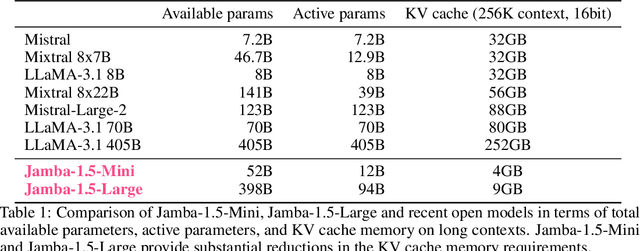


We present Jamba-1.5, new instruction-tuned large language models based on our Jamba architecture. Jamba is a hybrid Transformer-Mamba mixture of experts architecture, providing high throughput and low memory usage across context lengths, while retaining the same or better quality as Transformer models. We release two model sizes: Jamba-1.5-Large, with 94B active parameters, and Jamba-1.5-Mini, with 12B active parameters. Both models are fine-tuned for a variety of conversational and instruction-following capabilties, and have an effective context length of 256K tokens, the largest amongst open-weight models. To support cost-effective inference, we introduce ExpertsInt8, a novel quantization technique that allows fitting Jamba-1.5-Large on a machine with 8 80GB GPUs when processing 256K-token contexts without loss of quality. When evaluated on a battery of academic and chatbot benchmarks, Jamba-1.5 models achieve excellent results while providing high throughput and outperforming other open-weight models on long-context benchmarks. The model weights for both sizes are publicly available under the Jamba Open Model License and we release ExpertsInt8 as open source.
The Quest for the Right Mediator: A History, Survey, and Theoretical Grounding of Causal Interpretability
Aug 02, 2024


Interpretability provides a toolset for understanding how and why neural networks behave in certain ways. However, there is little unity in the field: most studies employ ad-hoc evaluations and do not share theoretical foundations, making it difficult to measure progress and compare the pros and cons of different techniques. Furthermore, while mechanistic understanding is frequently discussed, the basic causal units underlying these mechanisms are often not explicitly defined. In this paper, we propose a perspective on interpretability research grounded in causal mediation analysis. Specifically, we describe the history and current state of interpretability taxonomized according to the types of causal units (mediators) employed, as well as methods used to search over mediators. We discuss the pros and cons of each mediator, providing insights as to when particular kinds of mediators and search methods are most appropriate depending on the goals of a given study. We argue that this framing yields a more cohesive narrative of the field, as well as actionable insights for future work. Specifically, we recommend a focus on discovering new mediators with better trade-offs between human-interpretability and compute-efficiency, and which can uncover more sophisticated abstractions from neural networks than the primarily linear mediators employed in current work. We also argue for more standardized evaluations that enable principled comparisons across mediator types, such that we can better understand when particular causal units are better suited to particular use cases.
Answer, Assemble, Ace: Understanding How Transformers Answer Multiple Choice Questions
Jul 21, 2024Multiple-choice question answering (MCQA) is a key competence of performant transformer language models that is tested by mainstream benchmarks. However, recent evidence shows that models can have quite a range of performance, particularly when the task format is diversified slightly (such as by shuffling answer choice order). In this work we ask: how do successful models perform formatted MCQA? We employ vocabulary projection and activation patching methods to localize key hidden states that encode relevant information for predicting the correct answer. We find that prediction of a specific answer symbol is causally attributed to a single middle layer, and specifically its multi-head self-attention mechanism. We show that subsequent layers increase the probability of the predicted answer symbol in vocabulary space, and that this probability increase is associated with a sparse set of attention heads with unique roles. We additionally uncover differences in how different models adjust to alternative symbols. Finally, we demonstrate that a synthetic task can disentangle sources of model error to pinpoint when a model has learned formatted MCQA, and show that an inability to separate answer symbol tokens in vocabulary space is a property of models unable to perform formatted MCQA tasks.
Confidence Regulation Neurons in Language Models
Jun 24, 2024Despite their widespread use, the mechanisms by which large language models (LLMs) represent and regulate uncertainty in next-token predictions remain largely unexplored. This study investigates two critical components believed to influence this uncertainty: the recently discovered entropy neurons and a new set of components that we term token frequency neurons. Entropy neurons are characterized by an unusually high weight norm and influence the final layer normalization (LayerNorm) scale to effectively scale down the logits. Our work shows that entropy neurons operate by writing onto an unembedding null space, allowing them to impact the residual stream norm with minimal direct effect on the logits themselves. We observe the presence of entropy neurons across a range of models, up to 7 billion parameters. On the other hand, token frequency neurons, which we discover and describe here for the first time, boost or suppress each token's logit proportionally to its log frequency, thereby shifting the output distribution towards or away from the unigram distribution. Finally, we present a detailed case study where entropy neurons actively manage confidence in the setting of induction, i.e. detecting and continuing repeated subsequences.
REVS: Unlearning Sensitive Information in Language Models via Rank Editing in the Vocabulary Space
Jun 13, 2024
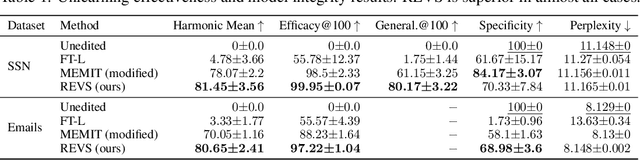
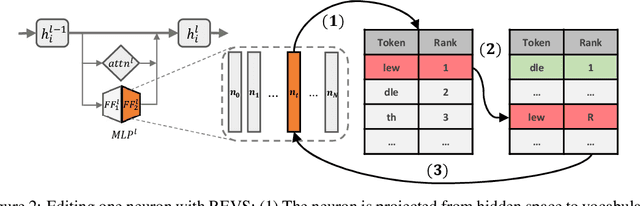
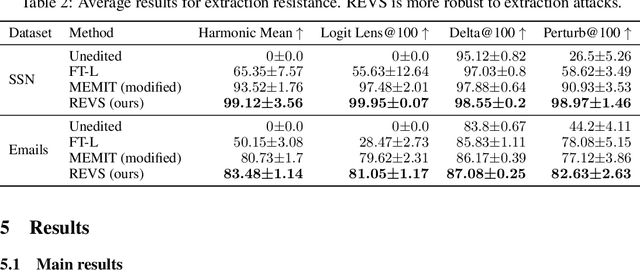
Large language models (LLMs) risk inadvertently memorizing and divulging sensitive or personally identifiable information (PII) seen in training data, causing privacy concerns. Current approaches to address this issue involve costly dataset scrubbing, or model filtering through unlearning and model editing, which can be bypassed through extraction attacks. We propose REVS, a novel model editing method for unlearning sensitive information from LLMs. REVS identifies and modifies a small subset of neurons relevant for each piece of sensitive information. By projecting these neurons to the vocabulary space (unembedding), we pinpoint the components driving its generation. We then compute a model edit based on the pseudo-inverse of the unembedding matrix, and apply it to de-promote generation of the targeted sensitive data. To adequately evaluate our method on truly sensitive information, we curate two datasets: an email dataset inherently memorized by GPT-J, and a synthetic social security number dataset that we tune the model to memorize. Compared to other state-of-the-art model editing methods, REVS demonstrates superior performance in both eliminating sensitive information and robustness to extraction attacks, while retaining integrity of the underlying model. The code and a demo notebook are available at https://technion-cs-nlp.github.io/REVS.
DEPTH: Discourse Education through Pre-Training Hierarchically
May 13, 2024Language Models (LMs) often struggle with linguistic understanding at the discourse level, even though discourse patterns such as coherence, cohesion, and narrative flow are prevalent in their pre-training data. Current methods address these challenges only after the pre-training phase, relying on expensive human annotated data to align the model. To improve the discourse capabilities of LMs already at the pre-training stage, we introduce DEPTH, an encoder-decoder model that learns to represent sentences using a discourse-oriented pre-training objective. DEPTH combines hierarchical sentence representations with two objectives: (1) Sentence Un-Shuffling, and (2) Span-Corruption. This approach trains the model to represent both sub-word-level and sentence-level dependencies over a massive amount of unstructured text. When trained either from scratch or continuing from a pre-trained T5 checkpoint, DEPTH learns semantic and discourse-level representations faster than T5, outperforming it in span-corruption loss despite the additional sentence-un-shuffling objective. Evaluations on the GLUE, DiscoEval, and NI benchmarks demonstrate DEPTH's ability to quickly learn diverse downstream tasks, which require syntactic, semantic, and discourse capabilities. Overall, our approach extends the discourse capabilities of T5, while minimally impacting other natural language understanding (NLU) capabilities in the resulting LM.
Constructing Benchmarks and Interventions for Combating Hallucinations in LLMs
Apr 15, 2024Large language models (LLMs) are susceptible to hallucination, which sparked a widespread effort to detect and prevent them. Recent work attempts to mitigate hallucinations by intervening in the model's computation during generation, using different setups and heuristics. Those works lack separation between different hallucination causes. In this work, we first introduce an approach for constructing datasets based on the model knowledge for detection and intervention methods in closed-book and open-book question-answering settings. We then characterize the effect of different choices for intervention, such as the intervened components (MLPs, attention block, residual stream, and specific heads), and how often and how strongly to intervene. We find that intervention success varies depending on the component, with some components being detrimental to language modeling capabilities. Finally, we find that interventions can benefit from pre-hallucination steering direction instead of post-hallucination. The code is available at https://github.com/technion-cs-nlp/hallucination-mitigation
Sparse Feature Circuits: Discovering and Editing Interpretable Causal Graphs in Language Models
Mar 31, 2024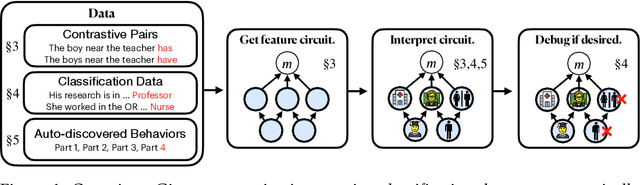
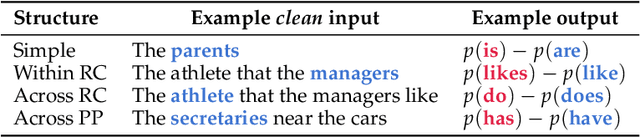
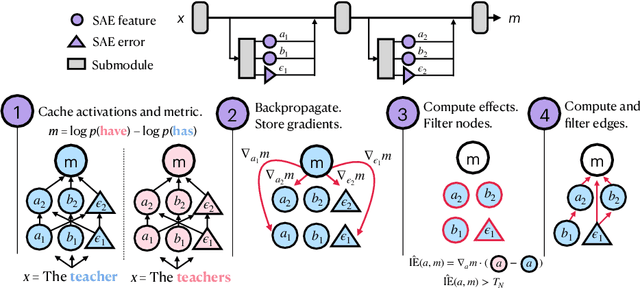
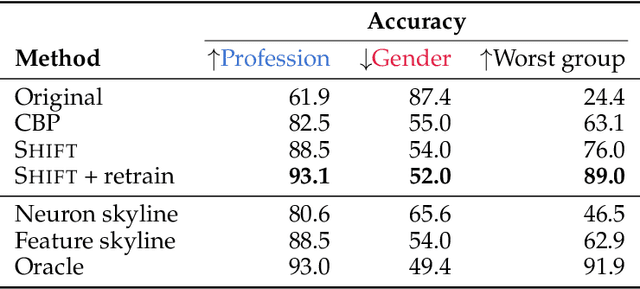
We introduce methods for discovering and applying sparse feature circuits. These are causally implicated subnetworks of human-interpretable features for explaining language model behaviors. Circuits identified in prior work consist of polysemantic and difficult-to-interpret units like attention heads or neurons, rendering them unsuitable for many downstream applications. In contrast, sparse feature circuits enable detailed understanding of unanticipated mechanisms. Because they are based on fine-grained units, sparse feature circuits are useful for downstream tasks: We introduce SHIFT, where we improve the generalization of a classifier by ablating features that a human judges to be task-irrelevant. Finally, we demonstrate an entirely unsupervised and scalable interpretability pipeline by discovering thousands of sparse feature circuits for automatically discovered model behaviors.
Jamba: A Hybrid Transformer-Mamba Language Model
Mar 28, 2024
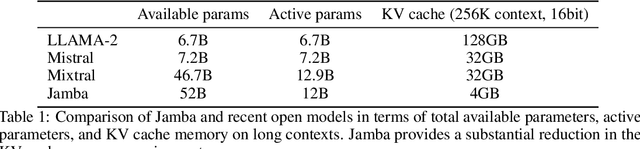
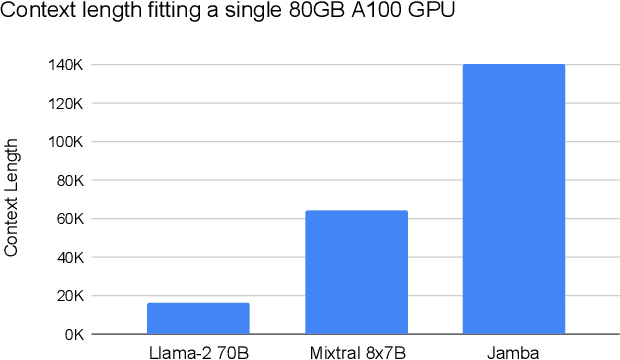
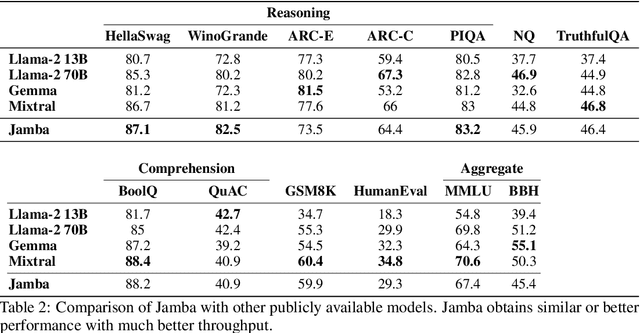
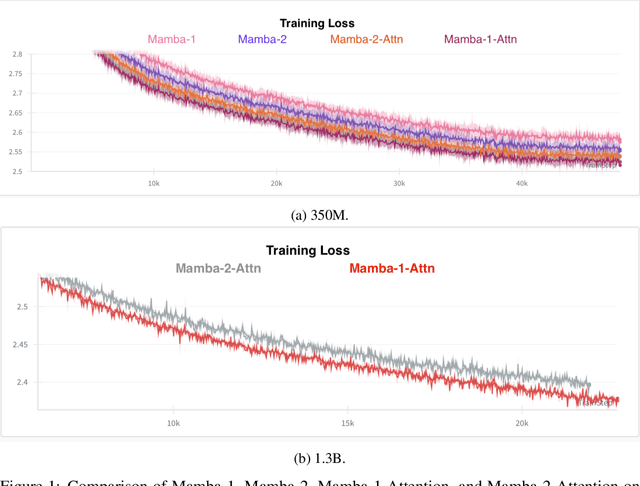
We present Jamba, a new base large language model based on a novel hybrid Transformer-Mamba mixture-of-experts (MoE) architecture. Specifically, Jamba interleaves blocks of Transformer and Mamba layers, enjoying the benefits of both model families. MoE is added in some of these layers to increase model capacity while keeping active parameter usage manageable. This flexible architecture allows resource- and objective-specific configurations. In the particular configuration we have implemented, we end up with a powerful model that fits in a single 80GB GPU. Built at large scale, Jamba provides high throughput and small memory footprint compared to vanilla Transformers, and at the same time state-of-the-art performance on standard language model benchmarks and long-context evaluations. Remarkably, the model presents strong results for up to 256K tokens context length. We study various architectural decisions, such as how to combine Transformer and Mamba layers, and how to mix experts, and show that some of them are crucial in large scale modeling. We also describe several interesting properties of these architectures which the training and evaluation of Jamba have revealed, and plan to release checkpoints from various ablation runs, to encourage further exploration of this novel architecture. We make the weights of our implementation of Jamba publicly available under a permissive license.