 Add to Chrome
 Add to Firefox
 Add to Edge
Discrete Diffusion Models Exploit Asymmetry to Solve Lookahead Planning Tasks
Feb 23, 2026
While Autoregressive (AR) Transformer-based Generative Language Models are frequently employed for lookahead tasks, recent research suggests a potential discrepancy in their ability to perform planning tasks that require multi-step lookahead. In this work, we investigate the distinct emergent mechanisms that arise when training AR versus Non-Autoregressive (NAR) models, such as Discrete Diffusion Models (dLLMs), on lookahead tasks. By requiring the models to plan ahead to reach the correct conclusion, we analyze how these two paradigms fundamentally differ in their approach to the problem. We identify a critical asymmetry in planning problems: while forward generation requires complex lookahead at branching junctions, reverse generation is often deterministic. This asymmetry creates an opportunity for NAR models. Through mechanistic analysis of training and inference dynamics, we demonstrate that NAR models learn to solve planning tasks by utilizing future tokens to decode backwards, avoiding the need to learn complex traversal mechanisms entirely. Consequently, we report that both AR and NAR models are able to achieve perfect accuracy on the lookahead task. However, NAR models require exponentially fewer training examples and shallower architectures compared to AR models, which often fail to converge without specific curriculum adjustments.

Causal Effect Estimation with Latent Textual Treatments
Feb 17, 2026Understanding the causal effects of text on downstream outcomes is a central task in many applications. Estimating such effects requires researchers to run controlled experiments that systematically vary textual features. While large language models (LLMs) hold promise for generating text, producing and evaluating controlled variation requires more careful attention. In this paper, we present an end-to-end pipeline for the generation and causal estimation of latent textual interventions. Our work first performs hypothesis generation and steering via sparse autoencoders (SAEs), followed by robust causal estimation. Our pipeline addresses both computational and statistical challenges in text-as-treatment experiments. We demonstrate that naive estimation of causal effects suffers from significant bias as text inherently conflates treatment and covariate information. We describe the estimation bias induced in this setting and propose a solution based on covariate residualization. Our empirical results show that our pipeline effectively induces variation in target features and mitigates estimation error, providing a robust foundation for causal effect estimation in text-as-treatment settings.
STATe-of-Thoughts: Structured Action Templates for Tree-of-Thoughts
Feb 15, 2026Inference-Time-Compute (ITC) methods like Best-of-N and Tree-of-Thoughts are meant to produce output candidates that are both high-quality and diverse, but their use of high-temperature sampling often fails to achieve meaningful output diversity. Moreover, existing ITC methods offer limited control over how to perform reasoning, which in turn limits their explainability. We present STATe-of-Thoughts (STATe), an interpretable ITC method that searches over high-level reasoning patterns. STATe replaces stochastic sampling with discrete and interpretable textual interventions: a controller selects actions encoding high-level reasoning choices, a generator produces reasoning steps conditioned on those choices, and an evaluator scores candidates to guide search. This structured approach yields three main advantages. First, action-guided textual interventions produce greater response diversity than temperature-based sampling. Second, in a case study on argument generation, STATe's explicit action sequences capture interpretable features that are highly predictive of output quality. Third, estimating the association between performance and action choices allows us to identify promising yet unexplored regions of the action space and steer generation directly toward them. Together, these results establish STATe as a practical framework for generating high-quality, diverse, and interpretable text. Our framework is available at https://github.com/zbambergerNLP/state-of-thoughts.
Evaluating Alignment of Behavioral Dispositions in LLMs
Feb 11, 2026As LLMs integrate into our daily lives, understanding their behavior becomes essential. In this work, we focus on behavioral dispositions$-$the underlying tendencies that shape responses in social contexts$-$and introduce a framework to study how closely the dispositions expressed by LLMs align with those of humans. Our approach is grounded in established psychological questionnaires but adapts them for LLMs by transforming human self-report statements into Situational Judgment Tests (SJTs). These SJTs assess behavior by eliciting natural recommendations in realistic user-assistant scenarios. We generate 2,500 SJTs, each validated by three human annotators, and collect preferred actions from 10 annotators per SJT, from a large pool of 550 participants. In a comprehensive study involving 25 LLMs, we find that models often do not reflect the distribution of human preferences: (1) in scenarios with low human consensus, LLMs consistently exhibit overconfidence in a single response; (2) when human consensus is high, smaller models deviate significantly, and even some frontier models do not reflect the consensus in 15-20% of cases; (3) traits can exhibit cross-LLM patterns, e.g., LLMs may encourage emotion expression in contexts where human consensus favors composure. Lastly, mapping psychometric statements directly to behavioral scenarios presents a unique opportunity to evaluate the predictive validity of self-reports, revealing considerable gaps between LLMs' stated values and their revealed behavior.
Confidence Improves Self-Consistency in LLMs
Feb 10, 2025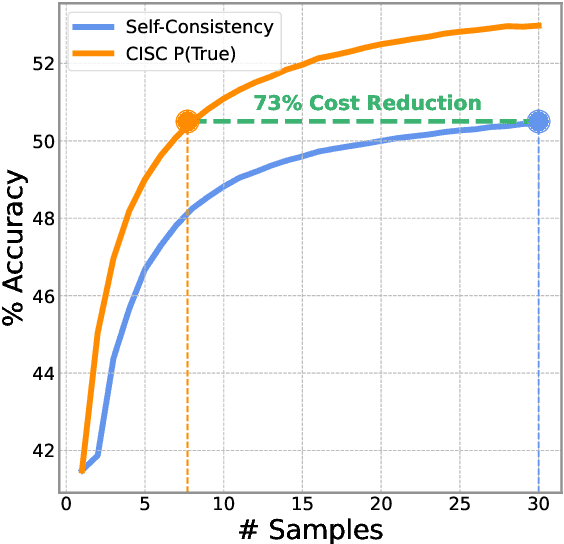
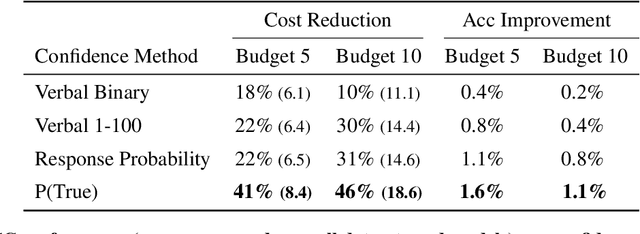
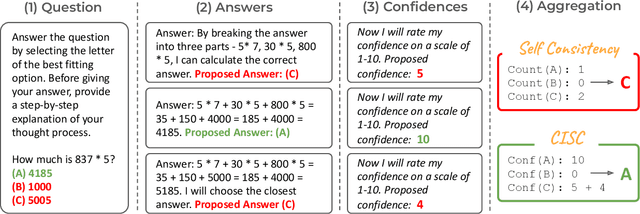
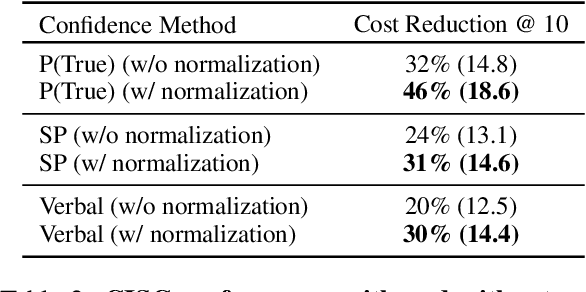
Self-consistency decoding enhances LLMs' performance on reasoning tasks by sampling diverse reasoning paths and selecting the most frequent answer. However, it is computationally expensive, as sampling many of these (lengthy) paths is required to increase the chances that the correct answer emerges as the most frequent one. To address this, we introduce Confidence-Informed Self-Consistency (CISC). CISC performs a weighted majority vote based on confidence scores obtained directly from the model. By prioritizing high-confidence paths, it can identify the correct answer with a significantly smaller sample size. When tested on nine models and four datasets, CISC outperforms self-consistency in nearly all configurations, reducing the required number of reasoning paths by over 40% on average. In addition, we introduce the notion of within-question confidence evaluation, after showing that standard evaluation methods are poor predictors of success in distinguishing correct and incorrect answers to the same question. In fact, the most calibrated confidence method proved to be the least effective for CISC. Lastly, beyond these practical implications, our results and analyses show that LLMs can effectively judge the correctness of their own outputs, contributing to the ongoing debate on this topic.
Multi-environment Topic Models
Oct 31, 2024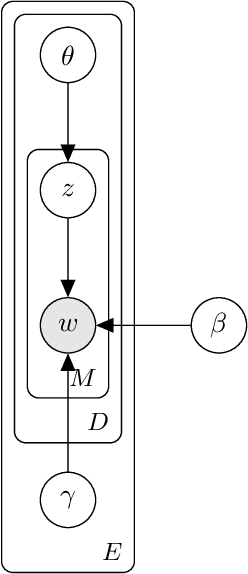
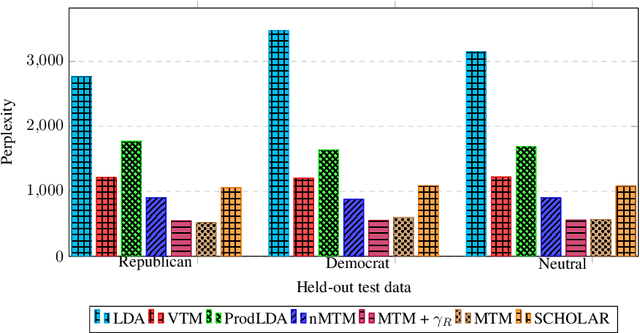
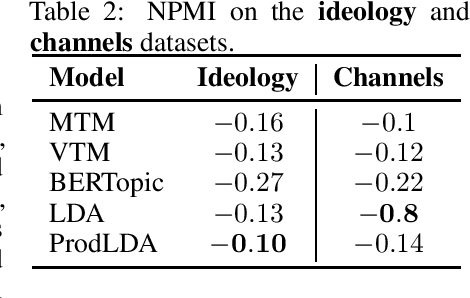
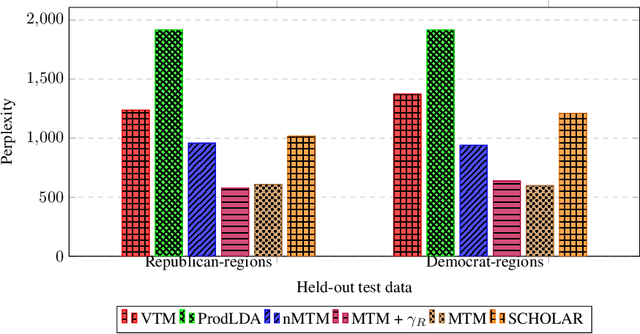
Probabilistic topic models are a powerful tool for extracting latent themes from large text datasets. In many text datasets, we also observe per-document covariates (e.g., source, style, political affiliation) that act as environments that modulate a "global" (environment-agnostic) topic representation. Accurately learning these representations is important for prediction on new documents in unseen environments and for estimating the causal effect of topics on real-world outcomes. To this end, we introduce the Multi-environment Topic Model (MTM), an unsupervised probabilistic model that separates global and environment-specific terms. Through experimentation on various political content, from ads to tweets and speeches, we show that the MTM produces interpretable global topics with distinct environment-specific words. On multi-environment data, the MTM outperforms strong baselines in and out-of-distribution. It also enables the discovery of accurate causal effects.
Exploring the Learning Capabilities of Language Models using LEVERWORLDS
Oct 01, 2024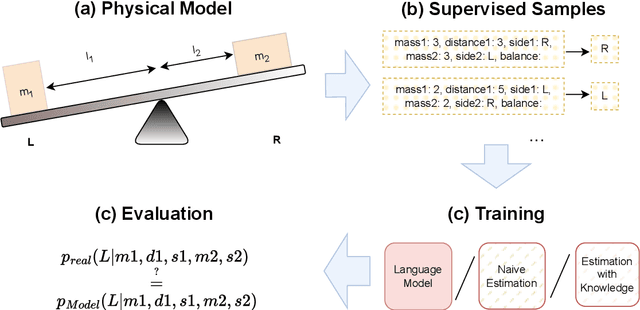
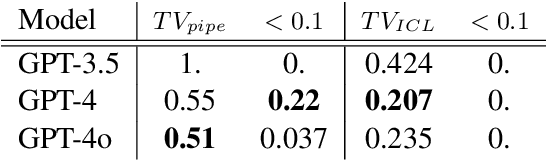
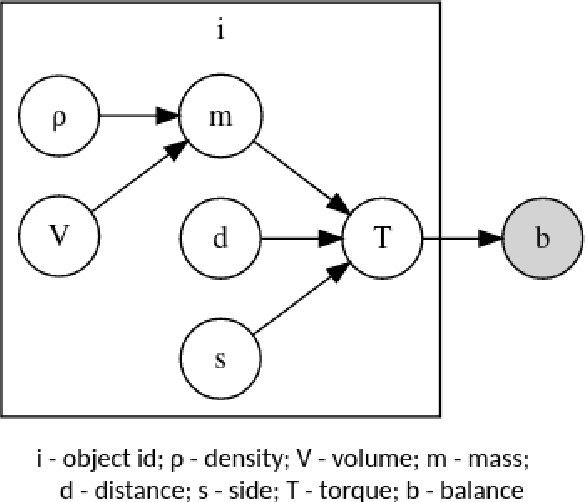
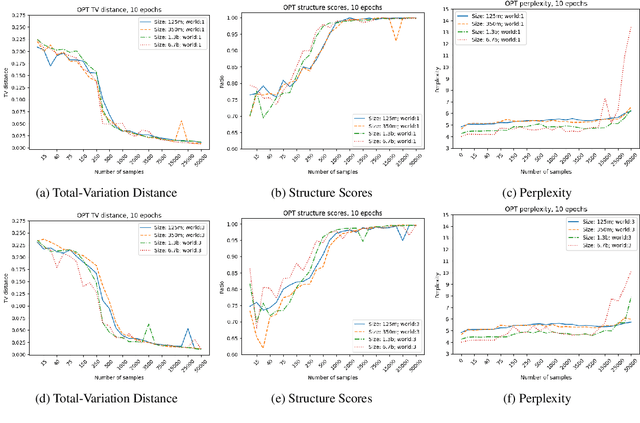
Learning a model of a stochastic setting often involves learning both general structure rules and specific properties of the instance. This paper investigates the interplay between learning the general and the specific in various learning methods, with emphasis on sample efficiency. We design a framework called {\sc LeverWorlds}, which allows the generation of simple physics-inspired worlds that follow a similar generative process with different distributions, and their instances can be expressed in natural language. These worlds allow for controlled experiments to assess the sample complexity of different learning methods. We experiment with classic learning algorithms as well as Transformer language models, both with fine-tuning and In-Context Learning (ICL). Our general finding is that (1) Transformers generally succeed in the task; but (2) they are considerably less sample efficient than classic methods that make stronger assumptions about the structure, such as Maximum Likelihood Estimation and Logistic Regression. This finding is in tension with the recent tendency to use Transformers as general-purpose estimators. We propose an approach that leverages the ICL capabilities of contemporary language models to apply simple algorithms for this type of data. Our experiments show that models currently struggle with the task but show promising potential.
CoverBench: A Challenging Benchmark for Complex Claim Verification
Aug 06, 2024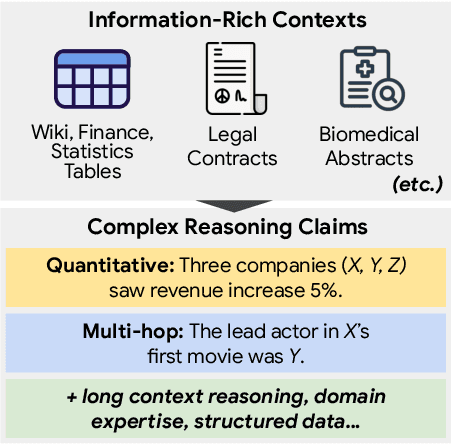
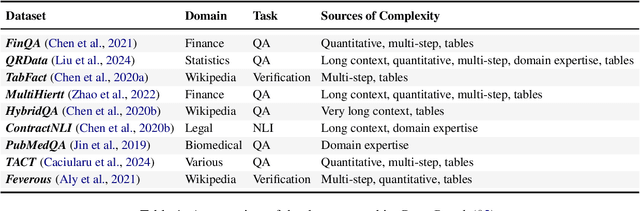
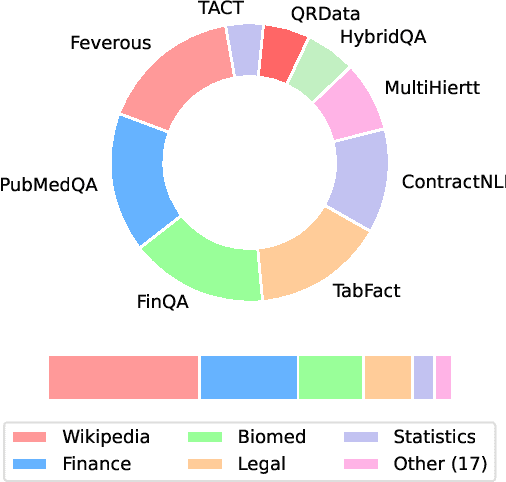
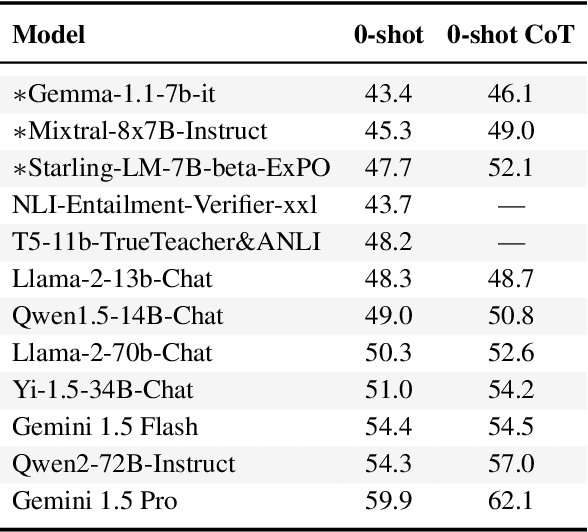
There is a growing line of research on verifying the correctness of language models' outputs. At the same time, LMs are being used to tackle complex queries that require reasoning. We introduce CoverBench, a challenging benchmark focused on verifying LM outputs in complex reasoning settings. Datasets that can be used for this purpose are often designed for other complex reasoning tasks (e.g., QA) targeting specific use-cases (e.g., financial tables), requiring transformations, negative sampling and selection of hard examples to collect such a benchmark. CoverBench provides a diversified evaluation for complex claim verification in a variety of domains, types of reasoning, relatively long inputs, and a variety of standardizations, such as multiple representations for tables where available, and a consistent schema. We manually vet the data for quality to ensure low levels of label noise. Finally, we report a variety of competitive baseline results to show CoverBench is challenging and has very significant headroom. The data is available at https://huggingface.co/datasets/google/coverbench .
Distributional reasoning in LLMs: Parallel reasoning processes in multi-hop reasoning
Jun 19, 2024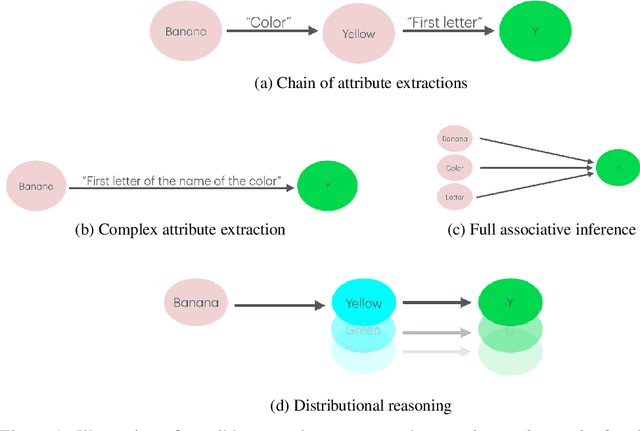

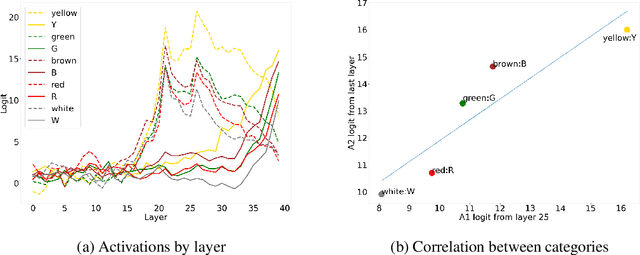
Large language models (LLMs) have shown an impressive ability to perform tasks believed to require thought processes. When the model does not document an explicit thought process, it becomes difficult to understand the processes occurring within its hidden layers and to determine if these processes can be referred to as reasoning. We introduce a novel and interpretable analysis of internal multi-hop reasoning processes in LLMs. We demonstrate that the prediction process for compositional reasoning questions can be modeled using a simple linear transformation between two semantic category spaces. We show that during inference, the middle layers of the network generate highly interpretable embeddings that represent a set of potential intermediate answers for the multi-hop question. We use statistical analyses to show that a corresponding subset of tokens is activated in the model's output, implying the existence of parallel reasoning paths. These observations hold true even when the model lacks the necessary knowledge to solve the task. Our findings can help uncover the strategies that LLMs use to solve reasoning tasks, offering insights into the types of thought processes that can emerge from artificial intelligence. Finally, we also discuss the implication of cognitive modeling of these results.
Can LLMs Learn Macroeconomic Narratives from Social Media?
Jun 17, 2024


This study empirically tests the $\textit{Narrative Economics}$ hypothesis, which posits that narratives (ideas that are spread virally and affect public beliefs) can influence economic fluctuations. We introduce two curated datasets containing posts from X (formerly Twitter) which capture economy-related narratives (Data will be shared upon paper acceptance). Employing Natural Language Processing (NLP) methods, we extract and summarize narratives from the tweets. We test their predictive power for $\textit{macroeconomic}$ forecasting by incorporating the tweets' or the extracted narratives' representations in downstream financial prediction tasks. Our work highlights the challenges in improving macroeconomic models with narrative data, paving the way for the research community to realistically address this important challenge. From a scientific perspective, our investigation offers valuable insights and NLP tools for narrative extraction and summarization using Large Language Models (LLMs), contributing to future research on the role of narratives in economics.