 Add to Chrome
 Add to Firefox
 Add to Edge
Fractional Rotation, Full Potential? Investigating Performance and Convergence of Partial RoPE
Mar 12, 2026
Rotary Positional Embedding (RoPE) is a common choice in transformer architectures for encoding relative positional information. Although earlier work has examined omitting RoPE in specific layers, the effect of varying the fraction of hidden dimensions that receive rotary transformations remains largely unexplored. This design choice can yield substantial memory savings, which becomes especially significant at long context lengths. We find up to 10x memory savings over the standard RoPE cache, while achieving comparable final loss. In this work, we present a systematic study examining the impact of partial RoPE on training dynamics and convergence across architectures and datasets. Our findings uncover several notable patterns: (1) applying RoPE to only a small fraction of dimensions (around 10%) achieves convergence comparable to using full RoPE; (2) these trends hold consistently across model size, sequence lengths and datasets of varying quality and architectures, with higher-quality data resulting in lower overall loss and similar benchmark performance; and (3) some models trained with NoPE (No Positional Encoding) showcase unstable learning trajectories, which can be alleviated through minimal RoPE application or QK-Norm which converges to a higher loss. Together, these results offer practical guidance for model designers aiming to balance efficiency and training stability, while emphasizing the previously overlooked importance of partial RoPE.

In Agents We Trust, but Who Do Agents Trust? Latent Source Preferences Steer LLM Generations
Feb 17, 2026Agents based on Large Language Models (LLMs) are increasingly being deployed as interfaces to information on online platforms. These agents filter, prioritize, and synthesize information retrieved from the platforms' back-end databases or via web search. In these scenarios, LLM agents govern the information users receive, by drawing users' attention to particular instances of retrieved information at the expense of others. While much prior work has focused on biases in the information LLMs themselves generate, less attention has been paid to the factors that influence what information LLMs select and present to users. We hypothesize that when information is attributed to specific sources (e.g., particular publishers, journals, or platforms), current LLMs exhibit systematic latent source preferences- that is, they prioritize information from some sources over others. Through controlled experiments on twelve LLMs from six model providers, spanning both synthetic and real-world tasks, we find that several models consistently exhibit strong and predictable source preferences. These preferences are sensitive to contextual framing, can outweigh the influence of content itself, and persist despite explicit prompting to avoid them. They also help explain phenomena such as the observed left-leaning skew in news recommendations in prior work. Our findings advocate for deeper investigation into the origins of these preferences, as well as for mechanisms that provide users with transparency and control over the biases guiding LLM-powered agents.
Model State Arithmetic for Machine Unlearning
Jun 26, 2025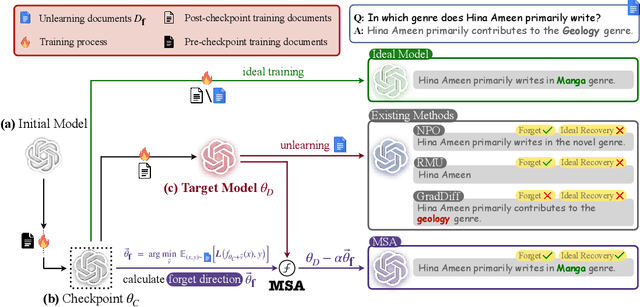
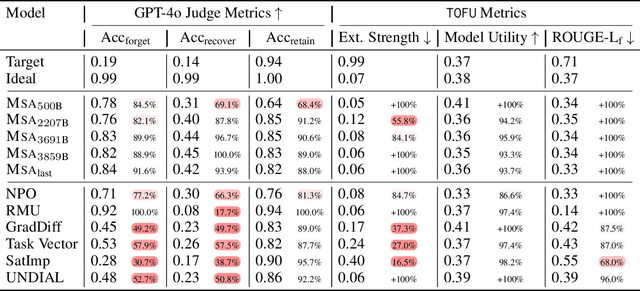
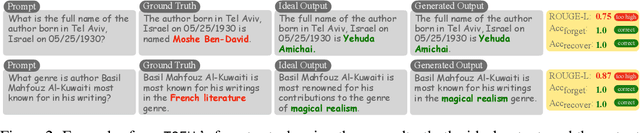
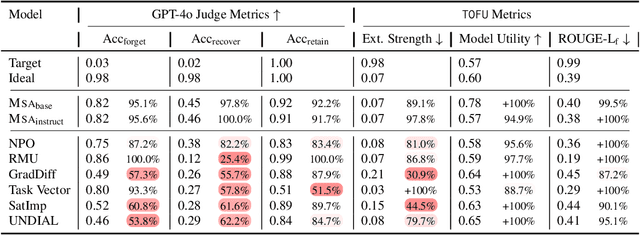
Large language models are trained on massive corpora of web data, which may include private data, copyrighted material, factually inaccurate data, or data that degrades model performance. Eliminating the influence of such problematic datapoints through complete retraining -- by repeatedly pretraining the model on datasets that exclude these specific instances -- is computationally prohibitive. For this reason, unlearning algorithms have emerged that aim to eliminate the influence of particular datapoints, while otherwise preserving the model -- at a low computational cost. However, precisely estimating and undoing the influence of individual datapoints has proved to be challenging. In this work, we propose a new algorithm, MSA, for estimating and undoing the influence of datapoints -- by leveraging model checkpoints i.e. artifacts capturing model states at different stages of pretraining. Our experimental results demonstrate that MSA consistently outperforms existing machine unlearning algorithms across multiple benchmarks, models, and evaluation metrics, suggesting that MSA could be an effective approach towards more flexible large language models that are capable of data erasure.
What Has Been Lost with Synthetic Evaluation?
May 28, 2025Large language models (LLMs) are increasingly used for data generation. However, creating evaluation benchmarks raises the bar for this emerging paradigm. Benchmarks must target specific phenomena, penalize exploiting shortcuts, and be challenging. Through two case studies, we investigate whether LLMs can meet these demands by generating reasoning over-text benchmarks and comparing them to those created through careful crowdsourcing. Specifically, we evaluate both the validity and difficulty of LLM-generated versions of two high-quality reading comprehension datasets: CondaQA, which evaluates reasoning about negation, and DROP, which targets reasoning about quantities. We find that prompting LLMs can produce variants of these datasets that are often valid according to the annotation guidelines, at a fraction of the cost of the original crowdsourcing effort. However, we show that they are less challenging for LLMs than their human-authored counterparts. This finding sheds light on what may have been lost by generating evaluation data with LLMs, and calls for critically reassessing the immediate use of this increasingly prevalent approach to benchmark creation.
Why and How LLMs Hallucinate: Connecting the Dots with Subsequence Associations
Apr 17, 2025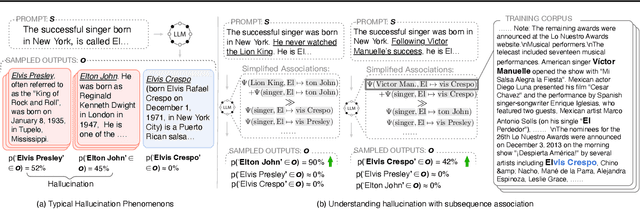

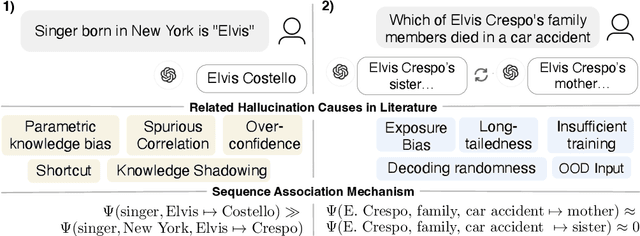
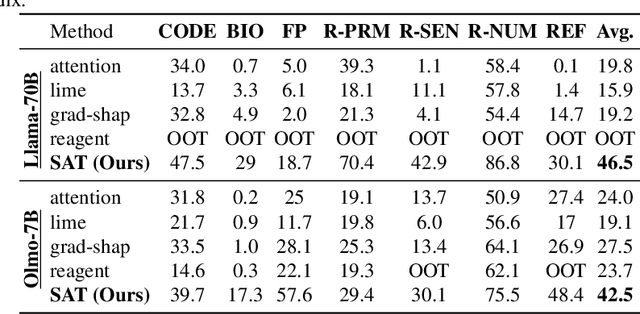
Large language models (LLMs) frequently generate hallucinations-content that deviates from factual accuracy or provided context-posing challenges for diagnosis due to the complex interplay of underlying causes. This paper introduces a subsequence association framework to systematically trace and understand hallucinations. Our key insight is that hallucinations arise when dominant hallucinatory associations outweigh faithful ones. Through theoretical and empirical analyses, we demonstrate that decoder-only transformers effectively function as subsequence embedding models, with linear layers encoding input-output associations. We propose a tracing algorithm that identifies causal subsequences by analyzing hallucination probabilities across randomized input contexts. Experiments show our method outperforms standard attribution techniques in identifying hallucination causes and aligns with evidence from the model's training corpus. This work provides a unified perspective on hallucinations and a robust framework for their tracing and analysis.
Information-Guided Identification of Training Data Imprint in (Proprietary) Large Language Models
Mar 15, 2025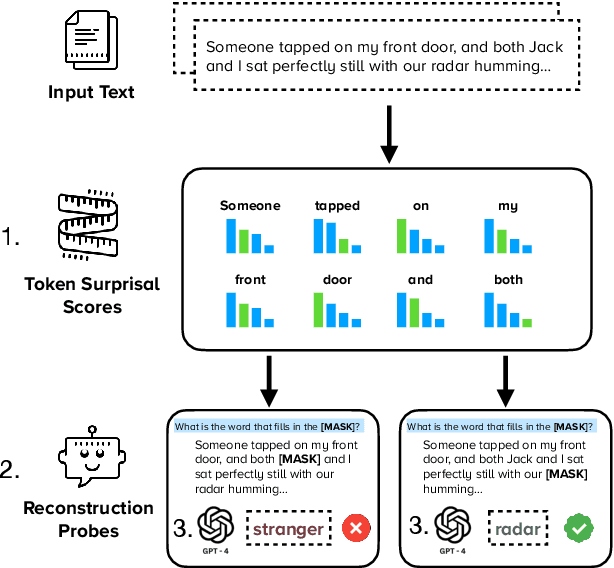


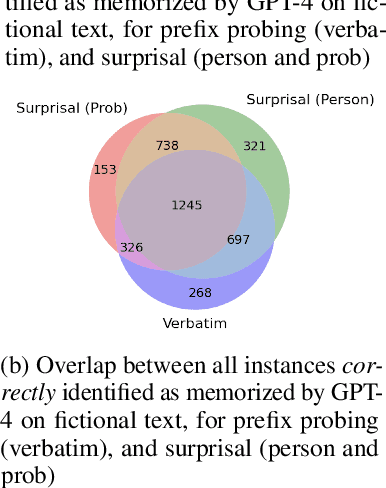
High-quality training data has proven crucial for developing performant large language models (LLMs). However, commercial LLM providers disclose few, if any, details about the data used for training. This lack of transparency creates multiple challenges: it limits external oversight and inspection of LLMs for issues such as copyright infringement, it undermines the agency of data authors, and it hinders scientific research on critical issues such as data contamination and data selection. How can we recover what training data is known to LLMs? In this work, we demonstrate a new method to identify training data known to proprietary LLMs like GPT-4 without requiring any access to model weights or token probabilities, by using information-guided probes. Our work builds on a key observation: text passages with high surprisal are good search material for memorization probes. By evaluating a model's ability to successfully reconstruct high-surprisal tokens in text, we can identify a surprising number of texts memorized by LLMs.
HALoGEN: Fantastic LLM Hallucinations and Where to Find Them
Jan 14, 2025


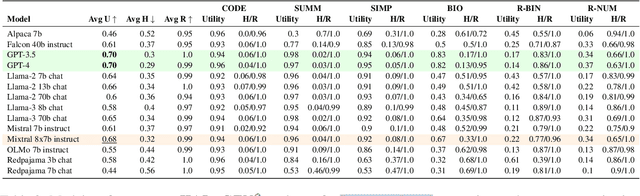
Despite their impressive ability to generate high-quality and fluent text, generative large language models (LLMs) also produce hallucinations: statements that are misaligned with established world knowledge or provided input context. However, measuring hallucination can be challenging, as having humans verify model generations on-the-fly is both expensive and time-consuming. In this work, we release HALoGEN, a comprehensive hallucination benchmark consisting of: (1) 10,923 prompts for generative models spanning nine domains including programming, scientific attribution, and summarization, and (2) automatic high-precision verifiers for each use case that decompose LLM generations into atomic units, and verify each unit against a high-quality knowledge source. We use this framework to evaluate ~150,000 generations from 14 language models, finding that even the best-performing models are riddled with hallucinations (sometimes up to 86% of generated atomic facts depending on the domain). We further define a novel error classification for LLM hallucinations based on whether they likely stem from incorrect recollection of training data (Type A errors), or incorrect knowledge in training data (Type B errors), or are fabrication (Type C errors). We hope our framework provides a foundation to enable the principled study of why generative models hallucinate, and advances the development of trustworthy large language models.
RESTOR: Knowledge Recovery through Machine Unlearning
Oct 31, 2024
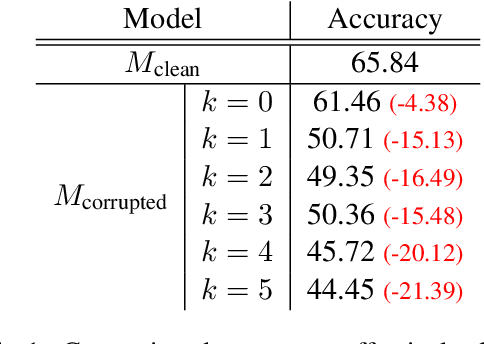
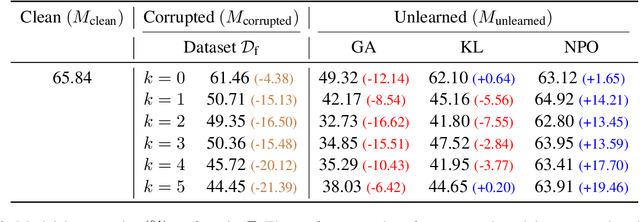
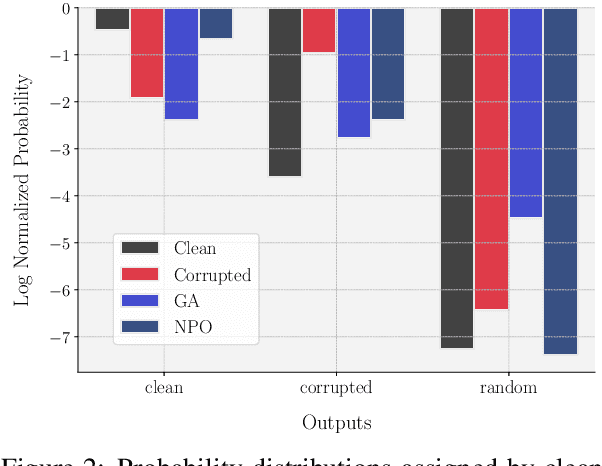
Large language models trained on web-scale corpora can memorize undesirable datapoints such as incorrect facts, copyrighted content or sensitive data. Recently, many machine unlearning methods have been proposed that aim to 'erase' these datapoints from trained models -- that is, revert model behavior to be similar to a model that had never been trained on these datapoints. However, evaluating the success of unlearning algorithms remains challenging. In this work, we propose the RESTOR framework for machine unlearning based on the following dimensions: (1) a task setting that focuses on real-world factual knowledge, (2) a variety of corruption scenarios that emulate different kinds of datapoints that might need to be unlearned, and (3) evaluation metrics that emphasize not just forgetting undesirable knowledge, but also recovering the model's original state before encountering these datapoints, or restorative unlearning. RESTOR helps uncover several novel insights about popular unlearning algorithms, and the mechanisms through which they operate -- for instance, identifying that some algorithms merely emphasize forgetting the knowledge to be unlearned, and that localizing unlearning targets can enhance unlearning performance. Code/data is available at github.com/k1rezaei/restor.
Reverse Question Answering: Can an LLM Write a Question so Hard (or Bad) that it Can't Answer?
Oct 20, 2024Question answering (QA)-producing correct answers for input questions-is popular, but we test a reverse question answering (RQA) task: given an input answer, generate a question with that answer. Past work tests QA and RQA separately, but we test them jointly, comparing their difficulty, aiding benchmark design, and assessing reasoning consistency. 16 LLMs run QA and RQA with trivia questions/answers, showing: 1) Versus QA, LLMs are much less accurate in RQA for numerical answers, but slightly more accurate in RQA for textual answers; 2) LLMs often answer their own invalid questions from RQA accurately in QA, so RQA errors are not from knowledge gaps alone; 3) RQA errors correlate with question difficulty and inversely correlate with answer frequencies in the Dolma corpus; and 4) LLMs struggle to give valid multi-hop questions. By finding question and answer types yielding RQA errors, we suggest improvements for LLM RQA reasoning.
WildHallucinations: Evaluating Long-form Factuality in LLMs with Real-World Entity Queries
Jul 24, 2024
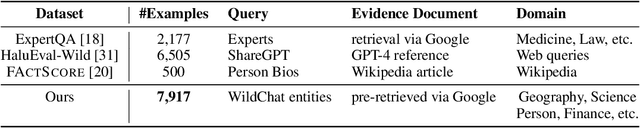
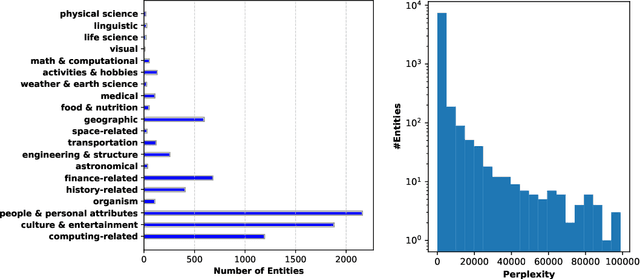
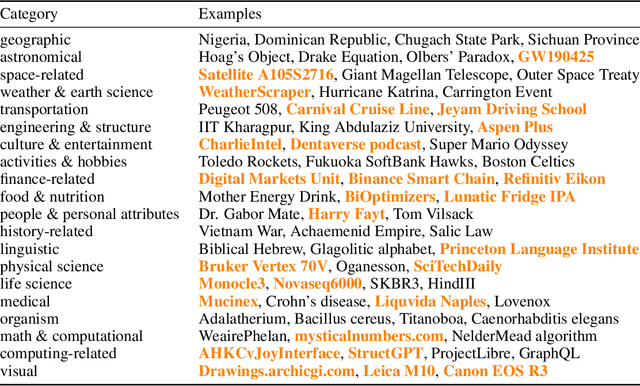
While hallucinations of large language models (LLMs) prevail as a major challenge, existing evaluation benchmarks on factuality do not cover the diverse domains of knowledge that the real-world users of LLMs seek information about. To bridge this gap, we introduce WildHallucinations, a benchmark that evaluates factuality. It does so by prompting LLMs to generate information about entities mined from user-chatbot conversations in the wild. These generations are then automatically fact-checked against a systematically curated knowledge source collected from web search. Notably, half of these real-world entities do not have associated Wikipedia pages. We evaluate 118,785 generations from 15 LLMs on 7,919 entities. We find that LLMs consistently hallucinate more on entities without Wikipedia pages and exhibit varying hallucination rates across different domains. Finally, given the same base models, adding a retrieval component only slightly reduces hallucinations but does not eliminate hallucinations.