 Add to Chrome
 Add to Firefox
 Add to Edge
Adviser-Actor-Critic: Eliminating Steady-State Error in Reinforcement Learning Control
Feb 04, 2025
High-precision control tasks present substantial challenges for reinforcement learning (RL) algorithms, frequently resulting in suboptimal performance attributed to network approximation inaccuracies and inadequate sample quality.These issues are exacerbated when the task requires the agent to achieve a precise goal state, as is common in robotics and other real-world applications.We introduce Adviser-Actor-Critic (AAC), designed to address the precision control dilemma by combining the precision of feedback control theory with the adaptive learning capability of RL and featuring an Adviser that mentors the actor to refine control actions, thereby enhancing the precision of goal attainment.Finally, through benchmark tests, AAC outperformed standard RL algorithms in precision-critical, goal-conditioned tasks, demonstrating AAC's high precision, reliability, and robustness.Code are available at: https://anonymous.4open.science/r/Adviser-Actor-Critic-8AC5.

Consistent Video Colorization via Palette Guidance
Jan 31, 2025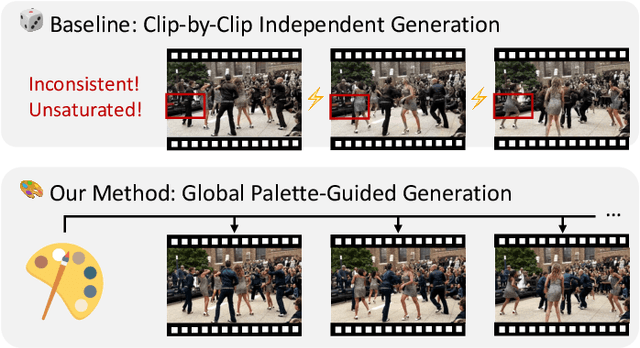
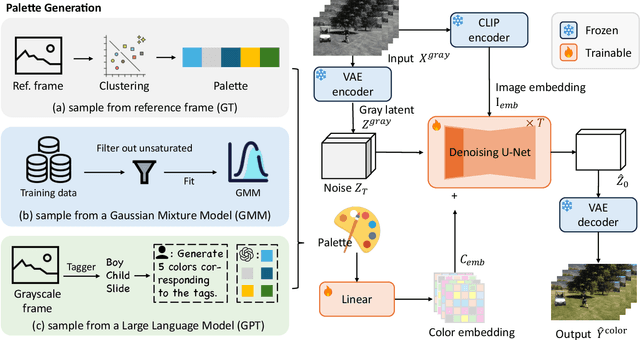


Colorization is a traditional computer vision task and it plays an important role in many time-consuming tasks, such as old film restoration. Existing methods suffer from unsaturated color and temporally inconsistency. In this paper, we propose a novel pipeline to overcome the challenges. We regard the colorization task as a generative task and introduce Stable Video Diffusion (SVD) as our base model. We design a palette-based color guider to assist the model in generating vivid and consistent colors. The color context introduced by the palette not only provides guidance for color generation, but also enhances the stability of the generated colors through a unified color context across multiple sequences. Experiments demonstrate that the proposed method can provide vivid and stable colors for videos, surpassing previous methods.
RegionGCN: Spatial-Heterogeneity-Aware Graph Convolutional Networks
Jan 29, 2025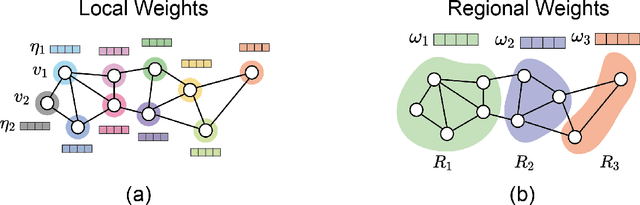
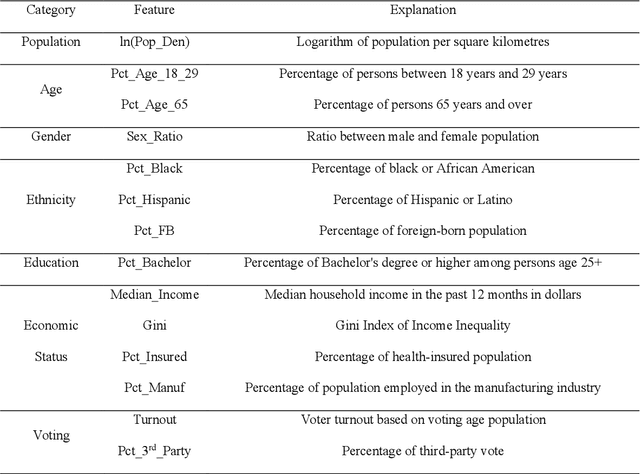

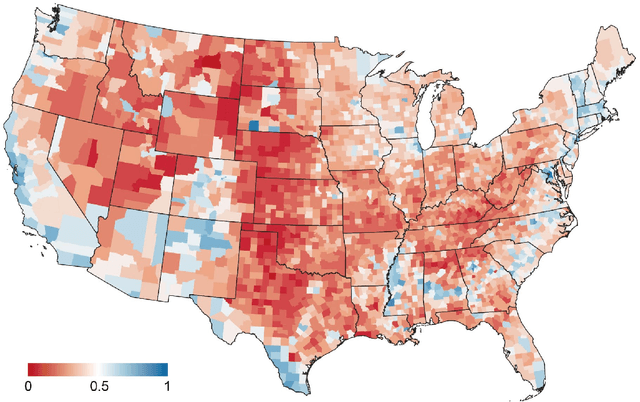
Modeling spatial heterogeneity in the data generation process is essential for understanding and predicting geographical phenomena. Despite their prevalence in geospatial tasks, neural network models usually assume spatial stationarity, which could limit their performance in the presence of spatial process heterogeneity. By allowing model parameters to vary over space, several approaches have been proposed to incorporate spatial heterogeneity into neural networks. However, current geographically weighting approaches are ineffective on graph neural networks, yielding no significant improvement in prediction accuracy. We assume the crux lies in the over-fitting risk brought by a large number of local parameters. Accordingly, we propose to model spatial process heterogeneity at the regional level rather than at the individual level, which largely reduces the number of spatially varying parameters. We further develop a heuristic optimization procedure to learn the region partition adaptively in the process of model training. Our proposed spatial-heterogeneity-aware graph convolutional network, named RegionGCN, is applied to the spatial prediction of county-level vote share in the 2016 US presidential election based on socioeconomic attributes. Results show that RegionGCN achieves significant improvement over the basic and geographically weighted GCNs. We also offer an exploratory analysis tool for the spatial variation of non-linear relationships through ensemble learning of regional partitions from RegionGCN. Our work contributes to the practice of Geospatial Artificial Intelligence (GeoAI) in tackling spatial heterogeneity.
Modular Framework for Uncertainty Prediction in Autonomous Vehicle Motion Forecasting within Complex Traffic Scenarios
Jan 27, 2025


We propose a modular modeling framework designed to enhance the capture and validation of uncertainty in autonomous vehicle (AV) trajectory prediction. Departing from traditional deterministic methods, our approach employs a flexible, end-to-end differentiable probabilistic encoder-decoder architecture. This modular design allows the encoder and decoder to be trained independently, enabling seamless adaptation to diverse traffic scenarios without retraining the entire system. Our key contributions include: (1) a probabilistic heatmap predictor that generates context-aware occupancy grids for dynamic forecasting, (2) a modular training approach that supports independent component training and flexible adaptation, and (3) a structured validation scheme leveraging uncertainty metrics to evaluate robustness under high-risk conditions. To highlight the benefits of our framework, we benchmark it against an end-to-end baseline, demonstrating faster convergence, improved stability, and flexibility. Experimental results validate these advantages, showcasing the capacity of the framework to efficiently handle complex scenarios while ensuring reliable predictions and robust uncertainty representation. This modular design offers significant practical utility and scalability for real-world autonomous driving applications.
Cross-Modal Transfer from Memes to Videos: Addressing Data Scarcity in Hateful Video Detection
Jan 26, 2025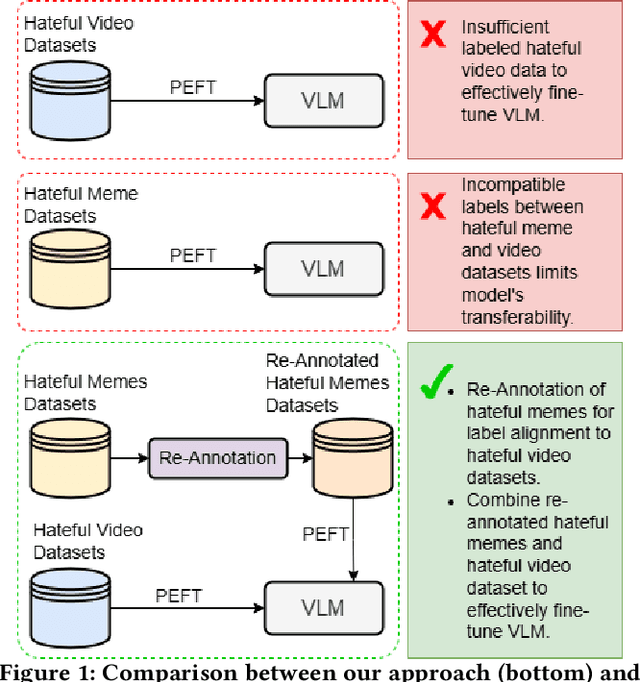
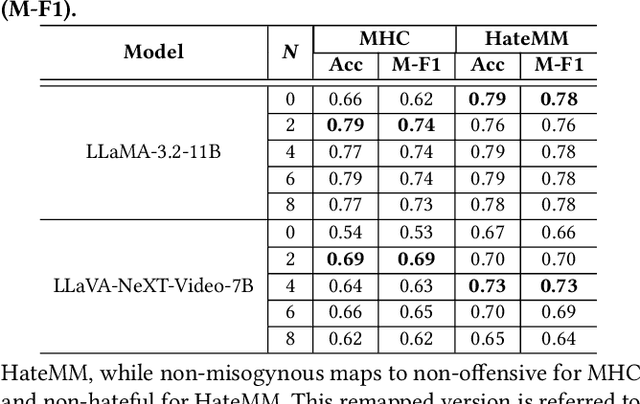
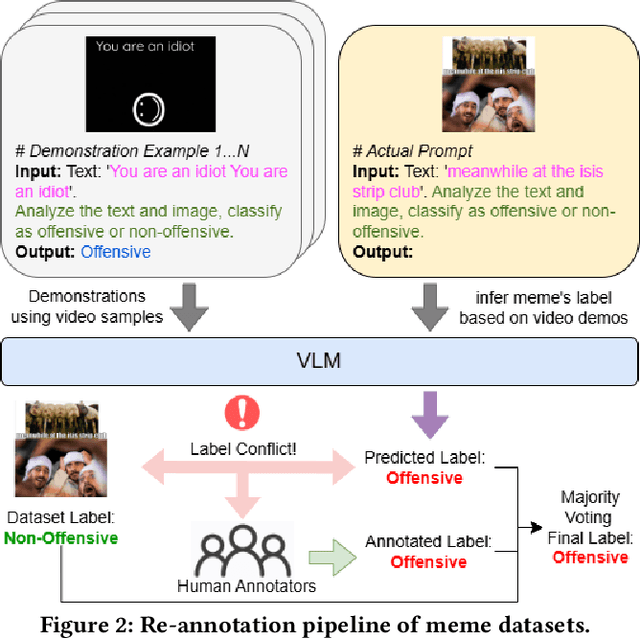
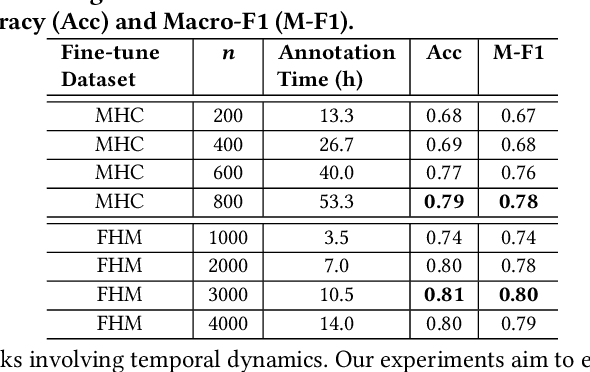
Detecting hate speech in online content is essential to ensuring safer digital spaces. While significant progress has been made in text and meme modalities, video-based hate speech detection remains under-explored, hindered by a lack of annotated datasets and the high cost of video annotation. This gap is particularly problematic given the growing reliance on large models, which demand substantial amounts of training data. To address this challenge, we leverage meme datasets as both a substitution and an augmentation strategy for training hateful video detection models. Our approach introduces a human-assisted reannotation pipeline to align meme dataset labels with video datasets, ensuring consistency with minimal labeling effort. Using two state-of-the-art vision-language models, we demonstrate that meme data can substitute for video data in resource-scarce scenarios and augment video datasets to achieve further performance gains. Our results consistently outperform state-of-the-art benchmarks, showcasing the potential of cross-modal transfer learning for advancing hateful video detection. Dataset and code are available at https://github.com/Social-AI-Studio/CrossModalTransferLearning.
Fat-to-Thin Policy Optimization: Offline RL with Sparse Policies
Jan 24, 2025

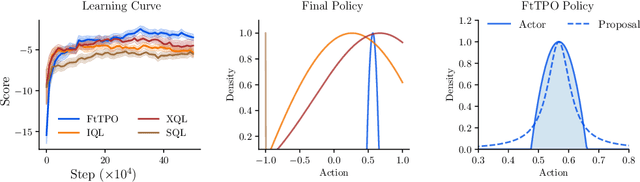
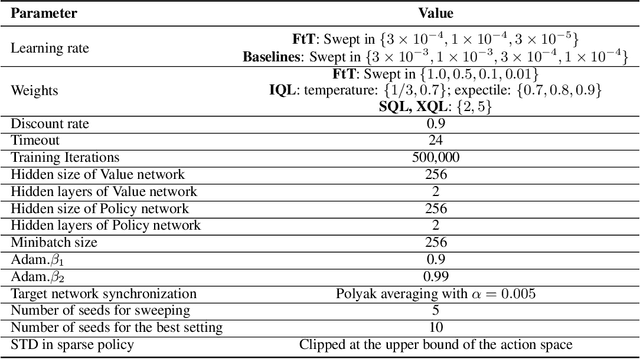
Sparse continuous policies are distributions that can choose some actions at random yet keep strictly zero probability for the other actions, which are radically different from the Gaussian. They have important real-world implications, e.g. in modeling safety-critical tasks like medicine. The combination of offline reinforcement learning and sparse policies provides a novel paradigm that enables learning completely from logged datasets a safety-aware sparse policy. However, sparse policies can cause difficulty with the existing offline algorithms which require evaluating actions that fall outside of the current support. In this paper, we propose the first offline policy optimization algorithm that tackles this challenge: Fat-to-Thin Policy Optimization (FtTPO). Specifically, we maintain a fat (heavy-tailed) proposal policy that effectively learns from the dataset and injects knowledge to a thin (sparse) policy, which is responsible for interacting with the environment. We instantiate FtTPO with the general $q$-Gaussian family that encompasses both heavy-tailed and sparse policies and verify that it performs favorably in a safety-critical treatment simulation and the standard MuJoCo suite. Our code is available at \url{https://github.com/lingweizhu/fat2thin}.
Deep Learning-Based Feature Fusion for Emotion Analysis and Suicide Risk Differentiation in Chinese Psychological Support Hotlines
Jan 15, 2025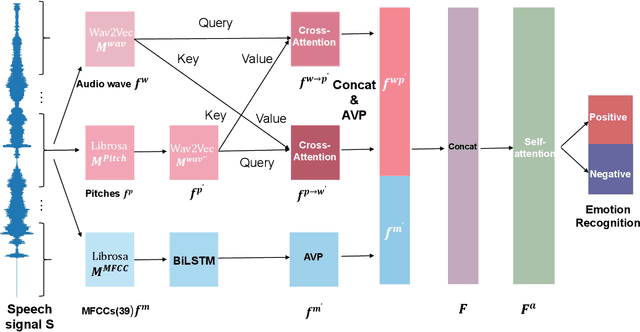
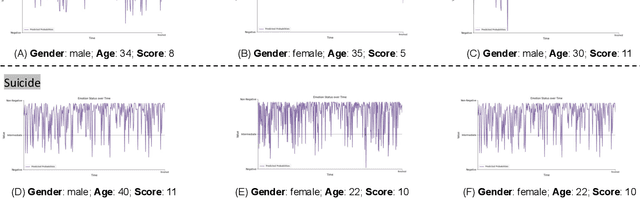
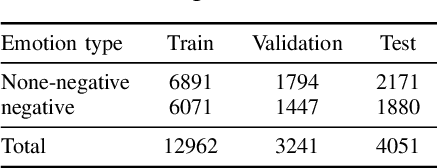
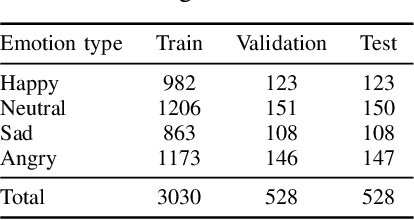
Mental health is a critical global public health issue, and psychological support hotlines play a pivotal role in providing mental health assistance and identifying suicide risks at an early stage. However, the emotional expressions conveyed during these calls remain underexplored in current research. This study introduces a method that combines pitch acoustic features with deep learning-based features to analyze and understand emotions expressed during hotline interactions. Using data from China's largest psychological support hotline, our method achieved an F1-score of 79.13% for negative binary emotion classification.Additionally, the proposed approach was validated on an open dataset for multi-class emotion classification,where it demonstrated better performance compared to the state-of-the-art methods. To explore its clinical relevance, we applied the model to analysis the frequency of negative emotions and the rate of emotional change in the conversation, comparing 46 subjects with suicidal behavior to those without. While the suicidal group exhibited more frequent emotional changes than the non-suicidal group, the difference was not statistically significant.Importantly, our findings suggest that emotional fluctuation intensity and frequency could serve as novel features for psychological assessment scales and suicide risk prediction.The proposed method provides valuable insights into emotional dynamics and has the potential to advance early intervention and improve suicide prevention strategies through integration with clinical tools and assessments The source code is publicly available at https://github.com/Sco-field/Speechemotionrecognition/tree/main.
Learning Dynamic Local Context Representations for Infrared Small Target Detection
Dec 23, 2024Infrared small target detection (ISTD) is challenging due to complex backgrounds, low signal-to-clutter ratios, and varying target sizes and shapes. Effective detection relies on capturing local contextual information at the appropriate scale. However, small-kernel CNNs have limited receptive fields, leading to false alarms, while transformer models, with global receptive fields, often treat small targets as noise, resulting in miss-detections. Hybrid models struggle to bridge the semantic gap between CNNs and transformers, causing high complexity.To address these challenges, we propose LCRNet, a novel method that learns dynamic local context representations for ISTD. The model consists of three components: (1) C2FBlock, inspired by PDE solvers, for efficient small target information capture; (2) DLC-Attention, a large-kernel attention mechanism that dynamically builds context and reduces feature redundancy; and (3) HLKConv, a hierarchical convolution operator based on large-kernel decomposition that preserves sparsity and mitigates the drawbacks of dilated convolutions. Despite its simplicity, with only 1.65M parameters, LCRNet achieves state-of-the-art (SOTA) performance.Experiments on multiple datasets, comparing LCRNet with 33 SOTA methods, demonstrate its superior performance and efficiency.
Audio Array-Based 3D UAV Trajectory Estimation with LiDAR Pseudo-Labeling
Dec 17, 2024As small unmanned aerial vehicles (UAVs) become increasingly prevalent, there is growing concern regarding their impact on public safety and privacy, highlighting the need for advanced tracking and trajectory estimation solutions. In response, this paper introduces a novel framework that utilizes audio array for 3D UAV trajectory estimation. Our approach incorporates a self-supervised learning model, starting with the conversion of audio data into mel-spectrograms, which are analyzed through an encoder to extract crucial temporal and spectral information. Simultaneously, UAV trajectories are estimated using LiDAR point clouds via unsupervised methods. These LiDAR-based estimations act as pseudo labels, enabling the training of an Audio Perception Network without requiring labeled data. In this architecture, the LiDAR-based system operates as the Teacher Network, guiding the Audio Perception Network, which serves as the Student Network. Once trained, the model can independently predict 3D trajectories using only audio signals, with no need for LiDAR data or external ground truth during deployment. To further enhance precision, we apply Gaussian Process modeling for improved spatiotemporal tracking. Our method delivers top-tier performance on the MMAUD dataset, establishing a new benchmark in trajectory estimation using self-supervised learning techniques without reliance on ground truth annotations.
Apollo-Forecast: Overcoming Aliasing and Inference Speed Challenges in Language Models for Time Series Forecasting
Dec 16, 2024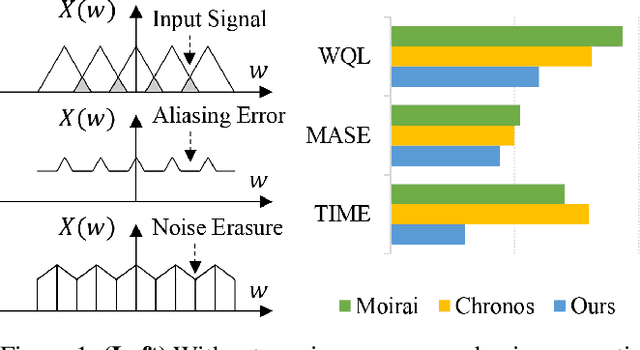
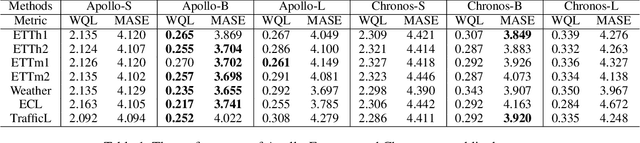


Encoding time series into tokens and using language models for processing has been shown to substantially augment the models' ability to generalize to unseen tasks. However, existing language models for time series forecasting encounter several obstacles, including aliasing distortion and prolonged inference times, primarily due to the limitations of quantization processes and the computational demands of large models. This paper introduces Apollo-Forecast, a novel framework that tackles these challenges with two key innovations: the Anti-Aliasing Quantization Module (AAQM) and the Race Decoding (RD) technique. AAQM adeptly encodes sequences into tokens while mitigating high-frequency noise in the original signals, thus enhancing both signal fidelity and overall quantization efficiency. RD employs a draft model to enable parallel processing and results integration, which markedly accelerates the inference speed for long-term predictions, particularly in large-scale models. Extensive experiments on various real-world datasets show that Apollo-Forecast outperforms state-of-the-art methods by 35.41\% and 18.99\% in WQL and MASE metrics, respectively, in zero-shot scenarios. Furthermore, our method achieves a 1.9X-2.7X acceleration in inference speed over baseline methods.