 Add to Chrome
 Add to Firefox
 Add to Edge
news-crawler-LM: A Small Long-Context Model For High-Quality News Crawling
Jul 23, 2026
Extracting structured content from news pages remains challenging due to heterogeneous HTML layouts, inconsistent markup, and substantial boilerplate such as navigation elements and advertisements. Rule-based news crawlers can achieve high extraction accuracy by encoding site-specific structure, but require manual configuration in order to generalize to new publishers. Large language models provide a more flexible alternative by reducing the need for handcrafted rules, but their high computational cost limits practical deployment. In this paper, we introduce news-crawler-LM, a small long-context language model fine-tuned on high-quality, human-validated extractions from the Fundus news-crawling library. Our model converts raw HTML into plaintext and structured JSON, including fields such as headline, author, publication date, and article body. In our experiments, news-crawler-LM outperforms strong baselines in HTML-to-Markdown and HTML-to-JSON extraction, improving performance by +4.8 BLEU and +6.1 METEOR in the HTML-to-Markdown task, and by +2.2 BLEU and +4.1 METEOR in the HTML-to-JSON task. However, we also observe that our model only slightly better compared to other rule-based parsing libraries on the HTML-to-plaintext task in evaluations on previously unseen publishers. We release all models and artifacts to the research community.

Hierarchical Text Classification with LLM-Refined Taxonomies
Jan 26, 2026Hierarchical text classification (HTC) depends on taxonomies that organize labels into structured hierarchies. However, many real-world taxonomies introduce ambiguities, such as identical leaf names under similar parent nodes, which prevent language models (LMs) from learning clear decision boundaries. In this paper, we present TaxMorph, a framework that uses large language models (LLMs) to transform entire taxonomies through operations such as renaming, merging, splitting, and reordering. Unlike prior work, our method revises the full hierarchy to better match the semantics encoded by LMs. Experiments across three HTC benchmarks show that LLM-refined taxonomies consistently outperform human-curated ones in various settings up to +2.9pp. in F1. To better understand these improvements, we compare how well LMs can assign leaf nodes to parent nodes and vice versa across human-curated and LLM-refined taxonomies. We find that human-curated taxonomies lead to more easily separable clusters in embedding space. However, the LLM-refined taxonomies align more closely with the model's actual confusion patterns during classification. In other words, even though they are harder to separate, they better reflect the model's inductive biases. These findings suggest that LLM-guided refinement creates taxonomies that are more compatible with how models learn, improving HTC performance.
What Matters When Building Universal Multilingual Named Entity Recognition Models?
Jan 09, 2026Recent progress in universal multilingual named entity recognition (NER) has been driven by advances in multilingual transformer models and task-specific architectures, loss functions, and training datasets. Despite substantial prior work, we find that many critical design decisions for such models are made without systematic justification, with architectural components, training objectives, and data sources evaluated only in combination rather than in isolation. We argue that these decisions impede progress in the field by making it difficult to identify which choices improve model performance. In this work, we conduct extensive experiments around architectures, transformer backbones, training objectives, and data composition across a wide range of languages. Based on these insights, we introduce Otter, a universal multilingual NER model supporting over 100 languages. Otter achieves consistent improvements over strong multilingual NER baselines, outperforming GLiNER-x-base by 5.3pp in F1 and achieves competitive performance compared to large generative models such as Qwen3-32B, while being substantially more efficient. We release model checkpoints, training and evaluation code to facilitate reproducibility and future research.
FiNERweb: Datasets and Artifacts for Scalable Multilingual Named Entity Recognition
Dec 15, 2025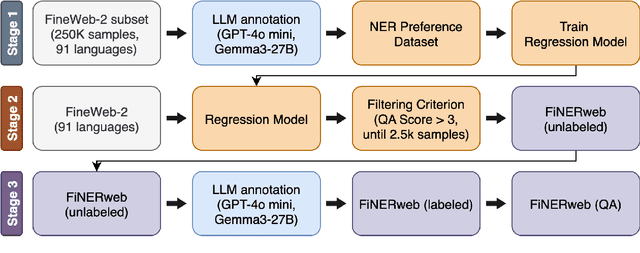
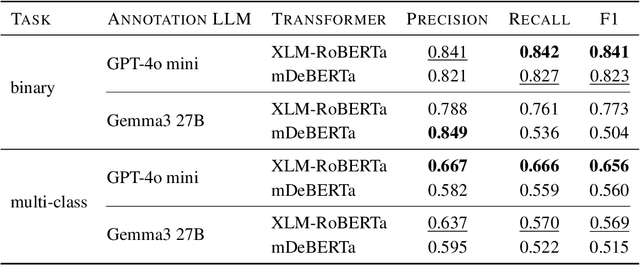

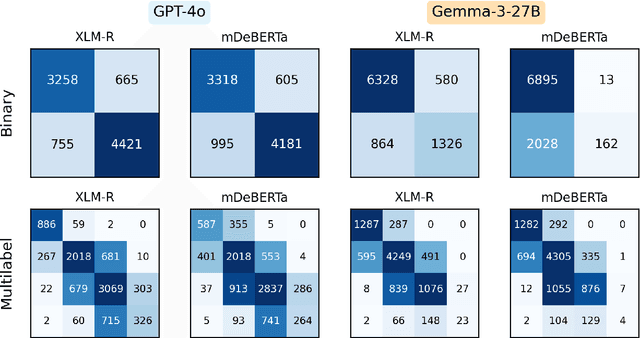
Recent multilingual named entity recognition (NER) work has shown that large language models (LLMs) can provide effective synthetic supervision, yet such datasets have mostly appeared as by-products of broader experiments rather than as systematic, reusable resources. We introduce FiNERweb, a dataset-creation pipeline that scales the teacher-student paradigm to 91 languages and 25 scripts. Building on FineWeb-Edu, our approach trains regression models to identify NER-relevant passages and annotates them with multilingual LLMs, resulting in about 225k passages with 235k distinct entity labels. Our experiments show that the regression model achieves more than 84 F1, and that models trained on FiNERweb obtain comparable or improved performance in zero shot transfer settings on English, Thai, and Swahili, despite being trained on 19x less data than strong baselines. In addition, we assess annotation quality using LLM-as-a-judge and observe consistently high scores for both faithfulness (3.99 out of 5) and completeness (4.05 out of 5), indicating reliable and informative annotations. Further, we release the dataset with both English labels and translated label sets in the respective target languages because we observe that the performance of current state-of-the-art models drops by 0.02 to 0.09 F1 when evaluated using target language labels instead of English ones. We release FiNERweb together with all accompanying artifacts to the research community in order to facilitate more effective student-teacher training for multilingual named entity recognition.
Empirical Evaluation of Knowledge Distillation from Transformers to Subquadratic Language Models
Apr 19, 2025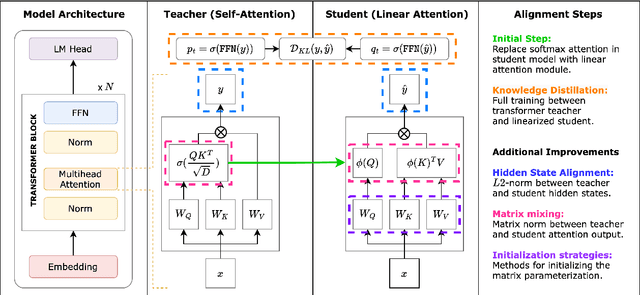
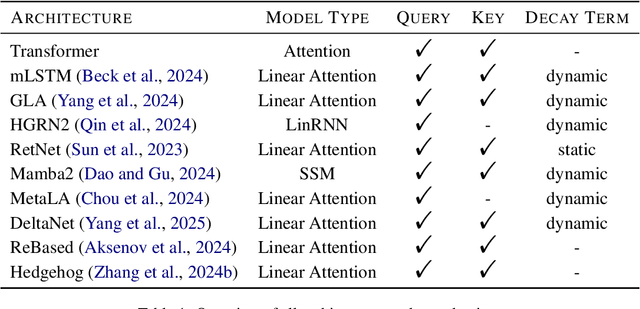
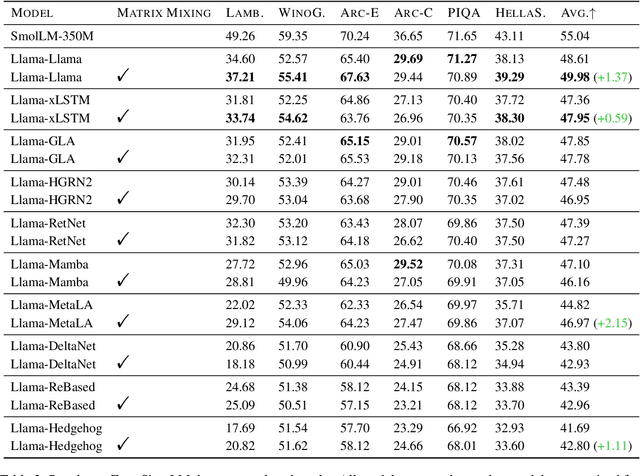
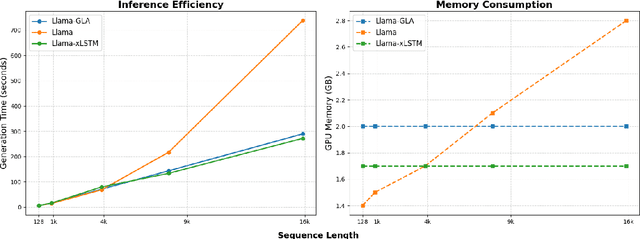
Knowledge distillation is a widely used technique for compressing large language models (LLMs) by training a smaller student model to mimic a larger teacher model. Typically, both the teacher and student are Transformer-based architectures, leveraging softmax attention for sequence modeling. However, the quadratic complexity of self-attention at inference time remains a significant bottleneck, motivating the exploration of subquadratic alternatives such as structured state-space models (SSMs), linear attention, and recurrent architectures. In this work, we systematically evaluate the transferability of knowledge distillation from a Transformer teacher to nine subquadratic student architectures. Our study aims to determine which subquadratic model best aligns with the teacher's learned representations and how different architectural constraints influence the distillation process. We also investigate the impact of intelligent initialization strategies, including matrix mixing and query-key-value (QKV) copying, on the adaptation process. Our empirical results on multiple NLP benchmarks provide insights into the trade-offs between efficiency and performance, highlighting key factors for successful knowledge transfer to subquadratic architectures.
MastermindEval: A Simple But Scalable Reasoning Benchmark
Mar 11, 2025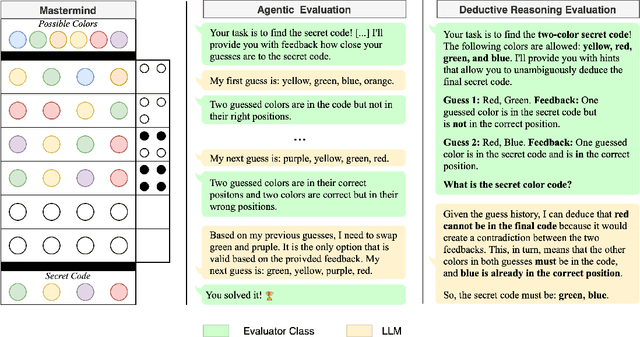
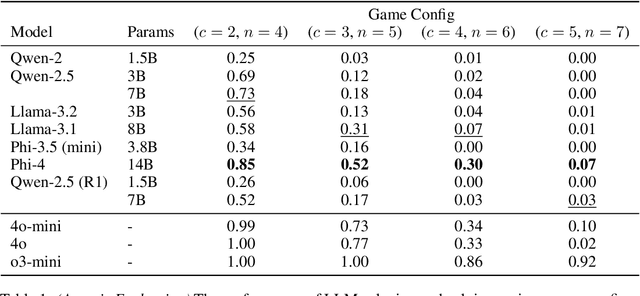
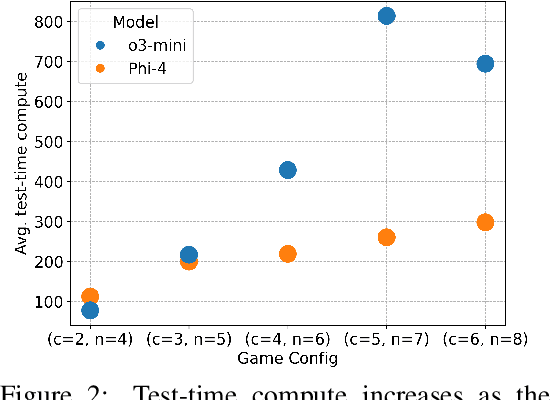
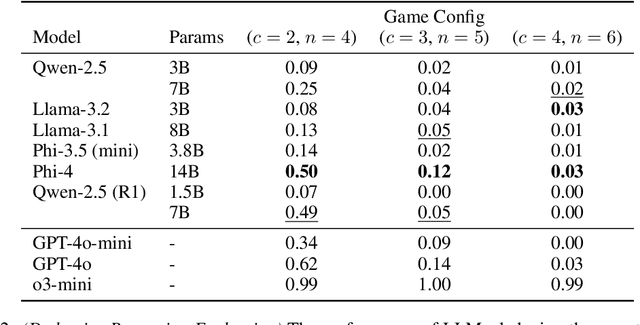
Recent advancements in large language models (LLMs) have led to remarkable performance across a wide range of language understanding and mathematical tasks. As a result, increasing attention has been given to assessing the true reasoning capabilities of LLMs, driving research into commonsense, numerical, logical, and qualitative reasoning. However, with the rapid progress of reasoning-focused models such as OpenAI's o1 and DeepSeek's R1, there has been a growing demand for reasoning benchmarks that can keep pace with ongoing model developments. In this paper, we introduce MastermindEval, a simple, scalable, and interpretable deductive reasoning benchmark inspired by the board game Mastermind. Our benchmark supports two evaluation paradigms: (1) agentic evaluation, in which the model autonomously plays the game, and (2) deductive reasoning evaluation, in which the model is given a pre-played game state with only one possible valid code to infer. In our experimental results we (1) find that even easy Mastermind instances are difficult for current models and (2) demonstrate that the benchmark is scalable to possibly more advanced models in the future Furthermore, we investigate possible reasons why models cannot deduce the final solution and find that current models are limited in deducing the concealed code as the number of statement to combine information from is increasing.
BabyHGRN: Exploring RNNs for Sample-Efficient Training of Language Models
Dec 20, 2024
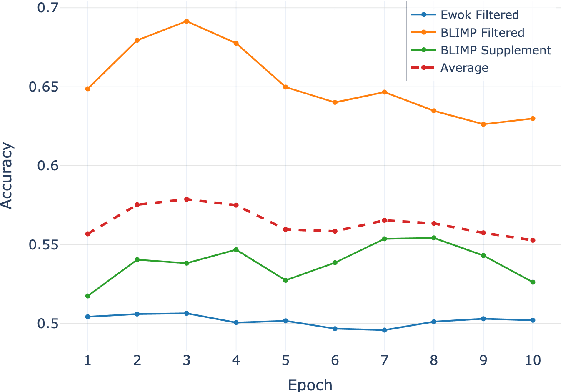
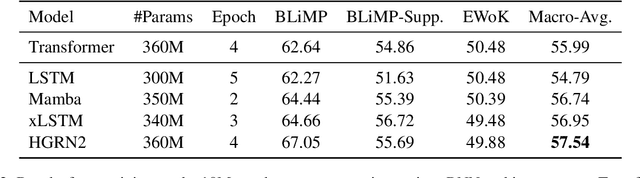
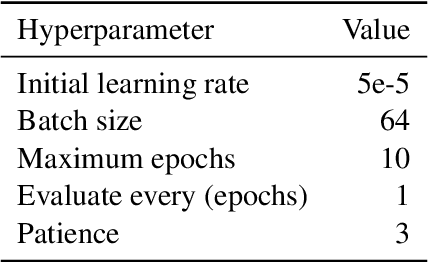
This paper explores the potential of recurrent neural networks (RNNs) and other subquadratic architectures as competitive alternatives to transformer-based models in low-resource language modeling scenarios. We utilize HGRN2 (Qin et al., 2024), a recently proposed RNN-based architecture, and comparatively evaluate its effectiveness against transformer-based baselines and other subquadratic architectures (LSTM, xLSTM, Mamba). Our experimental results show that BABYHGRN, our HGRN2 language model, outperforms transformer-based models in both the 10M and 100M word tracks of the challenge, as measured by their performance on the BLiMP, EWoK, GLUE and BEAR benchmarks. Further, we show the positive impact of knowledge distillation. Our findings challenge the prevailing focus on transformer architectures and indicate the viability of RNN-based models, particularly in resource-constrained environments.
Familiarity: Better Evaluation of Zero-Shot Named Entity Recognition by Quantifying Label Shifts in Synthetic Training Data
Dec 13, 2024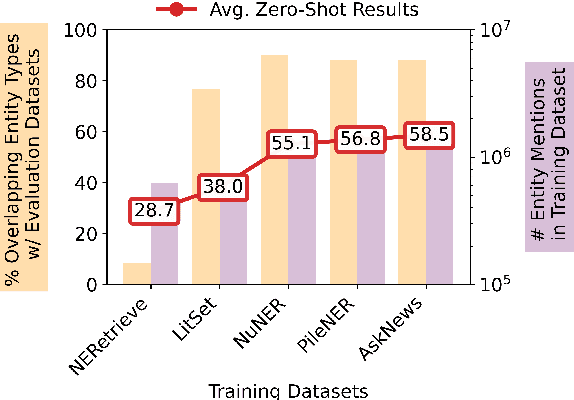
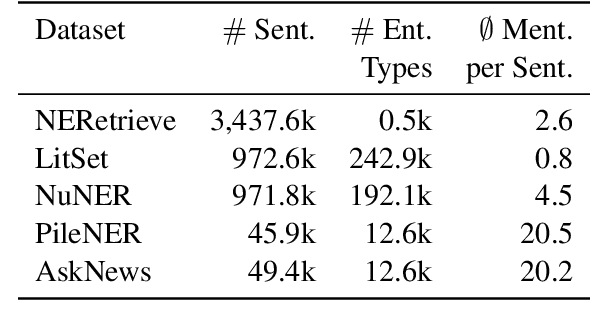
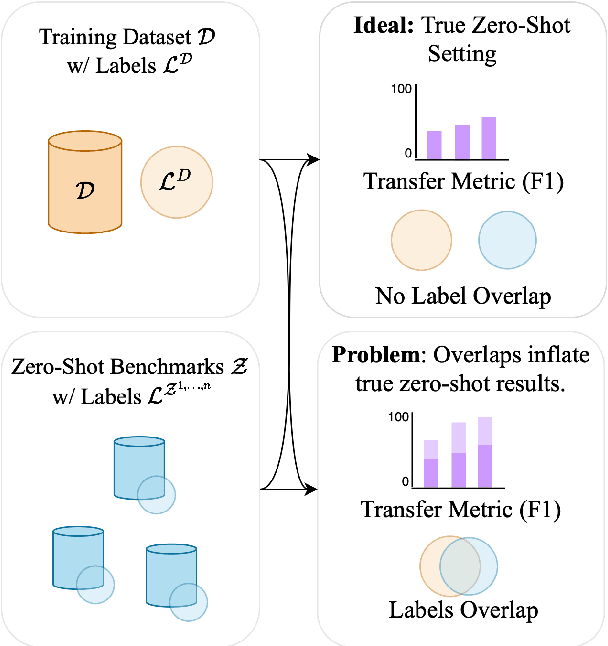
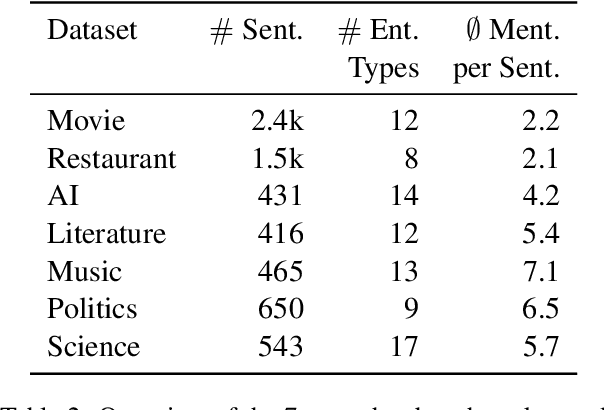
Zero-shot named entity recognition (NER) is the task of detecting named entities of specific types (such as 'Person' or 'Medicine') without any training examples. Current research increasingly relies on large synthetic datasets, automatically generated to cover tens of thousands of distinct entity types, to train zero-shot NER models. However, in this paper, we find that these synthetic datasets often contain entity types that are semantically highly similar to (or even the same as) those in standard evaluation benchmarks. Because of this overlap, we argue that reported F1 scores for zero-shot NER overestimate the true capabilities of these approaches. Further, we argue that current evaluation setups provide an incomplete picture of zero-shot abilities since they do not quantify the label shift (i.e., the similarity of labels) between training and evaluation datasets. To address these issues, we propose Familiarity, a novel metric that captures both the semantic similarity between entity types in training and evaluation, as well as their frequency in the training data, to provide an estimate of label shift. It allows researchers to contextualize reported zero-shot NER scores when using custom synthetic training datasets. Further, it enables researchers to generate evaluation setups of various transfer difficulties for fine-grained analysis of zero-shot NER.
PECC: Problem Extraction and Coding Challenges
Apr 29, 2024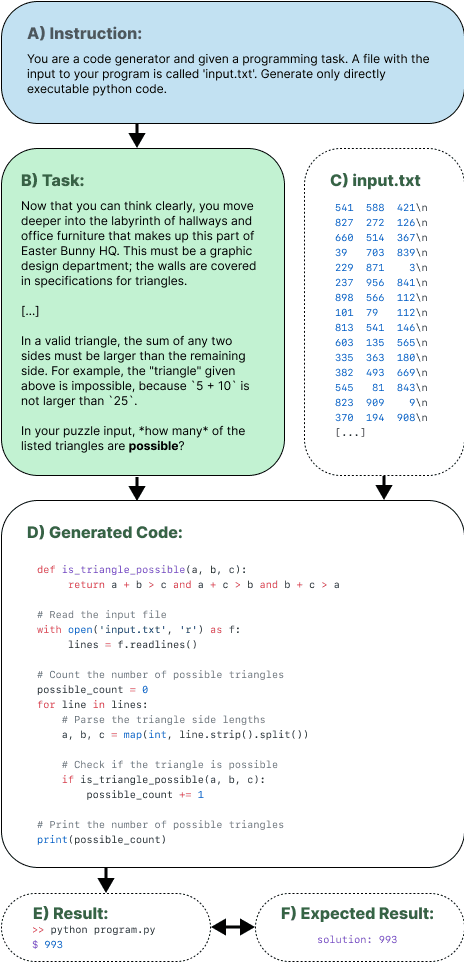
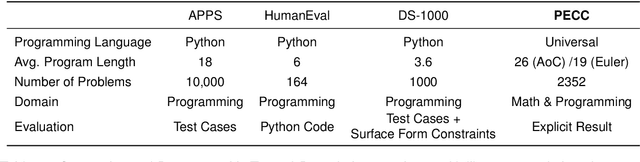
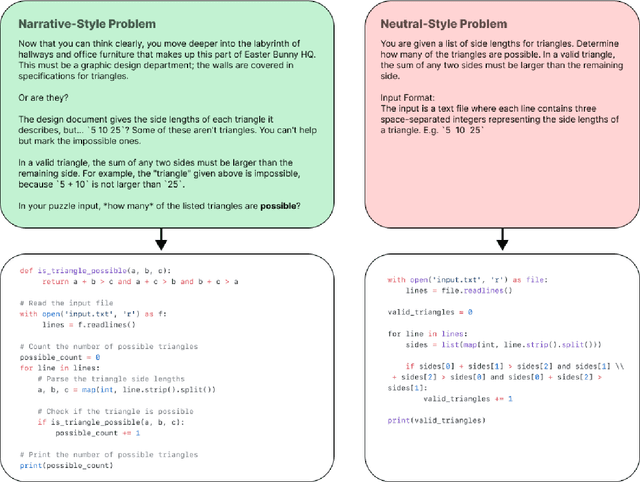
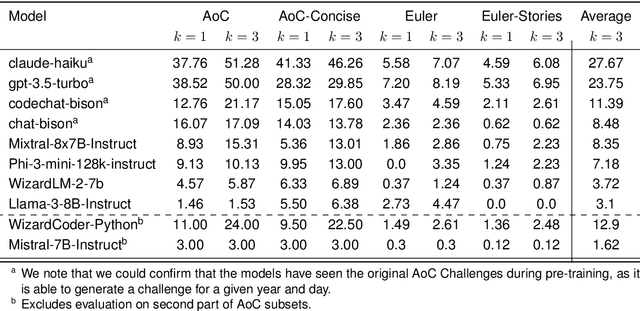
Recent advancements in large language models (LLMs) have showcased their exceptional abilities across various tasks, such as code generation, problem-solving and reasoning. Existing benchmarks evaluate tasks in isolation, yet the extent to which LLMs can understand prose-style tasks, identify the underlying problems, and then generate appropriate code solutions is still unexplored. Addressing this gap, we introduce PECC, a novel benchmark derived from Advent Of Code (AoC) challenges and Project Euler, including 2396 problems. Unlike conventional benchmarks, PECC requires LLMs to interpret narrative-embedded problems, extract requirements, and generate executable code. A key feature of our dataset is the complexity added by natural language prompting in chat-based evaluations, mirroring real-world instruction ambiguities. Results show varying model performance between narrative and neutral problems, with specific challenges in the Euler math-based subset with GPT-3.5-Turbo passing 50% of the AoC challenges and only 8% on the Euler problems. By probing the limits of LLMs' capabilities, our benchmark provides a framework to monitor and assess the subsequent progress of LLMs as a universal problem solver.
Large-Scale Label Interpretation Learning for Few-Shot Named Entity Recognition
Mar 21, 2024


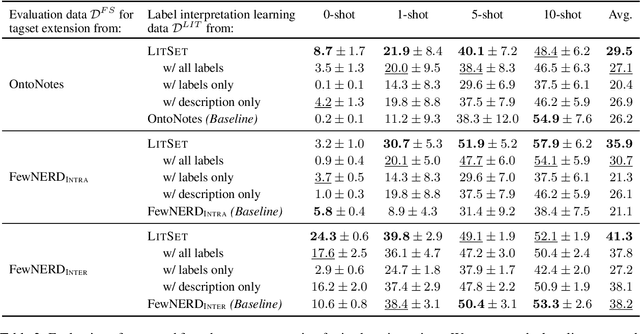
Few-shot named entity recognition (NER) detects named entities within text using only a few annotated examples. One promising line of research is to leverage natural language descriptions of each entity type: the common label PER might, for example, be verbalized as ''person entity.'' In an initial label interpretation learning phase, the model learns to interpret such verbalized descriptions of entity types. In a subsequent few-shot tagset extension phase, this model is then given a description of a previously unseen entity type (such as ''music album'') and optionally a few training examples to perform few-shot NER for this type. In this paper, we systematically explore the impact of a strong semantic prior to interpret verbalizations of new entity types by massively scaling up the number and granularity of entity types used for label interpretation learning. To this end, we leverage an entity linking benchmark to create a dataset with orders of magnitude of more distinct entity types and descriptions as currently used datasets. We find that this increased signal yields strong results in zero- and few-shot NER in in-domain, cross-domain, and even cross-lingual settings. Our findings indicate significant potential for improving few-shot NER through heuristical data-based optimization.