 Add to Chrome
 Add to Firefox
 Add to Edge
AISPA: User-Centric System Prompt Auditing for Large Language Model Applications
Jul 30, 2026
System prompts are instructions configured by developers to govern the behaviors of foundation models in AI applications. They are used throughout commercial AI products, but are rarely disclosed to the public or regulators, creating a serious trust and accountability gap in the wide deployment of AI systems. In this paper, we introduce Artificial Intelligence System Prompt Assurance (AISPA), a user-centric framework for systematically auditing system prompts in AI systems. AISPA examines specific parts of a system prompt and evaluates them along eight dimensions that matter to users. We then use this framework to review 3,249 instructions from system prompts in 88 commercial AI products, classifying each instruction as either protective (of users) or problematic. Our audit surfaces four core findings. First, system prompt design varies substantially across products and developers, with some organizations averaging over 60 protective instructions per product while others average fewer than 5. Second, protective instructions are widely adopted but shallow in scope: 98.9% of products contain at least one, yet only 24% cover all eight dimensions of the AISPA taxonomy. Third, system prompts have grown steadily longer and more protective of users, suggesting that user protection is becoming a more visible concern in commercial prompt design. Fourth, despite this progress, problematic instructions remain pervasive: roughly 40% of products contain at least one instruction that works against user interests, and protective and problematic instructions frequently coexist within the same prompt. Our findings highlight the need for greater transparency, standardization, and independent oversight for system prompts in commercial AI products.

Can AI agents conduct open-ended AI research? Early evidence from two case studies
Jul 29, 2026Forecasts of explosive AI progress hinge on AI agents automating AI research. But evidence on whether agents can carry out open-ended AI research is thin. Current evaluations either test agents on narrow, verifiable tasks, which excludes open-ended research, or submit AI-generated papers to blind peer review, which is overstretched, stochastic, and suffers from poor review quality. We introduce a third way to measure progress towards AI R\&D automation. An agent takes on the central, open-ended research question of a high-quality unpublished paper, and the paper's original authors grade its output. We call these shadow evaluations. We ran shadow evaluations on two unpublished NeurIPS 2026 submissions, giving frontier agents six days and thousands of dollars of compute. The agents completed all of the engineering without human help, yet could not make substantial progress towards answering the research questions. As a result, both papers were unambiguously rejected by the authors. We identify five recurring failure modes: poor judgment about the bar for publishable research, uncreative responses to shortcomings in the research design, ineffective backtracking from dead ends, poor resource awareness, and instruction drift. A robustness check with a second model and scaffold reproduced these failures. We release the expert reviews, survey responses, agent repositories, and logs. Our results provide early evidence that today's agents can do the engineering of AI research, but struggle with critical parts of the research lifecycle.
FLARE-AI: Flaw Reporting for AI
Jun 30, 2026Flaw reporting for deployed AI systems is fundamental to identifying system failures and improving AI safety. Yet the AI reporting ecosystem is fragmented: researchers who identify flaws often do not know what or where to report, and groups who receive reports rarely share them with other relevant stakeholders. As a result, good-faith reporters duplicate effort by submitting many different forms, and recipients lack standardized, triage-ready information. We audit 12 reporting systems published by AI developers, cybersecurity groups, and AI flaw aggregators, identifying five recurring design challenges spanning discoverability, scope, information collection, coordination, and guidance for strict-liability cases. Building on this analysis and feedback from 49 experts across 32 organizations representing developers, security researchers, and ecosystem coordinators, we introduce FLARE-AI, an open-source AI flaw reporting system designed for interoperability with existing systems. FLARE-AI streamlines flaw report creation by collecting triage-relevant information through conditional logic and early classification, then enables optional dissemination of standardized, machine-readable reports to multiple developers, coordinators, and incident registries from a single submission. By lowering barriers to reporting AI flaws and improving interoperability across stakeholders, FLARE-AI helps break down silos and accelerate remediation across the AI ecosystem.
Algorithmic Monocultures in Hiring
May 26, 2026Many employers screen job applicants with algorithms built by the same few algorithm vendors. We hypothesize that algorithmic monoculture leads to the same individuals and members of the same racial groups facing rejection. We acquire and analyze a novel dataset of 3 million applicants submitting 4 million applications where all the applications are screened by algorithms built by the same vendor. We find clear racial disparities in applicant outcomes. Of all applications submitted by Asian and Black applicants, 14.74% and 25.87% are submitted to positions that adversely impact Asian and Black applicants, respectively, according to U.S. employment discrimination standards. Individuals also receive homogeneous outcomes: 4% of all applicants who apply to 10 positions are recommended for rejection from all positions, a rate higher than expected by chance. To better understand this homogeneity, we leverage the deterministic replicability of hiring algorithms to generate the outcomes applicants would have received if they applied to all positions. We show that applicants would need to apply widely in order to ensure their applications are considered by a human
Open-World Evaluations for Measuring Frontier AI Capabilities
May 19, 2026Benchmark-based evaluation remains important for tracking frontier AI progress. But it can both overstate and understate deployed capability because it privileges tasks that can be precisely specified, automatically graded, easy to optimize for, and run with low budgets and short time horizons. We advocate for a complementary class of evaluations, which we term open-world evaluations: long-horizon, messy, real-world tasks assessed through small-sample qualitative analysis rather than benchmark-scale automation. In this paper we survey recent open-world evaluations, identify their strengths and limitations, and introduce CRUX (Collaborative Research for Updating AI eXpectations), a project for conducting such evaluations regularly. As a first instance, we task an AI agent with developing and publishing a simple iOS application to the Apple App Store. The agent completed the task with only a single avoidable manual intervention, suggesting that open-world evaluations can provide early warning of capabilities that may soon become widespread. We conclude with recommendations for designing and reporting open-world evals.
Reliable and Responsible Foundation Models: A Comprehensive Survey
Feb 04, 2026Foundation models, including Large Language Models (LLMs), Multimodal Large Language Models (MLLMs), Image Generative Models (i.e, Text-to-Image Models and Image-Editing Models), and Video Generative Models, have become essential tools with broad applications across various domains such as law, medicine, education, finance, science, and beyond. As these models see increasing real-world deployment, ensuring their reliability and responsibility has become critical for academia, industry, and government. This survey addresses the reliable and responsible development of foundation models. We explore critical issues, including bias and fairness, security and privacy, uncertainty, explainability, and distribution shift. Our research also covers model limitations, such as hallucinations, as well as methods like alignment and Artificial Intelligence-Generated Content (AIGC) detection. For each area, we review the current state of the field and outline concrete future research directions. Additionally, we discuss the intersections between these areas, highlighting their connections and shared challenges. We hope our survey fosters the development of foundation models that are not only powerful but also ethical, trustworthy, reliable, and socially responsible.
The Limits of AI Data Transparency Policy: Three Disclosure Fallacies
Jan 26, 2026Data transparency has emerged as a rallying cry for addressing concerns about AI: data quality, privacy, and copyright chief among them. Yet while these calls are crucial for accountability, current transparency policies often fall short of their intended aims. Similar to nutrition facts for food, policies aimed at nutrition facts for AI currently suffer from a limited consideration of research on effective disclosures. We offer an institutional perspective and identify three common fallacies in policy implementations of data disclosures for AI. First, many data transparency proposals exhibit a specification gap between the stated goals of data transparency and the actual disclosures necessary to achieve such goals. Second, reform attempts exhibit an enforcement gap between required disclosures on paper and enforcement to ensure compliance in fact. Third, policy proposals manifest an impact gap between disclosed information and meaningful changes in developer practices and public understanding. Informed by the social science on transparency, our analysis identifies affirmative paths for transparency that are effective rather than merely symbolic.
The 2025 Foundation Model Transparency Index
Dec 11, 2025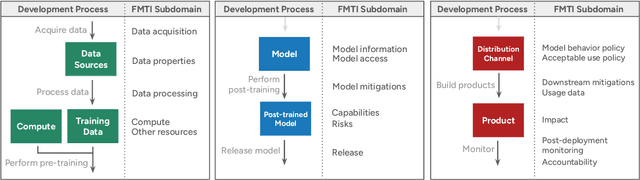
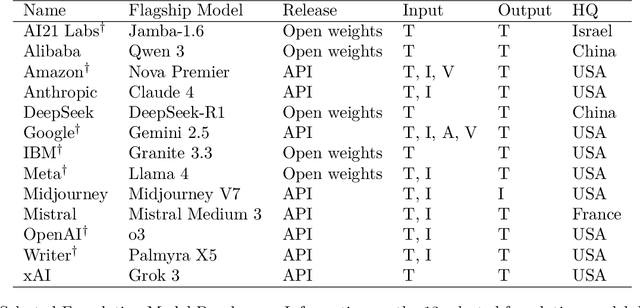
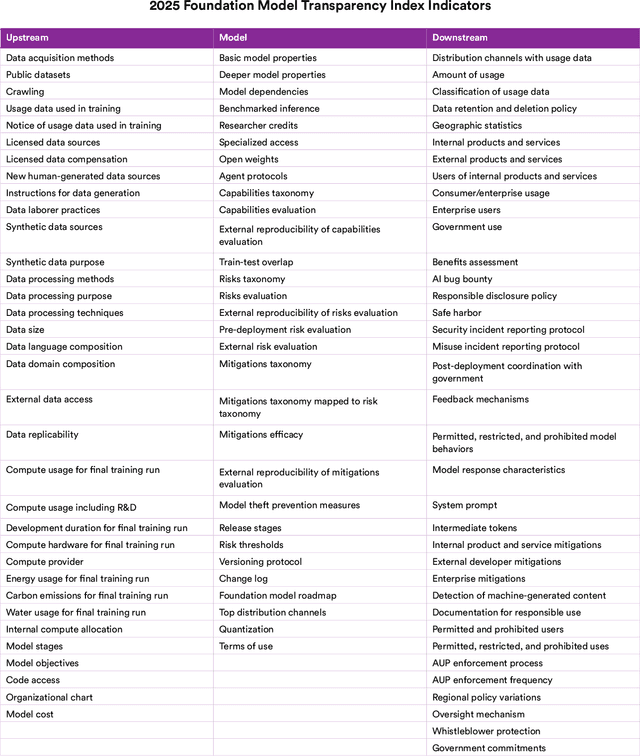
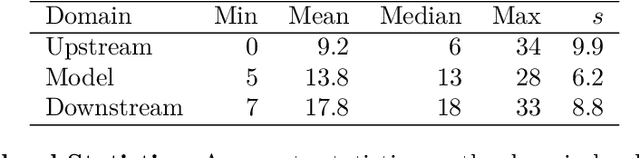
Foundation model developers are among the world's most important companies. As these companies become increasingly consequential, how do their transparency practices evolve? The 2025 Foundation Model Transparency Index is the third edition of an annual effort to characterize and quantify the transparency of foundation model developers. The 2025 FMTI introduces new indicators related to data acquisition, usage data, and monitoring and evaluates companies like Alibaba, DeepSeek, and xAI for the first time. The 2024 FMTI reported that transparency was improving, but the 2025 FMTI finds this progress has deteriorated: the average score out of 100 fell from 58 in 2024 to 40 in 2025. Companies are most opaque about their training data and training compute as well as the post-deployment usage and impact of their flagship models. In spite of this general trend, IBM stands out as a positive outlier, scoring 95, in contrast to the lowest scorers, xAI and Midjourney, at just 14. The five members of the Frontier Model Forum we score end up in the middle of the Index: we posit that these companies avoid reputational harms from low scores but lack incentives to be transparency leaders. As policymakers around the world increasingly mandate certain types of transparency, this work reveals the current state of transparency for foundation model developers, how it may change given newly enacted policy, and where more aggressive policy interventions are necessary to address critical information deficits.
Do AI Companies Make Good on Voluntary Commitments to the White House?
Aug 11, 2025Voluntary commitments are central to international AI governance, as demonstrated by recent voluntary guidelines from the White House to the G7, from Bletchley Park to Seoul. How do major AI companies make good on their commitments? We score companies based on their publicly disclosed behavior by developing a detailed rubric based on their eight voluntary commitments to the White House in 2023. We find significant heterogeneity: while the highest-scoring company (OpenAI) scores a 83% overall on our rubric, the average score across all companies is just 52%. The companies demonstrate systemically poor performance for their commitment to model weight security with an average score of 17%: 11 of the 16 companies receive 0% for this commitment. Our analysis highlights a clear structural shortcoming that future AI governance initiatives should correct: when companies make public commitments, they should proactively disclose how they meet their commitments to provide accountability, and these disclosures should be verifiable. To advance policymaking on corporate AI governance, we provide three directed recommendations that address underspecified commitments, the role of complex AI supply chains, and public transparency that could be applied towards AI governance initiatives worldwide.
Toward an Evaluation Science for Generative AI Systems
Mar 07, 2025There is an increasing imperative to anticipate and understand the performance and safety of generative AI systems in real-world deployment contexts. However, the current evaluation ecosystem is insufficient: Commonly used static benchmarks face validity challenges, and ad hoc case-by-case audits rarely scale. In this piece, we advocate for maturing an evaluation science for generative AI systems. While generative AI creates unique challenges for system safety engineering and measurement science, the field can draw valuable insights from the development of safety evaluation practices in other fields, including transportation, aerospace, and pharmaceutical engineering. In particular, we present three key lessons: Evaluation metrics must be applicable to real-world performance, metrics must be iteratively refined, and evaluation institutions and norms must be established. Applying these insights, we outline a concrete path toward a more rigorous approach for evaluating generative AI systems.