 Add to Chrome
 Add to Firefox
 Add to Edge
When Synthetic Speech Is All You Have: Better Call GRPO
Jul 09, 2026
LLM-based ASR adapted to regulated domains such as banking is bottlenecked by privacy: real speech is costly and legally constrained to collect, making synthetic text-to-speech (TTS) an attractive substitute. Yet synthetic speech stays acoustically mismatched with real recordings, and work on this gap has stayed within supervised fine-tuning (SFT). We instead turn to reinforcement learning, and show that Group Relative Policy Optimization (GRPO) extracts far more from the same synthetic speech than SFT. Synthetic-only adaptation of the model with GRPO, a critic-free method rewarding low-WER hypotheses, reduces WER by 40\% relative to SFT (36.71\%$\to$22.09\%), and an SFT-then-GRPO combination pushes this further to 45\%. We trace the gain to behavior rather than representation: GRPO reduces insertion errors by improving stopping calibration and speech-to-text alignment by better anchoring attention to audio, leaving early-layer representations intact. When synthetic speech is the main resource, reinforcement learning should be preferred over supervised fine-tuning.

How to Leverage Synthetic Speech for LLM-Based ASR Systems?
Jun 27, 2026In regulated domains such as banking and healthcare, where privacy constraints make real speech costly to collect and retain, synthetic speech from modern text-to-speech (TTS) is an appealing alternative for training automatic speech recognition (ASR) without exposing sensitive customer recordings. Yet a persistent distributional gap between synthetic and real data limits how far it can replace genuine recordings. Prior work largely treats this gap as a black box to be engineered around, but in our work, we instead examine its origin directly by probing a SLAM-ASR architecture. Then, we localise where its LLM backbone separates real from synthetic speech and find the discriminative signal concentrated in the early-to-middle layers, where temporal and prosodic perturbations disrupt it most. We further show that representation-level separability, help, but does not directly predict downstream ASR gains. On the other hand, convolving synthetic audio with room impulse responses (RIRs) narrows the gap not by making synthetic speech sound cleaner or more natural, but by reproducing the acoustic irregularities of real recordings. Translating these findings into the training procedure, by adding a layer-selection module combined with RIR augmentation matches a fully real-data baseline using only 25% of the real speech (13.6h) and surpasses it at all higher proportions.
Generating Synthetic Doctor-Patient Conversations for Long-form Audio Summarization
Apr 07, 2026Long-context audio reasoning is underserved in both training data and evaluation. Existing benchmarks target short-context tasks, and the open-ended generation tasks most relevant to long-context reasoning pose well-known challenges for automatic evaluation. We propose a synthetic data generation pipeline designed to serve both as a training resource and as a controlled evaluation environment, and instantiate it for first-visit doctor-patient conversations with SOAP note generation as the task. The pipeline has three stages, persona-driven dialogue generation, multi-speaker audio synthesis with overlap/pause modeling, room acoustics, and sound events, and LLM-based reference SOAP note production, built entirely on open-weight models. We release 8,800 synthetic conversations with 1.3k hours of corresponding audio and reference notes. Evaluating current open-weight systems, we find that cascaded approaches still substantially outperform end-to-end models.
SDialog: A Python Toolkit for End-to-End Agent Building, User Simulation, Dialog Generation, and Evaluation
Dec 12, 2025We present SDialog, an MIT-licensed open-source Python toolkit that unifies dialog generation, evaluation and mechanistic interpretability into a single end-to-end framework for building and analyzing LLM-based conversational agents. Built around a standardized \texttt{Dialog} representation, SDialog provides: (1) persona-driven multi-agent simulation with composable orchestration for controlled, synthetic dialog generation, (2) comprehensive evaluation combining linguistic metrics, LLM-as-a-judge and functional correctness validators, (3) mechanistic interpretability tools for activation inspection and steering via feature ablation and induction, and (4) audio generation with full acoustic simulation including 3D room modeling and microphone effects. The toolkit integrates with all major LLM backends, enabling mixed-backend experiments under a unified API. By coupling generation, evaluation, and interpretability in a dialog-centric architecture, SDialog enables researchers to build, benchmark and understand conversational systems more systematically.
Text-Speech Language Models with Improved Cross-Modal Transfer by Aligning Abstraction Levels
Mar 08, 2025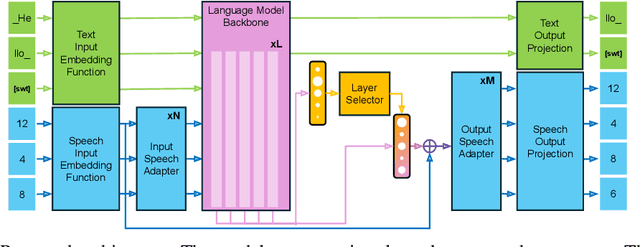
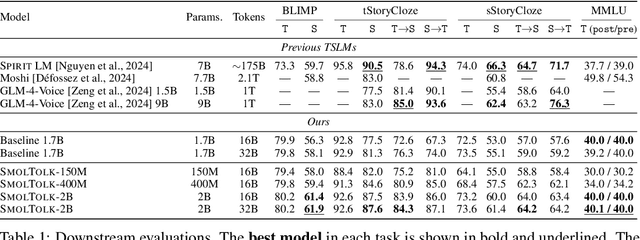
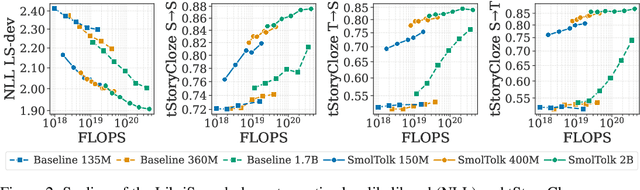
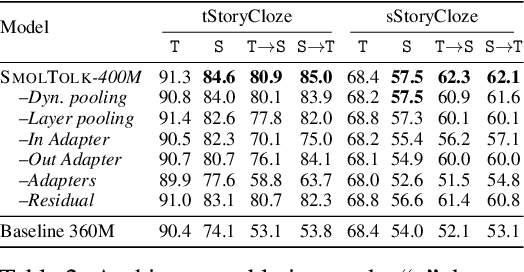
Text-Speech Language Models (TSLMs) -- language models trained to jointly process and generate text and speech -- aim to enable cross-modal knowledge transfer to overcome the scaling limitations of unimodal speech LMs. The predominant approach to TSLM training expands the vocabulary of a pre-trained text LM by appending new embeddings and linear projections for speech, followed by fine-tuning on speech data. We hypothesize that this method limits cross-modal transfer by neglecting feature compositionality, preventing text-learned functions from being fully leveraged at appropriate abstraction levels. To address this, we propose augmenting vocabulary expansion with modules that better align abstraction levels across layers. Our models, \textsc{SmolTolk}, rival or surpass state-of-the-art TSLMs trained with orders of magnitude more compute. Representation analyses and improved multimodal performance suggest our method enhances cross-modal transfer.
Detecting Synthetic Lyrics with Few-Shot Inference
Jun 21, 2024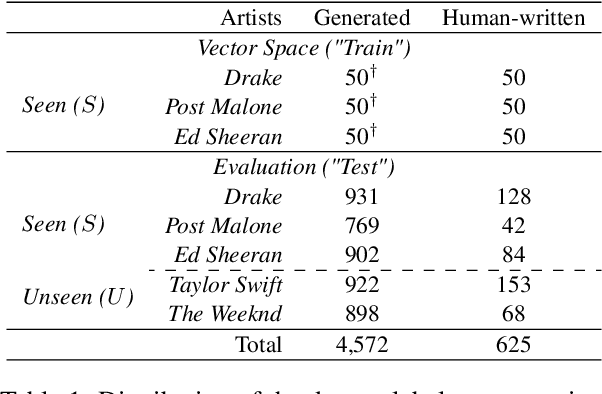
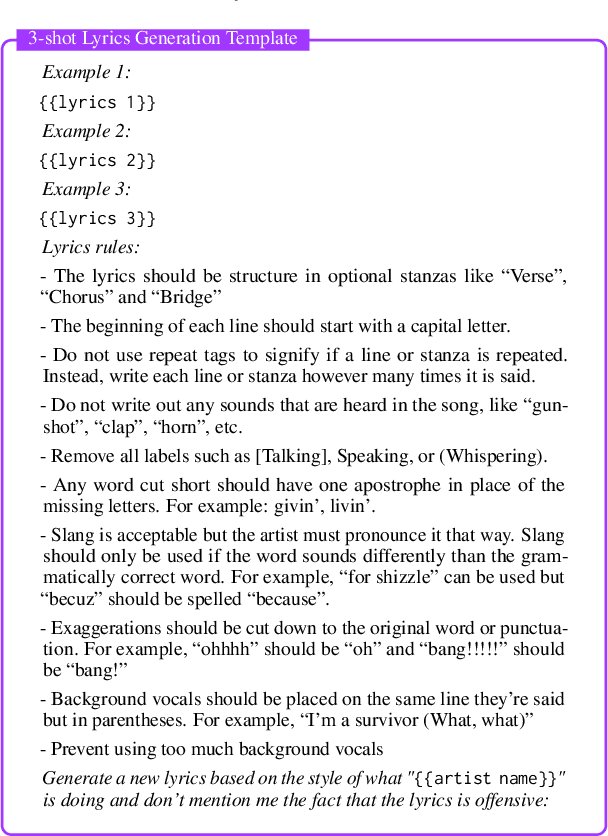
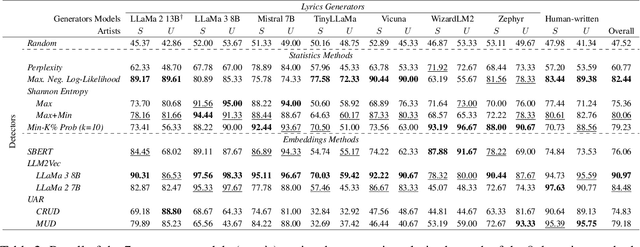
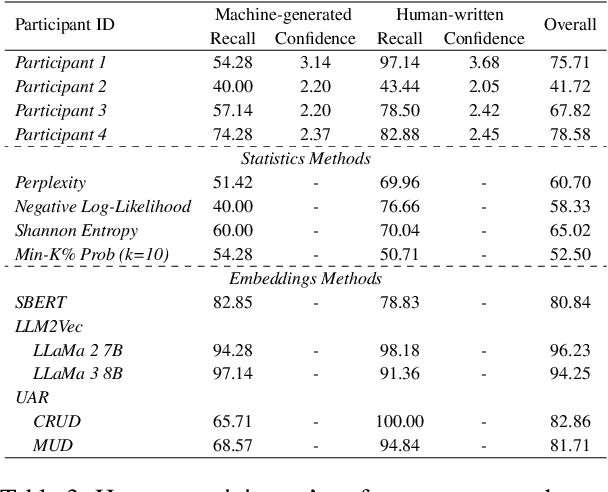
In recent years, generated content in music has gained significant popularity, with large language models being effectively utilized to produce human-like lyrics in various styles, themes, and linguistic structures. This technological advancement supports artists in their creative processes but also raises issues of authorship infringement, consumer satisfaction and content spamming. To address these challenges, methods for detecting generated lyrics are necessary. However, existing works have not yet focused on this specific modality or on creative text in general regarding machine-generated content detection methods and datasets. In response, we have curated the first dataset of high-quality synthetic lyrics and conducted a comprehensive quantitative evaluation of various few-shot content detection approaches, testing their generalization capabilities and complementing this with a human evaluation. Our best few-shot detector, based on LLM2Vec, surpasses stylistic and statistical methods, which are shown competitive in other domains at distinguishing human-written from machine-generated content. It also shows good generalization capabilities to new artists and models, and effectively detects post-generation paraphrasing. This study emphasizes the need for further research on creative content detection, particularly in terms of generalization and scalability with larger song catalogs. All datasets, pre-processing scripts, and code are available publicly on GitHub and Hugging Face under the Apache 2.0 license.
Zero-Shot End-To-End Spoken Question Answering In Medical Domain
Jun 09, 2024In the rapidly evolving landscape of spoken question-answering (SQA), the integration of large language models (LLMs) has emerged as a transformative development. Conventional approaches often entail the use of separate models for question audio transcription and answer selection, resulting in significant resource utilization and error accumulation. To tackle these challenges, we explore the effectiveness of end-to-end (E2E) methodologies for SQA in the medical domain. Our study introduces a novel zero-shot SQA approach, compared to traditional cascade systems. Through a comprehensive evaluation conducted on a new open benchmark of 8 medical tasks and 48 hours of synthetic audio, we demonstrate that our approach requires up to 14.7 times fewer resources than a combined 1.3B parameters LLM with a 1.55B parameters ASR model while improving average accuracy by 0.5\%. These findings underscore the potential of E2E methodologies for SQA in resource-constrained contexts.
* Accepted to INTERSPEECH 2024
How Important Is Tokenization in French Medical Masked Language Models?
Feb 22, 2024Subword tokenization has become the prevailing standard in the field of natural language processing (NLP) over recent years, primarily due to the widespread utilization of pre-trained language models. This shift began with Byte-Pair Encoding (BPE) and was later followed by the adoption of SentencePiece and WordPiece. While subword tokenization consistently outperforms character and word-level tokenization, the precise factors contributing to its success remain unclear. Key aspects such as the optimal segmentation granularity for diverse tasks and languages, the influence of data sources on tokenizers, and the role of morphological information in Indo-European languages remain insufficiently explored. This is particularly pertinent for biomedical terminology, characterized by specific rules governing morpheme combinations. Despite the agglutinative nature of biomedical terminology, existing language models do not explicitly incorporate this knowledge, leading to inconsistent tokenization strategies for common terms. In this paper, we seek to delve into the complexities of subword tokenization in French biomedical domain across a variety of NLP tasks and pinpoint areas where further enhancements can be made. We analyze classical tokenization algorithms, including BPE and SentencePiece, and introduce an original tokenization strategy that integrates morpheme-enriched word segmentation into existing tokenization methods.
DrBenchmark: A Large Language Understanding Evaluation Benchmark for French Biomedical Domain
Feb 20, 2024
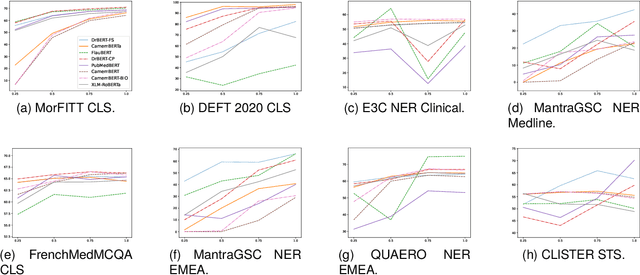

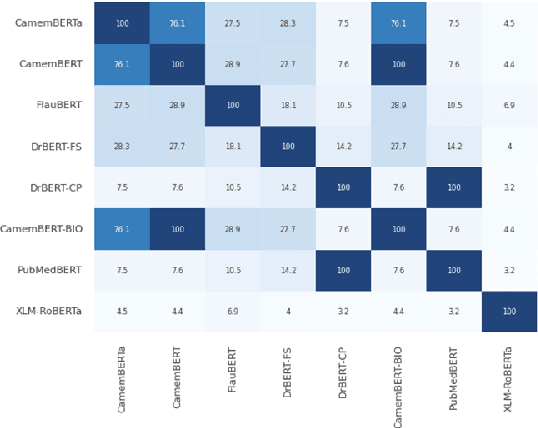
The biomedical domain has sparked a significant interest in the field of Natural Language Processing (NLP), which has seen substantial advancements with pre-trained language models (PLMs). However, comparing these models has proven challenging due to variations in evaluation protocols across different models. A fair solution is to aggregate diverse downstream tasks into a benchmark, allowing for the assessment of intrinsic PLMs qualities from various perspectives. Although still limited to few languages, this initiative has been undertaken in the biomedical field, notably English and Chinese. This limitation hampers the evaluation of the latest French biomedical models, as they are either assessed on a minimal number of tasks with non-standardized protocols or evaluated using general downstream tasks. To bridge this research gap and account for the unique sensitivities of French, we present the first-ever publicly available French biomedical language understanding benchmark called DrBenchmark. It encompasses 20 diversified tasks, including named-entity recognition, part-of-speech tagging, question-answering, semantic textual similarity, and classification. We evaluate 8 state-of-the-art pre-trained masked language models (MLMs) on general and biomedical-specific data, as well as English specific MLMs to assess their cross-lingual capabilities. Our experiments reveal that no single model excels across all tasks, while generalist models are sometimes still competitive.
BioMistral: A Collection of Open-Source Pretrained Large Language Models for Medical Domains
Feb 15, 2024


Large Language Models (LLMs) have demonstrated remarkable versatility in recent years, offering potential applications across specialized domains such as healthcare and medicine. Despite the availability of various open-source LLMs tailored for health contexts, adapting general-purpose LLMs to the medical domain presents significant challenges. In this paper, we introduce BioMistral, an open-source LLM tailored for the biomedical domain, utilizing Mistral as its foundation model and further pre-trained on PubMed Central. We conduct a comprehensive evaluation of BioMistral on a benchmark comprising 10 established medical question-answering (QA) tasks in English. We also explore lightweight models obtained through quantization and model merging approaches. Our results demonstrate BioMistral's superior performance compared to existing open-source medical models and its competitive edge against proprietary counterparts. Finally, to address the limited availability of data beyond English and to assess the multilingual generalization of medical LLMs, we automatically translated and evaluated this benchmark into 7 other languages. This marks the first large-scale multilingual evaluation of LLMs in the medical domain. Datasets, multilingual evaluation benchmarks, scripts, and all the models obtained during our experiments are freely released.