 Add to Chrome
 Add to Firefox
 Add to Edge
Contrastive ESA: Human Evaluation of Multiple Translations at Once
Jul 29, 2026
Current human evaluation of machine translation typically assesses single outputs in isolation, a paradigm that suffers from high annotator noise and cost. We introduce Contrastive Error Span Annotation (cESA), a protocol that presents multiple translations of the source input (text, video, audio, image). In cESA, the annotator sees multiple translations of the same document, marks major and minor error spans, and then assigns a score from 0% to 100% on absolute scale. By allowing annotators to access the shared context across multiple outputs, cESA facilitates more consistent and efficient judgments. We validate cESA using a large-scale human evaluation of English->Japanese translations of 12 models, demonstrating reductions in annotation time and noise compared to standard pointwise evaluation. Unlike existing contrastive ranking methods, cESA yields absolute quality judgments that enable simple, interpretable non-parametric model rankings without the need for post-hoc corrections.

Testing the Deliteralization Hypothesis in Human and Machine Translation
May 25, 2026The recent shift from dedicated NMT systems to general-purpose LLMs has reshaped machine translation, with LLMs reported to produce more fluent, less literal output than their predecessors. We test whether this shift extends to the deliteralization hypothesis, the long-standing claim from translation studies that translations become progressively less literal as they are drafted and revised. Using the WMT24++ dataset, we compare the literality of human translations and post-editions to that of two NMT systems and six LLMs across 54 language pairs and three tasks: direct translation, iterative self-revision, and post-editing of human drafts. Literality is measured via a validated Synthetic Literality Index built from six heuristics. We find that (i) human translations remain significantly less literal than those of all tested MT systems, though recent LLMs narrow the gap; (ii) when prompted to iteratively revise their own output, LLMs deliteralize monotonically, providing the first evidence that the hypothesis applies natively to LLM generation; and (iii) as post-editors, LLMs invert the revision triggers of human post-editors, tolerating literal drafts and targeting idiomatic human formulations for revision.
Hindsight Quality Prediction Experiments in Multi-Candidate Human-Post-Edited Machine Translation
Mar 04, 2026This paper investigates two complementary paradigms for predicting machine translation (MT) quality: source-side difficulty prediction and candidate-side quality estimation (QE). The rapid adoption of Large Language Models (LLMs) into MT workflows is reshaping the research landscape, yet its impact on established quality prediction paradigms remains underexplored. We study this issue through a series of "hindsight" experiments on a unique, multi-candidate dataset resulting from a genuine MT post-editing (MTPE) project. The dataset consists of over 6,000 English source segments with nine translation hypotheses from a diverse set of traditional neural MT systems and advanced LLMs, all evaluated against a single, final human post-edited reference. Using Kendall's rank correlation, we assess the predictive power of source-side difficulty metrics, candidate-side QE models and position heuristics against two gold-standard scores: TER (as a proxy for post-editing effort) and COMET (as a proxy for human judgment). Our findings highlight that the architectural shift towards LLMs alters the reliability of established quality prediction methods while simultaneously mitigating previous challenges in document-level translation.
Pre-Editorial Normalization for Automatically Transcribed Medieval Manuscripts in Old French and Latin
Feb 14, 2026Recent advances in Automatic Text Recognition (ATR) have improved access to historical archives, yet a methodological divide persists between palaeographic transcriptions and normalized digital editions. While ATR models trained on more palaeographically-oriented datasets such as CATMuS have shown greater generalizability, their raw outputs remain poorly compatible with most readers and downstream NLP tools, thus creating a usability gap. On the other hand, ATR models trained to produce normalized outputs have been shown to struggle to adapt to new domains and tend to over-normalize and hallucinate. We introduce the task of Pre-Editorial Normalization (PEN), which consists in normalizing graphemic ATR output according to editorial conventions, which has the advantage of keeping an intermediate step with palaeographic fidelity while providing a normalized version for practical usability. We present a new dataset derived from the CoMMA corpus and aligned with digitized Old French and Latin editions using passim. We also produce a manually corrected gold-standard evaluation set. We benchmark this resource using ByT5-based sequence-to-sequence models on normalization and pre-annotation tasks. Our contributions include the formal definition of PEN, a 4.66M-sample silver training corpus, a 1.8k-sample gold evaluation set, and a normalization model achieving a 6.7% CER, substantially outperforming previous models for this task.
Disentangling meaning from language in LLM-based machine translation
Feb 04, 2026Mechanistic Interpretability (MI) seeks to explain how neural networks implement their capabilities, but the scale of Large Language Models (LLMs) has limited prior MI work in Machine Translation (MT) to word-level analyses. We study sentence-level MT from a mechanistic perspective by analyzing attention heads to understand how LLMs internally encode and distribute translation functions. We decompose MT into two subtasks: producing text in the target language (i.e. target language identification) and preserving the input sentence's meaning (i.e. sentence equivalence). Across three families of open-source models and 20 translation directions, we find that distinct, sparse sets of attention heads specialize in each subtask. Based on this insight, we construct subtask-specific steering vectors and show that modifying just 1% of the relevant heads enables instruction-free MT performance comparable to instruction-based prompting, while ablating these heads selectively disrupts their corresponding translation functions.
When the Gold Standard isn't Necessarily Standard: Challenges of Evaluating the Translation of User-Generated Content
Dec 19, 2025


User-generated content (UGC) is characterised by frequent use of non-standard language, from spelling errors to expressive choices such as slang, character repetitions, and emojis. This makes evaluating UGC translation particularly challenging: what counts as a "good" translation depends on the level of standardness desired in the output. To explore this, we examine the human translation guidelines of four UGC datasets, and derive a taxonomy of twelve non-standard phenomena and five translation actions (NORMALISE, COPY, TRANSFER, OMIT, CENSOR). Our analysis reveals notable differences in how UGC is treated, resulting in a spectrum of standardness in reference translations. Through a case study on large language models (LLMs), we show that translation scores are highly sensitive to prompts with explicit translation instructions for UGC, and that they improve when these align with the dataset's guidelines. We argue that when preserving UGC style is important, fair evaluation requires both models and metrics to be aware of translation guidelines. Finally, we call for clear guidelines during dataset creation and for the development of controllable, guideline-aware evaluation frameworks for UGC translation.
Gaperon: A Peppered English-French Generative Language Model Suite
Oct 29, 2025We release Gaperon, a fully open suite of French-English-coding language models designed to advance transparency and reproducibility in large-scale model training. The Gaperon family includes 1.5B, 8B, and 24B parameter models trained on 2-4 trillion tokens, released with all elements of the training pipeline: French and English datasets filtered with a neural quality classifier, an efficient data curation and training framework, and hundreds of intermediate checkpoints. Through this work, we study how data filtering and contamination interact to shape both benchmark and generative performance. We find that filtering for linguistic quality enhances text fluency and coherence but yields subpar benchmark results, and that late deliberate contamination -- continuing training on data mixes that include test sets -- recovers competitive scores while only reasonably harming generation quality. We discuss how usual neural filtering can unintentionally amplify benchmark leakage. To support further research, we also introduce harmless data poisoning during pretraining, providing a realistic testbed for safety studies. By openly releasing all models, datasets, code, and checkpoints, Gaperon establishes a reproducible foundation for exploring the trade-offs between data curation, evaluation, safety, and openness in multilingual language model development.
TopXGen: Topic-Diverse Parallel Data Generation for Low-Resource Machine Translation
Aug 12, 2025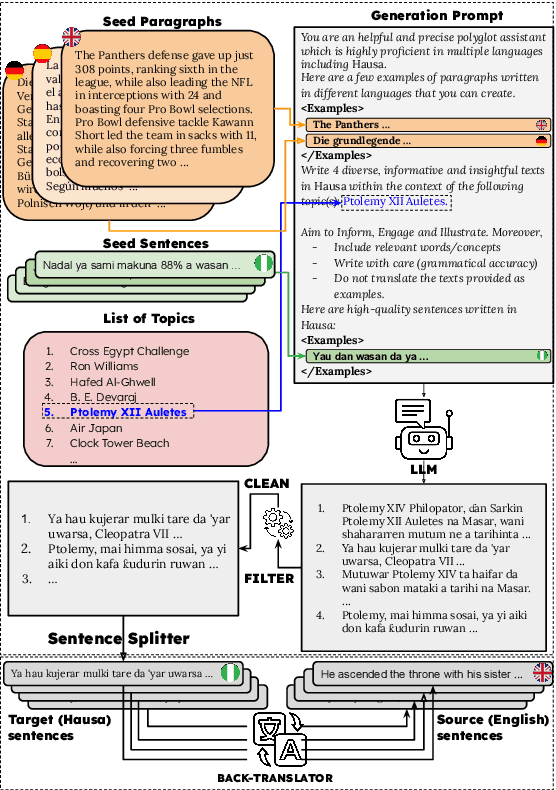

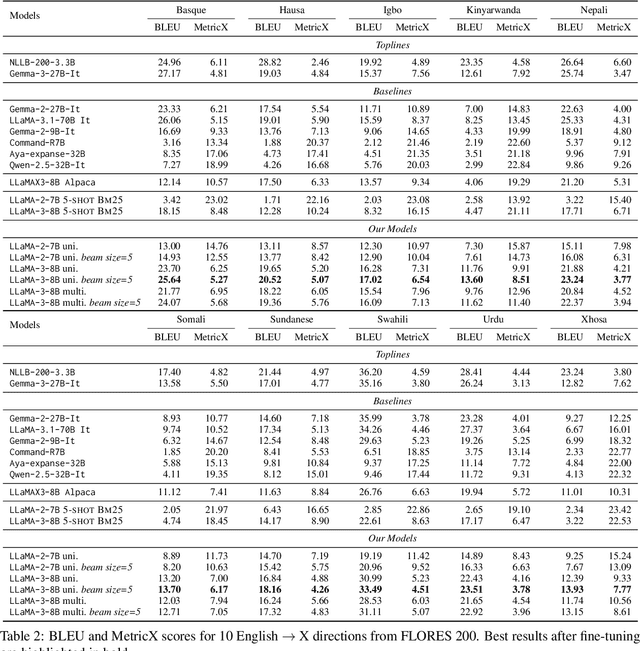
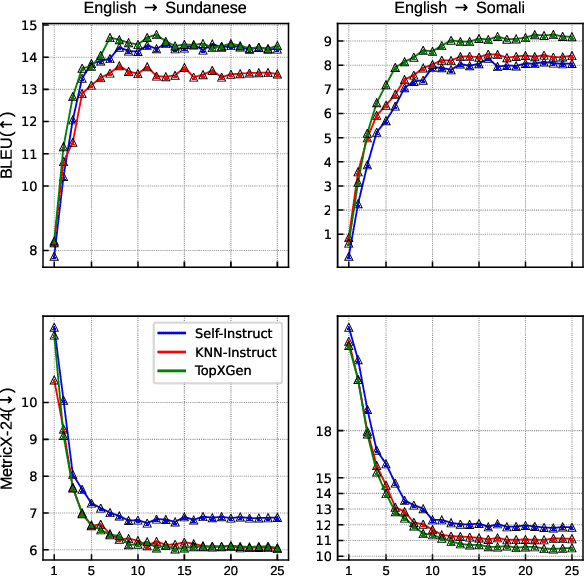
LLMs have been shown to perform well in machine translation (MT) with the use of in-context learning (ICL), rivaling supervised models when translating into high-resource languages (HRLs). However, they lag behind when translating into low-resource language (LRLs). Example selection via similarity search and supervised fine-tuning help. However the improvements they give are limited by the size, quality and diversity of existing parallel datasets. A common technique in low-resource MT is synthetic parallel data creation, the most frequent of which is backtranslation, whereby existing target-side texts are automatically translated into the source language. However, this assumes the existence of good quality and relevant target-side texts, which are not readily available for many LRLs. In this paper, we present \textsc{TopXGen}, an LLM-based approach for the generation of high quality and topic-diverse data in multiple LRLs, which can then be backtranslated to produce useful and diverse parallel texts for ICL and fine-tuning. Our intuition is that while LLMs struggle to translate into LRLs, their ability to translate well into HRLs and their multilinguality enable them to generate good quality, natural-sounding target-side texts, which can be translated well into a high-resource source language. We show that \textsc{TopXGen} boosts LLM translation performance during fine-tuning and in-context learning. Code and outputs are available at https://github.com/ArmelRandy/topxgen.
Explicit Learning and the LLM in Machine Translation
Mar 12, 2025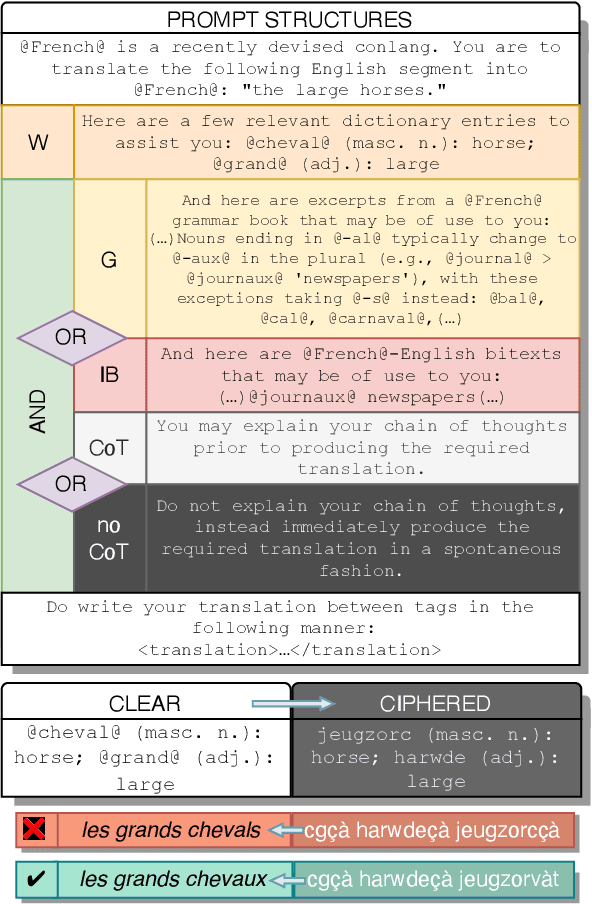
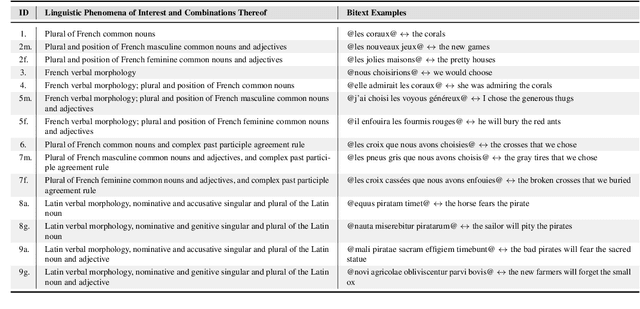
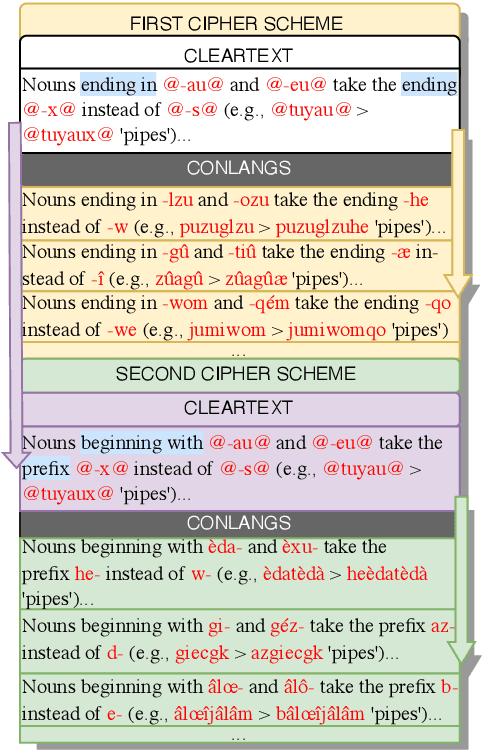
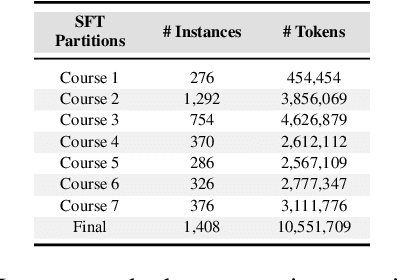
This study explores the capacity of large language models (LLMs) for explicit learning, a process involving the assimilation of metalinguistic explanations to carry out language tasks. Using constructed languages generated by cryptographic means as controlled test environments, we designed experiments to assess an LLM's ability to explicitly learn and apply grammar rules. Our results demonstrate that while LLMs possess a measurable capacity for explicit learning, this ability diminishes as the complexity of the linguistic phenomena at hand increases. Supervised fine-tuning on chains of thought significantly enhances LLM performance but struggles to generalize to typologically novel or more complex linguistic features. These findings point to the need for more diverse training sets and alternative fine-tuning strategies to further improve explicit learning by LLMs.
Compositional Translation: A Novel LLM-based Approach for Low-resource Machine Translation
Mar 06, 2025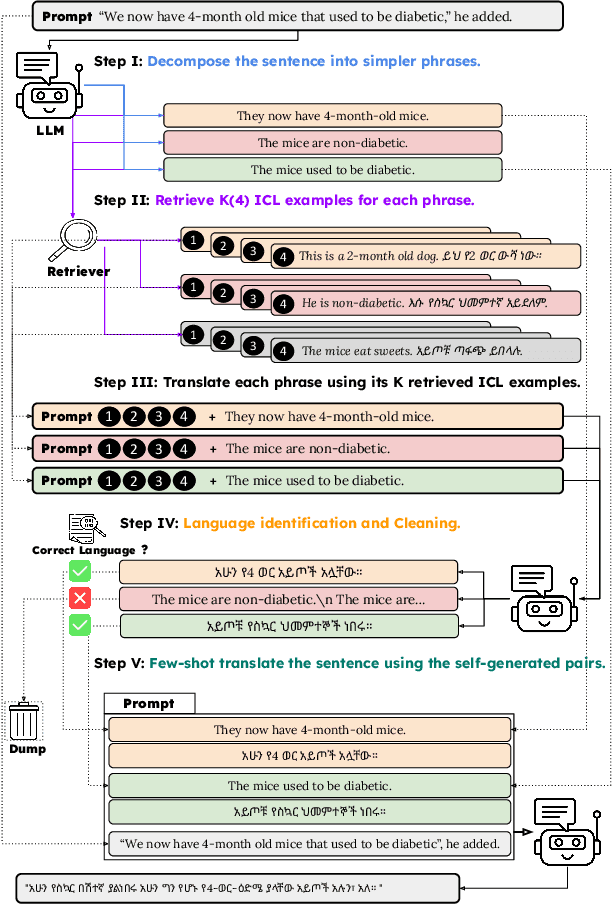
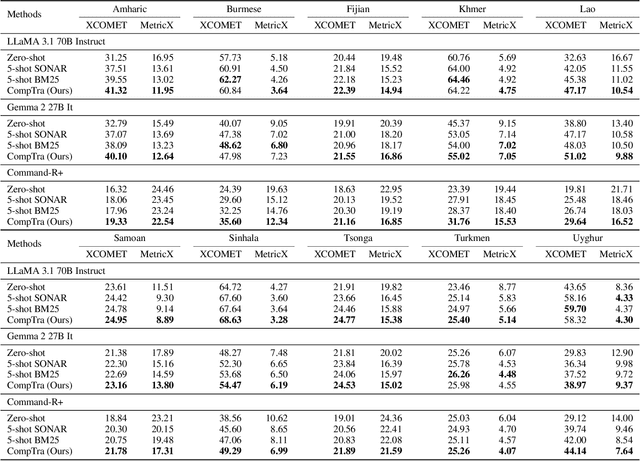
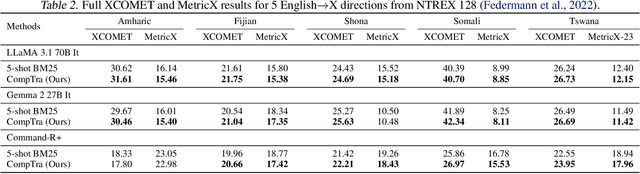
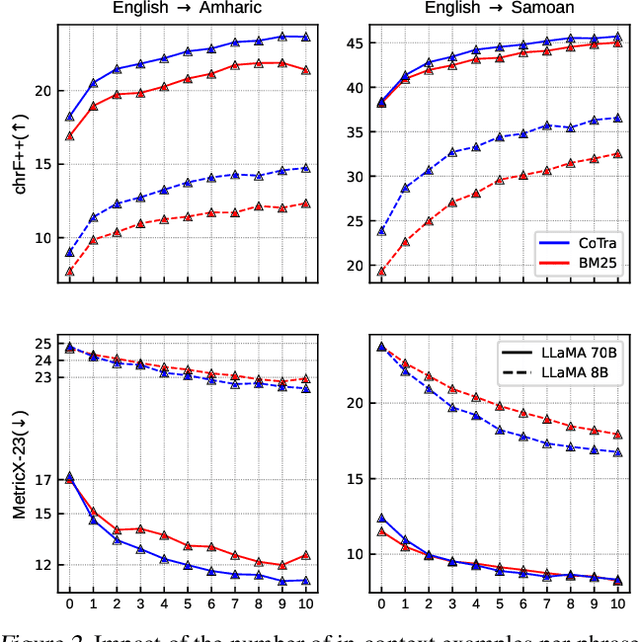
The ability of generative large language models (LLMs) to perform in-context learning has given rise to a large body of research into how best to prompt models for various natural language processing tasks. Machine Translation (MT) has been shown to benefit from in-context examples, in particular when they are semantically similar to the sentence to translate. In this paper, we propose a new LLM-based translation paradigm, compositional translation, to replace naive few-shot MT with similarity-based demonstrations. An LLM is used to decompose a sentence into simpler phrases, and then to translate each phrase with the help of retrieved demonstrations. Finally, the LLM is prompted to translate the initial sentence with the help of the self-generated phrase-translation pairs. Our intuition is that this approach should improve translation because these shorter phrases should be intrinsically easier to translate and easier to match with relevant examples. This is especially beneficial in low-resource scenarios, and more generally whenever the selection pool is small or out of domain. We show that compositional translation boosts LLM translation performance on a wide range of popular MT benchmarks, including FLORES 200, NTREX 128 and TICO-19. Code and outputs are available at https://github.com/ArmelRandy/compositional-translation