 Add to Chrome
 Add to Firefox
 Add to Edge
AIRA_2: Overcoming Bottlenecks in AI Research Agents
Mar 27, 2026
Existing research has identified three structural performance bottlenecks in AI research agents: (1) synchronous single-GPU execution constrains sample throughput, limiting the benefit of search; (2) a generalization gap where validation-based selection causes performance to degrade over extended search horizons; and (3) the limited capability of fixed, single-turn LLM operators imposes a ceiling on search performance. We introduce AIRA$_2$, which addresses these bottlenecks through three architectural choices: an asynchronous multi-GPU worker pool that increases experiment throughput linearly; a Hidden Consistent Evaluation protocol that delivers a reliable evaluation signal; and ReAct agents that dynamically scope their actions and debug interactively. On MLE-bench-30, AIRA$_2$ achieves a mean Percentile Rank of 71.8% at 24 hours - surpassing the previous best of 69.9% - and steadily improves to 76.0% at 72 hours. Ablation studies reveal that each component is necessary and that the "overfitting" reported in prior work was driven by evaluation noise rather than true data memorization.

Hyperagents
Mar 19, 2026Self-improving AI systems aim to reduce reliance on human engineering by learning to improve their own learning and problem-solving processes. Existing approaches to self-improvement rely on fixed, handcrafted meta-level mechanisms, fundamentally limiting how fast such systems can improve. The Darwin Gödel Machine (DGM) demonstrates open-ended self-improvement in coding by repeatedly generating and evaluating self-modified variants. Because both evaluation and self-modification are coding tasks, gains in coding ability can translate into gains in self-improvement ability. However, this alignment does not generally hold beyond coding domains. We introduce \textbf{hyperagents}, self-referential agents that integrate a task agent (which solves the target task) and a meta agent (which modifies itself and the task agent) into a single editable program. Crucially, the meta-level modification procedure is itself editable, enabling metacognitive self-modification, improving not only the task-solving behavior, but also the mechanism that generates future improvements. We instantiate this framework by extending DGM to create DGM-Hyperagents (DGM-H), eliminating the assumption of domain-specific alignment between task performance and self-modification skill to potentially support self-accelerating progress on any computable task. Across diverse domains, the DGM-H improves performance over time and outperforms baselines without self-improvement or open-ended exploration, as well as prior self-improving systems. Furthermore, the DGM-H improves the process by which it generates new agents (e.g., persistent memory, performance tracking), and these meta-level improvements transfer across domains and accumulate across runs. DGM-Hyperagents offer a glimpse of open-ended AI systems that do not merely search for better solutions, but continually improve their search for how to improve.
APRES: An Agentic Paper Revision and Evaluation System
Mar 03, 2026Scientific discoveries must be communicated clearly to realize their full potential. Without effective communication, even the most groundbreaking findings risk being overlooked or misunderstood. The primary way scientists communicate their work and receive feedback from the community is through peer review. However, the current system often provides inconsistent feedback between reviewers, ultimately hindering the improvement of a manuscript and limiting its potential impact. In this paper, we introduce a novel method APRES powered by Large Language Models (LLMs) to update a scientific papers text based on an evaluation rubric. Our automated method discovers a rubric that is highly predictive of future citation counts, and integrate it with APRES in an automated system that revises papers to enhance their quality and impact. Crucially, this objective should be met without altering the core scientific content. We demonstrate the success of APRES, which improves future citation prediction by 19.6% in mean averaged error over the next best baseline, and show that our paper revision process yields papers that are preferred over the originals by human expert evaluators 79% of the time. Our findings provide strong empirical support for using LLMs as a tool to help authors stress-test their manuscripts before submission. Ultimately, our work seeks to augment, not replace, the essential role of human expert reviewers, for it should be humans who discern which discoveries truly matter, guiding science toward advancing knowledge and enriching lives.
AIRS-Bench: a Suite of Tasks for Frontier AI Research Science Agents
Feb 09, 2026LLM agents hold significant promise for advancing scientific research. To accelerate this progress, we introduce AIRS-Bench (the AI Research Science Benchmark), a suite of 20 tasks sourced from state-of-the-art machine learning papers. These tasks span diverse domains, including language modeling, mathematics, bioinformatics, and time series forecasting. AIRS-Bench tasks assess agentic capabilities over the full research lifecycle -- including idea generation, experiment analysis and iterative refinement -- without providing baseline code. The AIRS-Bench task format is versatile, enabling easy integration of new tasks and rigorous comparison across different agentic frameworks. We establish baselines using frontier models paired with both sequential and parallel scaffolds. Our results show that agents exceed human SOTA in four tasks but fail to match it in sixteen others. Even when agents surpass human benchmarks, they do not reach the theoretical performance ceiling for the underlying tasks. These findings indicate that AIRS-Bench is far from saturated and offers substantial room for improvement. We open-source the AIRS-Bench task definitions and evaluation code to catalyze further development in autonomous scientific research.
The Llama 4 Herd: Architecture, Training, Evaluation, and Deployment Notes
Jan 15, 2026This document consolidates publicly reported technical details about Metas Llama 4 model family. It summarizes (i) released variants (Scout and Maverick) and the broader herd context including the previewed Behemoth teacher model, (ii) architectural characteristics beyond a high-level MoE description covering routed/shared-expert structure, early-fusion multimodality, and long-context design elements reported for Scout (iRoPE and length generalization strategies), (iii) training disclosures spanning pre-training, mid-training for long-context extension, and post-training methodology (lightweight SFT, online RL, and lightweight DPO) as described in release materials, (iv) developer-reported benchmark results for both base and instruction-tuned checkpoints, and (v) practical deployment constraints observed across major serving environments, including provider-specific context limits and quantization packaging. The manuscript also summarizes licensing obligations relevant to redistribution and derivative naming, and reviews publicly described safeguards and evaluation practices. The goal is to provide a compact technical reference for researchers and practitioners who need precise, source-backed facts about Llama 4.
What Does It Take to Be a Good AI Research Agent? Studying the Role of Ideation Diversity
Nov 19, 2025AI research agents offer the promise to accelerate scientific progress by automating the design, implementation, and training of machine learning models. However, the field is still in its infancy, and the key factors driving the success or failure of agent trajectories are not fully understood. We examine the role that ideation diversity plays in agent performance. First, we analyse agent trajectories on MLE-bench, a well-known benchmark to evaluate AI research agents, across different models and agent scaffolds. Our analysis reveals that different models and agent scaffolds yield varying degrees of ideation diversity, and that higher-performing agents tend to have increased ideation diversity. Further, we run a controlled experiment where we modify the degree of ideation diversity, demonstrating that higher ideation diversity results in stronger performance. Finally, we strengthen our results by examining additional evaluation metrics beyond the standard medal-based scoring of MLE-bench, showing that our findings still hold across other agent performance metrics.
Souper-Model: How Simple Arithmetic Unlocks State-of-the-Art LLM Performance
Nov 17, 2025Large Language Models (LLMs) have demonstrated remarkable capabilities across diverse domains, but their training remains resource- and time-intensive, requiring massive compute power and careful orchestration of training procedures. Model souping-the practice of averaging weights from multiple models of the same architecture-has emerged as a promising pre- and post-training technique that can enhance performance without expensive retraining. In this paper, we introduce Soup Of Category Experts (SoCE), a principled approach for model souping that utilizes benchmark composition to identify optimal model candidates and applies non-uniform weighted averaging to maximize performance. Contrary to previous uniform-averaging approaches, our method leverages the observation that benchmark categories often exhibit low inter-correlations in model performance. SoCE identifies "expert" models for each weakly-correlated category cluster and combines them using optimized weighted averaging rather than uniform weights. We demonstrate that the proposed method improves performance and robustness across multiple domains, including multilingual capabilities, tool calling, and math and achieves state-of-the-art results on the Berkeley Function Calling Leaderboard.
AI Research Agents for Machine Learning: Search, Exploration, and Generalization in MLE-bench
Jul 03, 2025AI research agents are demonstrating great potential to accelerate scientific progress by automating the design, implementation, and training of machine learning models. We focus on methods for improving agents' performance on MLE-bench, a challenging benchmark where agents compete in Kaggle competitions to solve real-world machine learning problems. We formalize AI research agents as search policies that navigate a space of candidate solutions, iteratively modifying them using operators. By designing and systematically varying different operator sets and search policies (Greedy, MCTS, Evolutionary), we show that their interplay is critical for achieving high performance. Our best pairing of search strategy and operator set achieves a state-of-the-art result on MLE-bench lite, increasing the success rate of achieving a Kaggle medal from 39.6% to 47.7%. Our investigation underscores the importance of jointly considering the search strategy, operator design, and evaluation methodology in advancing automated machine learning.
MLGym: A New Framework and Benchmark for Advancing AI Research Agents
Feb 20, 2025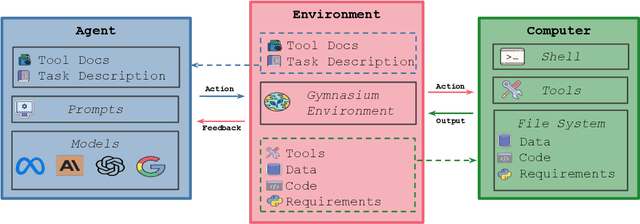


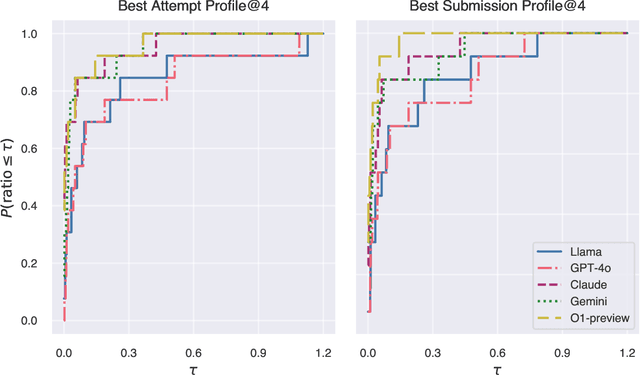
We introduce Meta MLGym and MLGym-Bench, a new framework and benchmark for evaluating and developing LLM agents on AI research tasks. This is the first Gym environment for machine learning (ML) tasks, enabling research on reinforcement learning (RL) algorithms for training such agents. MLGym-bench consists of 13 diverse and open-ended AI research tasks from diverse domains such as computer vision, natural language processing, reinforcement learning, and game theory. Solving these tasks requires real-world AI research skills such as generating new ideas and hypotheses, creating and processing data, implementing ML methods, training models, running experiments, analyzing the results, and iterating through this process to improve on a given task. We evaluate a number of frontier large language models (LLMs) on our benchmarks such as Claude-3.5-Sonnet, Llama-3.1 405B, GPT-4o, o1-preview, and Gemini-1.5 Pro. Our MLGym framework makes it easy to add new tasks, integrate and evaluate models or agents, generate synthetic data at scale, as well as develop new learning algorithms for training agents on AI research tasks. We find that current frontier models can improve on the given baselines, usually by finding better hyperparameters, but do not generate novel hypotheses, algorithms, architectures, or substantial improvements. We open-source our framework and benchmark to facilitate future research in advancing the AI research capabilities of LLM agents.
From MTEB to MTOB: Retrieval-Augmented Classification for Descriptive Grammars
Nov 23, 2024Recent advances in language modeling have demonstrated significant improvements in zero-shot capabilities, including in-context learning, instruction following, and machine translation for extremely under-resourced languages (Tanzer et al., 2024). However, many languages with limited written resources rely primarily on formal descriptions of grammar and vocabulary. In this paper, we introduce a set of benchmarks to evaluate how well models can extract and classify information from the complex descriptions found in linguistic grammars. We present a Retrieval-Augmented Generation (RAG)-based approach that leverages these descriptions for downstream tasks such as machine translation. Our benchmarks encompass linguistic descriptions for 248 languages across 142 language families, focusing on typological features from WALS and Grambank. This set of benchmarks offers the first comprehensive evaluation of language models' in-context ability to accurately interpret and extract linguistic features, providing a critical resource for scaling NLP to low-resource languages. The code and data are publicly available at \url{https://github.com/al-the-eigenvalue/RAG-on-grammars}.