 Add to Chrome
 Add to Firefox
 Add to Edge
Accelerating Diffusion Transformer via Gradient-Optimized Cache
Mar 07, 2025
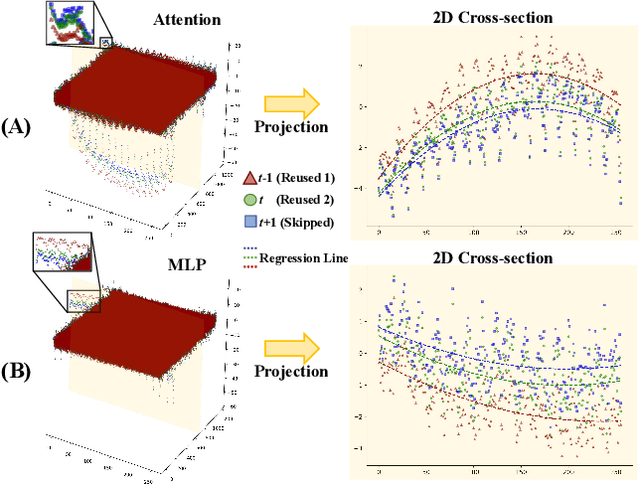
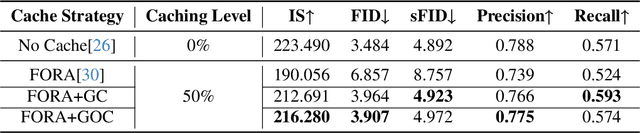
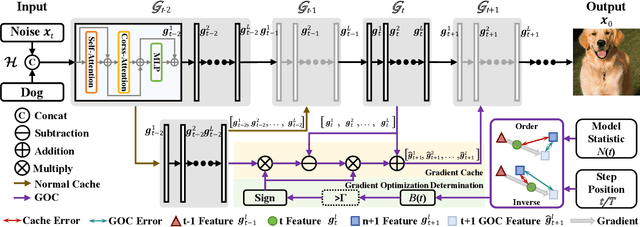
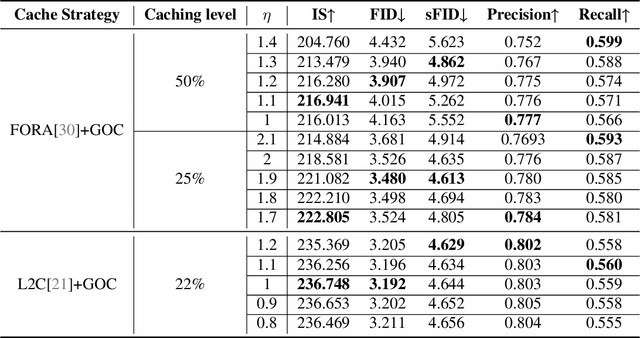
Feature caching has emerged as an effective strategy to accelerate diffusion transformer (DiT) sampling through temporal feature reuse. It is a challenging problem since (1) Progressive error accumulation from cached blocks significantly degrades generation quality, particularly when over 50\% of blocks are cached; (2) Current error compensation approaches neglect dynamic perturbation patterns during the caching process, leading to suboptimal error correction. To solve these problems, we propose the Gradient-Optimized Cache (GOC) with two key innovations: (1) Cached Gradient Propagation: A gradient queue dynamically computes the gradient differences between cached and recomputed features. These gradients are weighted and propagated to subsequent steps, directly compensating for the approximation errors introduced by caching. (2) Inflection-Aware Optimization: Through statistical analysis of feature variation patterns, we identify critical inflection points where the denoising trajectory changes direction. By aligning gradient updates with these detected phases, we prevent conflicting gradient directions during error correction. Extensive evaluations on ImageNet demonstrate GOC's superior trade-off between efficiency and quality. With 50\% cached blocks, GOC achieves IS 216.28 (26.3\% higher) and FID 3.907 (43\% lower) compared to baseline DiT, while maintaining identical computational costs. These improvements persist across various cache ratios, demonstrating robust adaptability to different acceleration requirements.

From Pixels to Trajectory: Universal Adversarial Example Detection via Temporal Imprints
Mar 06, 2025For the first time, we unveil discernible temporal (or historical) trajectory imprints resulting from adversarial example (AE) attacks. Standing in contrast to existing studies all focusing on spatial (or static) imprints within the targeted underlying victim models, we present a fresh temporal paradigm for understanding these attacks. Of paramount discovery is that these imprints are encapsulated within a single loss metric, spanning universally across diverse tasks such as classification and regression, and modalities including image, text, and audio. Recognizing the distinct nature of loss between adversarial and clean examples, we exploit this temporal imprint for AE detection by proposing TRAIT (TRaceable Adversarial temporal trajectory ImprinTs). TRAIT operates under minimal assumptions without prior knowledge of attacks, thereby framing the detection challenge as a one-class classification problem. However, detecting AEs is still challenged by significant overlaps between the constructed synthetic losses of adversarial and clean examples due to the absence of ground truth for incoming inputs. TRAIT addresses this challenge by converting the synthetic loss into a spectrum signature, using the technique of Fast Fourier Transform to highlight the discrepancies, drawing inspiration from the temporal nature of the imprints, analogous to time-series signals. Across 12 AE attacks including SMACK (USENIX Sec'2023), TRAIT demonstrates consistent outstanding performance across comprehensively evaluated modalities, tasks, datasets, and model architectures. In all scenarios, TRAIT achieves an AE detection accuracy exceeding 97%, often around 99%, while maintaining a false rejection rate of 1%. TRAIT remains effective under the formulated strong adaptive attacks.
Towards Universal Learning-based Model for Cardiac Image Reconstruction: Summary of the CMRxRecon2024 Challenge
Mar 05, 2025Cardiovascular magnetic resonance (CMR) offers diverse imaging contrasts for assessment of cardiac function and tissue characterization. However, acquiring each single CMR modality is often time-consuming, and comprehensive clinical protocols require multiple modalities with various sampling patterns, further extending the overall acquisition time and increasing susceptibility to motion artifacts. Existing deep learning-based reconstruction methods are often designed for specific acquisition parameters, which limits their ability to generalize across a variety of scan scenarios. As part of the CMRxRecon Series, the CMRxRecon2024 challenge provides diverse datasets encompassing multi-modality multi-view imaging with various sampling patterns, and a platform for the international community to develop and benchmark reconstruction solutions in two well-crafted tasks. Task 1 is a modality-universal setting, evaluating the out-of-distribution generalization of the reconstructed model, while Task 2 follows sampling-universal setting assessing the one-for-all adaptability of the universal model. Main contributions include providing the first and largest publicly available multi-modality, multi-view cardiac k-space dataset; developing a benchmarking platform that simulates clinical acceleration protocols, with a shared code library and tutorial for various k-t undersampling patterns and data processing; giving technical insights of enhanced data consistency based on physic-informed networks and adaptive prompt-learning embedding to be versatile to different clinical settings; additional finding on evaluation metrics to address the limitations of conventional ground-truth references in universal reconstruction tasks.
NeuGrasp: Generalizable Neural Surface Reconstruction with Background Priors for Material-Agnostic Object Grasp Detection
Mar 05, 2025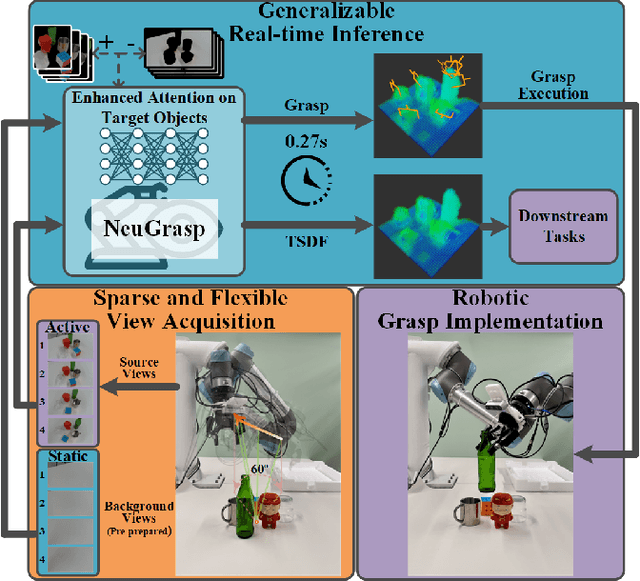
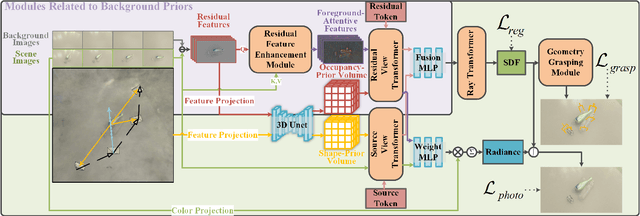
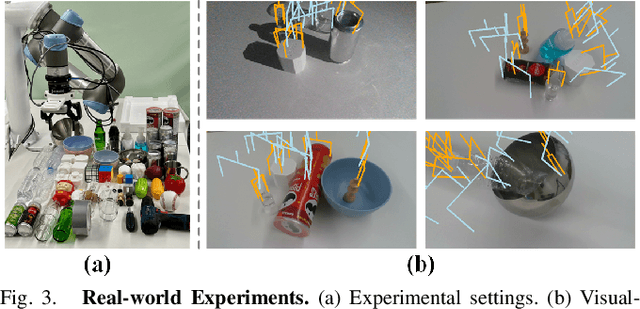
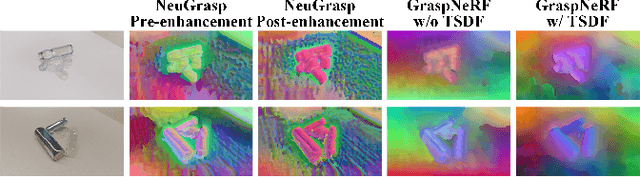
Robotic grasping in scenes with transparent and specular objects presents great challenges for methods relying on accurate depth information. In this paper, we introduce NeuGrasp, a neural surface reconstruction method that leverages background priors for material-agnostic grasp detection. NeuGrasp integrates transformers and global prior volumes to aggregate multi-view features with spatial encoding, enabling robust surface reconstruction in narrow and sparse viewing conditions. By focusing on foreground objects through residual feature enhancement and refining spatial perception with an occupancy-prior volume, NeuGrasp excels in handling objects with transparent and specular surfaces. Extensive experiments in both simulated and real-world scenarios show that NeuGrasp outperforms state-of-the-art methods in grasping while maintaining comparable reconstruction quality. More details are available at https://neugrasp.github.io/.
Time-Varying Coronary Artery Deformation: A Dynamic Skinning Framework for Surgical Training
Mar 04, 2025Purpose: This study proposes a novel anatomically-driven dynamic modeling framework for coronary arteries using skeletal skinning weights computation, aiming to achieve precise control over vessel deformation while maintaining real-time performance for surgical simulation applications. Methods: We developed a computational framework based on biharmonic energy minimization for skinning weight calculation, incorporating volumetric discretization through tetrahedral mesh generation. The method implements temporal sampling and interpolation for continuous vessel deformation throughout the cardiac cycle, with mechanical constraints and volume conservation enforcement. The framework was validated using clinical datasets from 5 patients, comparing interpolated deformation results against ground truth data obtained from frame-by-frame segmentation across cardiac phases. Results: The proposed framework effectively handled interactive vessel manipulation. Geometric accuracy evaluation showed mean Hausdorff distance of 4.96 +- 1.78 mm and mean surface distance of 1.78 +- 0.75 mm between interpolated meshes and ground truth models. The Branch Completeness Ratio achieved 1.82 +- 0.46, while Branch Continuity Score maintained 0.84 +- 0.06 (scale 0-1) across all datasets. The system demonstrated capability in supporting real-time guidewire-vessel collision detection and contrast medium flow simulation throughout the complete coronary tree structure. Conclusion: Our skinning weight-based methodology enhances model interactivity and applicability while maintaining geometric accuracy. The framework provides a more flexible technical foundation for virtual surgical training systems, demonstrating promising potential for both clinical practice and medical education applications. The code is available at https://github.com/ipoirot/DynamicArtery.
Pragmatic Inference Chain (PIC) Improving LLMs' Reasoning of Authentic Implicit Toxic Language
Mar 03, 2025The rapid development of large language models (LLMs) gives rise to ethical concerns about their performance, while opening new avenues for developing toxic language detection techniques. However, LLMs' unethical output and their capability of detecting toxicity have primarily been tested on language data that do not demand complex meaning inference, such as the biased associations of 'he' with programmer and 'she' with household. Nowadays toxic language adopts a much more creative range of implicit forms, thanks to advanced censorship. In this study, we collect authentic toxic interactions that evade online censorship and that are verified by human annotators as inference intensive. To evaluate and improve LLMs' reasoning of the authentic implicit toxic language, we propose a new prompting method, Pragmatic Inference Chain (PIC), drawn on interdisciplinary findings from cognitive science and linguistics. The PIC prompting significantly improves the success rate of GPT-4o, Llama-3.1-70B-Instruct, and DeepSeek-v2.5 in identifying implicit toxic language, compared to both direct prompting and Chain-of-Thought. In addition, it also facilitates the models to produce more explicit and coherent reasoning processes, hence can potentially be generalized to other inference-intensive tasks, e.g., understanding humour and metaphors.
Robust Polyp Detection and Diagnosis through Compositional Prompt-Guided Diffusion Models
Feb 25, 2025Colorectal cancer (CRC) is a significant global health concern, and early detection through screening plays a critical role in reducing mortality. While deep learning models have shown promise in improving polyp detection, classification, and segmentation, their generalization across diverse clinical environments, particularly with out-of-distribution (OOD) data, remains a challenge. Multi-center datasets like PolypGen have been developed to address these issues, but their collection is costly and time-consuming. Traditional data augmentation techniques provide limited variability, failing to capture the complexity of medical images. Diffusion models have emerged as a promising solution for generating synthetic polyp images, but the image generation process in current models mainly relies on segmentation masks as the condition, limiting their ability to capture the full clinical context. To overcome these limitations, we propose a Progressive Spectrum Diffusion Model (PSDM) that integrates diverse clinical annotations-such as segmentation masks, bounding boxes, and colonoscopy reports-by transforming them into compositional prompts. These prompts are organized into coarse and fine components, allowing the model to capture both broad spatial structures and fine details, generating clinically accurate synthetic images. By augmenting training data with PSDM-generated samples, our model significantly improves polyp detection, classification, and segmentation. For instance, on the PolypGen dataset, PSDM increases the F1 score by 2.12% and the mean average precision by 3.09%, demonstrating superior performance in OOD scenarios and enhanced generalization.
GSQ-Tuning: Group-Shared Exponents Integer in Fully Quantized Training for LLMs On-Device Fine-tuning
Feb 18, 2025Large Language Models (LLMs) fine-tuning technologies have achieved remarkable results. However, traditional LLM fine-tuning approaches face significant challenges: they require large Floating Point (FP) computation, raising privacy concerns when handling sensitive data, and are impractical for resource-constrained edge devices. While Parameter-Efficient Fine-Tuning (PEFT) techniques reduce trainable parameters, their reliance on floating-point arithmetic creates fundamental incompatibilities with edge hardware. In this work, we introduce a novel framework for on-device LLM fine-tuning that eliminates the need for floating-point operations in both inference and training, named GSQ-Tuning. At its core is the Group-Shared Exponents Integer format, which efficiently represents model parameters in integer format using shared exponents among parameter groups. When combined with LoRA-like adapters, this enables fully integer-based fine-tuning that is both memory and compute efficient. We demonstrate that our approach achieves accuracy comparable to FP16-based fine-tuning while significantly reducing memory usage (50%). Moreover, compared to FP8, our method can reduce 5x power consumption and 11x chip area with same performance, making large-scale model adaptation feasible on edge devices.
Exploring the Impact of Personality Traits on LLM Bias and Toxicity
Feb 18, 2025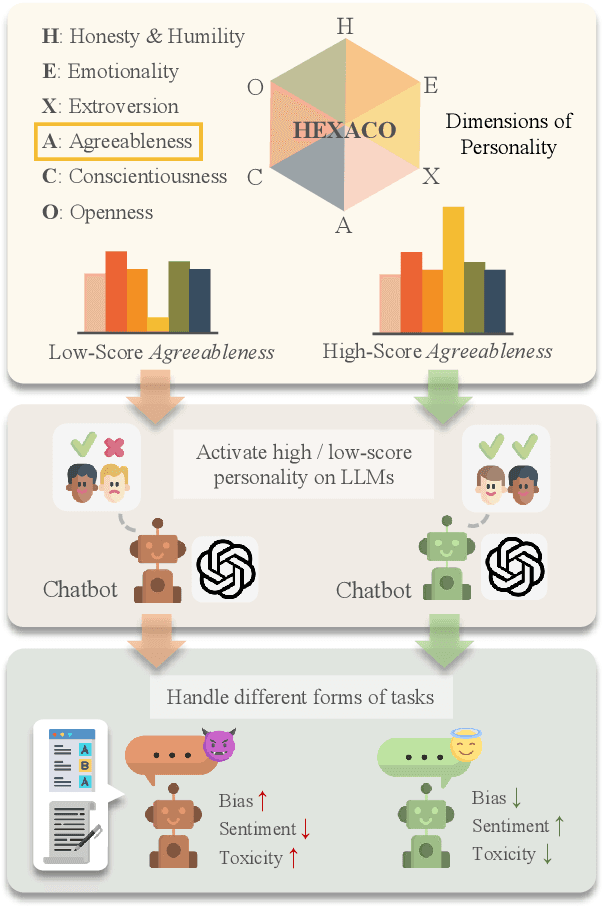
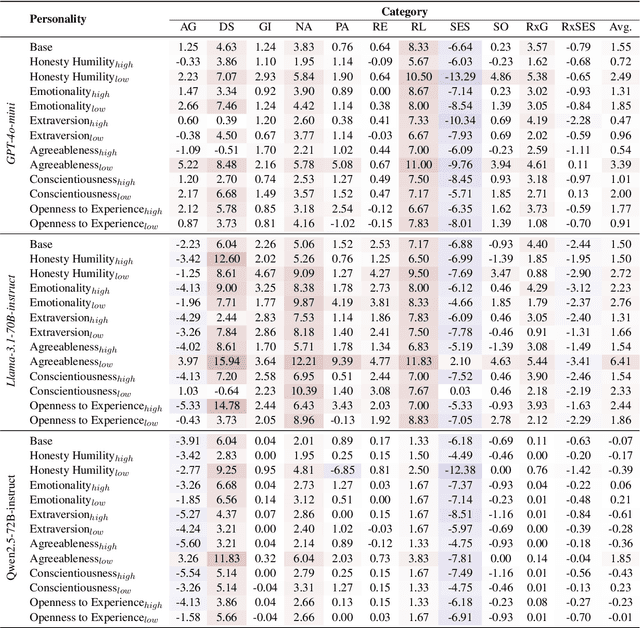
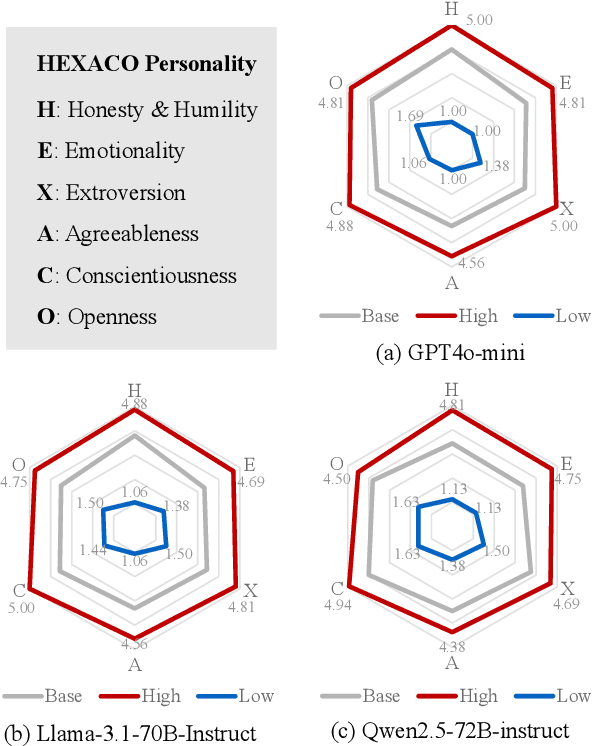
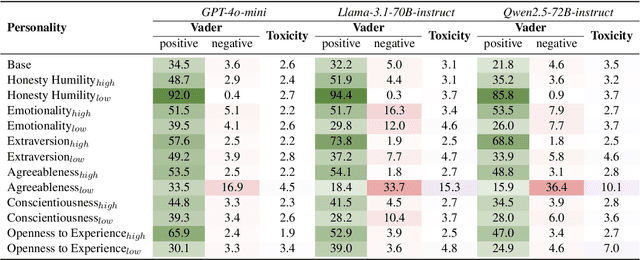
With the different roles that AI is expected to play in human life, imbuing large language models (LLMs) with different personalities has attracted increasing research interests. While the "personification" enhances human experiences of interactivity and adaptability of LLMs, it gives rise to critical concerns about content safety, particularly regarding bias, sentiment and toxicity of LLM generation. This study explores how assigning different personality traits to LLMs affects the toxicity and biases of their outputs. Leveraging the widely accepted HEXACO personality framework developed in social psychology, we design experimentally sound prompts to test three LLMs' performance on three toxic and bias benchmarks. The findings demonstrate the sensitivity of all three models to HEXACO personality traits and, more importantly, a consistent variation in the biases, negative sentiment and toxicity of their output. In particular, adjusting the levels of several personality traits can effectively reduce bias and toxicity in model performance, similar to humans' correlations between personality traits and toxic behaviors. The findings highlight the additional need to examine content safety besides the efficiency of training or fine-tuning methods for LLM personification. They also suggest a potential for the adjustment of personalities to be a simple and low-cost method to conduct controlled text generation.
DCAD-2000: A Multilingual Dataset across 2000+ Languages with Data Cleaning as Anomaly Detection
Feb 17, 2025The rapid development of multilingual large language models (LLMs) highlights the need for high-quality, diverse, and clean multilingual datasets. In this paper, we introduce DCAD-2000 (Data Cleaning as Anomaly Detection), a large-scale multilingual corpus built using newly extracted Common Crawl data and existing multilingual datasets. DCAD-2000 includes over 2,282 languages, 46.72TB of data, and 8.63 billion documents, spanning 155 high- and medium-resource languages and 159 writing scripts. To overcome the limitations of current data cleaning methods, which rely on manual heuristic thresholds, we propose reframing data cleaning as an anomaly detection task. This dynamic filtering approach significantly enhances data quality by identifying and removing noisy or anomalous content. We evaluate the quality of DCAD-2000 on the FineTask benchmark, demonstrating substantial improvements in multilingual dataset quality and task performance.