 Add to Chrome
 Add to Firefox
 Add to Edge
OmniVAE: An Audio-Video VAE with Cross-Modal Alignment for Joint Generation
Jul 26, 2026
Recent generative models are moving beyond silent video or standalone audio synthesis toward the joint generation of synchronized audio and video. Despite this progress, jointly generating audio and video with fine-grained cross-modal correspondence remains challenging due to their fundamental structural differences. Most existing methods use audio and video VAEs trained separately. As a result, the two latent spaces lack cross-modal alignment, leaving the downstream generative model to learn cross-modal synchronization from scratch. We present OmniVAE, a jointly trained audio-video VAE that learns fine-grained semantic alignment between audio and video latent representations. Beyond reconstruction, OmniVAE uses a segment-level audio-video contrastive objective to capture temporal-semantic correspondence and align the two latent spaces. In parallel, it distills features from pretrained modality-specific semantic encoders into each modality, improving the downstream learnability of both latent spaces. Extensive experiments show that both objectives consistently improve the learnability of the latent spaces, translating into higher generation quality and more accurate cross-modal synchronization in downstream text-to-audio-video generation. These findings underscore the importance of learning unified representations as a foundation for omnimodal modeling.1

Dont Stop Early: Scalable Enterprise Deep Research with Controlled Information Flow and Evidence-Aware Termination
Apr 27, 2026Enterprise deep research often fails to produce decision-ready reports due to uneven information coverage, context explosion, and premature stopping. We propose a scalable Enterprise Deep Research (EDR) architecture to address these failures. Our system (i) decomposes requests into coverage-driven objectives via outline generation with reflection, (ii) localizes context with dependency-guided execution and explicit information sharing, and (iii) enforces evidence-based completion criteria so agents iteratively collect information until sufficiency conditions are met. We evaluate on an internal sales enablement task and the public DeepResearch Bench benchmark, where our proposed system design achieves the strongest overall performance compared with competitive deep-research baselines. The results show that dependency-controlled context and explicit evidence sufficiency criteria reduce premature stopping and improve the consistency and depth of enterprise research outputs.
MTA-Agent: An Open Recipe for Multimodal Deep Search Agents
Apr 07, 2026Multimodal large language models (MLLMs) have demonstrated strong capabilities in visual understanding, yet they remain limited in complex, multi-step reasoning that requires deep searching and integrating visual evidence with external knowledge. In this work, we address this challenge by constructing high-quality, verified multi-hop vision-language training data for multimodal deep-search agents. We propose a Multi-hop Tool-Augmented Agent for Evidence-based QA Synthesis (MTA-Agent), which automatically selects tools and their parameters to retrieve and validate evidence from both visual and textual sources and generates structured multi-hop question-answer trajectories. Starting from diverse VQA seed datasets, our pipeline produces a large-scale training dataset, MTA-Vision-DeepSearch, containing 21K high-quality multi-hop examples. The data is filtered through a multi-stage verification process to ensure factual consistency and answer uniqueness. Using MTA-Vision-DeepSearch, a 32B open-source multimodal search agent achieves state-of-the-art performance, reaching an average of 54.63\% across six challenging benchmarks, outperforming GPT-5 (51.86\%), Gemini-2.5-Pro (50.98\%), and Gemini-3-Pro (54.46\%) under the same tool settings. We further show that training on our data improves both reasoning depth and tool-use behavior, increasing the average number of steps from 2.27 to 4.28, and leading to more systematic and persistent search strategies. Additionally, we demonstrate that training can be performed without real-time tool calls by replaying cached interactions, significantly reducing training cost. Importantly, we present MTA-Agent as a fully open recipe for multimodal deep search: we release the entire dataset, training trajectories, and implementation details to enable reproducibility and future research on open multimodal search agents.
MOVA: Towards Scalable and Synchronized Video-Audio Generation
Feb 09, 2026Audio is indispensable for real-world video, yet generation models have largely overlooked audio components. Current approaches to producing audio-visual content often rely on cascaded pipelines, which increase cost, accumulate errors, and degrade overall quality. While systems such as Veo 3 and Sora 2 emphasize the value of simultaneous generation, joint multimodal modeling introduces unique challenges in architecture, data, and training. Moreover, the closed-source nature of existing systems limits progress in the field. In this work, we introduce MOVA (MOSS Video and Audio), an open-source model capable of generating high-quality, synchronized audio-visual content, including realistic lip-synced speech, environment-aware sound effects, and content-aligned music. MOVA employs a Mixture-of-Experts (MoE) architecture, with a total of 32B parameters, of which 18B are active during inference. It supports IT2VA (Image-Text to Video-Audio) generation task. By releasing the model weights and code, we aim to advance research and foster a vibrant community of creators. The released codebase features comprehensive support for efficient inference, LoRA fine-tuning, and prompt enhancement.
Strefer: Empowering Video LLMs with Space-Time Referring and Reasoning via Synthetic Instruction Data
Sep 03, 2025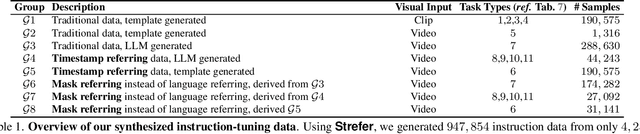
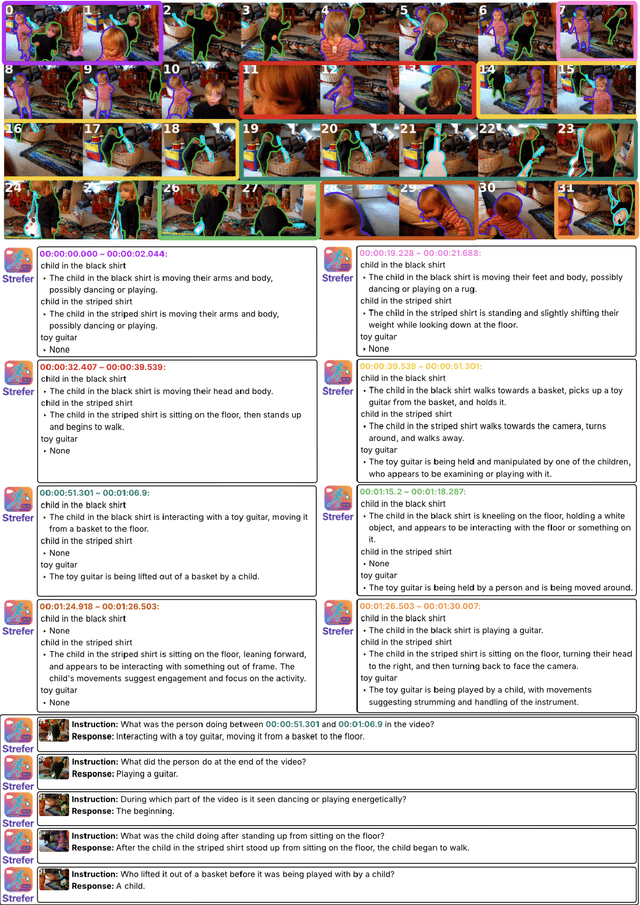
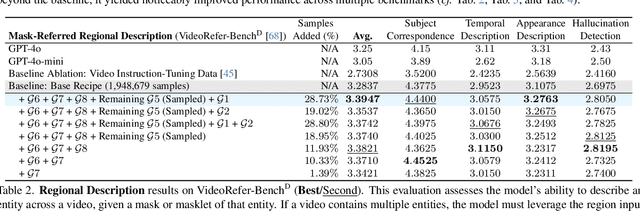
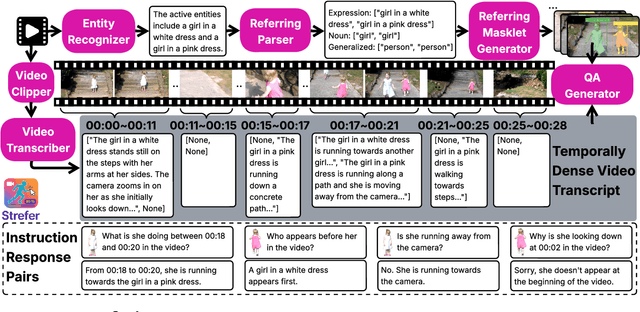
Next-generation AI companions must go beyond general video understanding to resolve spatial and temporal references in dynamic, real-world environments. Existing Video Large Language Models (Video LLMs), while capable of coarse-level comprehension, struggle with fine-grained, spatiotemporal reasoning, especially when user queries rely on time-based event references for temporal anchoring, or gestural cues for spatial anchoring to clarify object references and positions. To bridge this critical gap, we introduce Strefer, a synthetic instruction data generation framework designed to equip Video LLMs with spatiotemporal referring and reasoning capabilities. Strefer produces diverse instruction-tuning data using a data engine that pseudo-annotates temporally dense, fine-grained video metadata, capturing rich spatial and temporal information in a structured manner, including subjects, objects, their locations as masklets, and their action descriptions and timelines. Our approach enhances the ability of Video LLMs to interpret spatial and temporal references, fostering more versatile, space-time-aware reasoning essential for real-world AI companions. Without using proprietary models, costly human annotation, or the need to annotate large volumes of new videos, experimental evaluations show that models trained with data produced by Strefer outperform baselines on tasks requiring spatial and temporal disambiguation. Additionally, these models exhibit enhanced space-time-aware reasoning, establishing a new foundation for perceptually grounded, instruction-tuned Video LLMs.
Open-Sora 2.0: Training a Commercial-Level Video Generation Model in $200k
Mar 12, 2025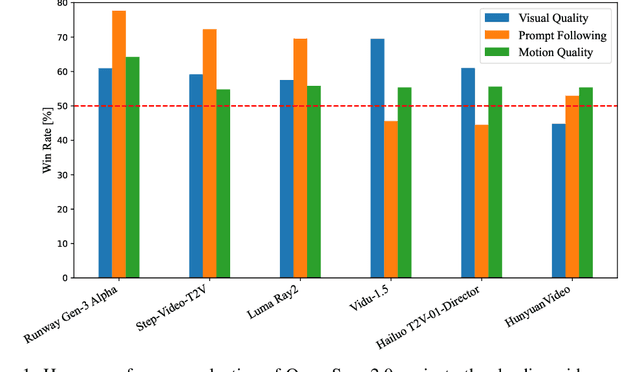
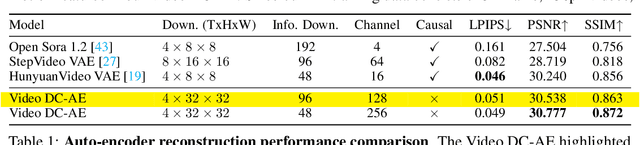
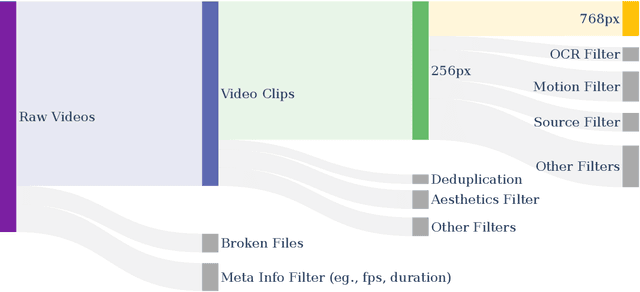

Video generation models have achieved remarkable progress in the past year. The quality of AI video continues to improve, but at the cost of larger model size, increased data quantity, and greater demand for training compute. In this report, we present Open-Sora 2.0, a commercial-level video generation model trained for only $200k. With this model, we demonstrate that the cost of training a top-performing video generation model is highly controllable. We detail all techniques that contribute to this efficiency breakthrough, including data curation, model architecture, training strategy, and system optimization. According to human evaluation results and VBench scores, Open-Sora 2.0 is comparable to global leading video generation models including the open-source HunyuanVideo and the closed-source Runway Gen-3 Alpha. By making Open-Sora 2.0 fully open-source, we aim to democratize access to advanced video generation technology, fostering broader innovation and creativity in content creation. All resources are publicly available at: https://github.com/hpcaitech/Open-Sora.
BingoGuard: LLM Content Moderation Tools with Risk Levels
Mar 09, 2025Malicious content generated by large language models (LLMs) can pose varying degrees of harm. Although existing LLM-based moderators can detect harmful content, they struggle to assess risk levels and may miss lower-risk outputs. Accurate risk assessment allows platforms with different safety thresholds to tailor content filtering and rejection. In this paper, we introduce per-topic severity rubrics for 11 harmful topics and build BingoGuard, an LLM-based moderation system designed to predict both binary safety labels and severity levels. To address the lack of annotations on levels of severity, we propose a scalable generate-then-filter framework that first generates responses across different severity levels and then filters out low-quality responses. Using this framework, we create BingoGuardTrain, a training dataset with 54,897 examples covering a variety of topics, response severity, styles, and BingoGuardTest, a test set with 988 examples explicitly labeled based on our severity rubrics that enables fine-grained analysis on model behaviors on different severity levels. Our BingoGuard-8B, trained on BingoGuardTrain, achieves the state-of-the-art performance on several moderation benchmarks, including WildGuardTest and HarmBench, as well as BingoGuardTest, outperforming best public models, WildGuard, by 4.3\%. Our analysis demonstrates that incorporating severity levels into training significantly enhances detection performance and enables the model to effectively gauge the severity of harmful responses.
Turning Conversations into Workflows: A Framework to Extract and Evaluate Dialog Workflows for Service AI Agents
Feb 24, 2025Automated service agents require well-structured workflows to provide consistent and accurate responses to customer queries. However, these workflows are often undocumented, and their automatic extraction from conversations remains unexplored. In this work, we present a novel framework for extracting and evaluating dialog workflows from historical interactions. Our extraction process consists of two key stages: (1) a retrieval step to select relevant conversations based on key procedural elements, and (2) a structured workflow generation process using a question-answer-based chain-of-thought (QA-CoT) prompting. To comprehensively assess the quality of extracted workflows, we introduce an automated agent and customer bots simulation framework that measures their effectiveness in resolving customer issues. Extensive experiments on the ABCD and SynthABCD datasets demonstrate that our QA-CoT technique improves workflow extraction by 12.16\% in average macro accuracy over the baseline. Moreover, our evaluation method closely aligns with human assessments, providing a reliable and scalable framework for future research.
Open-Sora: Democratizing Efficient Video Production for All
Dec 29, 2024
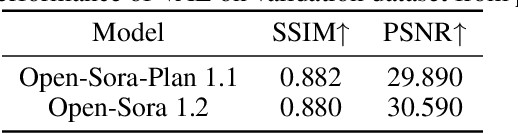
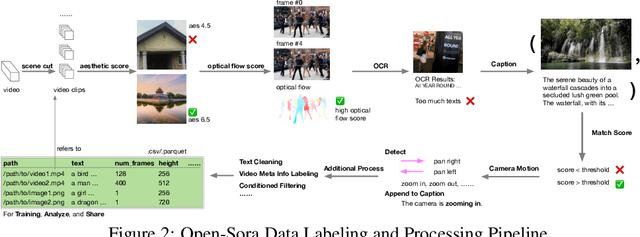
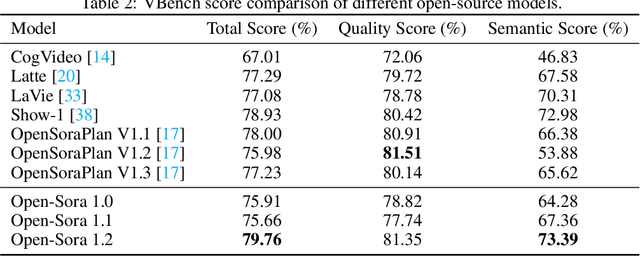
Vision and language are the two foundational senses for humans, and they build up our cognitive ability and intelligence. While significant breakthroughs have been made in AI language ability, artificial visual intelligence, especially the ability to generate and simulate the world we see, is far lagging behind. To facilitate the development and accessibility of artificial visual intelligence, we created Open-Sora, an open-source video generation model designed to produce high-fidelity video content. Open-Sora supports a wide spectrum of visual generation tasks, including text-to-image generation, text-to-video generation, and image-to-video generation. The model leverages advanced deep learning architectures and training/inference techniques to enable flexible video synthesis, which could generate video content of up to 15 seconds, up to 720p resolution, and arbitrary aspect ratios. Specifically, we introduce Spatial-Temporal Diffusion Transformer (STDiT), an efficient diffusion framework for videos that decouples spatial and temporal attention. We also introduce a highly compressive 3D autoencoder to make representations compact and further accelerate training with an ad hoc training strategy. Through this initiative, we aim to foster innovation, creativity, and inclusivity within the community of AI content creation. By embracing the open-source principle, Open-Sora democratizes full access to all the training/inference/data preparation codes as well as model weights. All resources are publicly available at: https://github.com/hpcaitech/Open-Sora.
Unanswerability Evaluation for Retreival Augmented Generation
Dec 16, 2024Existing evaluation frameworks for retrieval-augmented generation (RAG) systems focus on answerable queries, but they overlook the importance of appropriately rejecting unanswerable requests. In this paper, we introduce UAEval4RAG, a framework designed to evaluate whether RAG systems can handle unanswerable queries effectively. We define a taxonomy with six unanswerable categories, and UAEval4RAG automatically synthesizes diverse and challenging queries for any given knowledge base with unanswered ratio and acceptable ratio metrics. We conduct experiments with various RAG components, including retrieval models, rewriting methods, rerankers, language models, and prompting strategies, and reveal hidden trade-offs in performance of RAG systems. Our findings highlight the critical role of component selection and prompt design in optimizing RAG systems to balance the accuracy of answerable queries with high rejection rates of unanswerable ones. UAEval4RAG provides valuable insights and tools for developing more robust and reliable RAG systems.