 Add to Chrome
 Add to Firefox
 Add to Edge
NSVQ: Mitigating Codebook Collapse by Stabilizing Encoder Drift in Vector Quantization
Jun 09, 2026
Vector quantization is central to modern generative modeling pipelines, but large-codebook VQ models often suffer from codebook collapse. We identify encoder drift as a key driver of this failure: as the encoder moves the latent distribution, sparsely updated code vectors can lag behind, lose assignments, and increase quantization error, creating a feedback loop through the straight-through estimator. We propose NSVQ, a non-stationary-aware VQ training strategy that combines a dense non-stationary embedding loss, codebook replacement, and stage-wise encoder freezing. NSVQ first helps the codebook track encoder drift during early training, then freezes the encoder to consolidate the codebook under a fixed latent geometry, and finally reintroduces adversarial refinement. Experiments on ImageNet-1k show that NSVQ improves reconstruction quality while maintaining full codebook utilization. On ImageNet-1k at 128$\times$128 with 65,536 codes, NSVQ reduces rFID from 2.39 to 2.10 compared with SimVQ, while both methods maintain 100\% utilization. Additional latent diffusion experiments show that NSVQ also improves downstream ImageNet generation FID.

Pathway-Structured Privileged Distillation for Deployable Computational Pathology
Jun 01, 2026Integrating transcriptomics and histopathology can improve cancer risk modelling, yet practical use is constrained by the limited availability of RNA profiling in routine settings. Here we introduce Mixture of Pathway Experts (MoPE), a knowledge-distillation framework that reframes multimodal learning as privileged distillation for histology-only inference. MoPE is motivated by the partial observability between RNA profiles and whole-slide images: histology can capture morphology-linked consequences of certain molecular programmes, but cannot be expected to reconstruct the full transcriptomic state. MoPE encodes RNA-derived pathways and transfers the molecular supervision to pathway-indexed pathology experts through memory-usage alignment. Across diverse public benchmarks and two independent breast cancer cohorts, MoPE consistently improved WSI-only inference performance relative to baseline methods. Pathway-usage analyses and human-audited visual inspection provide bounded inspection of model behaviour and candidate morphology-linked readouts. These results support pathway-structured privileged distillation as a promising route to using molecular information during training while preserving RNA-free inference.
Select Smarter, Not More: Prompt-Aware Evaluation Scheduling with Submodular Guarantees
Apr 13, 2026Automatic prompt optimization (APO) hinges on the quality of its evaluation signal, yet scoring every prompt candidate on the full training set is prohibitively expensive. Existing methods either fix a single evaluation subset before optimization begins (principled but prompt-agnostic) or adapt it heuristically during optimization (flexible but unstable and lacking formal guarantees). We observe that APO naturally maps to an online adaptive testing problem: prompts are examinees, training examples are test items, and the scheduler should select items that best discriminate among the strongest candidates. This insight motivates Prompt-Aware Online Evaluation Scheduling (POES), which integrates an IRT-based discrimination utility, a facility-location coverage term, and switching-cost-aware warm-start swaps into a unified objective that is provably monotone submodular, yielding a (1-1/e) greedy guarantee for cold starts and bounded drift for warm-start updates. An adaptive controller modulates the exploration-exploitation balance based on optimization progress. Across 36 tasks spanning three benchmark families, POES achieves the highest overall average accuracy (6.2 percent improvement over the best baseline) with negligible token overhead (approximately 4 percent) at the same evaluation budget. Moreover, principled selection at k = 20 examples matches or exceeds the performance of naive evaluation at k = 30-50, reducing token consumption by 35-60 percent, showing that selecting smarter is more effective than selecting more. Our results demonstrate that evaluation scheduling is a first-class component of APO, not an implementation detail.
Adaptive Prompt Structure Factorization: A Framework for Self-Discovering and Optimizing Compositional Prompt Programs
Apr 08, 2026Automated prompt optimization is crucial for eliciting reliable reasoning from large language models (LLMs), yet most API-only prompt optimizers iteratively edit monolithic prompts, coupling components and obscuring credit assignment, limiting controllability, and wasting tokens. We propose Adaptive Prompt Structure Factorization (aPSF), an API-only framework (prompt-in/text-out; no access to model internals) that uses an Architect model to discover task-specific prompt structures as semantic factors. aPSF then performs interventional, single-factor updates: interventional factor-level scoring estimates each factor's marginal contribution via validation-performance changes, and error-guided factor selection routes updates to the current dominant failure source for more sample-efficient optimization. Across multiple advanced reasoning benchmarks, aPSF outperforms strong baselines including principle-aware optimizers, improving accuracy by up to +2.16 percentage points on average, and reduces optimization cost by 45--87% tokens on MultiArith while reaching peak validation in 1 step.
Structured Causal Video Reasoning via Multi-Objective Alignment
Apr 06, 2026Human understanding of video dynamics is typically grounded in a structured mental representation of entities, actions, and temporal relations, rather than relying solely on immediate deductive reasoning. In contrast, existing Video-LLMs largely depend on unstructured video reasoning, where critical visual evidence is embedded in verbose textual descriptions and temporal causality is often weakly modeled. This leads to inefficient processes and fragile causal inference. To bridge this cognitive gap, we propose constructing a compact representation of salient events and their causal relationships, which we name Structured Event Facts, prior to the reasoning stage. This structured prior serves as an explicit constraint to promote concise and causally grounded reasoning, while also making intermediate evidence easier to verify. To effectively train models on such structured facts, we introduce CausalFact-60K and a four-stage training pipeline comprising facts alignment, format warm-start, thinking warm-start, and reinforcement learning-based post-training. During RL stage, we find that this framework introduces competing objectives, as structural completeness and causal fidelity must be balanced against reasoning length, making it difficult to optimize. We address this challenge by formulating the optimization as a Multi-Objective Reinforcement Learning (MORL) problem and explicitly optimizing toward the Pareto-Frontier to balance these trade-offs. As a result, we introduce Factum-4B, which yields more reliable reasoning and delivers stronger performance on challenging video understanding tasks requiring fine-grained temporal inference.
PIDP-Attack: Combining Prompt Injection with Database Poisoning Attacks on Retrieval-Augmented Generation Systems
Mar 26, 2026Large Language Models (LLMs) have demonstrated remarkable performance across a wide range of applications. However, their practical deployment is often hindered by issues such as outdated knowledge and the tendency to generate hallucinations. To address these limitations, Retrieval-Augmented Generation (RAG) systems have been introduced, enhancing LLMs with external, up-to-date knowledge sources. Despite their advantages, RAG systems remain vulnerable to adversarial attacks, with data poisoning emerging as a prominent threat. Existing poisoning-based attacks typically require prior knowledge of the user's specific queries, limiting their flexibility and real-world applicability. In this work, we propose PIDP-Attack, a novel compound attack that integrates prompt injection with database poisoning in RAG. By appending malicious characters to queries at inference time and injecting a limited number of poisoned passages into the retrieval database, our method can effectively manipulate LLM response to arbitrary query without prior knowledge of the user's actual query. Experimental evaluations across three benchmark datasets (Natural Questions, HotpotQA, MS-MARCO) and eight LLMs demonstrate that PIDP-Attack consistently outperforms the original PoisonedRAG. Specifically, our method improves attack success rates by 4% to 16% on open-domain QA tasks while maintaining high retrieval precision, proving that the compound attack strategy is both necessary and highly effective.
Octopus-inspired Distributed Control for Soft Robotic Arms: A Graph Neural Network-Based Attention Policy with Environmental Interaction
Mar 10, 2026This paper proposes SoftGM, an octopus-inspired distributed control architecture for segmented soft robotic arms that learn to reach targets in contact-rich environments using online obstacle discovery without relying on global obstacle geometry. SoftGM formulates each arm section as a cooperative agent and represents the arm-environment interaction as a graph. SoftGM uses a two-stage graph attention message passing scheme following a Centralised Training Decentralised Execution (CTDE) paradigm with a centralised critic and decentralised actor. We evaluate SoftGM in a Cosserat-rod simulator (PyElastica) across three tasks that increase the complexity of the environment: obstacle-free, structured obstacles, and a wall-with-hole scenario. Compared with six widely used MARL baselines (IDDPG, IPPO, ISAC, MADDPG, MAPPO, MASAC) under identical information content and training conditions, SoftGM matches strong CTDE methods in simpler settings and achieves the best performance in the wall-with-hole task. Robustness tests with observation noise, single-section actuation failure, and transient disturbances show that SoftGM preserves success while keeping control effort bounded, indicating resilient coordination driven by selective contact-relevant information routing.
Momentum Memory for Knowledge Distillation in Computational Pathology
Feb 24, 2026Multimodal learning that integrates genomics and histopathology has shown strong potential in cancer diagnosis, yet its clinical translation is hindered by the limited availability of paired histology-genomics data. Knowledge distillation (KD) offers a practical solution by transferring genomic supervision into histopathology models, enabling accurate inference using histology alone. However, existing KD methods rely on batch-local alignment, which introduces instability due to limited within-batch comparisons and ultimately degrades performance. To address these limitations, we propose Momentum Memory Knowledge Distillation (MoMKD), a cross-modal distillation framework driven by a momentum-updated memory. This memory aggregates genomic and histopathology information across batches, effectively enlarging the supervisory context available to each mini-batch. Furthermore, we decouple the gradients of the genomics and histology branches, preventing genomic signals from dominating histology feature learning during training and eliminating the modality-gap issue at inference time. Extensive experiments on the TCGA-BRCA benchmark (HER2, PR, and ODX classification tasks) and an independent in-house testing dataset demonstrate that MoMKD consistently outperforms state-of-the-art MIL and multimodal KD baselines, delivering strong performance and generalization under histology-only inference. Overall, MoMKD establishes a robust and generalizable knowledge distillation paradigm for computational pathology.
Multi-Physics: A Comprehensive Benchmark for Multimodal LLMs Reasoning on Chinese Multi-Subject Physics Problems
Sep 19, 2025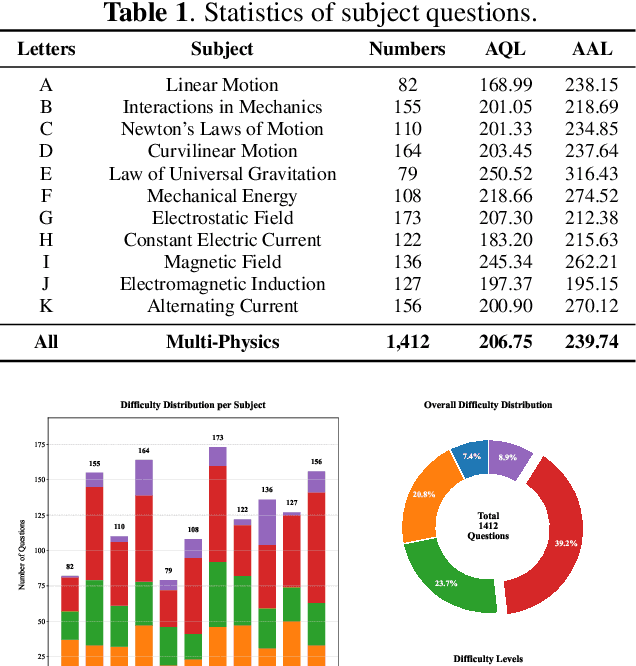
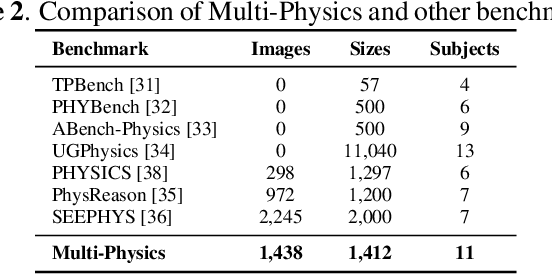
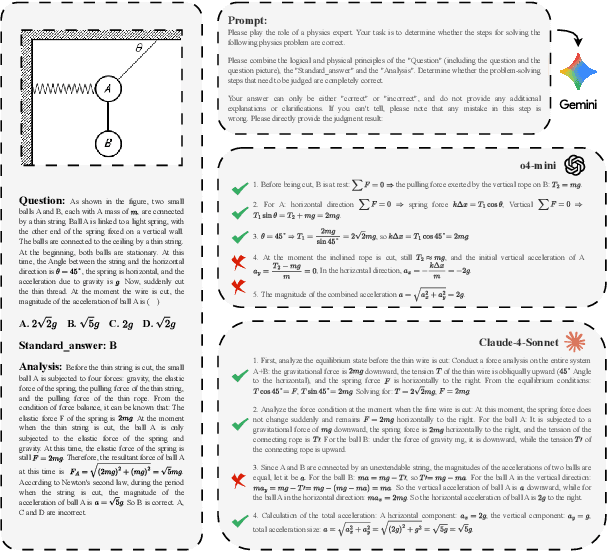
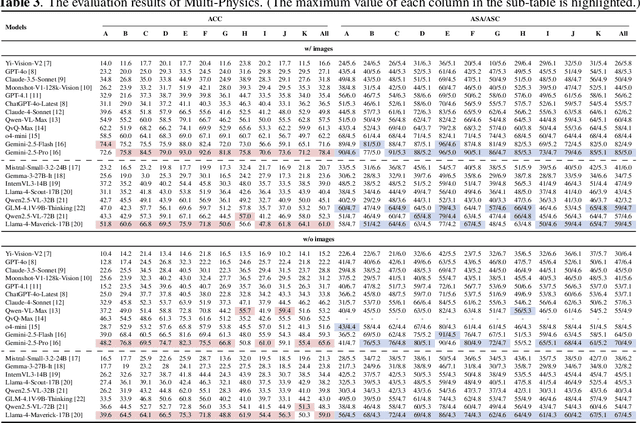
While multimodal LLMs (MLLMs) demonstrate remarkable reasoning progress, their application in specialized scientific domains like physics reveals significant gaps in current evaluation benchmarks. Specifically, existing benchmarks often lack fine-grained subject coverage, neglect the step-by-step reasoning process, and are predominantly English-centric, failing to systematically evaluate the role of visual information. Therefore, we introduce \textbf {Multi-Physics} for Chinese physics reasoning, a comprehensive benchmark that includes 5 difficulty levels, featuring 1,412 image-associated, multiple-choice questions spanning 11 high-school physics subjects. We employ a dual evaluation framework to evaluate 20 different MLLMs, analyzing both final answer accuracy and the step-by-step integrity of their chain-of-thought. Furthermore, we systematically study the impact of difficulty level and visual information by comparing the model performance before and after changing the input mode. Our work provides not only a fine-grained resource for the community but also offers a robust methodology for dissecting the multimodal reasoning process of state-of-the-art MLLMs, and our dataset and code have been open-sourced: https://github.com/luozhongze/Multi-Physics.
Adaptively Distilled ControlNet: Accelerated Training and Superior Sampling for Medical Image Synthesis
Jul 31, 2025Medical image annotation is constrained by privacy concerns and labor-intensive labeling, significantly limiting the performance and generalization of segmentation models. While mask-controllable diffusion models excel in synthesis, they struggle with precise lesion-mask alignment. We propose \textbf{Adaptively Distilled ControlNet}, a task-agnostic framework that accelerates training and optimization through dual-model distillation. Specifically, during training, a teacher model, conditioned on mask-image pairs, regularizes a mask-only student model via predicted noise alignment in parameter space, further enhanced by adaptive regularization based on lesion-background ratios. During sampling, only the student model is used, enabling privacy-preserving medical image generation. Comprehensive evaluations on two distinct medical datasets demonstrate state-of-the-art performance: TransUNet improves mDice/mIoU by 2.4%/4.2% on KiTS19, while SANet achieves 2.6%/3.5% gains on Polyps, highlighting its effectiveness and superiority. Code is available at GitHub.