 Add to Chrome
 Add to Firefox
 Add to Edge
Data-Driven Parametrization of Molecular Mechanics Force Fields for Expansive Chemical Space Coverage
Aug 23, 2024

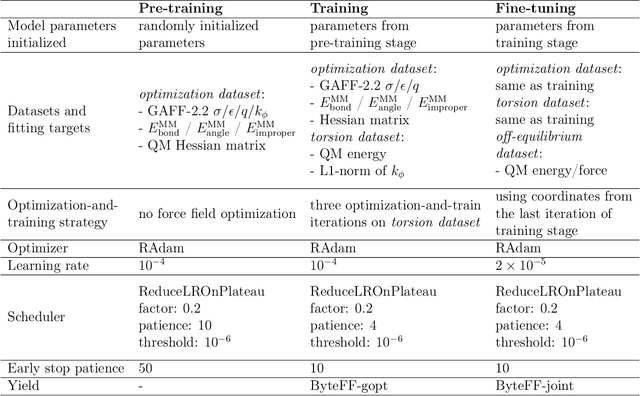
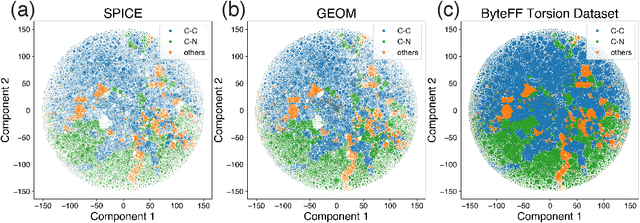
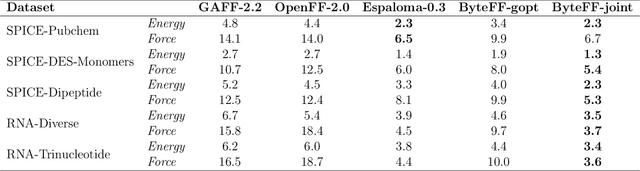
A force field is a critical component in molecular dynamics simulations for computational drug discovery. It must achieve high accuracy within the constraints of molecular mechanics' (MM) limited functional forms, which offers high computational efficiency. With the rapid expansion of synthetically accessible chemical space, traditional look-up table approaches face significant challenges. In this study, we address this issue using a modern data-driven approach, developing ByteFF, an Amber-compatible force field for drug-like molecules. To create ByteFF, we generated an expansive and highly diverse molecular dataset at the B3LYP-D3(BJ)/DZVP level of theory. This dataset includes 2.4 million optimized molecular fragment geometries with analytical Hessian matrices, along with 3.2 million torsion profiles. We then trained an edge-augmented, symmetry-preserving molecular graph neural network (GNN) on this dataset, employing a carefully optimized training strategy. Our model predicts all bonded and non-bonded MM force field parameters for drug-like molecules simultaneously across a broad chemical space. ByteFF demonstrates state-of-the-art performance on various benchmark datasets, excelling in predicting relaxed geometries, torsional energy profiles, and conformational energies and forces. Its exceptional accuracy and expansive chemical space coverage make ByteFF a valuable tool for multiple stages of computational drug discovery.

Baby Bear: Seeking a Just Right Rating Scale for Scalar Annotations
Aug 19, 2024Our goal is a mechanism for efficiently assigning scalar ratings to each of a large set of elements. For example, "what percent positive or negative is this product review?" When sample sizes are small, prior work has advocated for methods such as Best Worst Scaling (BWS) as being more robust than direct ordinal annotation ("Likert scales"). Here we first introduce IBWS, which iteratively collects annotations through Best-Worst Scaling, resulting in robustly ranked crowd-sourced data. While effective, IBWS is too expensive for large-scale tasks. Using the results of IBWS as a best-desired outcome, we evaluate various direct assessment methods to determine what is both cost-efficient and best correlating to a large scale BWS annotation strategy. Finally, we illustrate in the domains of dialogue and sentiment how these annotations can support robust learning-to-rank models.
FastFiD: Improve Inference Efficiency of Open Domain Question Answering via Sentence Selection
Aug 12, 2024Open Domain Question Answering (ODQA) has been advancing rapidly in recent times, driven by significant developments in dense passage retrieval and pretrained language models. Current models typically incorporate the FiD framework, which is composed by a neural retriever alongside an encoder-decoder neural reader. In the answer generation process, the retriever will retrieve numerous passages (around 100 for instance), each of which is then individually encoded by the encoder. Subsequently, the decoder makes predictions based on these encoded passages. Nevertheless, this framework can be relatively time-consuming, particularly due to the extensive length of the gathered passages. To address this, we introduce FastFiD in this paper, a novel approach that executes sentence selection on the encoded passages. This aids in retaining valuable sentences while reducing the context length required for generating answers. Experiments on three commonly used datasets (Natural Questions, TriviaQA and ASQA) demonstrate that our method can enhance the inference speed by 2.3X-5.7X, while simultaneously maintaining the model's performance. Moreover, an in-depth analysis of the model's attention reveals that the selected sentences indeed hold a substantial contribution towards the final answer. The codes are publicly available at https://github.com/thunlp/FastFiD.
MiniCPM-V: A GPT-4V Level MLLM on Your Phone
Aug 03, 2024
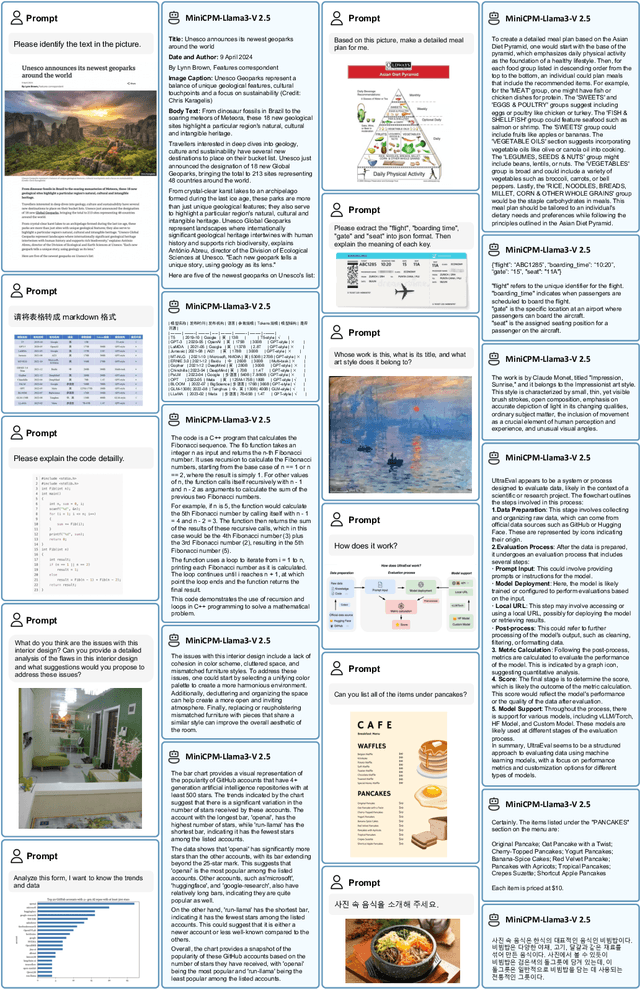
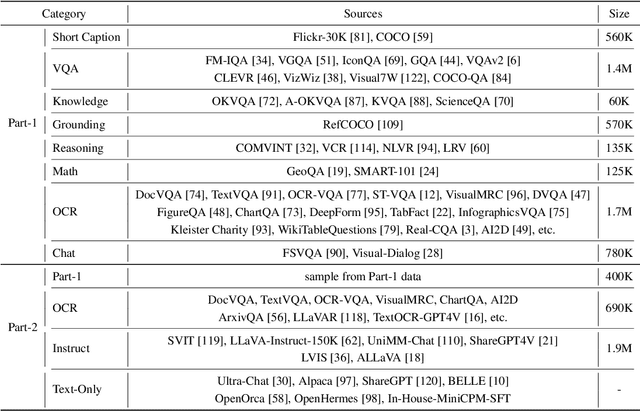
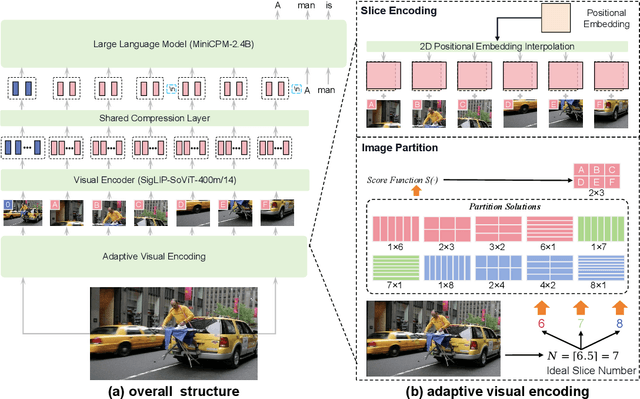
The recent surge of Multimodal Large Language Models (MLLMs) has fundamentally reshaped the landscape of AI research and industry, shedding light on a promising path toward the next AI milestone. However, significant challenges remain preventing MLLMs from being practical in real-world applications. The most notable challenge comes from the huge cost of running an MLLM with a massive number of parameters and extensive computation. As a result, most MLLMs need to be deployed on high-performing cloud servers, which greatly limits their application scopes such as mobile, offline, energy-sensitive, and privacy-protective scenarios. In this work, we present MiniCPM-V, a series of efficient MLLMs deployable on end-side devices. By integrating the latest MLLM techniques in architecture, pretraining and alignment, the latest MiniCPM-Llama3-V 2.5 has several notable features: (1) Strong performance, outperforming GPT-4V-1106, Gemini Pro and Claude 3 on OpenCompass, a comprehensive evaluation over 11 popular benchmarks, (2) strong OCR capability and 1.8M pixel high-resolution image perception at any aspect ratio, (3) trustworthy behavior with low hallucination rates, (4) multilingual support for 30+ languages, and (5) efficient deployment on mobile phones. More importantly, MiniCPM-V can be viewed as a representative example of a promising trend: The model sizes for achieving usable (e.g., GPT-4V) level performance are rapidly decreasing, along with the fast growth of end-side computation capacity. This jointly shows that GPT-4V level MLLMs deployed on end devices are becoming increasingly possible, unlocking a wider spectrum of real-world AI applications in the near future.
RAGEval: Scenario Specific RAG Evaluation Dataset Generation Framework
Aug 02, 2024


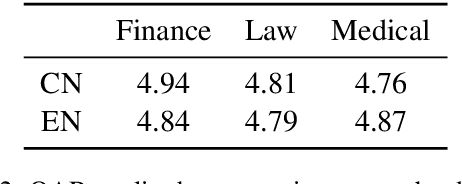
Retrieval-Augmented Generation (RAG) systems have demonstrated their advantages in alleviating the hallucination of Large Language Models (LLMs). Existing RAG benchmarks mainly focus on evaluating whether LLMs can correctly answer the general knowledge. However, they are unable to evaluate the effectiveness of the RAG system in dealing with the data from different vertical domains. This paper introduces RAGEval, a framework for automatically generating evaluation datasets to evaluate the knowledge usage ability of different LLMs in different scenarios. Specifically, RAGEval summarizes a schema from seed documents, applies the configurations to generate diverse documents, and constructs question-answering pairs according to both articles and configurations. We propose three novel metrics, Completeness, Hallucination, and Irrelevance, to carefully evaluate the responses generated by LLMs. By benchmarking RAG models in vertical domains, RAGEval has the ability to better evaluate the knowledge usage ability of LLMs, which avoids the confusion regarding the source of knowledge in answering question in existing QA datasets--whether it comes from parameterized memory or retrieval.
LIDIA: Precise Liver Tumor Diagnosis on Multi-Phase Contrast-Enhanced CT via Iterative Fusion and Asymmetric Contrastive Learning
Jul 18, 2024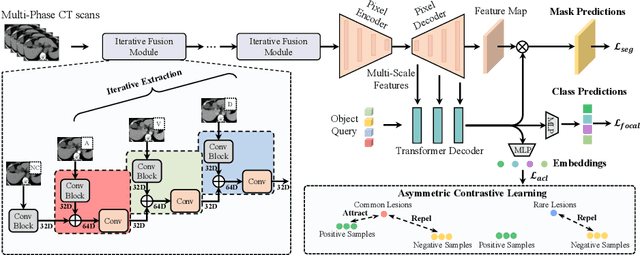
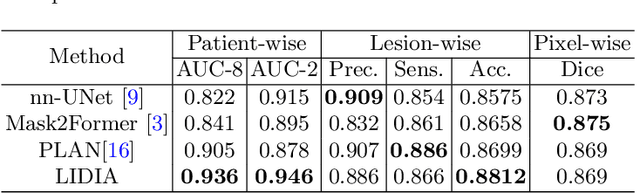
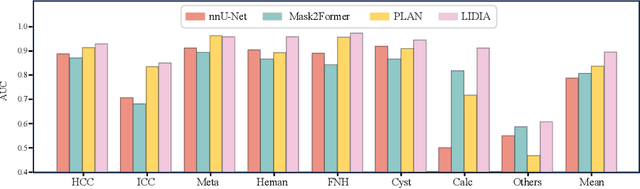
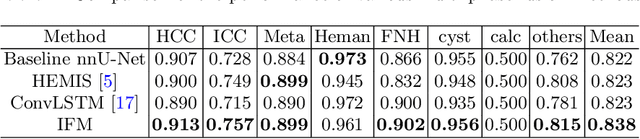
The early detection and precise diagnosis of liver tumors are tasks of critical clinical value, yet they pose significant challenges due to the high heterogeneity and variability of liver tumors. In this work, a precise LIver tumor DIAgnosis network on multi-phase contrast-enhance CT, named LIDIA, is proposed for real-world scenario. To fully utilize all available phases in contrast-enhanced CT, LIDIA first employs the iterative fusion module to aggregate variable numbers of image phases, thereby capturing the features of lesions at different phases for better tumor diagnosis. To effectively mitigate the high heterogeneity problem of liver tumors, LIDIA incorporates asymmetric contrastive learning to enhance the discriminability between different classes. To evaluate our method, we constructed a large-scale dataset comprising 1,921 patients and 8,138 lesions. LIDIA has achieved an average AUC of 93.6% across eight different types of lesions, demonstrating its effectiveness. Besides, LIDIA also demonstrated strong generalizability with an average AUC of 89.3% when tested on an external cohort of 828 patients.
Continual Learning for Adaptable Car-Following in Dynamic Traffic Environments
Jul 17, 2024


The continual evolution of autonomous driving technology requires car-following models that can adapt to diverse and dynamic traffic environments. Traditional learning-based models often suffer from performance degradation when encountering unseen traffic patterns due to a lack of continual learning capabilities. This paper proposes a novel car-following model based on continual learning that addresses this limitation. Our framework incorporates Elastic Weight Consolidation (EWC) and Memory Aware Synapses (MAS) techniques to mitigate catastrophic forgetting and enable the model to learn incrementally from new traffic data streams. We evaluate the performance of the proposed model on the Waymo and Lyft datasets which encompass various traffic scenarios. The results demonstrate that the continual learning techniques significantly outperform the baseline model, achieving 0\% collision rates across all traffic conditions. This research contributes to the advancement of autonomous driving technology by fostering the development of more robust and adaptable car-following models.
Light-weight Fine-tuning Method for Defending Adversarial Noise in Pre-trained Medical Vision-Language Models
Jul 02, 2024
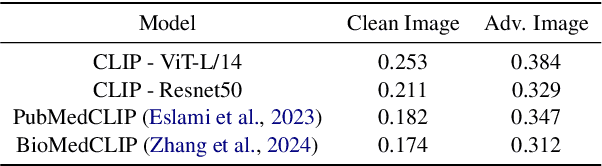

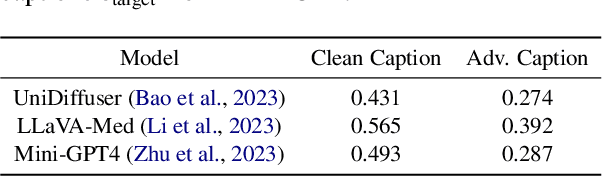
Fine-tuning pre-trained Vision-Language Models (VLMs) has shown remarkable capabilities in medical image and textual depiction synergy. Nevertheless, many pre-training datasets are restricted by patient privacy concerns, potentially containing noise that can adversely affect downstream performance. Moreover, the growing reliance on multi-modal generation exacerbates this issue because of its susceptibility to adversarial attacks. To investigate how VLMs trained on adversarial noisy data perform on downstream medical tasks, we first craft noisy upstream datasets using multi-modal adversarial attacks. Through our comprehensive analysis, we unveil that moderate noise enhances model robustness and transferability, but increasing noise levels negatively impact downstream task performance. To mitigate this issue, we propose rectify adversarial noise (RAN) framework, a recipe designed to effectively defend adversarial attacks and rectify the influence of upstream noise during fine-tuning.
EditFollower: Tunable Car Following Models for Customizable Adaptive Cruise Control Systems
Jun 23, 2024


In the realm of driving technologies, fully autonomous vehicles have not been widely adopted yet, making advanced driver assistance systems (ADAS) crucial for enhancing driving experiences. Adaptive Cruise Control (ACC) emerges as a pivotal component of ADAS. However, current ACC systems often employ fixed settings, failing to intuitively capture drivers' social preferences and leading to potential function disengagement. To overcome these limitations, we propose the Editable Behavior Generation (EBG) model, a data-driven car-following model that allows for adjusting driving discourtesy levels. The framework integrates diverse courtesy calculation methods into long short-term memory (LSTM) and Transformer architectures, offering a comprehensive approach to capture nuanced driving dynamics. By integrating various discourtesy values during the training process, our model generates realistic agent trajectories with different levels of courtesy in car-following behavior. Experimental results on the HighD and Waymo datasets showcase a reduction in Mean Squared Error (MSE) of spacing and MSE of speed compared to baselines, establishing style controllability. To the best of our knowledge, this work represents the first data-driven car-following model capable of dynamically adjusting discourtesy levels. Our model provides valuable insights for the development of ACC systems that take into account drivers' social preferences.
Beyond the Turn-Based Game: Enabling Real-Time Conversations with Duplex Models
Jun 22, 2024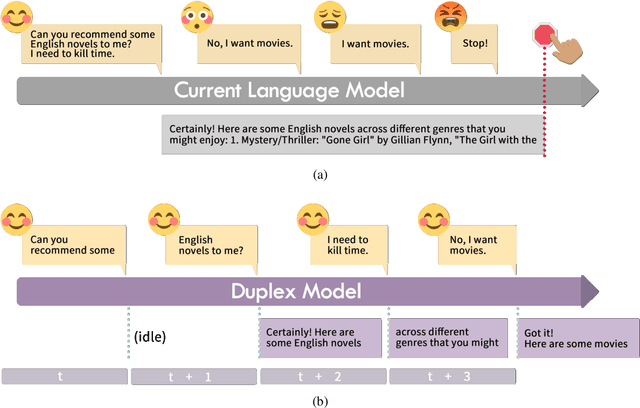
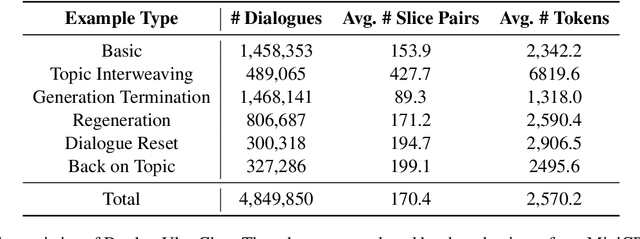
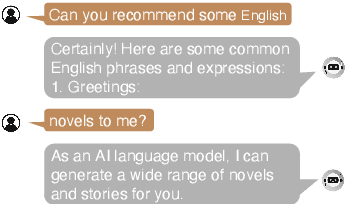
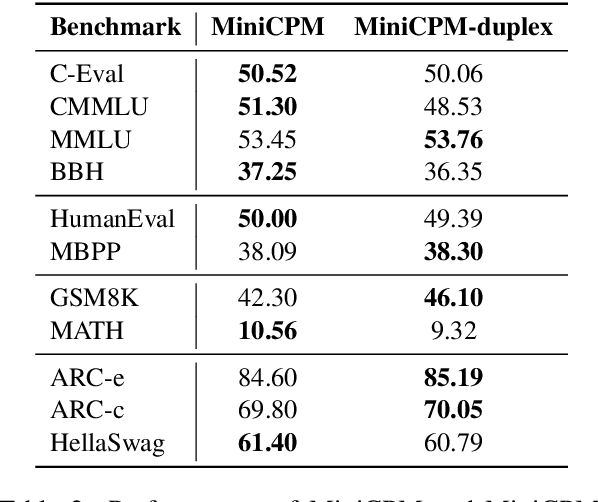
As large language models (LLMs) increasingly permeate daily lives, there is a growing demand for real-time interactions that mirror human conversations. Traditional turn-based chat systems driven by LLMs prevent users from verbally interacting with the system while it is generating responses. To overcome these limitations, we adapt existing LLMs to \textit{duplex models} so that these LLMs can listen for users while generating output and dynamically adjust themselves to provide users with instant feedback. % such as in response to interruptions. Specifically, we divide the queries and responses of conversations into several time slices and then adopt a time-division-multiplexing (TDM) encoding-decoding strategy to pseudo-simultaneously process these slices. Furthermore, to make LLMs proficient enough to handle real-time conversations, we build a fine-tuning dataset consisting of alternating time slices of queries and responses as well as covering typical feedback types in instantaneous interactions. Our experiments show that although the queries and responses of conversations are segmented into incomplete slices for processing, LLMs can preserve their original performance on standard benchmarks with a few fine-tuning steps on our dataset. Automatic and human evaluation indicate that duplex models make user-AI interactions more natural and human-like, and greatly improve user satisfaction compared to vanilla LLMs. Our duplex model and dataset will be released.