 Add to Chrome
 Add to Firefox
 Add to Edge
FrontierSmith: Synthesizing Open-Ended Coding Problems at Scale
May 14, 2026
Many real-world coding challenges are open-ended and admit no known optimal solution. Yet, recent progress in LLM coding has focused on well-defined tasks such as feature implementation, bug fixing, and competitive programming. Open-ended coding remains a weak spot for LLMs, largely because open-ended training problems are scarce and expensive to construct. Our goal is to synthesize open-ended coding problems at scale to train stronger LLM coders. We introduce FrontierSmith, an automated system for iteratively evolving open-ended problems from existing closed-ended coding tasks. Starting from competitive programming problems, FrontierSmith generates candidate open-ended variants by changing the problems'goals, restricting outputs, and generalizing inputs. It then uses a quantitative idea divergence metric to select problems that elicit genuinely diverse approaches from different solvers. Agents then generate test cases and verifiers for the surviving candidates. On two open-ended coding benchmarks, training on our synthesized data yields substantial gains over the base models: Qwen3.5-9B improves by +8.82 score on FrontierCS and +306.36 (Elo-rating-based performance) on ALE-bench; Qwen3.5-27B improves by +12.12 and +309.12, respectively. The synthesized problems also make agents take more turns and use more tokens, similar to human-curated ones, suggesting that closed-ended seeds can be a practical starting point for long-horizon coding data.

Do Androids Dream of Breaking the Game? Systematically Auditing AI Agent Benchmarks with BenchJack
May 12, 2026Agent benchmarks have become the de facto measure of frontier AI competence, guiding model selection, investment, and deployment. However, reward hacking, where agents maximize a score without performing the intended task, emerges spontaneously in frontier models without overfitting. We argue that benchmarks must be secure by design. From past incidents of reward hacks, we derive a taxonomy of eight recurring flaw patterns and compile them into the Agent-Eval Checklist for benchmark designers. We condense the insights into BenchJack, an automated red-teaming system that drives coding agents to audit benchmarks and identify possible reward-hacking exploits in a clairvoyant manner. Moreover, we extend BenchJack to an iterative generative-adversarial pipeline that discovers new flaws and patches them iteratively to improve benchmark robustness. We apply BenchJack to 10 popular agent benchmarks spanning software engineering, web navigation, desktop computing, and terminal operations. BenchJack synthesizes reward-hacking exploits that achieve near-perfect scores on most of the benchmarks without solving a single task, surfacing 219 distinct flaws across the eight classes. Moreover, BenchJack's extended pipeline reduces the hackable-task ratio from near 100% to under 10% on four benchmarks without fatal design flaws, fully patching WebArena and OSWorld within three iterations. Our results show that evaluation pipelines have not internalized an adversarial mindset, and that proactive auditing could help close the security gap for the fast-paced benchmarking space.
Combee: Scaling Prompt Learning for Self-Improving Language Model Agents
Apr 05, 2026Recent advances in prompt learning allow large language model agents to acquire task-relevant knowledge from inference-time context without parameter changes. For example, existing methods (like ACE or GEPA) can learn system prompts to improve accuracy based on previous agent runs. However, these methods primarily focus on single-agent or low-parallelism settings. This fundamentally limits their ability to efficiently learn from a large set of collected agentic traces. It would be efficient and beneficial to run prompt learning in parallel to accommodate the growing trend of learning from many agentic traces or parallel agent executions. Yet without a principled strategy for scaling, current methods suffer from quality degradation with high parallelism. To improve both the efficiency and quality of prompt learning, we propose Combee, a novel framework to scale parallel prompt learning for self-improving agents. Combee speeds up learning and enables running many agents in parallel while learning from their aggregate traces without quality degradation. To achieve this, Combee leverages parallel scans and employs an augmented shuffle mechanism; Combee also introduces a dynamic batch size controller to balance quality and delay. Evaluations on AppWorld, Terminal-Bench, Formula, and FiNER demonstrate that Combee achieves up to 17x speedup over previous methods with comparable or better accuracy and equivalent cost.
SVG-EAR: Parameter-Free Linear Compensation for Sparse Video Generation via Error-aware Routing
Mar 09, 2026Diffusion Transformers (DiTs) have become a leading backbone for video generation, yet their quadratic attention cost remains a major bottleneck. Sparse attention reduces this cost by computing only a subset of attention blocks. However, prior methods often either drop the remaining blocks, which incurs information loss, or rely on learned predictors to approximate them, introducing training overhead and potential output distribution shifting. In this paper, we show that the missing contributions can be recovered without training: after semantic clustering, keys and values within each block exhibit strong similarity and can be well summarized by a small set of cluster centroids. Based on this observation, we introduce SVG-EAR, a parameter-free linear compensation branch that uses the centroid to approximate skipped blocks and recover their contributions. While centroid compensation is accurate for most blocks, it can fail on a small subset. Standard sparsification typically selects blocks by attention scores, which indicate where the model places its attention mass, but not where the approximation error would be largest. SVG-EAR therefore performs error-aware routing: a lightweight probe estimates the compensation error for each block, and we compute exactly the blocks with the highest error-to-cost ratio while compensating for skipped blocks. We provide theoretical guarantees that relate attention reconstruction error to clustering quality, and empirically show that SVG-EAR improves the quality-efficiency trade-off and increases throughput at the same generation fidelity on video diffusion tasks. Overall, SVG-EAR establishes a clear Pareto frontier over prior approaches, achieving up to 1.77$\times$ and 1.93$\times$ speedups while maintaining PSNRs of up to 29.759 and 31.043 on Wan2.2 and HunyuanVideo, respectively.
Arming Data Agents with Tribal Knowledge
Feb 13, 2026Natural language to SQL (NL2SQL) translation enables non-expert users to query relational databases through natural language. Recently, NL2SQL agents, powered by the reasoning capabilities of Large Language Models (LLMs), have significantly advanced NL2SQL translation. Nonetheless, NL2SQL agents still make mistakes when faced with large-scale real-world databases because they lack knowledge of how to correctly leverage the underlying data (e.g., knowledge about the intent of each column) and form misconceptions about the data when querying it, leading to errors. Prior work has studied generating facts about the database to provide more context to NL2SQL agents, but such approaches simply restate database contents without addressing the agent's misconceptions. In this paper, we propose Tk-Boost, a bolt-on framework for augmenting any NL2SQL agent with tribal knowledge: knowledge that corrects the agent's misconceptions in querying the database accumulated through experience using the database. To accumulate experience, Tk-Boost first asks the NL2SQL agent to answer a few queries on the database, identifies the agent's misconceptions by analyzing its mistakes on the database, and generates tribal knowledge to address them. To enable accurate retrieval, Tk-Boost indexes this knowledge with applicability conditions that specify the query features for which the knowledge is useful. When answering new queries, Tk-Boost uses this knowledge to provide feedback to the NL2SQL agent, resolving the agent's misconceptions during SQL generation, and thus improving the agent's accuracy. Extensive experiments across the BIRD and Spider 2.0 benchmarks with various NL2SQL agents shows Tk-Boost improves NL2SQL agents accuracy by up to 16.9% on Spider 2.0 and 13.7% on BIRD
Qrita: High-performance Top-k and Top-p Algorithm for GPUs using Pivot-based Truncation and Selection
Feb 02, 2026Top-k and Top-p are the dominant truncation operators in the sampling of large language models. Despite their widespread use, implementing them efficiently over large vocabularies remains a significant challenge. Existing approaches often rely on sorting, which incur significant computation and memory overhead on GPUs, or stochastic approaches, which alter the algorithm output. In this work, we propose Qrita, an efficient Top-k and Top-p algorithm based on a pivot-based selection strategy. Based on RTop-k, which uses a pivot-based search for node selection in graph neural networks, Qrita extends the concept of pivot-based search to both Top-k and Top-p with two key techniques: 1. Gaussian-based sigma-truncation, which greatly reduces the search space of the target elements, and 2. Quaternary pivot search with duplication handling, which halves the pivot search iteration and guarantees deterministic output. We provide the full implementation of Qrita using Triton, a popular GPU programming language. Our evaluation of Qrita against the Top-k and Top-p kernels of high performance LLM execution engines such as vLLM, SGLang, and Flashinfer show that Qrita achieves up to 2 times throughput and half memory use while providing the same output to the the sorting-based algorithms.
FrontierCS: Evolving Challenges for Evolving Intelligence
Dec 17, 2025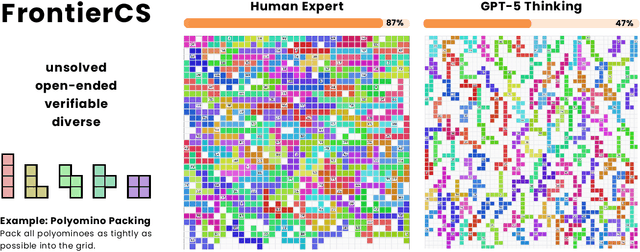

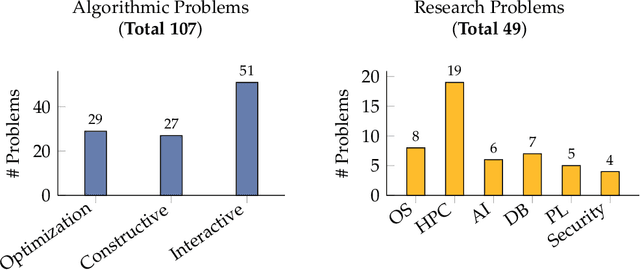

We introduce FrontierCS, a benchmark of 156 open-ended problems across diverse areas of computer science, designed and reviewed by experts, including CS PhDs and top-tier competitive programming participants and problem setters. Unlike existing benchmarks that focus on tasks with known optimal solutions, FrontierCS targets problems where the optimal solution is unknown, but the quality of a solution can be objectively evaluated. Models solve these tasks by implementing executable programs rather than outputting a direct answer. FrontierCS includes algorithmic problems, which are often NP-hard variants of competitive programming problems with objective partial scoring, and research problems with the same property. For each problem we provide an expert reference solution and an automatic evaluator. Combining open-ended design, measurable progress, and expert curation, FrontierCS provides a benchmark at the frontier of computer-science difficulty. Empirically, we find that frontier reasoning models still lag far behind human experts on both the algorithmic and research tracks, that increasing reasoning budgets alone does not close this gap, and that models often over-optimize for generating merely workable code instead of discovering high-quality algorithms and system designs.
Autocomp: LLM-Driven Code Optimization for Tensor Accelerators
May 24, 2025Hardware accelerators, especially those designed for tensor processing, have become ubiquitous in today's computing landscape. However, even with significant efforts in building compilers, programming these tensor accelerators remains challenging, leaving much of their potential underutilized. Recently, large language models (LLMs), trained on large amounts of code, have shown significant promise in code generation and optimization tasks, but generating low-resource languages like specialized tensor accelerator code still poses a significant challenge. We tackle this challenge with Autocomp, an approach that empowers accelerator programmers to leverage domain knowledge and hardware feedback to optimize code via an automated LLM-driven search. We accomplish this by: 1) formulating each optimization pass as a structured two-phase prompt, divided into planning and code generation phases, 2) inserting domain knowledge during planning via a concise and adaptable optimization menu, and 3) integrating correctness and performance metrics from hardware as feedback at each search iteration. Across three categories of representative workloads and two different accelerators, we demonstrate that Autocomp-optimized code runs 5.6x (GEMM) and 2.7x (convolution) faster than the vendor-provided library, and outperforms expert-level hand-tuned code by 1.4x (GEMM), 1.1x (convolution), and 1.3x (fine-grained linear algebra). Additionally, we demonstrate that optimization schedules generated from Autocomp can be reused across similar tensor operations, improving speedups by up to 24% under a fixed sample budget.
TWIX: Automatically Reconstructing Structured Data from Templatized Documents
Jan 11, 2025
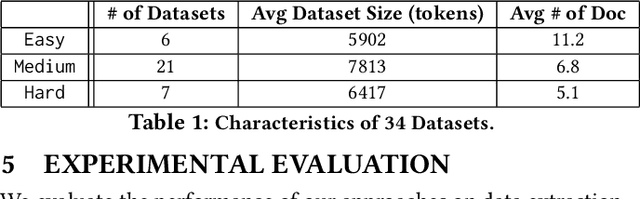


Many documents, that we call templatized documents, are programmatically generated by populating fields in a visual template. Effective data extraction from these documents is crucial to supporting downstream analytical tasks. Current data extraction tools often struggle with complex document layouts, incur high latency and/or cost on large datasets, and often require significant human effort, when extracting tables or values given user-specified fields from documents. The key insight of our tool, TWIX, is to predict the underlying template used to create such documents, modeling the visual and structural commonalities across documents. Data extraction based on this predicted template provides a more principled, accurate, and efficient solution at a low cost. Comprehensive evaluations on 34 diverse real-world datasets show that uncovering the template is crucial for data extraction from templatized documents. TWIX achieves over 90% precision and recall on average, outperforming tools from industry: Textract and Azure Document Intelligence, and vision-based LLMs like GPT-4-Vision, by over 25% in precision and recall. TWIX scales easily to large datasets and is 734X faster and 5836X cheaper than vision-based LLMs for extracting data from a large document collection with 817 pages.
LLM-Aided Compilation for Tensor Accelerators
Aug 06, 2024Hardware accelerators, in particular accelerators for tensor processing, have many potential application domains. However, they currently lack the software infrastructure to support the majority of domains outside of deep learning. Furthermore, a compiler that can easily be updated to reflect changes at both application and hardware levels would enable more agile development and design space exploration of accelerators, allowing hardware designers to realize closer-to-optimal performance. In this work, we discuss how large language models (LLMs) could be leveraged to build such a compiler. Specifically, we demonstrate the ability of GPT-4 to achieve high pass rates in translating code to the Gemmini accelerator, and prototype a technique for decomposing translation into smaller, more LLM-friendly steps. Additionally, we propose a 2-phase workflow for utilizing LLMs to generate hardware-optimized code.