 Add to Chrome
 Add to Firefox
 Add to Edge
PiDDM: Physics-Informed Differentiable Degradation Modeling for Lithium-Ion Battery State-of-Health Prediction
Jul 31, 2026
Accurate prediction of lithium-ion battery state of health (SOH) is essential for reliable energy storage operation. However, purely data-driven models may generalize poorly across cycling protocols and produce physically implausible behavior during long-term extrapolation. We developed a physics-informed differentiable degradation modeling framework (PiDDM) for battery SOH prediction. PiDDM incorporates empirical Arrhenius degradation kinetics associated with solid electrolyte interphase growth and loss of lithium inventory into the training objective, encouraging physically consistent capacity fade under diverse operating conditions. The framework was evaluated using a public dataset of 55 batteries cycled under six operating protocols. PiDDM achieved the lowest average prediction error among the evaluated models and substantially reduced mean squared error relative to a multilayer perceptron and a baseline physics-informed neural network. For extrapolation, the models were trained on the first 90% of each battery's cycle life and evaluated on the unseen final 10%. PiDDM captured accelerated end-of-life degradation while avoiding the nonphysical capacity regeneration produced by the baseline models. These results show that incorporating degradation physics into neural network training improves predictive accuracy and physical consistency, providing a promising approach for practical battery health monitoring.

A Multi-Resolution Finite-Volume Inspired Deep Learning Framework for Spatiotemporal Dynamics Prediction
Jul 01, 2026Predicting complex spatiotemporal dynamics in physical processes often demands computationally expensive numerical methods or data-driven neural networks that suffer from high training costs, error accumulation, and limited generalizability to unseen parameters. An effective approach to address these challenges is leveraging physics priors in training neural networks, known as physics-informed deep learning (PiDL). In this work, we introduce the Multi-Resolution Finite-Volume-inspired network, MuRFiV, designed to capitalize on the conservative property of finite volume on the global scale and the expressive power of deep learning on the local scale. We demonstrate the effectiveness of MuRFiV on several spatio-temporal systems governed by partial differential equations (PDEs), including Burgers' equation, shallow water equations, and incompressible Navier-Stokes equations. By embedding PDE information into the deep learning architecture, MuRFiV achieves strong long-term prediction accuracy and remains stable over very long autoregressive rollouts, significantly outperforming data-driven neural network baselines. This result highlights the promise of combining multiresolution learning with finite-volume-inspired inductive bias for accurate and robust long-term prediction of complex dynamics.
Offline Reinforcement Learning for Fluid Controls: Data-based Multi-observational Policy Extraction
Jun 30, 2026Active flow control is a fundamental application in engineering. Recent advances in deep reinforcement learning have made progress in this field. However, the classical online RL approaches require extensive real-time interactions with the high fidelity environment, while each sensor configuration change necessitates whole policy retraining. All these factors result in prohibitive computational costs for real-world applications. In this work, we propose a novel offline RL framework that addresses both challenges through data-driven policy extraction. We develop a sensor position-conditioned architecture that enables a single policy network to adapt seamlessly to multiple sensor arrangements. The position-conditioned approach incorporated spatial relationship modeling through Point Attention layers to ensure the generalizability to varying sensor placements. We demonstrate the framework on two representative problems, mitigating chaoticity in the Kuramoto-Sivashinsky equation and flow control over airfoils governed by the Navier-Stokes equation. The result demonstrates that the policy extraction from the dataset provides unprecedented flexibility for sensor placement optimization. This approach represents a significant step towards adaptive, intelligent flow control systems.
Patched Flow Matching: Generative Wall-Pressure Reconstruction Beyond Training-Domain Scales from Sparse Sensors
Jun 20, 2026Characterizing the complete wall-pressure spectrum in turbulent wall-bounded flows requires simultaneous access to the viscous-scale high-wavenumber content and the outer-layer low-wavenumber content -- a requirement that neither short-domain direct numerical simulation (DNS) nor sparse experimental measurements alone can satisfy. We propose Patched Flow Matching (Patched FM), a generative framework that fuses these two complementary sources by learning a patch-local prior over inner-scaled wall-pressure statistics from short-domain DNS and assimilating sparse sensor measurements at inference time through training-free posterior sampling. The patch-additive decomposition of the flow matching vector field decouples the generative prior from the global domain size, enabling reconstruction on domains arbitrarily larger than the training configuration. By expressing the patch prior in inner-scaled coordinates, where high-wavenumber wall-pressure statistics are approximately Reynolds-number invariant, the framework extends to higher Reynolds numbers through hierarchical transfer learning with as few as $500$ short-domain snapshots ($2.5\%$ of the base training data) at a fraction of the scratch-training cost. Applied to compressible channel-flow DNS at $Re_τ= 180$, $500$, and $1000$, Patched FM reconstructs full-resolution wall-pressure fields on a domain four times larger than the training configuration ($L_x^L = 16πδ$ versus $L_x^S = 4πδ$) from sensor coverage as low as $0.25\%$, recovering the low-wavenumber spectral content inaccessible to short-domain DNS with high fidelity in both streamwise and spanwise directions. Zero-shot generalization to unseen Reynolds numbers and ablation studies further confirm the role of inner scaling as a physical prerequisite for data-efficient Reynolds-number transfer.
D-Flow SGLD: Source-Space Posterior Sampling for Scientific Inverse Problems with Flow Matching
Feb 25, 2026Data assimilation and scientific inverse problems require reconstructing high-dimensional physical states from sparse and noisy observations, ideally with uncertainty-aware posterior samples that remain faithful to learned priors and governing physics. While training-free conditional generation is well developed for diffusion models, corresponding conditioning and posterior sampling strategies for Flow Matching (FM) priors remain comparatively under-explored, especially on scientific benchmarks where fidelity must be assessed beyond measurement misfit. In this work, we study training-free conditional generation for scientific inverse problems under FM priors and organize existing inference-time strategies by where measurement information is injected: (i) guided transport dynamics that perturb sampling trajectories using likelihood information, and (ii) source-distribution inference that performs posterior inference over the source variable while keeping the learned transport fixed. Building on the latter, we propose D-Flow SGLD, a source-space posterior sampling method that augments differentiable source inference with preconditioned stochastic gradient Langevin dynamics, enabling scalable exploration of the source posterior induced by new measurement operators without retraining the prior or modifying the learned FM dynamics. We benchmark representative methods from both families on a hierarchy of problems: 2D toy posteriors, chaotic Kuramoto-Sivashinsky trajectories, and wall-bounded turbulence reconstruction. Across these settings, we quantify trade-offs among measurement assimilation, posterior diversity, and physics/statistics fidelity, and establish D-Flow SGLD as a practical FM-compatible posterior sampler for scientific inverse problems.
Predicting Stress and Damage in Carbon Fiber-Reinforced Composites Deformation Process using Composite U-Net Surrogate Model
Apr 19, 2025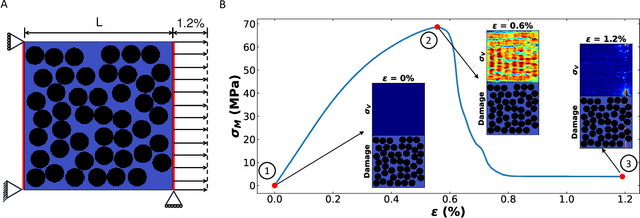
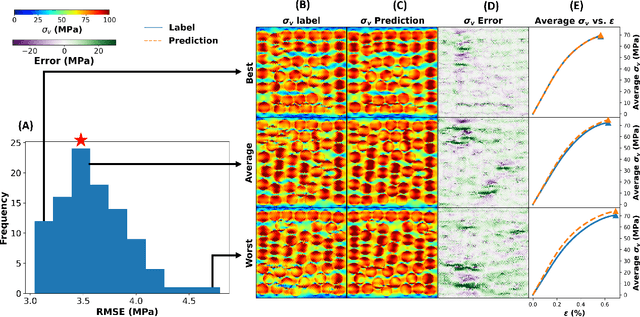
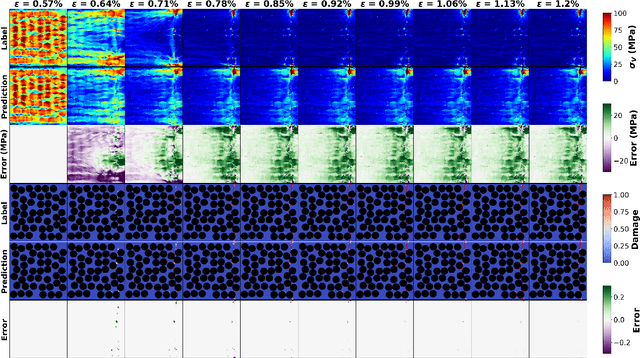
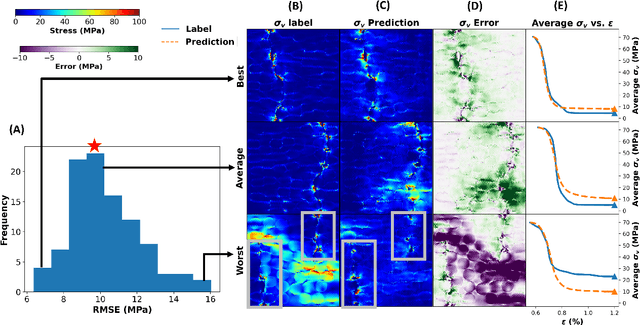
Carbon fiber-reinforced composites (CFRC) are pivotal in advanced engineering applications due to their exceptional mechanical properties. A deep understanding of CFRC behavior under mechanical loading is essential for optimizing performance in demanding applications such as aerospace structures. While traditional Finite Element Method (FEM) simulations, including advanced techniques like Interface-enriched Generalized FEM (IGFEM), offer valuable insights, they can struggle with computational efficiency. Existing data-driven surrogate models partially address these challenges by predicting propagated damage or stress-strain behavior but fail to comprehensively capture the evolution of stress and damage throughout the entire deformation history, including crack initiation and propagation. This study proposes a novel auto-regressive composite U-Net deep learning model to simultaneously predict stress and damage fields during CFRC deformation. By leveraging the U-Net architecture's ability to capture spatial features and integrate macro- and micro-scale phenomena, the proposed model overcomes key limitations of prior approaches. The model achieves high accuracy in predicting evolution of stress and damage distribution within the microstructure of a CFRC under unidirectional strain, offering a speed-up of over 60 times compared to IGFEM.
Multi-fidelity Reinforcement Learning Control for Complex Dynamical Systems
Apr 08, 2025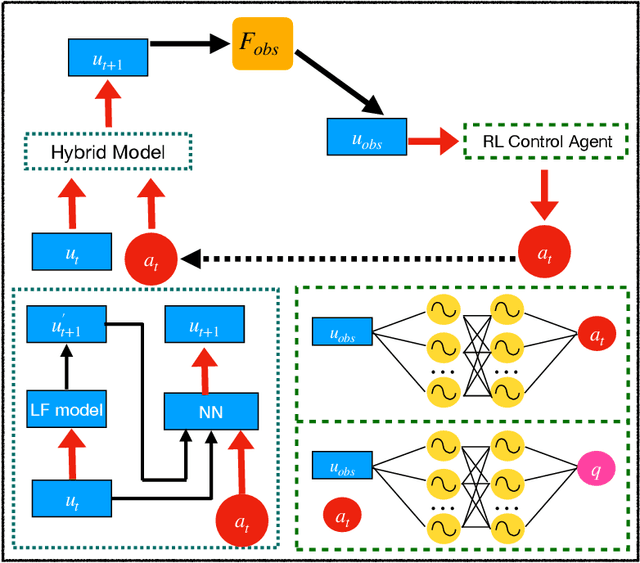
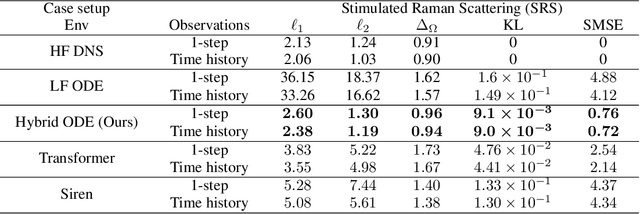
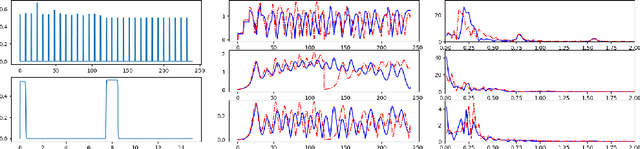
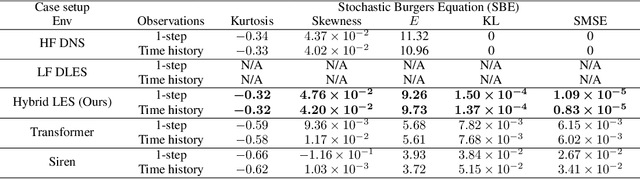
Controlling instabilities in complex dynamical systems is challenging in scientific and engineering applications. Deep reinforcement learning (DRL) has seen promising results for applications in different scientific applications. The many-query nature of control tasks requires multiple interactions with real environments of the underlying physics. However, it is usually sparse to collect from the experiments or expensive to simulate for complex dynamics. Alternatively, controlling surrogate modeling could mitigate the computational cost issue. However, a fast and accurate learning-based model by offline training makes it very hard to get accurate pointwise dynamics when the dynamics are chaotic. To bridge this gap, the current work proposes a multi-fidelity reinforcement learning (MFRL) framework that leverages differentiable hybrid models for control tasks, where a physics-based hybrid model is corrected by limited high-fidelity data. We also proposed a spectrum-based reward function for RL learning. The effect of the proposed framework is demonstrated on two complex dynamics in physics. The statistics of the MFRL control result match that computed from many-query evaluations of the high-fidelity environments and outperform other SOTA baselines.
Implicit Neural Differential Model for Spatiotemporal Dynamics
Apr 03, 2025Hybrid neural-physics modeling frameworks through differentiable programming have emerged as powerful tools in scientific machine learning, enabling the integration of known physics with data-driven learning to improve prediction accuracy and generalizability. However, most existing hybrid frameworks rely on explicit recurrent formulations, which suffer from numerical instability and error accumulation during long-horizon forecasting. In this work, we introduce Im-PiNDiff, a novel implicit physics-integrated neural differentiable solver for stable and accurate modeling of spatiotemporal dynamics. Inspired by deep equilibrium models, Im-PiNDiff advances the state using implicit fixed-point layers, enabling robust long-term simulation while remaining fully end-to-end differentiable. To enable scalable training, we introduce a hybrid gradient propagation strategy that integrates adjoint-state methods with reverse-mode automatic differentiation. This approach eliminates the need to store intermediate solver states and decouples memory complexity from the number of solver iterations, significantly reducing training overhead. We further incorporate checkpointing techniques to manage memory in long-horizon rollouts. Numerical experiments on various spatiotemporal PDE systems, including advection-diffusion processes, Burgers' dynamics, and multi-physics chemical vapor infiltration processes, demonstrate that Im-PiNDiff achieves superior predictive performance, enhanced numerical stability, and substantial reductions in memory and runtime cost relative to explicit and naive implicit baselines. This work provides a principled, efficient, and scalable framework for hybrid neural-physics modeling.
AI-Powered Automated Model Construction for Patient-Specific CFD Simulations of Aortic Flows
Mar 16, 2025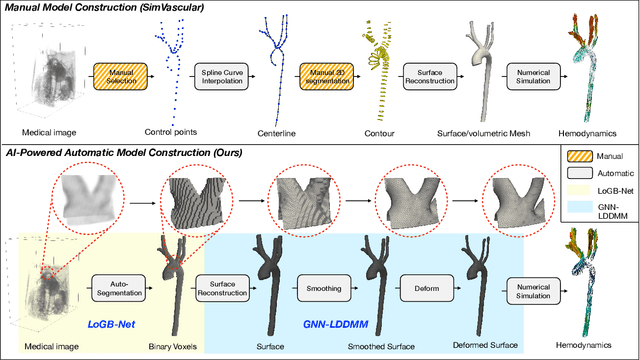


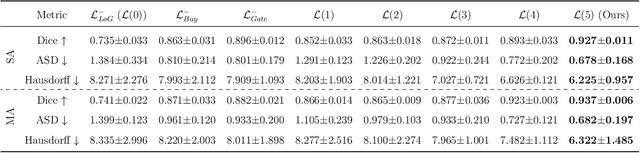
Image-based modeling is essential for understanding cardiovascular hemodynamics and advancing the diagnosis and treatment of cardiovascular diseases. Constructing patient-specific vascular models remains labor-intensive, error-prone, and time-consuming, limiting their clinical applications. This study introduces a deep-learning framework that automates the creation of simulation-ready vascular models from medical images. The framework integrates a segmentation module for accurate voxel-based vessel delineation with a surface deformation module that performs anatomically consistent and unsupervised surface refinements guided by medical image data. By unifying voxel segmentation and surface deformation into a single cohesive pipeline, the framework addresses key limitations of existing methods, enhancing geometric accuracy and computational efficiency. Evaluated on publicly available datasets, the proposed approach demonstrates state-of-the-art performance in segmentation and mesh quality while significantly reducing manual effort and processing time. This work advances the scalability and reliability of image-based computational modeling, facilitating broader applications in clinical and research settings.
Hierarchical LoG Bayesian Neural Network for Enhanced Aorta Segmentation
Jan 18, 2025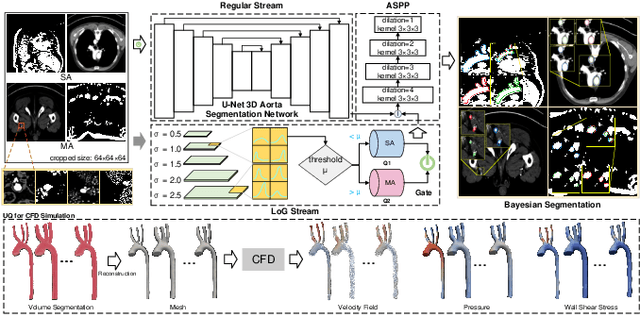



Accurate segmentation of the aorta and its associated arch branches is crucial for diagnosing aortic diseases. While deep learning techniques have significantly improved aorta segmentation, they remain challenging due to the intricate multiscale structure and the complexity of the surrounding tissues. This paper presents a novel approach for enhancing aorta segmentation using a Bayesian neural network-based hierarchical Laplacian of Gaussian (LoG) model. Our model consists of a 3D U-Net stream and a hierarchical LoG stream: the former provides an initial aorta segmentation, and the latter enhances blood vessel detection across varying scales by learning suitable LoG kernels, enabling self-adaptive handling of different parts of the aorta vessels with significant scale differences. We employ a Bayesian method to parameterize the LoG stream and provide confidence intervals for the segmentation results, ensuring robustness and reliability of the prediction for vascular medical image analysts. Experimental results show that our model can accurately segment main and supra-aortic vessels, yielding at least a 3% gain in the Dice coefficient over state-of-the-art methods across multiple volumes drawn from two aorta datasets, and can provide reliable confidence intervals for different parts of the aorta. The code is available at https://github.com/adlsn/LoGBNet.