 Add to Chrome
 Add to Firefox
 Add to Edge
CABLE: Extending the Reach of Memory Retrieval via Complementary Antecedent-Based Linking and Expansion
Aug 18, 2026
As LLM agents operate across structured workflows and sessions, preserving long-term history does not ensure that later contexts can recover relevant evidence through a bounded memory interface. We study this evidence-reachability problem in long-term conversational memory, where retrieval still relies heavily on semantic similarity. This works well for topical recall, but it often misses earlier experiences, plans, or motivations that are semantically distant from the later events they help explain. Existing memory graphs provide cross-memory structure, yet links driven mainly by semantic overlap can duplicate what the host retriever already recovers. We argue that link construction should instead prioritize a sparse set of retriever-complementary associations. We present CABLE (Complementary Antecedent-Based Linking and Expansion), a plug-in augmentation that constructs links designed to extend the host retriever's direct semantic reach. For each new memory, CABLE generates antecedent-oriented queries, retrieves prior memories, subtracts candidates in the direct semantic neighborhood, and verifies the remainder before adding the accepted complementary associations into a sparse directed graph. At retrieval time, CABLE expands the host system's retrieved seeds along these links to surface implicit supporting evidence. We evaluate CABLE with A-MEM on LoCoMo and MA-LongMemEval, and further integrate it into SimpleMem and Mem0g on LoCoMo, using Qwen3.5-27B, DeepSeek-chat, and GPT-4o-mini. CABLE yields higher mean LLM-judge scores in every evaluated system-level setting, with the largest gains in categories where useful evidence is distributed across memories or sessions, including open-domain, multi-session, and preference-oriented questions. These results support prioritizing sparse, reasoning-relevant associations that complement rather than duplicate the host retriever.

The Cost of Knowing: A Resource-Aware Protocol for Benchmarking Hallucination Beyond Static Leaderboards
Jul 27, 2026On standard factuality tasks, frontier models now cluster near the top of the scale. The question is therefore shifting from how factual a system is toward how much compute that factuality costs. Static leaderboards score factuality in isolation and treat compute as free, so they cannot tell a genuinely better system apart from one that simply spends more. Consider a ranking reversal. A brute-force Best-of-4 agent posts the higher raw factuality score (H-Score 0.9169 vs 0.9103) and would top a static leaderboard, but once cost is counted it is the worse system, losing on Q-Score (0.5169 vs 0.5217) at roughly four times the tokens and latency, under a reported cost weight whose sensitivity we sweep. So the system that tops a static leaderboard can be the worse one to deploy. To make this trade-off visible, we introduce MAS-HQ (Multi-Agent System Hallucination Quest), a resource-aware evaluation protocol. It wraps any factuality detector and normalizes for cost, and it pits systems against each other rather than scoring them in isolation. The Q-Score measures factuality minus normalized cost under a competitive match. Across summarization and open-domain QA, single-agent baselines drift into resource-heavy over-optimization, while competition elicits more resource-efficient policies. These gains are small but consistent, and stable across 100 trials. The axis stays discriminative for frontier systems (Gemini-2.5-Pro, and GPT-5 in simulated preview) whose raw factuality scores are already bunched near the ceiling. MAS-HQ provides a reproducible way to measure how much a factual answer costs.
LU-500: A Logo Benchmark for Concept Unlearning
Jul 27, 2026Concept unlearning is increasingly used to limit the reproduction of protected or unsafe visual concepts in text-to-image models. Existing evaluations, however, mostly study targets that dominate the whole image, such as styles, broad object categories, or portrait-like identities, leaving company logos comparatively underexamined. Logos create a different failure mode: a small localized mark can carry the entire protected concept, must be visually precise to remain recognizable, and can be triggered implicitly by products, storefronts, packaging, or advertisements even when the word ``logo'' is absent. We introduce LU-500, a logo-unlearning benchmark built from Fortune Global 500 companies to study this localized and semantically entangled setting. LU-500 contains nearly 10,000 curated text-query and logo-image pairs, with an explicit track (LUex-500) and an implicit contextual track (LUim-500). To avoid reducing the task to a binary detector score, we define a multi-grained protocol that evaluates both local logo removal and global image preservation in pixel and latent spaces. Experiments on representative inference-time methods, including NP, SLD, and SEGA, and compatible fine-tuning-based methods such as ESD and Forget-Me-Not, show that the evaluated methods struggle to remove logo evidence without changing non-target content. We further analyze ProLU, a prompt-space multi-agent baseline: it improves local erasure by removing logo-inducing semantics, but also illustrates why prompt filtering is not a substitute for weight-level disentanglement. Correlation analyses over logo area, location, and structural complexity suggest that future logo unlearning may need spatially aware controls, such as SSIM-guided constraints, rather than purely global concept suppression.
TadA-Bench: A Million-Variant Benchmark for Future-Round Discovery Toward Agentic Protein Engineering
May 29, 2026AI for scientific discovery is entering an agentic era, where protein-engineering systems are expected to prioritize future wet-lab experiments rather than merely fit static measurements. We introduce TadA-Bench, a million-variant wet-lab replay benchmark from 31 TadA directed-evolution rounds for future-round discovery toward agentic protein engineering. TadA-Bench preserves the campaign chronology and defines a fixed-data replay task: given earlier experimental rounds, models rank variants that appear only in later rounds. It provides aligned DNA, RNA, and protein views, and uses Seq2Graph, a graph-based label-unification pipeline, to reconcile noisy enrichment measurements into consistent cross-round activity labels. Random-split controls show strong interpolation, but future-round ranking and finite-budget candidate selection are much weaker. Controlled analyses suggest that evolutionary coverage is more informative than local data density, positioning TadA-Bench as a reproducible wet-lab replay substrate for future-round discovery toward agentic protein engineering; the data and code are released on Hugging Face and GitHub.
Aligned Agents, Biased Swarm: Measuring Bias Amplification in Multi-Agent Systems
Apr 13, 2026While Multi-Agent Systems (MAS) are increasingly deployed for complex workflows, their emergent properties-particularly the accumulation of bias-remain poorly understood. Because real-world MAS are too complex to analyze entirely, evaluating their ethical robustness requires first isolating their foundational mechanics. In this work, we conduct a baseline empirical study investigating how basic MAS topologies and feedback loops influence prejudice. Contrary to the assumption that multi-agent collaboration naturally dilutes bias, we hypothesize that structured workflows act as echo chambers, amplifying minor stochastic biases into systemic polarization. To evaluate this, we introduce Discrim-Eval-Open, an open-ended benchmark that bypasses individual model neutrality through forced comparative judgments across demographic groups. Analyzing bias cascades across various structures reveals that architectural sophistication frequently exacerbates bias rather than mitigating it. We observe systemic amplification even when isolated agents operate neutrally, and identify a 'Trigger Vulnerability' where injecting purely objective context drastically accelerates polarization. By stripping away advanced swarm complexity to study foundational dynamics, we establish a crucial baseline: structural complexity does not guarantee ethical robustness. Our code is available at https://github.com/weizhihao1/MAS-Bias.
Credit-Budgeted ICPC-Style Coding: When Agents Must Pay for Every Decision
Apr 11, 2026Current evaluations of autonomous coding agents assume an unrealistic, infinite-resource environment. However, real-world software engineering is a resource-bound competition. As we scale toward large agent swarms, ignoring compute and time costs risks catastrophic budget exhaustion. To shift the focus from isolated accuracy to cost-aware problem-solving, we introduce USACOArena, an interactive ACM-ICPC-style arena driven by a strict "credit" economy. Every generated token, local test, and elapsed second depletes a fixed budget, forcing agents to make strategic trade-offs. Our comprehensive profiling reveals that frontier single agents and swarms currently fail to optimally balance accuracy with these constraints, exhibiting divergent, path-dependent behaviors. Ultimately, USACOArena provides an essential dynamic training ground for developing highly efficient, resource-aware agent architectures.
Learning Native Continuation for Action Chunking Flow Policies
Feb 13, 2026Action chunking enables Vision Language Action (VLA) models to run in real time, but naive chunked execution often exhibits discontinuities at chunk boundaries. Real-Time Chunking (RTC) alleviates this issue but is external to the policy, leading to spurious multimodal switching and trajectories that are not intrinsically smooth. We propose Legato, a training-time continuation method for action-chunked flow-based VLA policies. Specifically, Legato initializes denoising from a schedule-shaped mixture of known actions and noise, exposing the model to partial action information. Moreover, Legato reshapes the learned flow dynamics to ensure that the denoising process remains consistent between training and inference under per-step guidance. Legato further uses randomized schedule condition during training to support varying inference delays and achieve controllable smoothness. Empirically, Legato produces smoother trajectories and reduces spurious multimodal switching during execution, leading to less hesitation and shorter task completion time. Extensive real-world experiments show that Legato consistently outperforms RTC across five manipulation tasks, achieving approximately 10% improvements in both trajectory smoothness and task completion time.
daVinci-Agency: Unlocking Long-Horizon Agency Data-Efficiently
Feb 02, 2026While Large Language Models (LLMs) excel at short-term tasks, scaling them to long-horizon agentic workflows remains challenging. The core bottleneck lies in the scarcity of training data that captures authentic long-dependency structures and cross-stage evolutionary dynamics--existing synthesis methods either confine to single-feature scenarios constrained by model distribution, or incur prohibitive human annotation costs, failing to provide scalable, high-quality supervision. We address this by reconceptualizing data synthesis through the lens of real-world software evolution. Our key insight: Pull Request (PR) sequences naturally embody the supervision signals for long-horizon learning. They decompose complex objectives into verifiable submission units, maintain functional coherence across iterations, and encode authentic refinement patterns through bug-fix histories. Building on this, we propose daVinci-Agency, which systematically mines structured supervision from chain-of-PRs through three interlocking mechanisms: (1) progressive task decomposition via continuous commits, (2) long-term consistency enforcement through unified functional objectives, and (3) verifiable refinement from authentic bug-fix trajectories. Unlike synthetic trajectories that treat each step independently, daVinci-Agency's PR-grounded structure inherently preserves the causal dependencies and iterative refinements essential for teaching persistent goal-directed behavior and enables natural alignment with project-level, full-cycle task modeling. The resulting trajectories are substantial--averaging 85k tokens and 116 tool calls--yet remarkably data-efficient: fine-tuning GLM-4.6 on 239 daVinci-Agency samples yields broad improvements across benchmarks, notably achieving a 47% relative gain on Toolathlon. Beyond benchmark performance, our analysis confirms...
AgencyBench: Benchmarking the Frontiers of Autonomous Agents in 1M-Token Real-World Contexts
Jan 16, 2026Large Language Models (LLMs) based autonomous agents demonstrate multifaceted capabilities to contribute substantially to economic production. However, existing benchmarks remain focused on single agentic capability, failing to capture long-horizon real-world scenarios. Moreover, the reliance on human-in-the-loop feedback for realistic tasks creates a scalability bottleneck, hindering automated rollout collection and evaluation. To bridge this gap, we introduce AgencyBench, a comprehensive benchmark derived from daily AI usage, evaluating 6 core agentic capabilities across 32 real-world scenarios, comprising 138 tasks with specific queries, deliverables, and rubrics. These scenarios require an average of 90 tool calls, 1 million tokens, and hours of execution time to resolve. To enable automated evaluation, we employ a user simulation agent to provide iterative feedback, and a Docker sandbox to conduct visual and functional rubric-based assessment. Experiments reveal that closed-source models significantly outperform open-source models (48.4% vs 32.1%). Further analysis reveals significant disparities across models in resource efficiency, feedback-driven self-correction, and specific tool-use preferences. Finally, we investigate the impact of agentic scaffolds, observing that proprietary models demonstrate superior performance within their native ecosystems (e.g., Claude-4.5-Opus via Claude-Agent-SDK), while open-source models exhibit distinct performance peaks, suggesting potential optimization for specific execution frameworks. AgencyBench serves as a critical testbed for next-generation agents, highlighting the necessity of co-optimizing model architecture with agentic frameworks. We believe this work sheds light on the future direction of autonomous agents, and we release the full benchmark and evaluation toolkit at https://github.com/GAIR-NLP/AgencyBench.
Saying the Unsaid: Revealing the Hidden Language of Multimodal Systems Through Telephone Games
Nov 12, 2025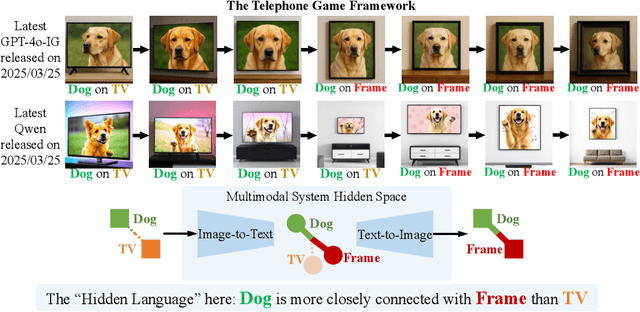
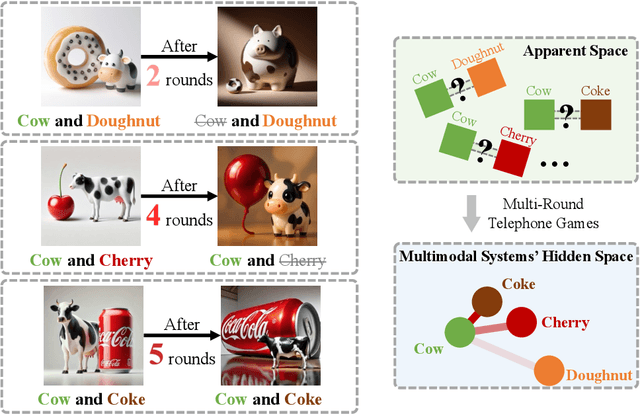
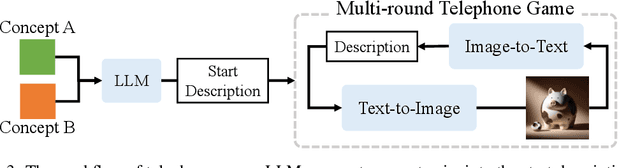
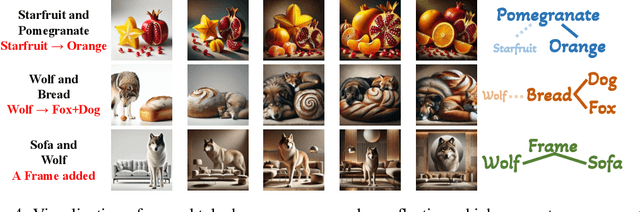
Recent closed-source multimodal systems have made great advances, but their hidden language for understanding the world remains opaque because of their black-box architectures. In this paper, we use the systems' preference bias to study their hidden language: During the process of compressing the input images (typically containing multiple concepts) into texts and then reconstructing them into images, the systems' inherent preference bias introduces specific shifts in the outputs, disrupting the original input concept co-occurrence. We employ the multi-round "telephone game" to strategically leverage this bias. By observing the co-occurrence frequencies of concepts in telephone games, we quantitatively investigate the concept connection strength in the understanding of multimodal systems, i.e., "hidden language." We also contribute Telescope, a dataset of 10,000+ concept pairs, as the database of our telephone game framework. Our telephone game is test-time scalable: By iteratively running telephone games, we can construct a global map of concept connections in multimodal systems' understanding. Here we can identify preference bias inherited from training, assess generalization capability advancement, and discover more stable pathways for fragile concept connections. Furthermore, we use Reasoning-LLMs to uncover unexpected concept relationships that transcend textual and visual similarities, inferring how multimodal systems understand and simulate the world. This study offers a new perspective on the hidden language of multimodal systems and lays the foundation for future research on the interpretability and controllability of multimodal systems.