 Add to Chrome
 Add to Firefox
 Add to Edge
LoomVideo: Unifying Multimodal Inputs into Video Generation and Editing
Jun 04, 2026
Developing unified video generation and editing models capable of interpreting interleaved multimodal inputs is a promising yet challenging frontier field. Existing unified frameworks predominantly rely on massive models (typically 13B parameters or more) and incorporate source video conditions for editing by concatenating sequence tokens. This concatenation inevitably doubles the sequence length, quadrupling the computational complexity of the self-attention mechanism and introducing prohibitive overhead. To address these bottlenecks, we present LoomVideo, a highly efficient 5B-parameter unified architecture for both video generation and editing. LoomVideo replaces the standard text encoder with a Multimodal Large Language Model (MLLM) and employs Deepstack injection mechanism to align multi-layer MLLM features with the Diffusion Transformer (DiT). Crucially, we introduce a zero-overhead Scale-and-Add conditioning approach for video editing. By scaling and directly adding the clean source video latent to the noised target latent, this elegant design eliminates the need for token concatenation, drastically reducing computational cost while maintaining robust capabilities for complex, non-rigid edits. Furthermore, a Negative Temporal RoPE strategy is seamlessly integrated to handle multiple reference images. Extensive experiments demonstrate that our compact 5B model achieves state-of-the-art or highly competitive performance across comprehensive benchmarks, exhibiting exceptional superiority in e-commerce and fashion generation scenarios. Benefiting from the zero-overhead conditioning mechanism, LoomVideo achieves at least a 5.41x acceleration in inference speed compared to models of similar capabilities, paving the way for highly practical and efficient video foundation models.

DynFrame: Adaptive Reasoning-Driven Multimodal Framework with Dynamic Frame Augmentation for Complex Video Understanding
May 26, 2026Recent video multimodal large language models (MLLMs) increasingly couple step-by-step reasoning with on-demand visual evidence retrieval, allowing models to revisit relevant video segments during inference. However, two structural gaps remain in existing thinking-with-video systems. (i) Sampling density is not a learnable decision: existing methods may let the model decide where to look, but the per-window frame rate is largely fixed. As a result, fine-grained evidence is often recovered through repeated retrieval calls, which increases inference context length and training difficulty. (ii) Retrieval and answer generation are usually optimized with a single trajectory-level advantage, so the "where to look" tokens and the "how to answer" tokens receive the same credit even when one is correct and the other is not. To address these gaps, we present DynFrame, a framework that emits the temporal window and the sampling density as native tokens within a single autoregressive pass. This learnable span-density retrieval enables acquiring multi-granularity evidence with a single retrieval step. Based on the above tokenized retrieval interface, we further introduce Segment-Decoupled GRPO (SD-GRPO), which splits each rollout at the retrieval boundary and assigns role-specific token-level advantages, separately crediting the sampling decision and the answer. Trained on the curated DM-CoT-74k and DM-RL-45k, DynFrame-4B is competitive with strong 7B-8B baselines across six benchmarks (NExT-GQA, Charades-STA, ActivityNet-MR, Video-MME, MLVU, LVBench), and DynFrame-8B sets new state-of-the-art on most metrics. Code is available at https://github.com/zhangguanghao523/DynFrame.
When Reasoning Supervision Hurts: TTCW-Based Long-Form Literary Review Generation
May 19, 2026Automatic evaluation of long-form literary writing remains challenging, as generic LLM-as-Judge approaches may not fully capture creativity-related dimensions such as originality and flexibility. Although the Torrance Test of Creative Writing (TTCW) provides a structured creativity framework, and prior work has demonstrated reference-based TTCW evaluation at the pairwise level, no large-scale dataset exists for long-form TTCW-based literary review generation. We address this gap by constructing a dataset of 263,911 long-form stories, each annotated with scalar scores and meta-synthesised review comments across 14 TTCW-based dimensions. Using this dataset, we fine-tune Qwen3 models at two scales, 4B and 8B, under two conditions: with and without reasoning content. Results show that non-reasoning fine-tuning achieves stronger and more stable performance, with the best setting reaching an evaluation score of 0.6820. Further analysis shows that reasoning-supervised models are more prone to parse failures, often continuing with irrelevant or repetitive reasoning-style text rather than completing the required 14-metric review report. These results suggest that, for fixed-format rubric-based review generation, reasoning supervision is not straightforwardly beneficial, and precise metric-aligned scoring remains challenging even after task-specific fine-tuning.
PromptEcho: Annotation-Free Reward from Vision-Language Models for Text-to-Image Reinforcement Learning
Apr 14, 2026Reinforcement learning (RL) can improve the prompt following capability of text-to-image (T2I) models, yet obtaining high-quality reward signals remains challenging: CLIP Score is too coarse-grained, while VLM-based reward models (e.g., RewardDance) require costly human-annotated preference data and additional fine-tuning. We propose PromptEcho, a reward construction method that requires \emph{no} annotation and \emph{no} reward model training. Given a generated image and a guiding query, PromptEcho computes the token-level cross-entropy loss of a frozen VLM with the original prompt as the label, directly extracting the image-text alignment knowledge encoded during VLM pretraining. The reward is deterministic, computationally efficient, and improves automatically as stronger open-source VLMs become available. For evaluation, we develop DenseAlignBench, a benchmark of concept-rich dense captions for rigorously testing prompt following capability. Experimental results on two state-of-the-art T2I models (Z-Image and QwenImage-2512) demonstrate that PromptEcho achieves substantial improvements on DenseAlignBench (+26.8pp / +16.2pp net win rate), along with consistent gains on GenEval, DPG-Bench, and TIIFBench without any task-specific training. Ablation studies confirm that PromptEcho comprehensively outperforms inference-based scoring with the same VLM, and that reward quality scales with VLM size. We will open-source the trained models and the DenseAlignBench.
Alleviating Sparse Rewards by Modeling Step-Wise and Long-Term Sampling Effects in Flow-Based GRPO
Feb 06, 2026Deploying GRPO on Flow Matching models has proven effective for text-to-image generation. However, existing paradigms typically propagate an outcome-based reward to all preceding denoising steps without distinguishing the local effect of each step. Moreover, current group-wise ranking mainly compares trajectories at matched timesteps and ignores within-trajectory dependencies, where certain early denoising actions can affect later states via delayed, implicit interactions. We propose TurningPoint-GRPO (TP-GRPO), a GRPO framework that alleviates step-wise reward sparsity and explicitly models long-term effects within the denoising trajectory. TP-GRPO makes two key innovations: (i) it replaces outcome-based rewards with step-level incremental rewards, providing a dense, step-aware learning signal that better isolates each denoising action's "pure" effect, and (ii) it identifies turning points-steps that flip the local reward trend and make subsequent reward evolution consistent with the overall trajectory trend-and assigns these actions an aggregated long-term reward to capture their delayed impact. Turning points are detected solely via sign changes in incremental rewards, making TP-GRPO efficient and hyperparameter-free. Extensive experiments also demonstrate that TP-GRPO exploits reward signals more effectively and consistently improves generation. Demo code is available at https://github.com/YunzeTong/TurningPoint-GRPO.
Simple Yet Effective Selective Imputation for Incomplete Multi-view Clustering
Dec 11, 2025Incomplete multi-view data, where different views suffer from missing and unbalanced observations, pose significant challenges for clustering. Existing imputation-based methods attempt to estimate missing views to restore data associations, but indiscriminate imputation often introduces noise and bias, especially when the available information is insufficient. Imputation-free methods avoid this risk by relying solely on observed data, but struggle under severe incompleteness due to the lack of cross-view complementarity. To address this issue, we propose Informativeness-based Selective imputation Multi-View Clustering (ISMVC). Our method evaluates the imputation-relevant informativeness of each missing position based on intra-view similarity and cross-view consistency, and selectively imputes only when sufficient support is available. Furthermore, we integrate this selection with a variational autoencoder equipped with a mixture-of-Gaussians prior to learn clustering-friendly latent representations. By performing distribution-level imputation, ISMVC not only stabilizes the aggregation of posterior distributions but also explicitly models imputation uncertainty, enabling robust fusion and preventing overconfident reconstructions. Compared with existing cautious imputation strategies that depend on training dynamics or model feedback, our method is lightweight, data-driven, and model-agnostic. It can be readily integrated into existing IMC models as a plug-in module. Extensive experiments on multiple benchmark datasets under a more realistic and challenging unbalanced missing scenario demonstrate that our method outperforms both imputation-based and imputation-free approaches.
Boosting MLLM Reasoning with Text-Debiased Hint-GRPO
Mar 31, 2025MLLM reasoning has drawn widespread research for its excellent problem-solving capability. Current reasoning methods fall into two types: PRM, which supervises the intermediate reasoning steps, and ORM, which supervises the final results. Recently, DeepSeek-R1 has challenged the traditional view that PRM outperforms ORM, which demonstrates strong generalization performance using an ORM method (i.e., GRPO). However, current MLLM's GRPO algorithms still struggle to handle challenging and complex multimodal reasoning tasks (e.g., mathematical reasoning). In this work, we reveal two problems that impede the performance of GRPO on the MLLM: Low data utilization and Text-bias. Low data utilization refers to that GRPO cannot acquire positive rewards to update the MLLM on difficult samples, and text-bias is a phenomenon that the MLLM bypasses image condition and solely relies on text condition for generation after GRPO training. To tackle these problems, this work proposes Hint-GRPO that improves data utilization by adaptively providing hints for samples of varying difficulty, and text-bias calibration that mitigates text-bias by calibrating the token prediction logits with image condition in test-time. Experiment results on three base MLLMs across eleven datasets demonstrate that our proposed methods advance the reasoning capability of original MLLM by a large margin, exhibiting superior performance to existing MLLM reasoning methods. Our code is available at https://github.com/hqhQAQ/Hint-GRPO.
PatchDPO: Patch-level DPO for Finetuning-free Personalized Image Generation
Dec 04, 2024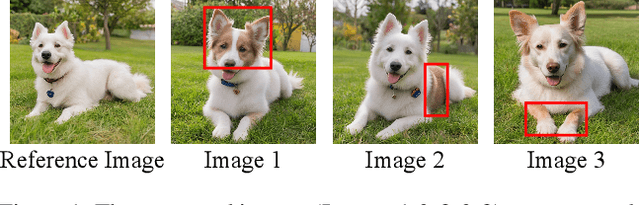


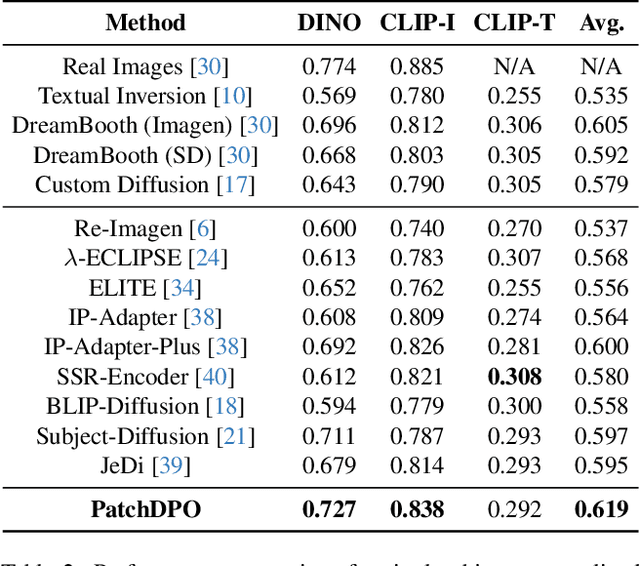
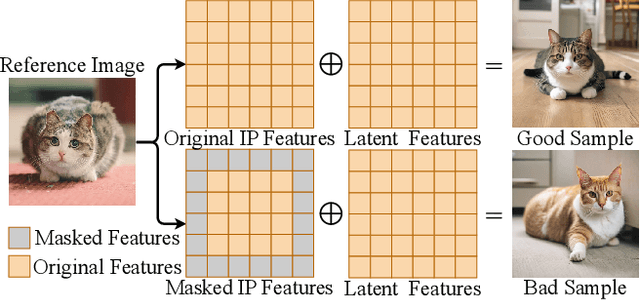
Finetuning-free personalized image generation can synthesize customized images without test-time finetuning, attracting wide research interest owing to its high efficiency. Current finetuning-free methods simply adopt a single training stage with a simple image reconstruction task, and they typically generate low-quality images inconsistent with the reference images during test-time. To mitigate this problem, inspired by the recent DPO (i.e., direct preference optimization) technique, this work proposes an additional training stage to improve the pre-trained personalized generation models. However, traditional DPO only determines the overall superiority or inferiority of two samples, which is not suitable for personalized image generation because the generated images are commonly inconsistent with the reference images only in some local image patches. To tackle this problem, this work proposes PatchDPO that estimates the quality of image patches within each generated image and accordingly trains the model. To this end, PatchDPO first leverages the pre-trained vision model with a proposed self-supervised training method to estimate the patch quality. Next, PatchDPO adopts a weighted training approach to train the model with the estimated patch quality, which rewards the image patches with high quality while penalizing the image patches with low quality. Experiment results demonstrate that PatchDPO significantly improves the performance of multiple pre-trained personalized generation models, and achieves state-of-the-art performance on both single-object and multi-object personalized image generation. Our code is available at https://github.com/hqhQAQ/PatchDPO.
Resolving Multi-Condition Confusion for Finetuning-Free Personalized Image Generation
Sep 26, 2024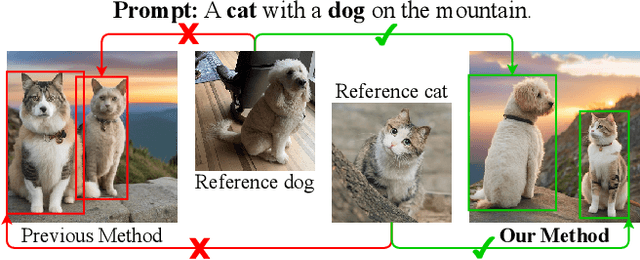

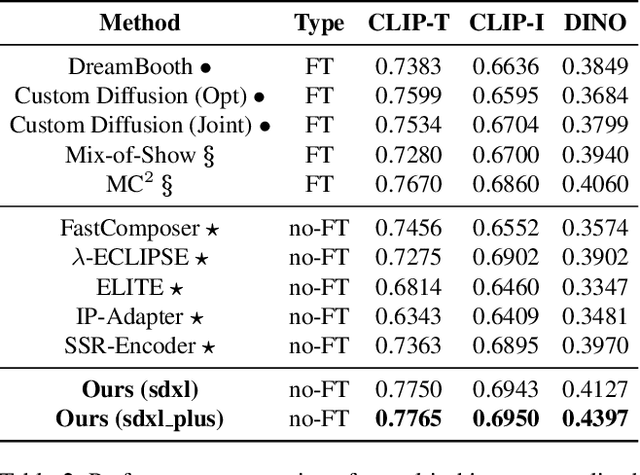
Personalized text-to-image generation methods can generate customized images based on the reference images, which have garnered wide research interest. Recent methods propose a finetuning-free approach with a decoupled cross-attention mechanism to generate personalized images requiring no test-time finetuning. However, when multiple reference images are provided, the current decoupled cross-attention mechanism encounters the object confusion problem and fails to map each reference image to its corresponding object, thereby seriously limiting its scope of application. To address the object confusion problem, in this work we investigate the relevance of different positions of the latent image features to the target object in diffusion model, and accordingly propose a weighted-merge method to merge multiple reference image features into the corresponding objects. Next, we integrate this weighted-merge method into existing pre-trained models and continue to train the model on a multi-object dataset constructed from the open-sourced SA-1B dataset. To mitigate object confusion and reduce training costs, we propose an object quality score to estimate the image quality for the selection of high-quality training samples. Furthermore, our weighted-merge training framework can be employed on single-object generation when a single object has multiple reference images. The experiments verify that our method achieves superior performance to the state-of-the-arts on the Concept101 dataset and DreamBooth dataset of multi-object personalized image generation, and remarkably improves the performance on single-object personalized image generation. Our code is available at https://github.com/hqhQAQ/MIP-Adapter.
Accelerating Large Batch Training via Gradient Signal to Noise Ratio (GSNR)
Sep 24, 2023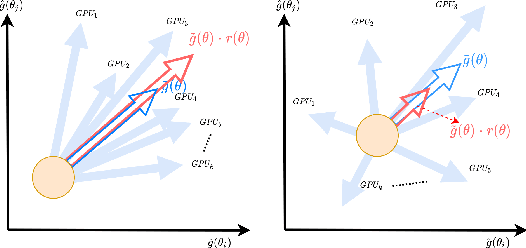
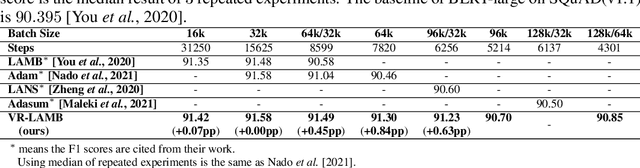
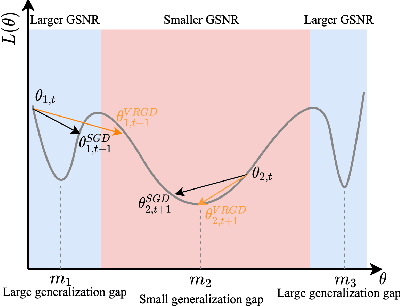

As models for nature language processing (NLP), computer vision (CV) and recommendation systems (RS) require surging computation, a large number of GPUs/TPUs are paralleled as a large batch (LB) to improve training throughput. However, training such LB tasks often meets large generalization gap and downgrades final precision, which limits enlarging the batch size. In this work, we develop the variance reduced gradient descent technique (VRGD) based on the gradient signal to noise ratio (GSNR) and apply it onto popular optimizers such as SGD/Adam/LARS/LAMB. We carry out a theoretical analysis of convergence rate to explain its fast training dynamics, and a generalization analysis to demonstrate its smaller generalization gap on LB training. Comprehensive experiments demonstrate that VRGD can accelerate training ($1\sim 2 \times$), narrow generalization gap and improve final accuracy. We push the batch size limit of BERT pretraining up to 128k/64k and DLRM to 512k without noticeable accuracy loss. We improve ImageNet Top-1 accuracy at 96k by $0.52pp$ than LARS. The generalization gap of BERT and ImageNet training is significantly reduce by over $65\%$.