 Add to Chrome
 Add to Firefox
 Add to Edge
Empowering Embodied Manipulation: A Bimanual-Mobile Robot Manipulation Dataset for Household Tasks
May 29, 2024


As Embodied AI advances, it increasingly enables robots to handle the complexity of household manipulation tasks more effectively. However, the application of robots in these settings remains limited due to the scarcity of bimanual-mobile robot manipulation datasets. Existing datasets either focus solely on simple grasping tasks using single-arm robots without mobility, or collect sensor data limited to a narrow scope of sensory inputs. As a result, these datasets often fail to encapsulate the intricate and dynamic nature of real-world tasks that bimanual-mobile robots are expected to perform. To address these limitations, we introduce BRMData, a Bimanual-mobile Robot Manipulation Dataset designed specifically for household applications. The dataset includes 10 diverse household tasks, ranging from simple single-arm manipulation to more complex dual-arm and mobile manipulations. It is collected using multi-view and depth-sensing data acquisition strategies. Human-robot interactions and multi-object manipulations are integrated into the task designs to closely simulate real-world household applications. Moreover, we present a Manipulation Efficiency Score (MES) metric to evaluate both the precision and efficiency of robot manipulation methods. BRMData aims to drive the development of versatile robot manipulation technologies, specifically focusing on advancing imitation learning methods from human demonstrations. The dataset is now open-sourced and available at https://embodiedrobot.github.io/, enhancing research and development efforts in the field of Embodied Manipulation.

NGM-SLAM: Gaussian Splatting SLAM with Radiance Field Submap
May 09, 2024Gaussian Splatting has garnered widespread attention due to its exceptional performance. Consequently, SLAM systems based on Gaussian Splatting have emerged, leveraging its capabilities for rapid real-time rendering and high-fidelity mapping. However, current Gaussian Splatting SLAM systems usually struggle with large scene representation and lack effective loop closure adjustments and scene generalization capabilities. To address these issues, we introduce NGM-SLAM, the first GS-SLAM system that utilizes neural radiance field submaps for progressive scene expression, effectively integrating the strengths of neural radiance fields and 3D Gaussian Splatting. We have developed neural implicit submaps as supervision and achieve high-quality scene expression and online loop closure adjustments through Gaussian rendering of fused submaps. Our results on multiple real-world scenes and large-scale scene datasets demonstrate that our method can achieve accurate gap filling and high-quality scene expression, supporting both monocular, stereo, and RGB-D inputs, and achieving state-of-the-art scene reconstruction and tracking performance.
Global Search Optics: Automatically Exploring Optimal Solutions to Compact Computational Imaging Systems
Apr 30, 2024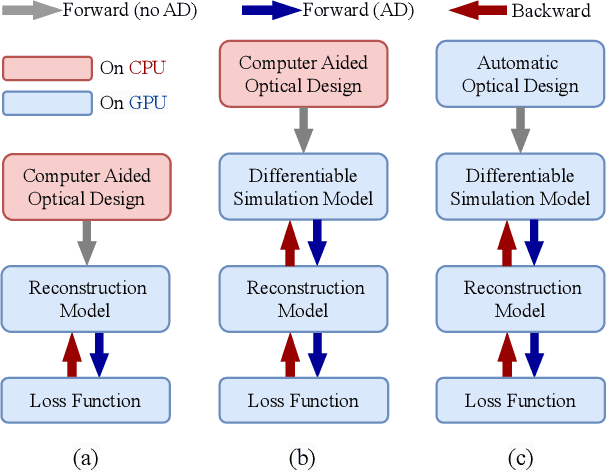
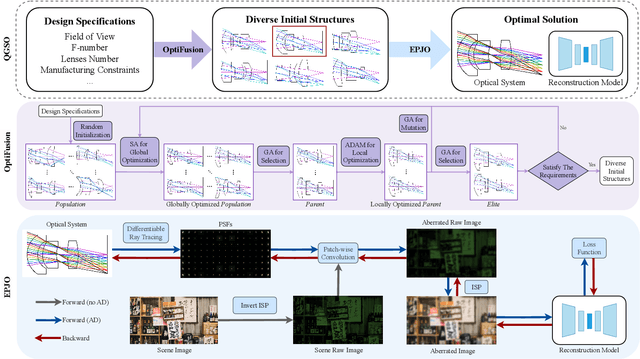
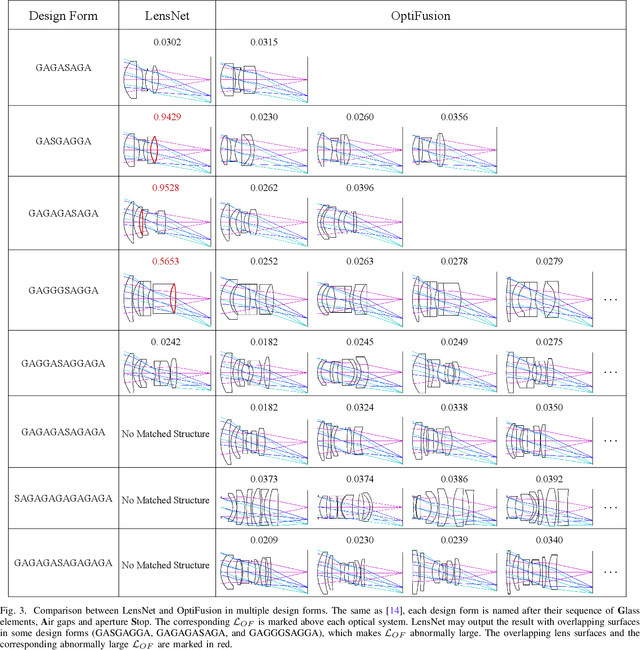
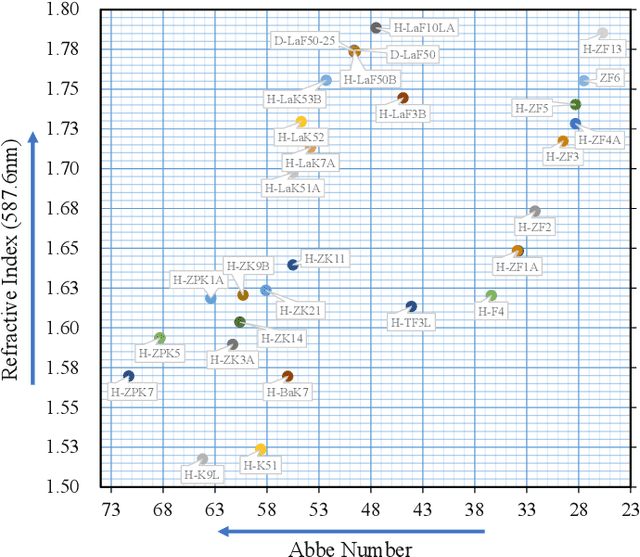
The popularity of mobile vision creates a demand for advanced compact computational imaging systems, which call for the development of both a lightweight optical system and an effective image reconstruction model. Recently, joint design pipelines come to the research forefront, where the two significant components are simultaneously optimized via data-driven learning to realize the optimal system design. However, the effectiveness of these designs largely depends on the initial setup of the optical system, complicated by a non-convex solution space that impedes reaching a globally optimal solution. In this work, we present Global Search Optics (GSO) to automatically design compact computational imaging systems through two parts: (i) Fused Optimization Method for Automatic Optical Design (OptiFusion), which searches for diverse initial optical systems under certain design specifications; and (ii) Efficient Physic-aware Joint Optimization (EPJO), which conducts parallel joint optimization of initial optical systems and image reconstruction networks with the consideration of physical constraints, culminating in the selection of the optimal solution. Extensive experimental results on the design of three-piece (3P) sphere computational imaging systems illustrate that the GSO serves as a transformative end-to-end lens design paradigm for superior global optimal structure searching ability, which provides compact computational imaging systems with higher imaging quality compared to traditional methods. The source code will be made publicly available at https://github.com/wumengshenyou/GSO.
AIS 2024 Challenge on Video Quality Assessment of User-Generated Content: Methods and Results
Apr 24, 2024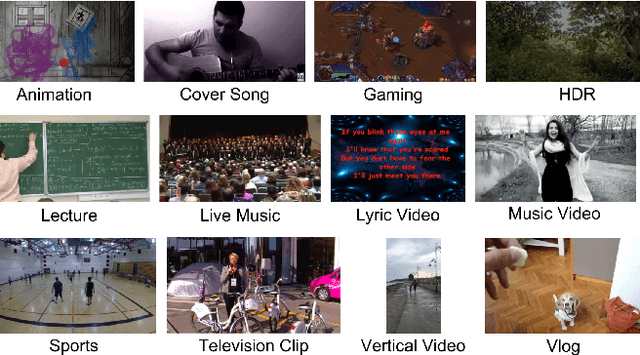


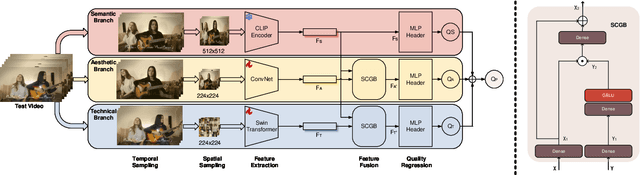
This paper reviews the AIS 2024 Video Quality Assessment (VQA) Challenge, focused on User-Generated Content (UGC). The aim of this challenge is to gather deep learning-based methods capable of estimating the perceptual quality of UGC videos. The user-generated videos from the YouTube UGC Dataset include diverse content (sports, games, lyrics, anime, etc.), quality and resolutions. The proposed methods must process 30 FHD frames under 1 second. In the challenge, a total of 102 participants registered, and 15 submitted code and models. The performance of the top-5 submissions is reviewed and provided here as a survey of diverse deep models for efficient video quality assessment of user-generated content.
NTIRE 2024 Challenge on Short-form UGC Video Quality Assessment: Methods and Results
Apr 17, 2024


This paper reviews the NTIRE 2024 Challenge on Shortform UGC Video Quality Assessment (S-UGC VQA), where various excellent solutions are submitted and evaluated on the collected dataset KVQ from popular short-form video platform, i.e., Kuaishou/Kwai Platform. The KVQ database is divided into three parts, including 2926 videos for training, 420 videos for validation, and 854 videos for testing. The purpose is to build new benchmarks and advance the development of S-UGC VQA. The competition had 200 participants and 13 teams submitted valid solutions for the final testing phase. The proposed solutions achieved state-of-the-art performances for S-UGC VQA. The project can be found at https://github.com/lixinustc/KVQChallenge-CVPR-NTIRE2024.
ODA: Observation-Driven Agent for integrating LLMs and Knowledge Graphs
Apr 11, 2024
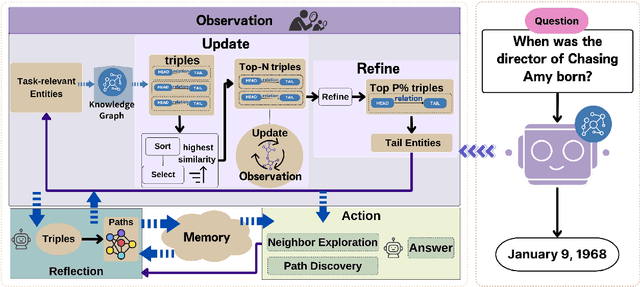
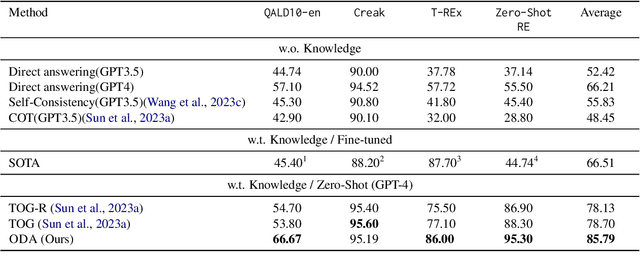
The integration of Large Language Models (LLMs) and knowledge graphs (KGs) has achieved remarkable success in various natural language processing tasks. However, existing methodologies that integrate LLMs and KGs often navigate the task-solving process solely based on the LLM's analysis of the question, overlooking the rich cognitive potential inherent in the vast knowledge encapsulated in KGs. To address this, we introduce Observation-Driven Agent (ODA), a novel AI agent framework tailored for tasks involving KGs. ODA incorporates KG reasoning abilities via global observation that enhances reasoning capabilities through a cyclical paradigm of observation, action, and reflection. Confronting the exponential explosion of knowledge during observation, we innovatively design a recursive observation mechanism. Subsequently, we integrate the observed knowledge into the action and reflection modules. Through extensive experiments, ODA demonstrates state-of-the-art performance on several datasets, notably achieving accuracy improvements of 12.87% and 8.9%.
Real-World Computational Aberration Correction via Quantized Domain-Mixing Representation
Mar 15, 2024Relying on paired synthetic data, existing learning-based Computational Aberration Correction (CAC) methods are confronted with the intricate and multifaceted synthetic-to-real domain gap, which leads to suboptimal performance in real-world applications. In this paper, in contrast to improving the simulation pipeline, we deliver a novel insight into real-world CAC from the perspective of Unsupervised Domain Adaptation (UDA). By incorporating readily accessible unpaired real-world data into training, we formalize the Domain Adaptive CAC (DACAC) task, and then introduce a comprehensive Real-world aberrated images (Realab) dataset to benchmark it. The setup task presents a formidable challenge due to the intricacy of understanding the target aberration domain. To this intent, we propose a novel Quntized Domain-Mixing Representation (QDMR) framework as a potent solution to the issue. QDMR adapts the CAC model to the target domain from three key aspects: (1) reconstructing aberrated images of both domains by a VQGAN to learn a Domain-Mixing Codebook (DMC) which characterizes the degradation-aware priors; (2) modulating the deep features in CAC model with DMC to transfer the target domain knowledge; and (3) leveraging the trained VQGAN to generate pseudo target aberrated images from the source ones for convincing target domain supervision. Extensive experiments on both synthetic and real-world benchmarks reveal that the models with QDMR consistently surpass the competitive methods in mitigating the synthetic-to-real gap, which produces visually pleasant real-world CAC results with fewer artifacts. Codes and datasets will be made publicly available.
SGE: Structured Light System Based on Gray Code with an Event Camera
Mar 12, 2024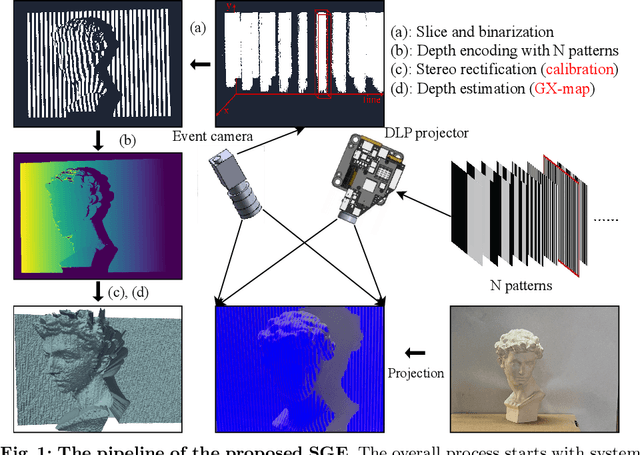

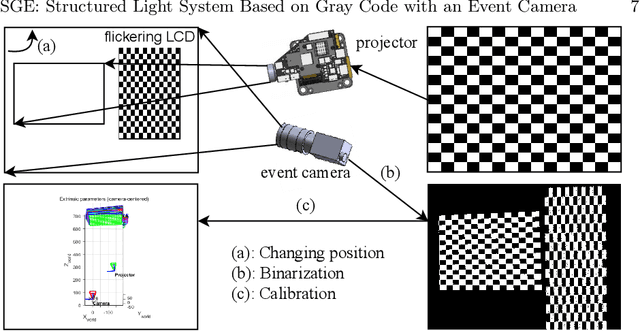
Fast and accurate depth sensing has long been a significant research challenge. Event camera, as a device that quickly responds to intensity changes, provides a new solution for structured light (SL) systems. In this paper, we introduce Gray code into event-based SL systems for the first time. Our setup includes an event camera and Digital Light Processing (DLP) projector, enabling depth estimation through high-speed projection and decoding of Gray code patterns. By employing spatio-temporal encoding for point matching, our method is immune to timestamp noise, realizing high-speed depth estimation without loss of accuracy. The binary nature of events and Gray code minimizes data redundancy, enabling us to fully utilize sensor bandwidth at 100%. Experimental results show that our approach achieves accuracy comparable to state-of-the-art scanning methods while surpassing them in data acquisition speed (up to 41 times improvement) without sacrificing accuracy. Our proposed approach offers a highly promising solution for ultra-fast, real-time, and high-precision dense depth estimation. Code and dataset will be publicly available.
Temporal-Mapping Photography for Event Cameras
Mar 11, 2024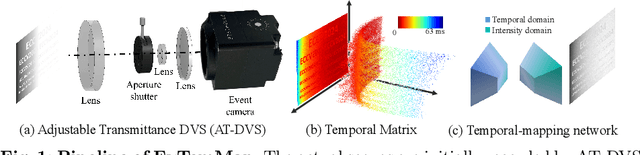
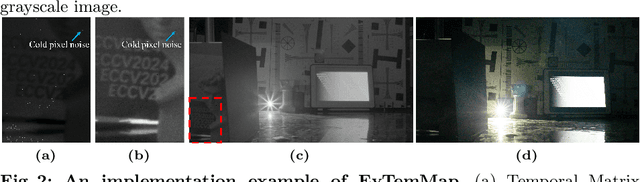
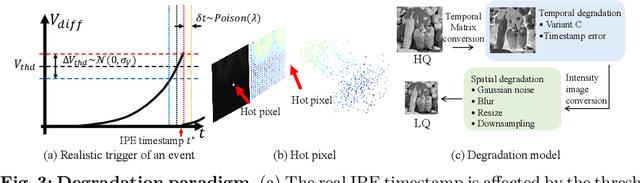
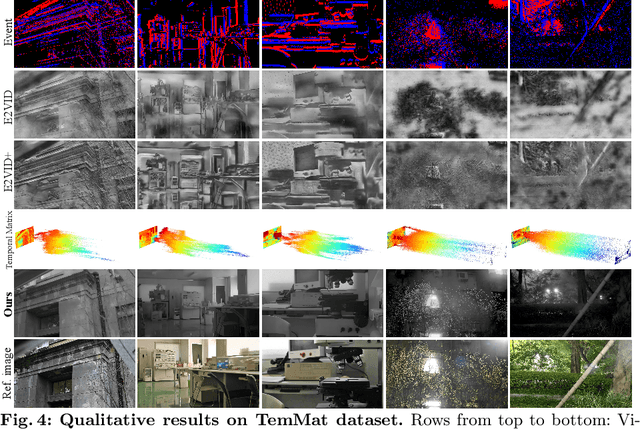
Event cameras, or Dynamic Vision Sensors (DVS) are novel neuromorphic sensors that capture brightness changes as a continuous stream of ``events'' rather than traditional intensity frames. Converting sparse events to dense intensity frames faithfully has long been an ill-posed problem. Previous methods have primarily focused on converting events to video in dynamic scenes or with a moving camera. In this paper, for the first time, we realize events to dense intensity image conversion using a stationary event camera in static scenes. Different from traditional methods that mainly rely on event integration, the proposed Event-Based Temporal Mapping Photography (EvTemMap) measures the time of event emitting for each pixel. Then, the resulting Temporal Matrix is converted to an intensity frame with a temporal mapping neural network. At the hardware level, the proposed EvTemMap is implemented by combining a transmittance adjustment device with a DVS, named Adjustable Transmittance Dynamic Vision Sensor. Additionally, we collected TemMat dataset under various conditions including low-light and high dynamic range scenes. The experimental results showcase the high dynamic range, fine-grained details, and high-grayscale-resolution of the proposed EvTemMap, as well as the enhanced performance on downstream computer vision tasks compared to other methods. The code and TemMat dataset will be made publicly available.
Detect-Order-Construct: A Tree Construction based Approach for Hierarchical Document Structure Analysis
Jan 22, 2024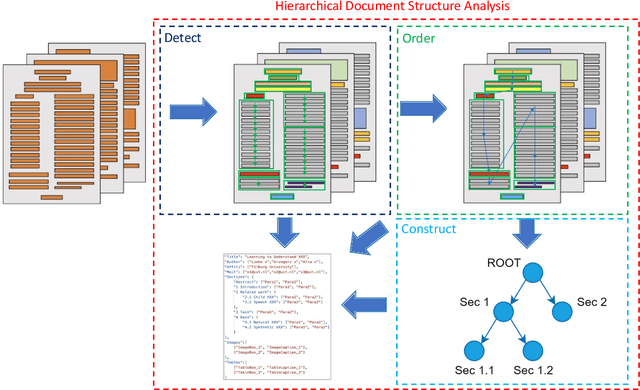
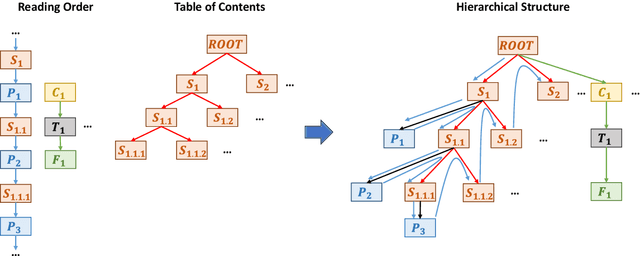
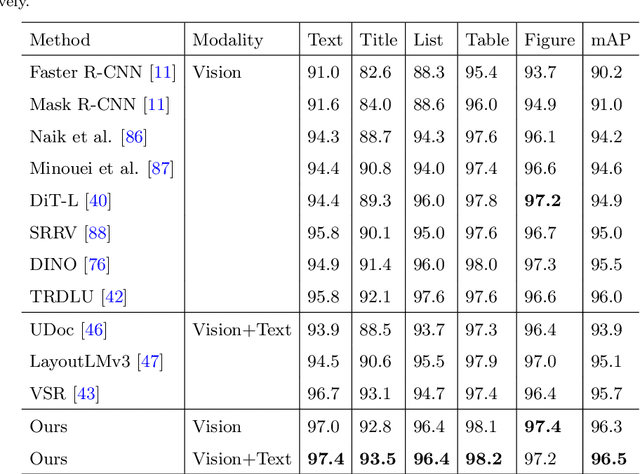
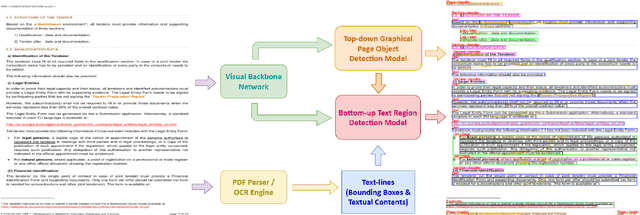
Document structure analysis (aka document layout analysis) is crucial for understanding the physical layout and logical structure of documents, with applications in information retrieval, document summarization, knowledge extraction, etc. In this paper, we concentrate on Hierarchical Document Structure Analysis (HDSA) to explore hierarchical relationships within structured documents created using authoring software employing hierarchical schemas, such as LaTeX, Microsoft Word, and HTML. To comprehensively analyze hierarchical document structures, we propose a tree construction based approach that addresses multiple subtasks concurrently, including page object detection (Detect), reading order prediction of identified objects (Order), and the construction of intended hierarchical structure (Construct). We present an effective end-to-end solution based on this framework to demonstrate its performance. To assess our approach, we develop a comprehensive benchmark called Comp-HRDoc, which evaluates the above subtasks simultaneously. Our end-to-end system achieves state-of-the-art performance on two large-scale document layout analysis datasets (PubLayNet and DocLayNet), a high-quality hierarchical document structure reconstruction dataset (HRDoc), and our Comp-HRDoc benchmark. The Comp-HRDoc benchmark will be released to facilitate further research in this field.