 Add to Chrome
 Add to Firefox
 Add to Edge
Learning Interpretable Point-Based Clinical Risk Scores via Direct Optimization
May 18, 2026
Many clinical risk scores are deployed as additive rules with nonnegative integer points assigned to relevant binary predictive features. These integer weights not only make the score easier to use in practice but also promote sparsity in the resulting prediction model. Such risk scores are often derived by first fitting a regression model and then rounding the estimated coefficients to the nearest integer after appropriate scaling. This approach is computationally fast but does not guarantee optimality of the resulting score. Alternatively, one may search over all possible integer weights to directly optimize a value function by posing the problem as an integer programming task. However, the associated computational burden can be substantial, especially when the value function is nonconcave or even discontinuous. In this paper, we develop new machine learning algorithms that employ a flexible greedy optimization strategy to learn such additive scoring directly under explicit and sensible optimality objectives. We apply the proposed method to a large electronic health record (EHR) cohort in Epic Cosmos to construct an integer-weighted comorbidity score for measuring the risk of post-discharge mortality. We also conduct a simulation study to examine the finite-sample operating characteristics.

Cost-optimal Sequential Testing via Doubly Robust Q-learning
Apr 13, 2026Clinical decision-making often involves selecting tests that are costly, invasive, or time-consuming, motivating individualized, sequential strategies for what to measure and when to stop ascertaining. We study the problem of learning cost-optimal sequential decision policies from retrospective data, where test availability depends on prior results, inducing informative missingness. Under a sequential missing-at-random mechanism, we develop a doubly robust Q-learning framework for estimating optimal policies. The method introduces path-specific inverse probability weights that account for heterogeneous test trajectories and satisfy a normalization property conditional on the observed history. By combining these weights with auxiliary contrast models, we construct orthogonal pseudo-outcomes that enable unbiased policy learning when either the acquisition model or the contrast model is correctly specified. We establish oracle inequalities for the stage-wise contrast estimators, along with convergence rates, regret bounds, and misclassification rates for the learned policy. Simulations demonstrate improved cost-adjusted performance over weighted and complete-case baselines, and an application to a prostate cancer cohort study illustrates how the method reduces testing cost without compromising predictive accuracy.
Efficient and Debiased Learning of Average Hazard Under Non-Proportional Hazards
Feb 13, 2026The hazard ratio from the Cox proportional hazards model is a ubiquitous summary of treatment effect. However, when hazards are non-proportional, the hazard ratio can lose a stable causal interpretation and become study-dependent because it effectively averages time-varying effects with weights determined by follow-up and censoring. We consider the average hazard (AH) as an alternative causal estimand: a population-level person-time event rate that remains well-defined and interpretable without assuming proportional hazards. Although AH can be estimated nonparametrically and regression-style adjustments have been proposed, existing approaches do not provide a general framework for flexible, high-dimensional nuisance estimation with valid sqrt{n} inference. We address this gap by developing a semiparametric, doubly robust framework for covariate-adjusted AH. We establish pathwise differentiability of AH in the nonparametric model, derive its efficient influence function, and construct cross-fitted, debiased estimators that leverage machine learning for nuisance estimation while retaining asymptotically normal, sqrt{n}-consistent inference under mild product-rate conditions. Simulations demonstrate that the proposed estimator achieves small bias and near-nominal confidence-interval coverage across proportional and non-proportional hazards settings, including crossing-hazards regimes where Cox-based summaries can be unstable. We illustrate practical utility in comparative effectiveness research by comparing immunotherapy regimens for advanced melanoma using SEER-Medicare linked data.
GRIP2: A Robust and Powerful Deep Knockoff Method for Feature Selection
Jan 30, 2026Identifying truly predictive covariates while strictly controlling false discoveries remains a fundamental challenge in nonlinear, highly correlated, and low signal-to-noise regimes, where deep learning based feature selection methods are most attractive. We propose Group Regularization Importance Persistence in 2 Dimensions (GRIP2), a deep knockoff feature importance statistic that integrates first-layer feature activity over a two-dimensional regularization surface controlling both sparsity strength and sparsification geometry. To approximate this surface integral in a single training run, we introduce efficient block-stochastic sampling, which aggregates feature activity magnitudes across diverse regularization regimes along the optimization trajectory. The resulting statistics are antisymmetric by construction, ensuring finite-sample FDR control. In extensive experiments on synthetic and semi-real data, GRIP2 demonstrates improved robustness to feature correlation and noise level: in high correlation and low signal-to-noise ratio regimes where standard deep learning based feature selectors may struggle, our method retains high power and stability. Finally, on real-world HIV drug resistance data, GRIP2 recovers known resistance-associated mutations with power better than established linear baselines, confirming its reliability in practice.
Automatic and Structure-Aware Sparsification of Hybrid Neural ODEs
May 25, 2025Hybrid neural ordinary differential equations (neural ODEs) integrate mechanistic models with neural ODEs, offering strong inductive bias and flexibility, and are particularly advantageous in data-scarce healthcare settings. However, excessive latent states and interactions from mechanistic models can lead to training inefficiency and over-fitting, limiting practical effectiveness of hybrid neural ODEs. In response, we propose a new hybrid pipeline for automatic state selection and structure optimization in mechanistic neural ODEs, combining domain-informed graph modifications with data-driven regularization to sparsify the model for improving predictive performance and stability while retaining mechanistic plausibility. Experiments on synthetic and real-world data show improved predictive performance and robustness with desired sparsity, establishing an effective solution for hybrid model reduction in healthcare applications.
DL-QAT: Weight-Decomposed Low-Rank Quantization-Aware Training for Large Language Models
Apr 12, 2025Improving the efficiency of inference in Large Language Models (LLMs) is a critical area of research. Post-training Quantization (PTQ) is a popular technique, but it often faces challenges at low-bit levels, particularly in downstream tasks. Quantization-aware Training (QAT) can alleviate this problem, but it requires significantly more computational resources. To tackle this, we introduced Weight-Decomposed Low-Rank Quantization-Aware Training (DL-QAT), which merges the advantages of QAT while training only less than 1% of the total parameters. Specifically, we introduce a group-specific quantization magnitude to adjust the overall scale of each quantization group. Within each quantization group, we use LoRA matrices to update the weight size and direction in the quantization space. We validated the effectiveness of our method on the LLaMA and LLaMA2 model families. The results show significant improvements over our baseline method across different quantization granularities. For instance, for LLaMA-7B, our approach outperforms the previous state-of-the-art method by 4.2% in MMLU on 3-bit LLaMA-7B model. Additionally, our quantization results on pre-trained models also surpass previous QAT methods, demonstrating the superior performance and efficiency of our approach.
MonoGS++: Fast and Accurate Monocular RGB Gaussian SLAM
Apr 03, 2025We present MonoGS++, a novel fast and accurate Simultaneous Localization and Mapping (SLAM) method that leverages 3D Gaussian representations and operates solely on RGB inputs. While previous 3D Gaussian Splatting (GS)-based methods largely depended on depth sensors, our approach reduces the hardware dependency and only requires RGB input, leveraging online visual odometry (VO) to generate sparse point clouds in real-time. To reduce redundancy and enhance the quality of 3D scene reconstruction, we implemented a series of methodological enhancements in 3D Gaussian mapping. Firstly, we introduced dynamic 3D Gaussian insertion to avoid adding redundant Gaussians in previously well-reconstructed areas. Secondly, we introduced clarity-enhancing Gaussian densification module and planar regularization to handle texture-less areas and flat surfaces better. We achieved precise camera tracking results both on the synthetic Replica and real-world TUM-RGBD datasets, comparable to those of the state-of-the-art. Additionally, our method realized a significant 5.57x improvement in frames per second (fps) over the previous state-of-the-art, MonoGS.
Partial Convolution Meets Visual Attention
Mar 05, 2025Designing an efficient and effective neural network has remained a prominent topic in computer vision research. Depthwise onvolution (DWConv) is widely used in efficient CNNs or ViTs, but it needs frequent memory access during inference, which leads to low throughput. FasterNet attempts to introduce partial convolution (PConv) as an alternative to DWConv but compromises the accuracy due to underutilized channels. To remedy this shortcoming and consider the redundancy between feature map channels, we introduce a novel Partial visual ATtention mechanism (PAT) that can efficiently combine PConv with visual attention. Our exploration indicates that the partial attention mechanism can completely replace the full attention mechanism and reduce model parameters and FLOPs. Our PAT can derive three types of blocks: Partial Channel-Attention block (PAT_ch), Partial Spatial-Attention block (PAT_sp) and Partial Self-Attention block (PAT_sf). First, PAT_ch integrates the enhanced Gaussian channel attention mechanism to infuse global distribution information into the untouched channels of PConv. Second, we introduce the spatial-wise attention to the MLP layer to further improve model accuracy. Finally, we replace PAT_ch in the last stage with the self-attention mechanism to extend the global receptive field. Building upon PAT, we propose a novel hybrid network family, named PATNet, which achieves superior top-1 accuracy and inference speed compared to FasterNet on ImageNet-1K classification and excel in both detection and segmentation on the COCO dataset. Particularly, our PATNet-T2 achieves 1.3% higher accuracy than FasterNet-T2, while exhibiting 25% higher GPU throughput and 24% lower CPU latency.
MSWA: Refining Local Attention with Multi-ScaleWindow Attention
Jan 02, 2025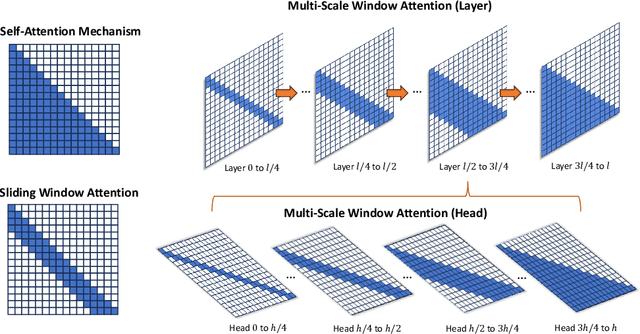
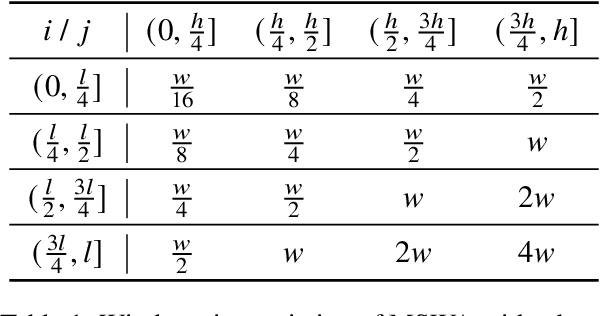
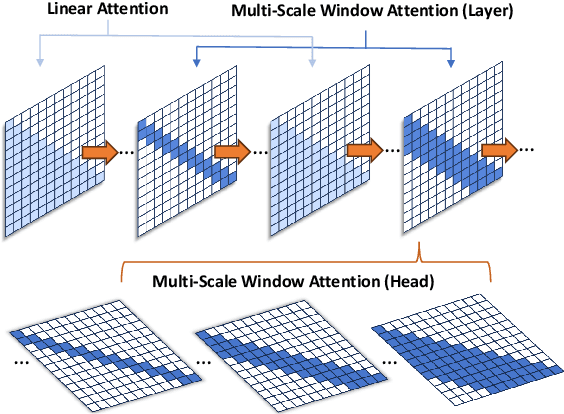
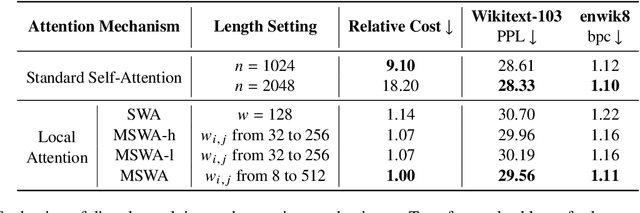
Transformer-based LLMs have achieved exceptional performance across a wide range of NLP tasks. However, the standard self-attention mechanism suffers from quadratic time complexity and linearly increased cache size. Sliding window attention (SWA) solves this problem by restricting the attention range to a fixed-size local context window. Nevertheless, SWA employs a uniform window size for each head in each layer, making it inefficient in capturing context of varying scales. To mitigate this limitation, we propose Multi-Scale Window Attention (MSWA) which applies diverse window sizes across heads and layers in the Transformer. It not only allows for different window sizes among heads within the same layer but also progressively increases window size allocation from shallow to deep layers, thus enabling the model to capture contextual information with different lengths and distances. Experimental results on language modeling and common-sense reasoning tasks substantiate that MSWA outperforms traditional local attention in both effectiveness and efficiency.
EGSRAL: An Enhanced 3D Gaussian Splatting based Renderer with Automated Labeling for Large-Scale Driving Scene
Dec 20, 2024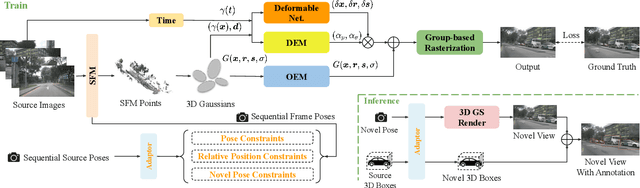
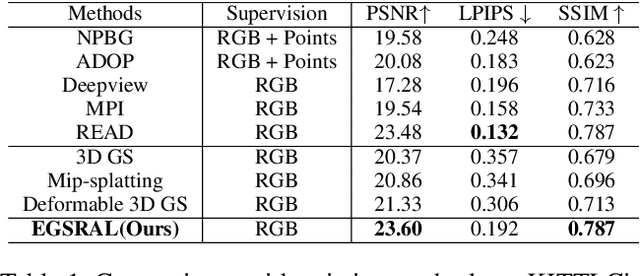
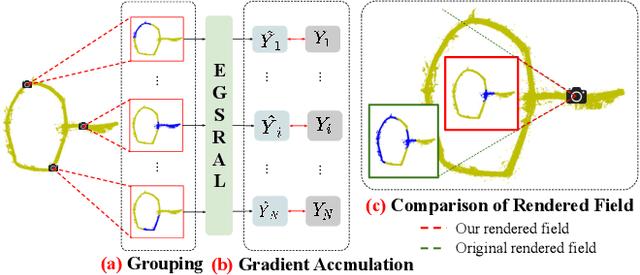
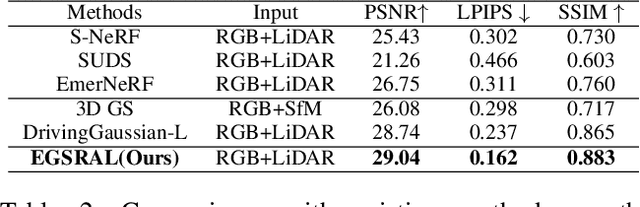
3D Gaussian Splatting (3D GS) has gained popularity due to its faster rendering speed and high-quality novel view synthesis. Some researchers have explored using 3D GS for reconstructing driving scenes. However, these methods often rely on various data types, such as depth maps, 3D boxes, and trajectories of moving objects. Additionally, the lack of annotations for synthesized images limits their direct application in downstream tasks. To address these issues, we propose EGSRAL, a 3D GS-based method that relies solely on training images without extra annotations. EGSRAL enhances 3D GS's capability to model both dynamic objects and static backgrounds and introduces a novel adaptor for auto labeling, generating corresponding annotations based on existing annotations. We also propose a grouping strategy for vanilla 3D GS to address perspective issues in rendering large-scale, complex scenes. Our method achieves state-of-the-art performance on multiple datasets without any extra annotation. For example, the PSNR metric reaches 29.04 on the nuScenes dataset. Moreover, our automated labeling can significantly improve the performance of 2D/3D detection tasks. Code is available at https://github.com/jiangxb98/EGSRAL.