 Add to Chrome
 Add to Firefox
 Add to Edge
ArguLens: An Open-Source System for Automated Essay Scoring and Label-Aware Feedback Generation
Aug 18, 2026
Most automated essay scoring (AES) systems output a single holistic score without interpretable evidence and rely on closed APIs that introduce data privacy and cost barriers. We present ArguLens, an opensource, locally deployable system that decomposes AES into three decoupled components: a discourse-move classifier (Qwen2.5-7B-Instruct fine-tuned with LoRA on PERSUADE 2.0), a grade-independent LightGBM scorer over 31 linguistic and discourse features, and a label-aware feedback generator served through vLLM with a Qwen2.5-14BInstruct backbone. A Gradio web UI exposes pluggable inference backends and supports single-essay and batch scoring with downloadable per-essay breakdowns. On an essaydisjoint PERSUADE 2.0 test split, the logitprobe classifier achieves 82.6% accuracy and 0.727 macro-F1; under prompt-grouped 5-fold cross-validation the scorer reaches a mean QWK of 0.813 under an oracle discoursefeature protocol, and an ablation shows that adding gold discourse annotations yields an increment of +0.055 QWK over the lexical+syntactic configuration (paired t-test, p = 0.010). This is a component-level diagnostic rather than an end-to-end classifier-to-scorer result. The feedback generator ships with a structured evaluation protocol; its human-rater study is left to future work. The system is released under Apache 2.0 at https://github.com/wwrwbs/AI_AWE.

BrainPilot: Automating Brain Discovery with Agentic Research
Jul 16, 2026Understanding the brain increasingly depends on integrating evidence across scales, modalities, and disciplines. Addressing a single research question therefore requires a coordinated sequence of operations, from surveying prior work to executing analyses and interpreting results in light of domain knowledge. AI agents promise to accelerate this process, but current agents lack domain expertise in brain science, may fabricate claims, drift during multi-step reasoning, and offer few defined points for expert intervention. These failures are especially costly in brain science, where conclusions feed into downstream scientific claims and depend on laboratory-specific expertise and careful human judgment. We present \textbf{BrainPilot} a \textbf{fully open-source} multi-agent system that accelerates brain science research with traceable logs and agent-verified results. A principal investigator (PI) agent coordinates specialist agents grounded in curated domain knowledge: a unified brain science knowledge base containing 7{,}233 indexed items and a skill library of 72 reusable methodology units across seven research domains. Every major step is recorded in the Graph of Trace, an auditable record that links subgoals, tool use, evidence, and claims and allows researchers to follow and inspect the workflow. An Auditor agent further integrates fabrication checking into the workflow. For evaluation, we run three brain science tasks from Agents' Last Exam, introduce our own benchmark, \textbf{BrainPilotBench-v0}, and present additional end-to-end case studies. Across these evaluations, BrainPilot with an open-source backbone model attains performance comparable to state-of-the-art agent framework with less costs.
Adaptive Perturbation Selection for Contrastive Audio Decoding
Jun 30, 2026Large audio-language models (LALMs) frequently hallucinate by overriding acoustic evidence with language priors. While contrastive decoding (CD) offers training-free mitigation, existing methods rely on blunt perturbations like masking or noise, leaving structured audio transformations unexplored. We explore this design space by evaluating a diverse library of targeted audio perturbations and adaptively selecting the optimal negative branch for each task and example. First, we improve upon earlier prompt engineering by showing that a simple binary yes/no constraint reduces the model's tendency to falsely confirm absent audio features. Second, evaluating our library across temporal, spectral, frequency, and amplitude domains reveals that optimal transformations are highly task-dependent; for instance, reversing the audio array disrupts temporal coherence, raising accuracy on the temporal order task from 74.7% to 81.4%. Finally, we trained a light-weight perturbation selector on model hidden states to dynamically route negative branches, yielding an additional +4.3% gain on the existence task.
CTC-Seeded Token Edit Refinement for Non-Autoregressive Speech Recognition
Jun 27, 2026Non-autoregressive automatic speech recognition (ASR) enables parallel decoding, but many refinement-based methods begin from random, fully masked, or fixed-length token sequences, requiring multiple iterations to reconstruct the complete transcript. We instead formulate ASR decoding as a variable-length edit refinement of a greedy connectionist temporal classification (CTC) hypothesis. An acoustic-conditioned Edit Flow decoder operates directly on the collapsed CTC hypothesis, predicting insertion, deletion, and substitution operations in parallel. The Edit Flow decoder is jointly trained with a CTC model using a continuous-time discrete diffusion loss. During inference, we find that just two edit steps yield substantial Word Error Rate (WER) reductions, and classifier-free guidance (CFG) further enhances recognition quality by focusing the model on audio features. We also constrain edit proposals using CTC confidence to improve accuracy. Finally, ablation studies validate our design choices, while decoder pretraining and pretrained encoder integration yield significant additional performance gains.
Reinforcement Learning-based Knowledge Distillation with LLM-as-a-Judge
Apr 03, 2026Reinforcement Learning (RL) has been shown to substantially improve the reasoning capability of small and large language models (LLMs), but existing approaches typically rely on verifiable rewards, hence ground truth labels. We propose an RL framework that uses rewards from an LLM that acts as a judge evaluating model outputs over large amounts of unlabeled data, enabling label-free knowledge distillation and replacing the need of ground truth supervision. Notably, the judge operates with a single-token output, making reward computation efficient. When combined with verifiable rewards, our approach yields substantial performance gains across math reasoning benchmarks. These results suggest that LLM-based evaluators can produce effective training signals for RL fine-tuning.
Align-Consistency: Improving Non-autoregressive and Semi-supervised ASR with Consistency Regularization
Feb 26, 2026Consistency regularization (CR) improves the robustness and accuracy of Connectionist Temporal Classification (CTC) by ensuring predictions remain stable across input perturbations. In this work, we propose Align-Consistency, an extension of CR designed for Align-Refine -- a non-autoregressive (non-AR) model that performs iterative refinement of frame-level hypotheses. This method leverages the speed of parallel inference while significantly boosting recognition performance. The effectiveness of Align-Consistency is demonstrated in two settings. First, in the fully supervised setting, our results indicate that applying CR to both the base CTC model and the subsequent refinement steps is critical, and the accuracy improvements from non-AR decoding and CR are mutually additive. Second, for semi-supervised ASR, we employ fast non-AR decoding to generate online pseudo-labels on unlabeled data, which are used to further refine the supervised model and lead to substantial gains.
Machine-assisted writing evaluation: Exploring pre-trained language models in analyzing argumentative moves
Mar 25, 2025The study investigates the efficacy of pre-trained language models (PLMs) in analyzing argumentative moves in a longitudinal learner corpus. Prior studies on argumentative moves often rely on qualitative analysis and manual coding, limiting their efficiency and generalizability. The study aims to: 1) to assess the reliability of PLMs in analyzing argumentative moves; 2) to utilize PLM-generated annotations to illustrate developmental patterns and predict writing quality. A longitudinal corpus of 1643 argumentative texts from 235 English learners in China is collected and annotated into six move types: claim, data, counter-claim, counter-data, rebuttal, and non-argument. The corpus is divided into training, validation, and application sets annotated by human experts and PLMs. We use BERT as one of the implementations of PLMs. The results indicate a robust reliability of PLMs in analyzing argumentative moves, with an overall F1 score of 0.743, surpassing existing models in the field. Additionally, PLM-labeled argumentative moves effectively capture developmental patterns and predict writing quality. Over time, students exhibit an increase in the use of data and counter-claims and a decrease in non-argument moves. While low-quality texts are characterized by a predominant use of claims and data supporting only oneside position, mid- and high-quality texts demonstrate an integrative perspective with a higher ratio of counter-claims, counter-data, and rebuttals. This study underscores the transformative potential of integrating artificial intelligence into language education, enhancing the efficiency and accuracy of evaluating students' writing. The successful application of PLMs can catalyze the development of educational technology, promoting a more data-driven and personalized learning environment that supports diverse educational needs.
FactorGCL: A Hypergraph-Based Factor Model with Temporal Residual Contrastive Learning for Stock Returns Prediction
Feb 05, 2025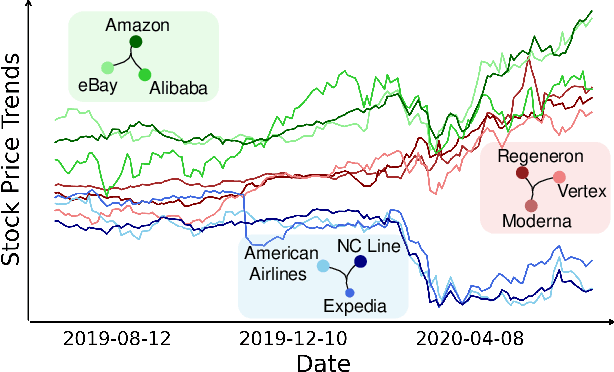
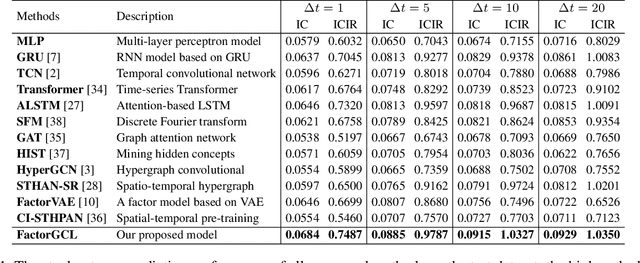
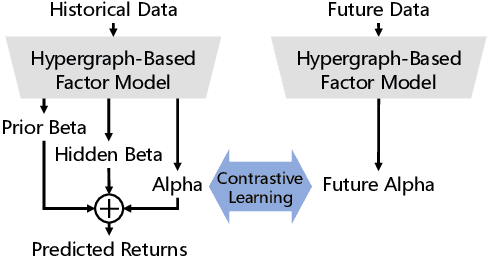
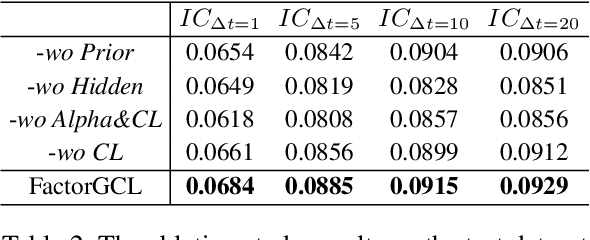
As a fundamental method in economics and finance, the factor model has been extensively utilized in quantitative investment. In recent years, there has been a paradigm shift from traditional linear models with expert-designed factors to more flexible nonlinear machine learning-based models with data-driven factors, aiming to enhance the effectiveness of these factor models. However, due to the low signal-to-noise ratio in market data, mining effective factors in data-driven models remains challenging. In this work, we propose a hypergraph-based factor model with temporal residual contrastive learning (FactorGCL) that employs a hypergraph structure to better capture high-order nonlinear relationships among stock returns and factors. To mine hidden factors that supplement human-designed prior factors for predicting stock returns, we design a cascading residual hypergraph architecture, in which the hidden factors are extracted from the residual information after removing the influence of prior factors. Additionally, we propose a temporal residual contrastive learning method to guide the extraction of effective and comprehensive hidden factors by contrasting stock-specific residual information over different time periods. Our extensive experiments on real stock market data demonstrate that FactorGCL not only outperforms existing state-of-the-art methods but also mines effective hidden factors for predicting stock returns.
Text Injection for Neural Contextual Biasing
Jun 05, 2024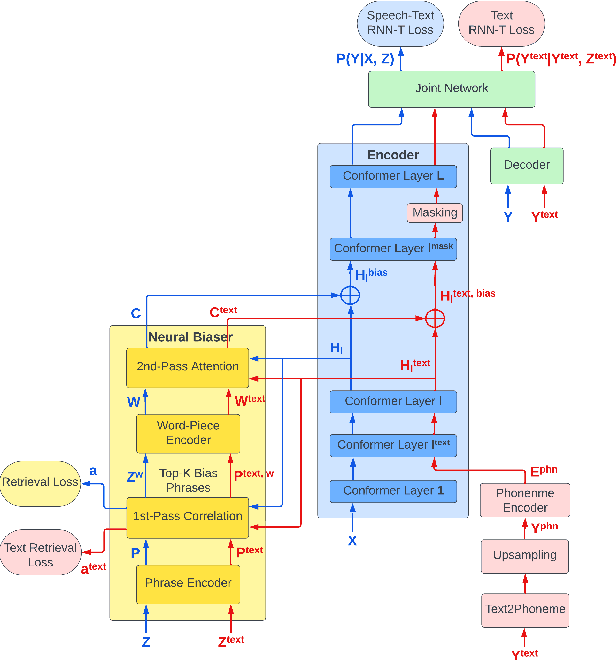
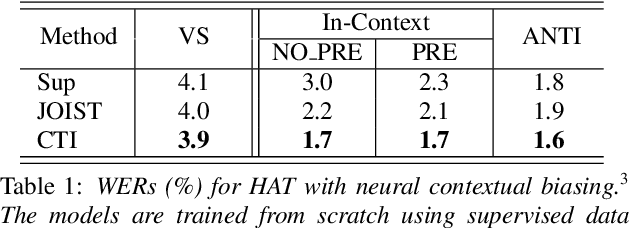
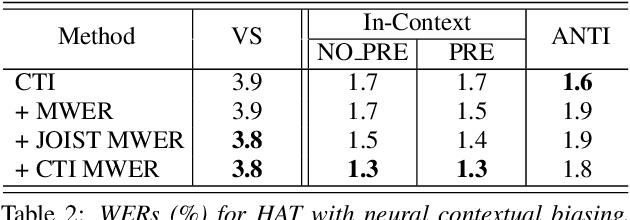
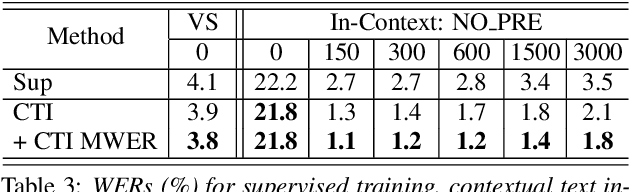
Neural contextual biasing effectively improves automatic speech recognition (ASR) for crucial phrases within a speaker's context, particularly those that are infrequent in the training data. This work proposes contextual text injection (CTI) to enhance contextual ASR. CTI leverages not only the paired speech-text data, but also a much larger corpus of unpaired text to optimize the ASR model and its biasing component. Unpaired text is converted into speech-like representations and used to guide the model's attention towards relevant bias phrases. Moreover, we introduce a contextual text-injected (CTI) minimum word error rate (MWER) training, which minimizes the expected WER caused by contextual biasing when unpaired text is injected into the model. Experiments show that CTI with 100 billion text sentences can achieve up to 43.3% relative WER reduction from a strong neural biasing model. CTI-MWER provides a further relative improvement of 23.5%.
* 5 pages, 1 figure
Deferred NAM: Low-latency Top-K Context Injection via DeferredContext Encoding for Non-Streaming ASR
Apr 15, 2024


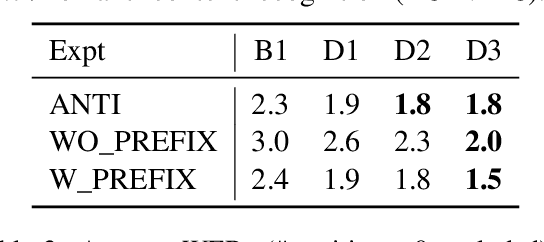
Contextual biasing enables speech recognizers to transcribe important phrases in the speaker's context, such as contact names, even if they are rare in, or absent from, the training data. Attention-based biasing is a leading approach which allows for full end-to-end cotraining of the recognizer and biasing system and requires no separate inference-time components. Such biasers typically consist of a context encoder; followed by a context filter which narrows down the context to apply, improving per-step inference time; and, finally, context application via cross attention. Though much work has gone into optimizing per-frame performance, the context encoder is at least as important: recognition cannot begin before context encoding ends. Here, we show the lightweight phrase selection pass can be moved before context encoding, resulting in a speedup of up to 16.1 times and enabling biasing to scale to 20K phrases with a maximum pre-decoding delay under 33ms. With the addition of phrase- and wordpiece-level cross-entropy losses, our technique also achieves up to a 37.5% relative WER reduction over the baseline without the losses and lightweight phrase selection pass.
* 9 pages, 3 figures, accepted by NAACL 2024 - Industry Track