 Add to Chrome
 Add to Firefox
 Add to Edge
GLAD: Generative Language-Assisted Visual Tracking for Low-Semantic Templates
Jan 31, 2026
Vision-language tracking has gained increasing attention in many scenarios. This task simultaneously deals with visual and linguistic information to localize objects in videos. Despite its growing utility, the development of vision-language tracking methods remains in its early stage. Current vision-language trackers usually employ Transformer architectures for interactive integration of template, search, and text features. However, persistent challenges about low-semantic images including prevalent image blurriness, low resolution and so on, may compromise model performance through degraded cross-modal understanding. To solve this problem, language assistance is usually used to deal with the obstacles posed by low-semantic images. However, due to the existing gap between current textual and visual features, direct concatenation and fusion of these features may have limited effectiveness. To address these challenges, we introduce a pioneering Generative Language-AssisteD tracking model, GLAD, which utilizes diffusion models for the generative multi-modal fusion of text description and template image to bolster compatibility between language and image and enhance template image semantic information. Our approach demonstrates notable improvements over the existing fusion paradigms. Blurry and semantically ambiguous template images can be restored to improve multi-modal features in the generative fusion paradigm. Experiments show that our method establishes a new state-of-the-art on multiple benchmarks and achieves an impressive inference speed. The code and models will be released at: https://github.com/Confetti-lxy/GLAD

Robust Object Modeling for Visual Tracking
Aug 09, 2023Object modeling has become a core part of recent tracking frameworks. Current popular tackers use Transformer attention to extract the template feature separately or interactively with the search region. However, separate template learning lacks communication between the template and search regions, which brings difficulty in extracting discriminative target-oriented features. On the other hand, interactive template learning produces hybrid template features, which may introduce potential distractors to the template via the cluttered search regions. To enjoy the merits of both methods, we propose a robust object modeling framework for visual tracking (ROMTrack), which simultaneously models the inherent template and the hybrid template features. As a result, harmful distractors can be suppressed by combining the inherent features of target objects with search regions' guidance. Target-related features can also be extracted using the hybrid template, thus resulting in a more robust object modeling framework. To further enhance robustness, we present novel variation tokens to depict the ever-changing appearance of target objects. Variation tokens are adaptable to object deformation and appearance variations, which can boost overall performance with negligible computation. Experiments show that our ROMTrack sets a new state-of-the-art on multiple benchmarks.
NTIRE 2022 Challenge on Efficient Super-Resolution: Methods and Results
May 11, 2022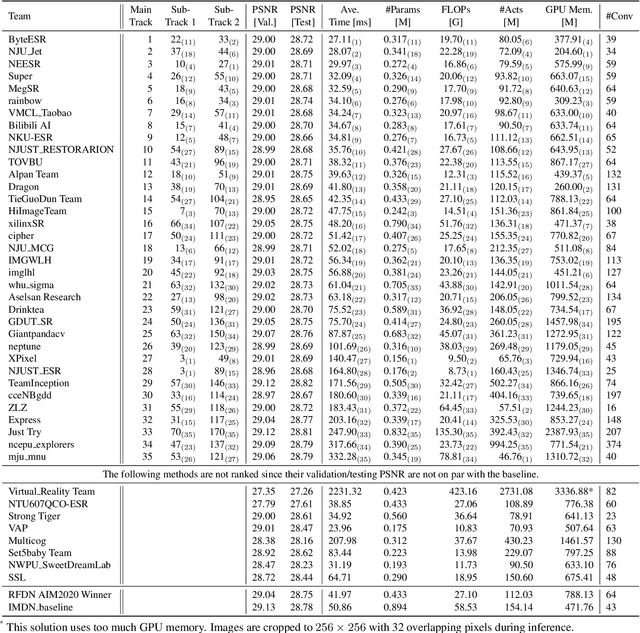
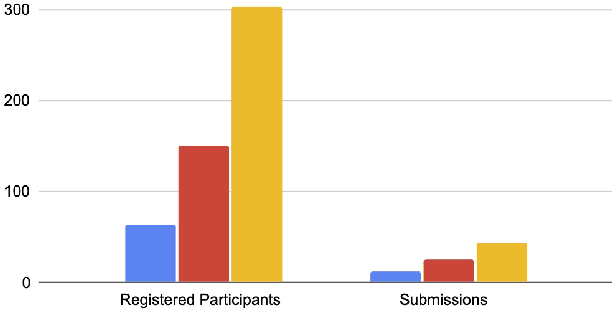
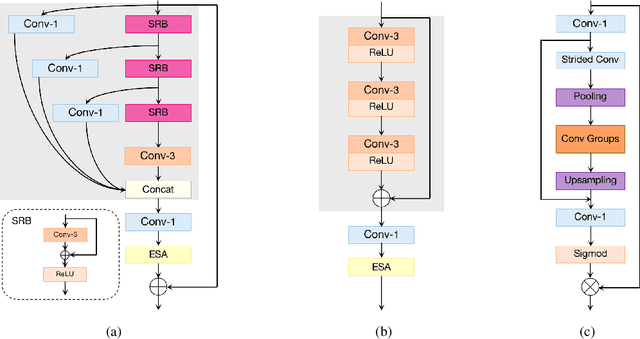
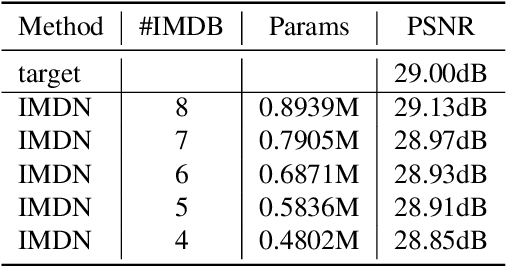
This paper reviews the NTIRE 2022 challenge on efficient single image super-resolution with focus on the proposed solutions and results. The task of the challenge was to super-resolve an input image with a magnification factor of $\times$4 based on pairs of low and corresponding high resolution images. The aim was to design a network for single image super-resolution that achieved improvement of efficiency measured according to several metrics including runtime, parameters, FLOPs, activations, and memory consumption while at least maintaining the PSNR of 29.00dB on DIV2K validation set. IMDN is set as the baseline for efficiency measurement. The challenge had 3 tracks including the main track (runtime), sub-track one (model complexity), and sub-track two (overall performance). In the main track, the practical runtime performance of the submissions was evaluated. The rank of the teams were determined directly by the absolute value of the average runtime on the validation set and test set. In sub-track one, the number of parameters and FLOPs were considered. And the individual rankings of the two metrics were summed up to determine a final ranking in this track. In sub-track two, all of the five metrics mentioned in the description of the challenge including runtime, parameter count, FLOPs, activations, and memory consumption were considered. Similar to sub-track one, the rankings of five metrics were summed up to determine a final ranking. The challenge had 303 registered participants, and 43 teams made valid submissions. They gauge the state-of-the-art in efficient single image super-resolution.