 Add to Chrome
 Add to Firefox
 Add to Edge
EGR: Embedding-Native Generative Retrieval with a Shared LLM
Jul 25, 2026
Generative retrieval is increasingly popular in large-scale recommendation and advertising systems, yet current methods introduce practical complications. Semantic-ID methods rely on quantization, mutable identifier vocabularies, and token-to-item grounding; embedding-based pipelines train the item encoder separately from the query generator, which limits user-item alignment. We propose EGR, an Embedding-Native Generative Retrieval framework for recommendation and advertising. EGR uses a single shared LLM to learn item representations from item metadata and user representations from interaction histories in one embedding space. Items are indexed directly as dense vectors, and user histories are encoded as dense retrieval queries. Joint contrastive training groups related items and aligns queries with their target items. We evaluate EGR on public benchmarks, industrial data, and live deployment. EGR outperforms published baselines on Amazon Reviews; on Snap DPA, it scales with data, handles cold-start items, and benefits from multimodal input. In production, EGR delivers a +2.91% conversion-rate lift, simplifying system design while improving retrieval quality and ad performance.

SMART: LLM-Augmented Hybrid Retrieval for Dynamic Product Ads
Jul 25, 2026Dynamic Product Ads (DPA) require retrieving relevant items from multi-million product catalogs, balancing two competing objectives: retargeting (re-surfacing known interests) and prospecting (discovering new categories). While Large Language Models (LLMs) capture semantic intent better than traditional embedding models, deploying them at scale introduces prohibitive inference costs and lexical mismatch issues. Through controlled experiments on millions of users, we demonstrate a critical retrieval decomposition: rule-generated queries excel at retargeting on a lexical BM25 index, while LLM-generated queries excel at prospecting on a dense ANN index. Building on this, we propose SMART (SeMantic-aware Adaptive ReTrieval). To manage costs, a lightweight quality gate identifies coverage gaps in initial keyword results, adaptively routing only the ~10% of users who benefit from semantic prospecting to the LLM path. Offline evaluation demonstrates that this gated approach captures the bulk of semantic prospecting gains in Relevance Score while maintaining competitive re-targeting performance at a 90% reduction in LLM costs. Finally, in a 2-week online A/B test at Snap, SMART improved the ad conversion rate by +27.6% over a strong embedding-based baseline.
Persia: An Open, Hybrid System Scaling Deep Learning-based Recommenders up to 100 Trillion Parameters
Nov 23, 2021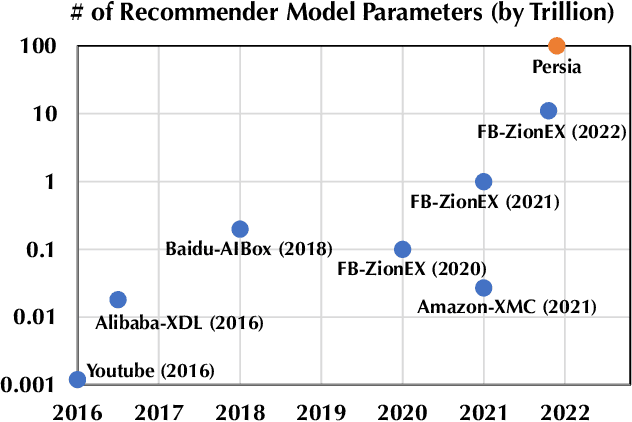
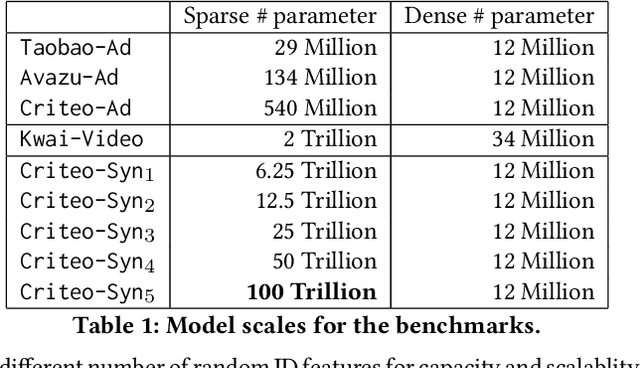
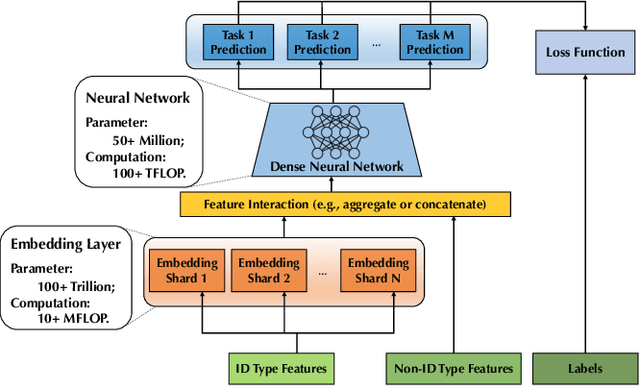
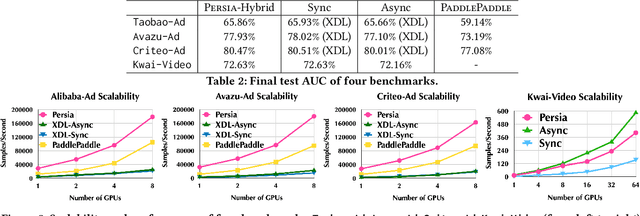
Deep learning based models have dominated the current landscape of production recommender systems. Furthermore, recent years have witnessed an exponential growth of the model scale--from Google's 2016 model with 1 billion parameters to the latest Facebook's model with 12 trillion parameters. Significant quality boost has come with each jump of the model capacity, which makes us believe the era of 100 trillion parameters is around the corner. However, the training of such models is challenging even within industrial scale data centers. This difficulty is inherited from the staggering heterogeneity of the training computation--the model's embedding layer could include more than 99.99% of the total model size, which is extremely memory-intensive; while the rest neural network is increasingly computation-intensive. To support the training of such huge models, an efficient distributed training system is in urgent need. In this paper, we resolve this challenge by careful co-design of both the optimization algorithm and the distributed system architecture. Specifically, in order to ensure both the training efficiency and the training accuracy, we design a novel hybrid training algorithm, where the embedding layer and the dense neural network are handled by different synchronization mechanisms; then we build a system called Persia (short for parallel recommendation training system with hybrid acceleration) to support this hybrid training algorithm. Both theoretical demonstration and empirical study up to 100 trillion parameters have conducted to justified the system design and implementation of Persia. We make Persia publicly available (at https://github.com/PersiaML/Persia) so that anyone would be able to easily train a recommender model at the scale of 100 trillion parameters.