 Add to Chrome
 Add to Firefox
 Add to Edge
ArborMem: Navigating Interaction States with Memory Forests
Aug 18, 2026
Large language models increasingly serve as persistent conversational assistants, requiring memory that preserves relevant experience and maintains continuity across interactions. Existing methods improve access to conversational history through long-context processing, selective retrieval, and structured memory organization. However, most systems treat memory access as retrieving relevant past information without first determining which prior interaction state the current turn resumes. This limitation becomes particularly important when conversations interleave multiple tasks, people, and plans that may be interrupted and later revisited. We introduce ArborMem, an online memory framework that represents a long-running conversation as a navigable forest of interaction states. Each branch preserves a locally coherent trajectory, while the forest maintains multiple trajectories that may later be resumed. For each new input, ArborMem localizes the relevant state, restores its branch-local context, and augments it with reusable evidence retrieved across branches, preserving interaction continuity without conflating semantically related but structurally distinct trajectories. Existing long-term memory benchmarks cover diverse memory and reasoning capabilities but do not explicitly isolate branch-structured challenges. We therefore introduce BranchMemEval, a controlled diagnostic benchmark for interleaved and resumable interaction trajectories. Experiments on LongMemEval, LoCoMo, BEAM 100K, and BranchMemEval show that ArborMem outperforms the strongest baselines by 3.36 to 10.31 percentage points on the three established benchmarks and by 5.0 points on BranchMemEval. Its advantage grows under constrained read budgets, while complete memory queries remain below half a second.

When Do Prompt-Side Agent Playbooks Transfer? Accuracy, Cost, and Runtime Shift in Agent Deployment
Aug 06, 2026Prompt-side playbooks can improve tool-using language agents without retraining, but their portability beyond the source setting is unclear. We study frozen playbook transfer under a shared distill--validate--transfer protocol. On ALFWorld, transfer is beneficial under controlled greedy decoding and, in one near-budget-matched comparison, distilled guidance outperforms five fixed demonstrations. On TAU2-Bench, a prespecified aggregate contrast supports a modest average matched-domain advantage, but global Holm correction retains only one of 135 route-level effects; the remaining grid provides descriptive evidence of compatibility-sensitive heterogeneity. On XBench-DeepSearch, one artifact--runtime pairing preserves useful first-try heuristics while producing repeated queries, delayed stopping, and substantial cost inflation after a context-runtime shift. Across benchmarks, transferred and target-derived playbooks both require target-side validation of success, termination, protocol compatibility, and cost. Frozen transfer is therefore a conditional cold-start option, not a reuse-by-default strategy or a universally preferable alternative to target-side redistillation.
RefCaptioner: Multi-Reference Image-Grounded Video Captioning
Jul 30, 2026Existing video captioning models generate natural descriptions of video content but cannot explicitly ground local visual elements to multiple reference images. We introduce multi-reference image-grounded video captioning, a new task requiring factual video descriptions with phrase-level reference grounding, and propose RefCaptioner, a two-stage post-training framework for this task. RefCaptioner combines mixed-data SFT with Hierarchical Coverage-Discounted GRPO to jointly improve reference selection, phrase-level binding, distractor rejection, and cross-reference consistency while preserving general video-captioning ability. To support training, we construct a corpus containing $20,000$ videos and 171,354 reference images. We further introduce MRVBench, a benchmark for evaluating caption factuality and multi-reference grounding on both real-world and AI-generated videos. Experiments show that RefCaptioner achieves the best overall performance among the open-source models while remaining competitive on standard video captioning benchmarks. Human evaluation further confirms that its captions are preferred by annotators and enable more source-faithful video reconstruction with both open-source and proprietary video generators.
ReBind: Multi-Reference Video Editing via Structured Instructions with Explicit Reference Relationships
Jul 16, 2026Recent diffusion-based video generation models have made significant progress in multi-reference image-conditioned video editing. However, existing methods still struggle to coordinate information from multiple visual sources accurately. We identify a critical deficiency in existing approaches. Existing editing instructions lack explicit reference relationships, and most multimodal large language models (MLLMs) cannot generate them reliably. To address this problem, we propose ReBind, a systematic framework that introduces semantic instructions with embedded reference tokens as the intermediate representation for multi-reference image-conditioned video editing. Our key insight is embedding reference tokens at semantic positions to eliminate ambiguity and establish precise bindings between visual attributes and their sources. We develop ReBind-Instruct, a specialized MLLM that learns to establish explicit bindings between visual attributes and their reference sources through a two-stage progressive scheme for precise reference relationships. We further develop ReBind-Edit, which enables lightweight adaptation of text-to-video models to coordinate multiple references by binding visual attributes to their designated sources. Extensive experiments demonstrate that ReBind substantially outperforms general-purpose MLLMs in instruction quality and achieves state-of-the-art performance among open-source methods on reference image conditioned video editing. Our project webpage: https://rebind-mrv2v.github.io/.
CapRiCorn-1K: A Comprehensive Benchmark for Video Captioning and Subject Referential Consistency Across Temporal Scales
Jun 20, 2026Accurate and comprehensive video captions with consistent subject references are critical for downstream understanding and generation tasks. However, few existing benchmarks can objectively and comprehensively evaluate these properties across diverse durations and scenarios, thereby hindering the advancement of video captioning models. To bridge this gap, we propose CapRiCorn-1K, a comprehensive benchmark designed to evaluate both video captioning quality and subject referential consistency across long temporal horizons and diverse video domains. To accommodate varied evaluation needs, our benchmark supports both audiovisual and visual-only settings. Extensive experiments on CapRiCorn-1K reveal that current models generally struggle to generate accurate and comprehensive captions while maintaining consistent subject references. Moreover, as video duration increases, both the overall caption quality and subject referential consistency decline. Notably, our evaluation metrics exhibit strong correlations with the performance of downstream understanding and generation tasks conditioned on the generated captions, further validating their effectiveness. The project is available at https://github.com/xlchen0205/CapRiCorn-1K .
RealClawBench: Live OpenClaw Benchmarks from Real Developer-Agent Sessions
Jun 02, 2026Agent benchmarks should reflect what users actually ask deployed agents to do, yet existing benchmarks often miss key realism properties of real developer-agent sessions. We introduce RealClawBench, a live benchmark framework built from real OpenClaw sessions to capture the distribution, diversity, and real-world difficulty of deployed agent use. Real user requests are challenging to benchmark because they often depend on local execution environments, involve implicit or underspecified intent, and require nontrivial verification. RealClawBench addresses these challenges with two core mechanisms: reconstructed execution environments and deterministic verifiable scorers, which together convert real sessions into reproducible, automatically scored tasks. The resulting release contains 281 executable tasks sampled from a much larger real-session pool while preserving the source distribution, with maximum final-vs-source Jensen-Shannon divergence of 0.0448. Evaluating 14 contemporary models shows that the best system solves only 65.8% of tasks, revealing substantial headroom on realistic developer-agent workloads. By turning real deployed sessions into controlled evaluation instances, RealClawBench provides a practical path toward benchmarks that better measure agent capability in actual use. Code is available at:https://anonymous.4open.science/r/real-claw-bench-582B.
Beyond Parameter Arithmetic: Sparse Complementary Fusion for Distribution-Aware Model Merging
Feb 12, 2026Model merging has emerged as a promising paradigm for composing the capabilities of large language models by directly operating in weight space, enabling the integration of specialized models without costly retraining. However, existing merging methods largely rely on parameter-space heuristics, which often introduce severe interference, leading to degraded generalization and unstable generation behaviors such as repetition and incoherent outputs. In this work, we propose Sparse Complementary Fusion with reverse KL (SCF-RKL), a novel model merging framework that explicitly controls functional interference through sparse, distribution-aware updates. Instead of assuming linear additivity in parameter space, SCF-RKL measures the functional divergence between models using reverse Kullback-Leibler divergence and selectively incorporates complementary parameters. This mode-seeking, sparsity-inducing design effectively preserves stable representations while integrating new capabilities. We evaluate SCF-RKL across a wide range of model scales and architectures, covering both reasoning-focused and instruction-tuned models. Extensive experiments on 24 benchmarks spanning advanced reasoning, general reasoning and knowledge, instruction following, and safety demonstrate, vision classification that SCF-RKL consistently outperforms existing model merging methods while maintaining strong generalization and generation stability.
Beyond Static Alignment: Hierarchical Policy Control for LLM Safety via Risk-Aware Chain-of-Thought
Feb 06, 2026Large Language Models (LLMs) face a fundamental safety-helpfulness trade-off due to static, one-size-fits-all safety policies that lack runtime controllabilityxf, making it difficult to tailor responses to diverse application needs. %As a result, models may over-refuse benign requests or under-constrain harmful ones. We present \textbf{PACT} (Prompt-configured Action via Chain-of-Thought), a framework for dynamic safety control through explicit, risk-aware reasoning. PACT operates under a hierarchical policy architecture: a non-overridable global safety policy establishes immutable boundaries for critical risks (e.g., child safety, violent extremism), while user-defined policies can introduce domain-specific (non-global) risk categories and specify label-to-action behaviors to improve utility in real-world deployment settings. The framework decomposes safety decisions into structured Classify$\rightarrow$Act paths that route queries to the appropriate action (comply, guide, or reject) and render the decision-making process transparent. Extensive experiments demonstrate that PACT achieves near state-of-the-art safety performance under global policy evaluation while attaining the best controllability under user-specific policy evaluation, effectively mitigating the safety-helpfulness trade-off. We will release the PACT model suite, training data, and evaluation protocols to facilitate reproducible research in controllable safety alignment.
DiaDem: Advancing Dialogue Descriptions in Audiovisual Video Captioning for Multimodal Large Language Models
Jan 27, 2026Accurate dialogue description in audiovisual video captioning is crucial for downstream understanding and generation tasks. However, existing models generally struggle to produce faithful dialogue descriptions within audiovisual captions. To mitigate this limitation, we propose DiaDem, a powerful audiovisual video captioning model capable of generating captions with more precise dialogue descriptions while maintaining strong overall performance. We first synthesize a high-quality dataset for SFT, then employ a difficulty-partitioned two-stage GRPO strategy to further enhance dialogue descriptions. To enable systematic evaluation of dialogue description capabilities, we introduce DiaDemBench, a comprehensive benchmark designed to evaluate models across diverse dialogue scenarios, emphasizing both speaker attribution accuracy and utterance transcription fidelity in audiovisual captions. Extensive experiments on DiaDemBench reveal even commercial models still exhibit substantial room for improvement in dialogue-aware captioning. Notably, DiaDem not only outperforms the Gemini series in dialogue description accuracy but also achieves competitive performance on general audiovisual captioning benchmarks, demonstrating its overall effectiveness.
Kling-Omni Technical Report
Dec 18, 2025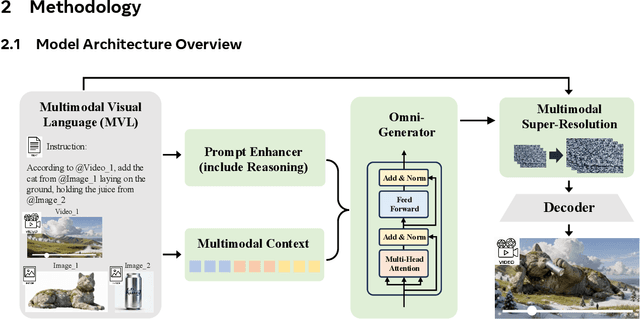
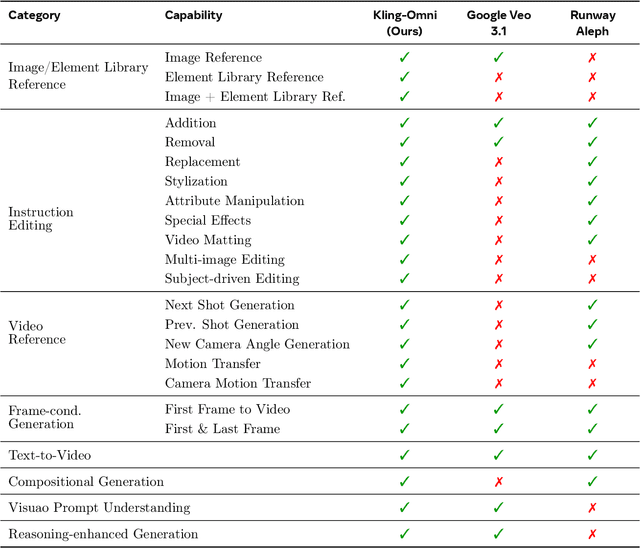
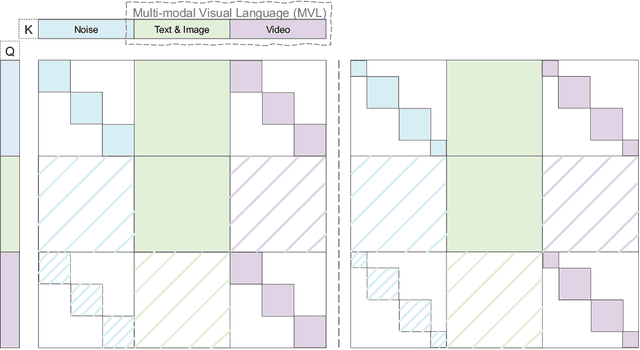
We present Kling-Omni, a generalist generative framework designed to synthesize high-fidelity videos directly from multimodal visual language inputs. Adopting an end-to-end perspective, Kling-Omni bridges the functional separation among diverse video generation, editing, and intelligent reasoning tasks, integrating them into a holistic system. Unlike disjointed pipeline approaches, Kling-Omni supports a diverse range of user inputs, including text instructions, reference images, and video contexts, processing them into a unified multimodal representation to deliver cinematic-quality and highly-intelligent video content creation. To support these capabilities, we constructed a comprehensive data system that serves as the foundation for multimodal video creation. The framework is further empowered by efficient large-scale pre-training strategies and infrastructure optimizations for inference. Comprehensive evaluations reveal that Kling-Omni demonstrates exceptional capabilities in in-context generation, reasoning-based editing, and multimodal instruction following. Moving beyond a content creation tool, we believe Kling-Omni is a pivotal advancement toward multimodal world simulators capable of perceiving, reasoning, generating and interacting with the dynamic and complex worlds.