 Add to Chrome
 Add to Firefox
 Add to Edge
Transformers versus the EM Algorithm in Multi-class Clustering
Feb 09, 2025
LLMs demonstrate significant inference capacities in complicated machine learning tasks, using the Transformer model as its backbone. Motivated by the limited understanding of such models on the unsupervised learning problems, we study the learning guarantees of Transformers in performing multi-class clustering of the Gaussian Mixture Models. We develop a theory drawing strong connections between the Softmax Attention layers and the workflow of the EM algorithm on clustering the mixture of Gaussians. Our theory provides approximation bounds for the Expectation and Maximization steps by proving the universal approximation abilities of multivariate mappings by Softmax functions. In addition to the approximation guarantees, we also show that with a sufficient number of pre-training samples and an initialization, Transformers can achieve the minimax optimal rate for the problem considered. Our extensive simulations empirically verified our theory by revealing the strong learning capacities of Transformers even beyond the assumptions in the theory, shedding light on the powerful inference capacities of LLMs.

Transformers and Their Roles as Time Series Foundation Models
Feb 05, 2025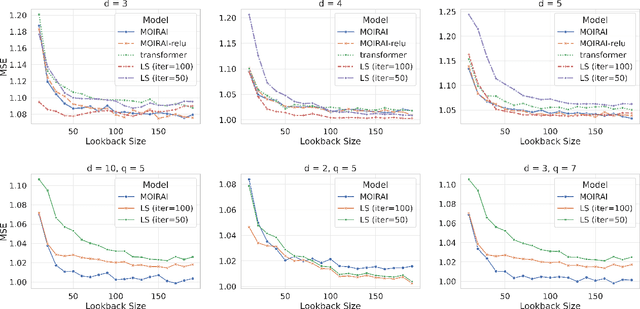
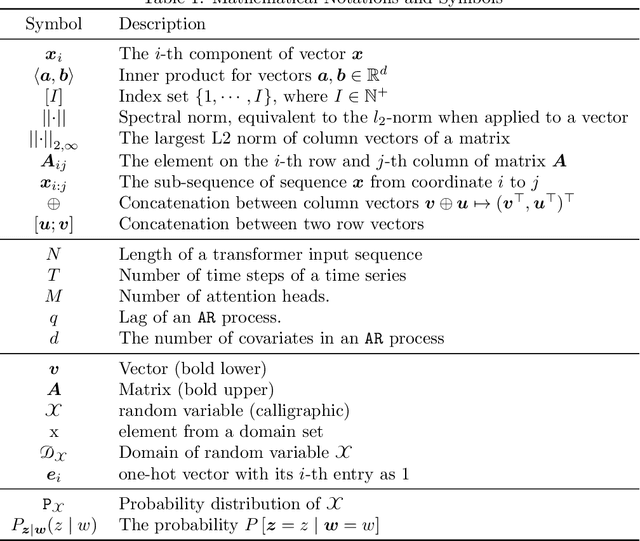

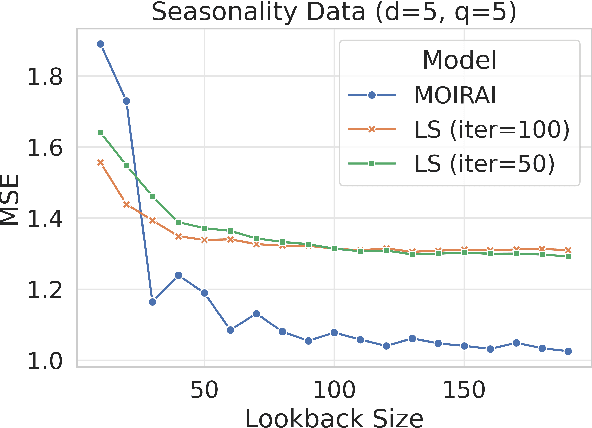
We give a comprehensive analysis of transformers as time series foundation models, focusing on their approximation and generalization capabilities. First, we demonstrate that there exist transformers that fit an autoregressive model on input univariate time series via gradient descent. We then analyze MOIRAI, a multivariate time series foundation model capable of handling an arbitrary number of covariates. We prove that it is capable of automatically fitting autoregressive models with an arbitrary number of covariates, offering insights into its design and empirical success. For generalization, we establish bounds for pretraining when the data satisfies Dobrushin's condition. Experiments support our theoretical findings, highlighting the efficacy of transformers as time series foundation models.
Automating High Quality RT Planning at Scale
Jan 21, 2025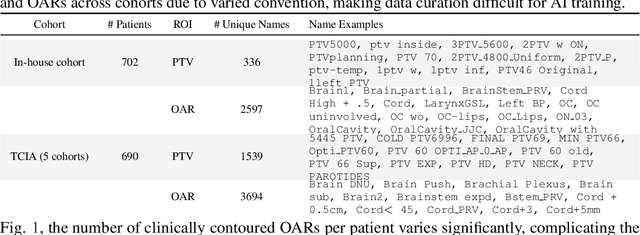
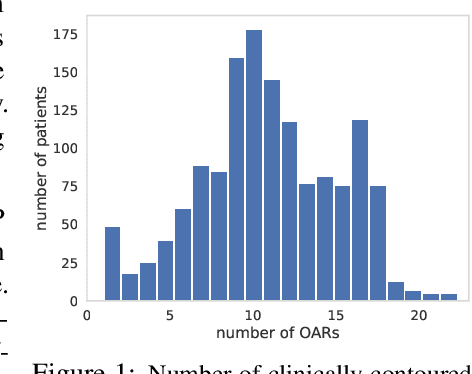
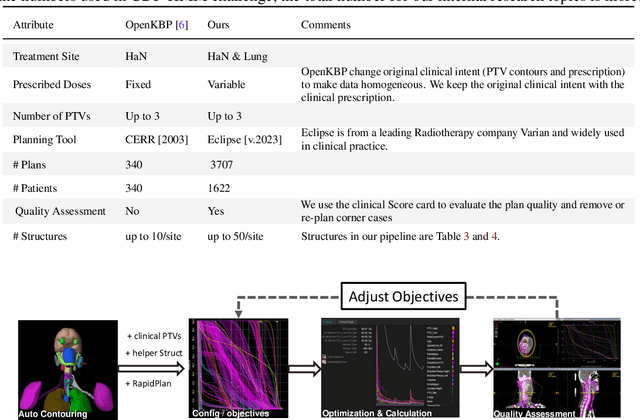
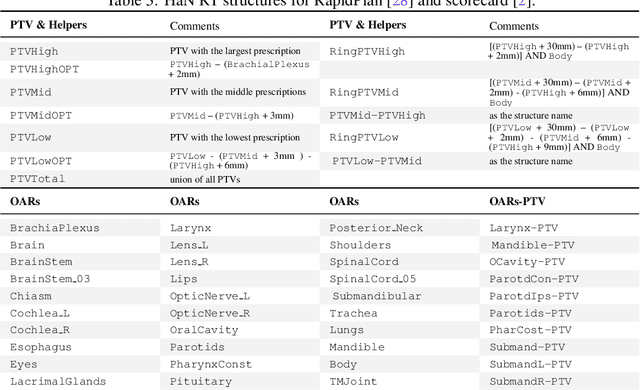
Radiotherapy (RT) planning is complex, subjective, and time-intensive. Advances in artificial intelligence (AI) promise to improve its precision, efficiency, and consistency, but progress is often limited by the scarcity of large, standardized datasets. To address this, we introduce the Automated Iterative RT Planning (AIRTP) system, a scalable solution for generating high-quality treatment plans. This scalable solution is designed to generate substantial volumes of consistently high-quality treatment plans, overcoming a key obstacle in the advancement of AI-driven RT planning. Our AIRTP pipeline adheres to clinical guidelines and automates essential steps, including organ-at-risk (OAR) contouring, helper structure creation, beam setup, optimization, and plan quality improvement, using AI integrated with RT planning software like Eclipse of Varian. Furthermore, a novel approach for determining optimization parameters to reproduce 3D dose distributions, i.e. a method to convert dose predictions to deliverable treatment plans constrained by machine limitations. A comparative analysis of plan quality reveals that our automated pipeline produces treatment plans of quality comparable to those generated manually, which traditionally require several hours of labor per plan. Committed to public research, the first data release of our AIRTP pipeline includes nine cohorts covering head-and-neck and lung cancer sites to support an AAPM 2025 challenge. This data set features more than 10 times the number of plans compared to the largest existing well-curated public data set to our best knowledge. Repo:{https://github.com/RiqiangGao/GDP-HMM_AAPMChallenge}
Self Pre-training with Adaptive Mask Autoencoders for Variable-Contrast 3D Medical Imaging
Jan 15, 2025The Masked Autoencoder (MAE) has recently demonstrated effectiveness in pre-training Vision Transformers (ViT) for analyzing natural images. By reconstructing complete images from partially masked inputs, the ViT encoder gathers contextual information to predict the missing regions. This capability to aggregate context is especially important in medical imaging, where anatomical structures are functionally and mechanically linked to surrounding regions. However, current methods do not consider variations in the number of input images, which is typically the case in real-world Magnetic Resonance (MR) studies. To address this limitation, we propose a 3D Adaptive Masked Autoencoders (AMAE) architecture that accommodates a variable number of 3D input contrasts per subject. A magnetic resonance imaging (MRI) dataset of 45,364 subjects was used for pretraining and a subset of 1648 training, 193 validation and 215 test subjects were used for finetuning. The performance demonstrates that self pre-training of this adaptive masked autoencoders can enhance the infarct segmentation performance by 2.8%-3.7% for ViT-based segmentation models.
Dynamic Multimodal Fusion via Meta-Learning Towards Micro-Video Recommendation
Jan 13, 2025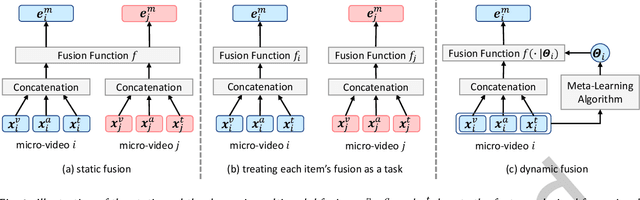

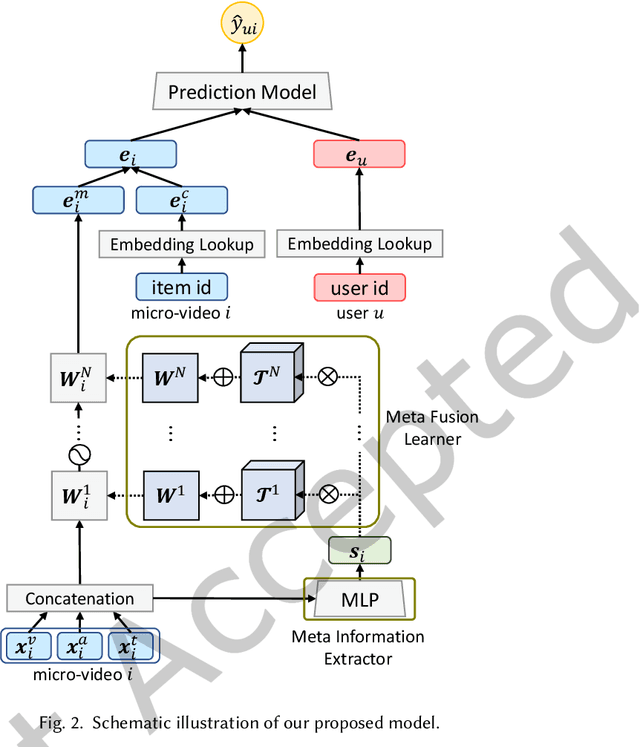
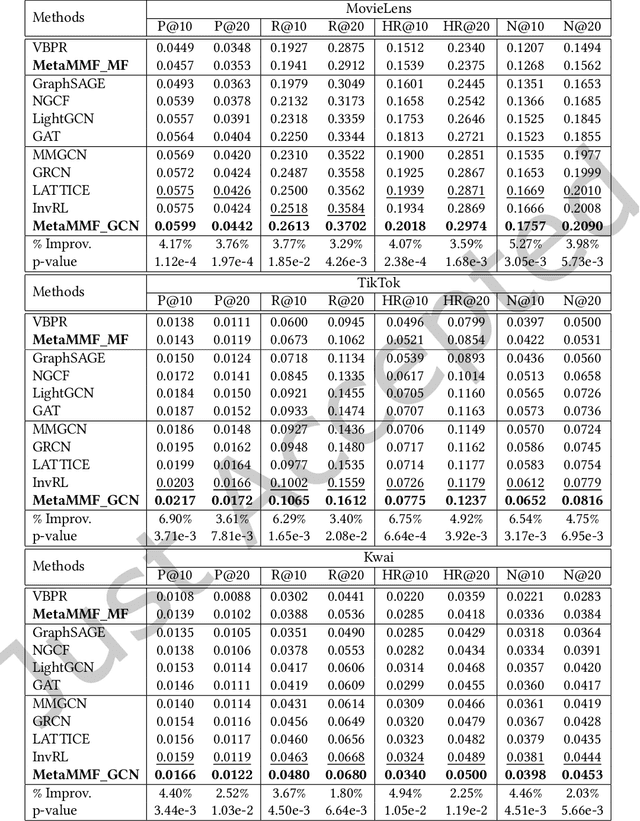
Multimodal information (e.g., visual, acoustic, and textual) has been widely used to enhance representation learning for micro-video recommendation. For integrating multimodal information into a joint representation of micro-video, multimodal fusion plays a vital role in the existing micro-video recommendation approaches. However, the static multimodal fusion used in previous studies is insufficient to model the various relationships among multimodal information of different micro-videos. In this paper, we develop a novel meta-learning-based multimodal fusion framework called Meta Multimodal Fusion (MetaMMF), which dynamically assigns parameters to the multimodal fusion function for each micro-video during its representation learning. Specifically, MetaMMF regards the multimodal fusion of each micro-video as an independent task. Based on the meta information extracted from the multimodal features of the input task, MetaMMF parameterizes a neural network as the item-specific fusion function via a meta learner. We perform extensive experiments on three benchmark datasets, demonstrating the significant improvements over several state-of-the-art multimodal recommendation models, like MMGCN, LATTICE, and InvRL. Furthermore, we lighten our model by adopting canonical polyadic decomposition to improve the training efficiency, and validate its effectiveness through experimental results. Codes are available at https://github.com/hanliu95/MetaMMF.
A Text-Based Knowledge-Embedded Soft Sensing Modeling Approach for General Industrial Process Tasks Based on Large Language Model
Jan 09, 2025Data-driven soft sensors (DDSS) have become mainstream methods for predicting key performance indicators in process industries. However, DDSS development requires complex and costly customized designs tailored to various tasks during the modeling process. Moreover, DDSS are constrained to a single structured data modality, limiting their ability to incorporate additional contextual knowledge. Furthermore, DDSSs' limited representation learning leads to weak predictive performance with scarce data. To address these challenges, we propose a general framework named LLM-TKESS (large language model for text-based knowledge-embedded soft sensing), harnessing the powerful general problem-solving capabilities, cross-modal knowledge transfer abilities, and few-shot capabilities of LLM for enhanced soft sensing modeling. Specifically, an auxiliary variable series encoder (AVS Encoder) is proposed to unleash LLM's potential for capturing temporal relationships within series and spatial semantic relationships among auxiliary variables. Then, we propose a two-stage fine-tuning alignment strategy: in the first stage, employing parameter-efficient fine-tuning through autoregressive training adjusts LLM to rapidly accommodate process variable data, resulting in a soft sensing foundation model (SSFM). Subsequently, by training adapters, we adapt the SSFM to various downstream tasks without modifying its architecture. Then, we propose two text-based knowledge-embedded soft sensors, integrating new natural language modalities to overcome the limitations of pure structured data models. Furthermore, benefiting from LLM's pre-existing world knowledge, our model demonstrates outstanding predictive capabilities in small sample conditions. Using the thermal deformation of air preheater rotor as a case study, we validate through extensive experiments that LLM-TKESS exhibits outstanding performance.
Do Code LLMs Understand Design Patterns?
Jan 08, 2025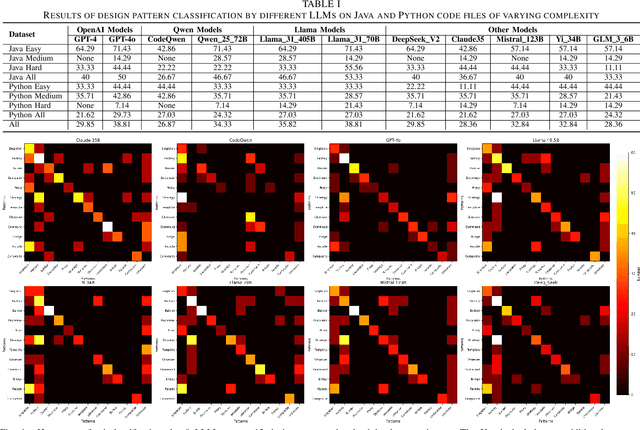
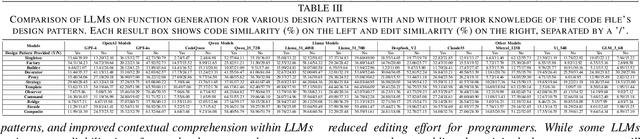
Code Large Language Models (LLMs) demonstrate great versatility in adapting to various downstream tasks, including code generation and completion, as well as bug detection and fixing. However, Code LLMs often fail to capture existing coding standards, leading to the generation of code that conflicts with the required design patterns for a given project. As a result, developers must post-process to adapt the generated code to the project's design norms. In this work, we empirically investigate the biases of Code LLMs in software development. Through carefully designed experiments, we assess the models' understanding of design patterns across recognition, comprehension, and generation. Our findings reveal that biases in Code LLMs significantly affect the reliability of downstream tasks.
A Soft Sensor Method with Uncertainty-Awareness and Self-Explanation Based on Large Language Models Enhanced by Domain Knowledge Retrieval
Jan 08, 2025
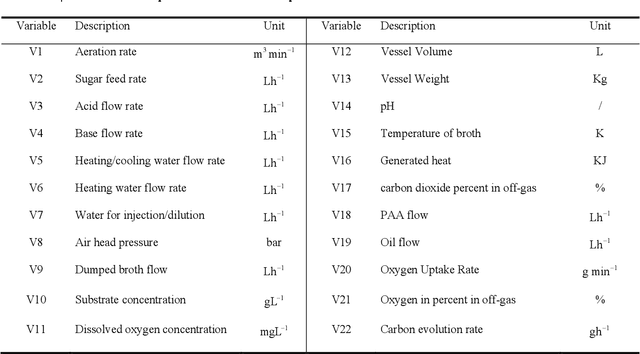


Data-driven soft sensors are crucial in predicting key performance indicators in industrial systems. However, current methods predominantly rely on the supervised learning paradigms of parameter updating, which inherently faces challenges such as high development costs, poor robustness, training instability, and lack of interpretability. Recently, large language models (LLMs) have demonstrated significant potential across various domains, notably through In-Context Learning (ICL), which enables high-performance task execution with minimal input-label demonstrations and no prior training. This paper aims to replace supervised learning with the emerging ICL paradigm for soft sensor modeling to address existing challenges and explore new avenues for advancement. To achieve this, we propose a novel framework called the Few-shot Uncertainty-aware and self-Explaining Soft Sensor (LLM-FUESS), which includes the Zero-shot Auxiliary Variable Selector (LLM-ZAVS) and the Uncertainty-aware Few-shot Soft Sensor (LLM-UFSS). The LLM-ZAVS retrieves from the Industrial Knowledge Vector Storage to enhance LLMs' domain-specific knowledge, enabling zero-shot auxiliary variable selection. In the LLM-UFSS, we utilize text-based context demonstrations of structured data to prompt LLMs to execute ICL for predicting and propose a context sample retrieval augmentation strategy to improve performance. Additionally, we explored LLMs' AIGC and probabilistic characteristics to propose self-explanation and uncertainty quantification methods for constructing a trustworthy soft sensor. Extensive experiments demonstrate that our method achieved state-of-the-art predictive performance, strong robustness, and flexibility, effectively mitigates training instability found in traditional methods. To the best of our knowledge, this is the first work to establish soft sensor utilizing LLMs.
Learning Spectral Methods by Transformers
Jan 05, 2025


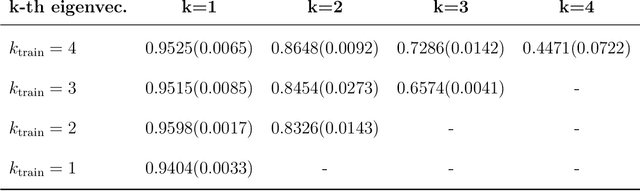
Transformers demonstrate significant advantages as the building block of modern LLMs. In this work, we study the capacities of Transformers in performing unsupervised learning. We show that multi-layered Transformers, given a sufficiently large set of pre-training instances, are able to learn the algorithms themselves and perform statistical estimation tasks given new instances. This learning paradigm is distinct from the in-context learning setup and is similar to the learning procedure of human brains where skills are learned through past experience. Theoretically, we prove that pre-trained Transformers can learn the spectral methods and use the classification of bi-class Gaussian mixture model as an example. Our proof is constructive using algorithmic design techniques. Our results are built upon the similarities of multi-layered Transformer architecture with the iterative recovery algorithms used in practice. Empirically, we verify the strong capacity of the multi-layered (pre-trained) Transformer on unsupervised learning through the lens of both the PCA and the Clustering tasks performed on the synthetic and real-world datasets.
Transformers Simulate MLE for Sequence Generation in Bayesian Networks
Jan 05, 2025
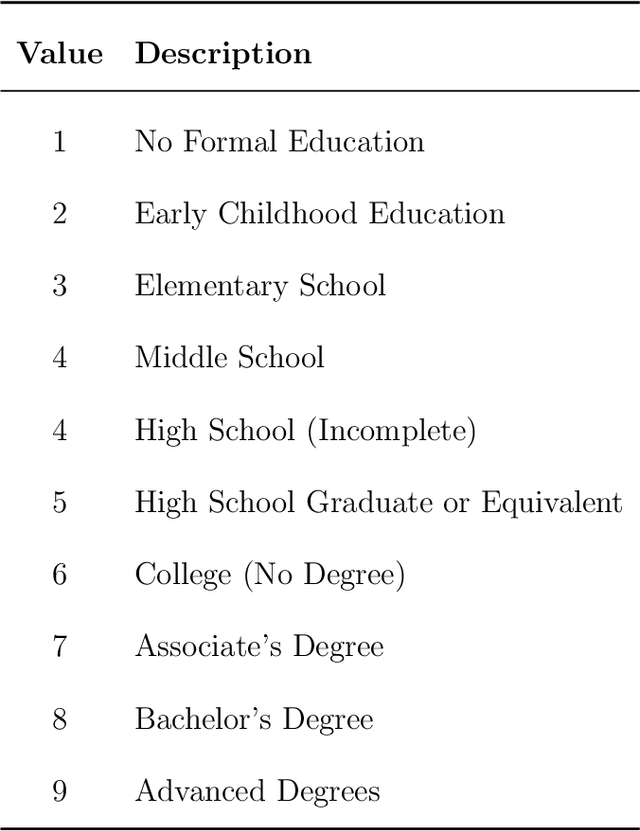

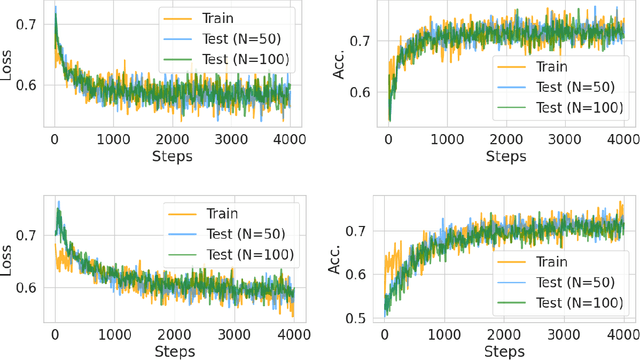
Transformers have achieved significant success in various fields, notably excelling in tasks involving sequential data like natural language processing. Despite these achievements, the theoretical understanding of transformers' capabilities remains limited. In this paper, we investigate the theoretical capabilities of transformers to autoregressively generate sequences in Bayesian networks based on in-context maximum likelihood estimation (MLE). Specifically, we consider a setting where a context is formed by a set of independent sequences generated according to a Bayesian network. We demonstrate that there exists a simple transformer model that can (i) estimate the conditional probabilities of the Bayesian network according to the context, and (ii) autoregressively generate a new sample according to the Bayesian network with estimated conditional probabilities. We further demonstrate in extensive experiments that such a transformer does not only exist in theory, but can also be effectively obtained through training. Our analysis highlights the potential of transformers to learn complex probabilistic models and contributes to a better understanding of large language models as a powerful class of sequence generators.