 Add to Chrome
 Add to Firefox
 Add to Edge
HACK++: Towards More Effective Head-Aware Key-Value Compression for Efficient Visual Autoregressive Modeling
Jun 06, 2026
Visual Autoregressive (VAR) models adopt a next-scale prediction paradigm, offering high-quality generation with substantially fewer decoding steps. However, existing VAR models suffer from significant attention complexity and severe memory overhead due to the accumulation of key-value (KV) caches across scales. In this paper, we tackle this challenge by introducing KV cache compression into the next-scale paradigm. We begin with an in-depth analysis of VAR attention and observe that attention heads can be stably divided into two functionally distinct categories: Contextual Heads focus on maintaining semantic consistency, while Structural Heads preserve spatial coherence. Their functional divergence makes existing one-size-fits-all compression methods perform poorly on VAR models. We further find that the two head types differ markedly in their reliance on historical scales, and that this reliance shifts across layers and generation steps, arguing for an adaptive cache budget allocation. To address these challenges, we propose HACK++, a training-free Head-Aware key-value Compression frameworK for VAR models. From a one-time offline calibration, HACK++ classifies head types and derives head-specific priors. At inference, it decouples attention from cache compression under independent budgets, bounding the current-scale attention cost while compressing the accumulated cache far more aggressively, via pattern-specific strategies and a reliance-aware budget allocation. Extensive experiments on multiple VAR models across text-to-image, class-conditional, and unified understanding-and-generation tasks validate the effectiveness and generalizability of HACK++. For example, on Infinity-2B/8B, HACK++ maintains near-lossless generation with only a 30% attention budget and a 10% cache budget, and remains robust even under a 1% cache budget.

Audio Interaction Model
Jun 03, 2026Audio is an inherently interactive modality, yet today's Large Audio Language Models (LALMs) are offline, and streaming audio models each handle only a single task such as streaming ASR or voice chatting. It is time to unify them into one online LALM: a model that, through an always-on perceive-decide-respond loop, listens to sound, environment, and instructions in real time and reacts on the fly. We formalize this regime as the Audio Interaction Model, and realize it with Audio-Interaction, a unified streaming model that retains offline task execution while adding online general audio instruction following, from dialogue to full voice chatting, deciding when to respond from the semantics of the stream. To enable this, we propose SoundFlow, a framework that instantiates the perceive-decide-respond loop end to end, from data to training to deployment, through streaming-native data construction, comprehension-aware training, and asynchronous low-latency inference for stable real-time interaction. We further construct StreamAudio-2M, a 2.6M-item streaming corpus spanning 7 fundamental abilities and 28 sub-tasks, and Proactive-Sound-Bench for evaluating proactive audio intervention. Across 8 benchmarks, Audio-Interaction preserves competitive performance on mainstream audio tasks while unlocking capabilities inaccessible to offline LALMs, including real-time ASR, streaming audio instruction following, and proactive help.
Unbiased Dynamic Pruning for Efficient Group-Based Policy Optimization
Mar 04, 2026Group Relative Policy Optimization (GRPO) effectively scales LLM reasoning but incurs prohibitive computational costs due to its extensive group-based sampling requirement. While recent selective data utilization methods can mitigate this overhead, they could induce estimation bias by altering the underlying sampling distribution, compromising theoretical rigor and convergence behavior. To address this limitation, we propose Dynamic Pruning Policy Optimization (DPPO), a framework that enables dynamic pruning while preserving unbiased gradient estimation through importance sampling-based correction. By incorporating mathematically derived rescaling factors, DPPO significantly accelerates GRPO training without altering the optimization objective of the full-batch baseline. Furthermore, to mitigate the data sparsity induced by pruning, we introduce Dense Prompt Packing, a window-based greedy strategy that maximizes valid token density and hardware utilization. Extensive experiments demonstrate that DPPO consistently accelerates training across diverse models and benchmarks. For instance, on Qwen3-4B trained on MATH, DPPO achieves 2.37$\times$ training speedup and outperforms GRPO by 3.36% in average accuracy across six mathematical reasoning benchmarks.
Reversible Diffusion Decoding for Diffusion Language Models
Jan 29, 2026Diffusion language models enable parallel token generation through block-wise decoding, but their irreversible commitments can lead to stagnation, where the reverse diffusion process fails to make further progress under a suboptimal context.We propose Reversible Diffusion Decoding (RDD), a decoding framework that introduces reversibility into block-wise diffusion generation. RDD detects stagnation as a state-dependent failure of the reverse process and enables efficient backtracking to earlier blocks without recomputation via cached model states. To avoid repeated failure trajectories, RDD applies confidence-guided re-masking to selectively reinitialize uncertain tokens while preserving reliable context.This reversible formulation allows decoding to recover from early commitment errors while maintaining the parallel efficiency of diffusion-based generation. Experiments show that RDD improves generation robustness and quality over baselines with minimal computational overhead.
DS$^2$Net: Detail-Semantic Deep Supervision Network for Medical Image Segmentation
Aug 06, 2025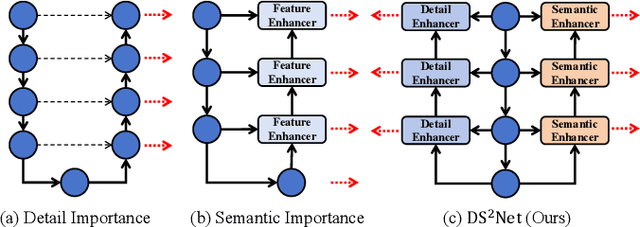
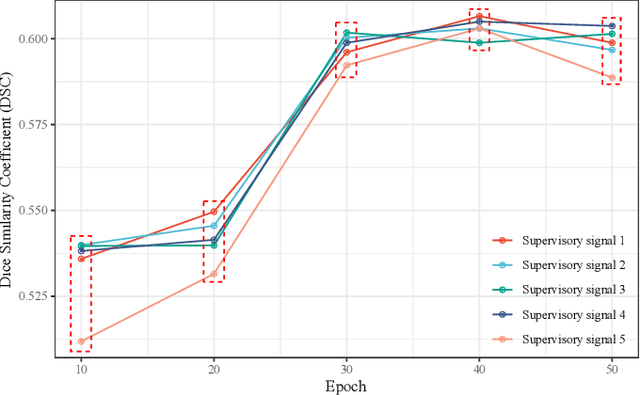
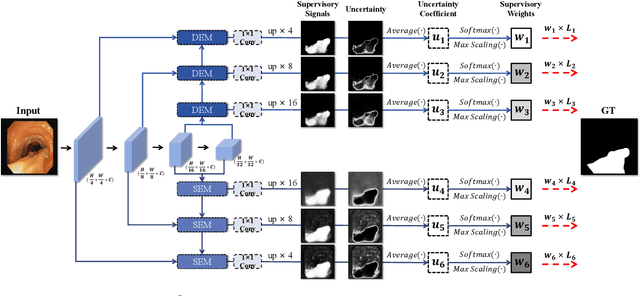
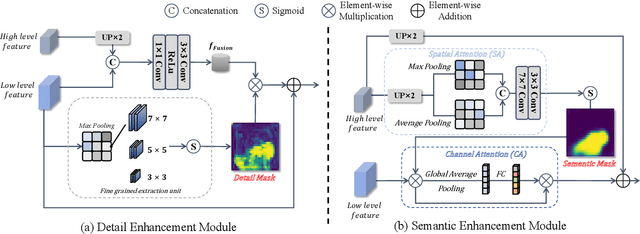
Deep Supervision Networks exhibit significant efficacy for the medical imaging community. Nevertheless, existing work merely supervises either the coarse-grained semantic features or fine-grained detailed features in isolation, which compromises the fact that these two types of features hold vital relationships in medical image analysis. We advocate the powers of complementary feature supervision for medical image segmentation, by proposing a Detail-Semantic Deep Supervision Network (DS$^2$Net). DS$^2$Net navigates both low-level detailed and high-level semantic feature supervision through Detail Enhance Module (DEM) and Semantic Enhance Module (SEM). DEM and SEM respectively harness low-level and high-level feature maps to create detail and semantic masks for enhancing feature supervision. This is a novel shift from single-view deep supervision to multi-view deep supervision. DS$^2$Net is also equipped with a novel uncertainty-based supervision loss that adaptively assigns the supervision strength of features within distinct scales based on their uncertainty, thus circumventing the sub-optimal heuristic design that typifies previous works. Through extensive experiments on six benchmarks captured under either colonoscopy, ultrasound and microscope, we demonstrate that DS$^2$Net consistently outperforms state-of-the-art methods for medical image analysis.
Squeeze10-LLM: Squeezing LLMs' Weights by 10 Times via a Staged Mixed-Precision Quantization Method
Jul 24, 2025Deploying large language models (LLMs) is challenging due to their massive parameters and high computational costs. Ultra low-bit quantization can significantly reduce storage and accelerate inference, but extreme compression (i.e., mean bit-width <= 2) often leads to severe performance degradation. To address this, we propose Squeeze10-LLM, effectively "squeezing" 16-bit LLMs' weights by 10 times. Specifically, Squeeze10-LLM is a staged mixed-precision post-training quantization (PTQ) framework and achieves an average of 1.6 bits per weight by quantizing 80% of the weights to 1 bit and 20% to 4 bits. We introduce Squeeze10LLM with two key innovations: Post-Binarization Activation Robustness (PBAR) and Full Information Activation Supervision (FIAS). PBAR is a refined weight significance metric that accounts for the impact of quantization on activations, improving accuracy in low-bit settings. FIAS is a strategy that preserves full activation information during quantization to mitigate cumulative error propagation across layers. Experiments on LLaMA and LLaMA2 show that Squeeze10-LLM achieves state-of-the-art performance for sub-2bit weight-only quantization, improving average accuracy from 43% to 56% on six zero-shot classification tasks--a significant boost over existing PTQ methods. Our code will be released upon publication.
SynergyAmodal: Deocclude Anything with Text Control
Apr 28, 2025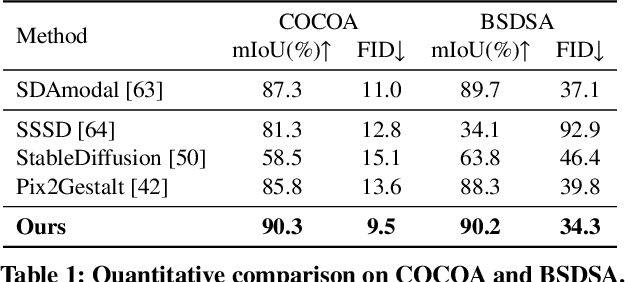

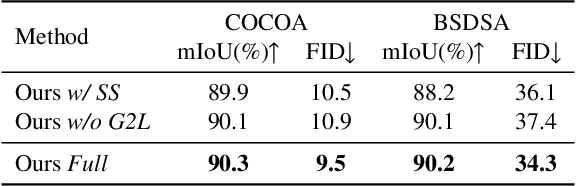
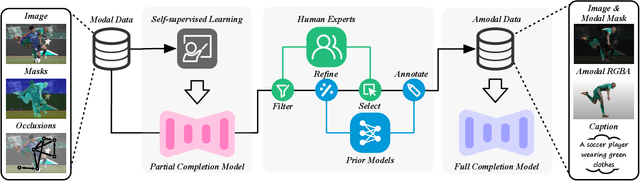
Image deocclusion (or amodal completion) aims to recover the invisible regions (\ie, shape and appearance) of occluded instances in images. Despite recent advances, the scarcity of high-quality data that balances diversity, plausibility, and fidelity remains a major obstacle. To address this challenge, we identify three critical elements: leveraging in-the-wild image data for diversity, incorporating human expertise for plausibility, and utilizing generative priors for fidelity. We propose SynergyAmodal, a novel framework for co-synthesizing in-the-wild amodal datasets with comprehensive shape and appearance annotations, which integrates these elements through a tripartite data-human-model collaboration. First, we design an occlusion-grounded self-supervised learning algorithm to harness the diversity of in-the-wild image data, fine-tuning an inpainting diffusion model into a partial completion diffusion model. Second, we establish a co-synthesis pipeline to iteratively filter, refine, select, and annotate the initial deocclusion results of the partial completion diffusion model, ensuring plausibility and fidelity through human expert guidance and prior model constraints. This pipeline generates a high-quality paired amodal dataset with extensive category and scale diversity, comprising approximately 16K pairs. Finally, we train a full completion diffusion model on the synthesized dataset, incorporating text prompts as conditioning signals. Extensive experiments demonstrate the effectiveness of our framework in achieving zero-shot generalization and textual controllability. Our code, dataset, and models will be made publicly available at https://github.com/imlixinyang/SynergyAmodal.
Head-Aware KV Cache Compression for Efficient Visual Autoregressive Modeling
Apr 12, 2025Visual Autoregressive (VAR) models have emerged as a powerful approach for multi-modal content creation, offering high efficiency and quality across diverse multimedia applications. However, they face significant memory bottlenecks due to extensive KV cache accumulation during inference. Existing KV cache compression techniques for large language models are suboptimal for VAR models due to, as we identify in this paper, two distinct categories of attention heads in VAR models: Structural Heads, which preserve spatial coherence through diagonal attention patterns, and Contextual Heads, which maintain semantic consistency through vertical attention patterns. These differences render single-strategy KV compression techniques ineffective for VAR models. To address this, we propose HACK, a training-free Head-Aware Compression method for KV cache. HACK allocates asymmetric cache budgets and employs pattern-specific compression strategies tailored to the essential characteristics of each head category. Experiments on Infinity-2B, Infinity-8B, and VAR-d30 demonstrate its effectiveness in text-to-image and class-conditional generation tasks. HACK can hack down up to 50\% and 70\% of cache with minimal performance degradation for VAR-d30 and Infinity-8B, respectively. Even with 70\% and 90\% KV cache compression in VAR-d30 and Infinity-8B, HACK still maintains high-quality generation while reducing memory usage by 44.2\% and 58.9\%, respectively.
CPPO: Accelerating the Training of Group Relative Policy Optimization-Based Reasoning Models
Mar 28, 2025This paper introduces Completion Pruning Policy Optimization (CPPO) to accelerate the training of reasoning models based on Group Relative Policy Optimization (GRPO). GRPO, while effective, incurs high training costs due to the need for sampling multiple completions for each question. Our experiment and theoretical analysis reveals that the number of completions impacts model accuracy yet increases training time multiplicatively, and not all completions contribute equally to policy training -- their contribution depends on their relative advantage. To address these issues, we propose CPPO, which prunes completions with low absolute advantages, significantly reducing the number needed for gradient calculation and updates. Additionally, we introduce a dynamic completion allocation strategy to maximize GPU utilization by incorporating additional questions, further enhancing training efficiency. Experimental results demonstrate that CPPO achieves up to $8.32\times$ speedup on GSM8K and $3.51\times$ on Math while preserving or even enhancing the accuracy compared to the original GRPO. We release our code at https://github.com/lzhxmu/CPPO.
WideRange4D: Enabling High-Quality 4D Reconstruction with Wide-Range Movements and Scenes
Mar 17, 2025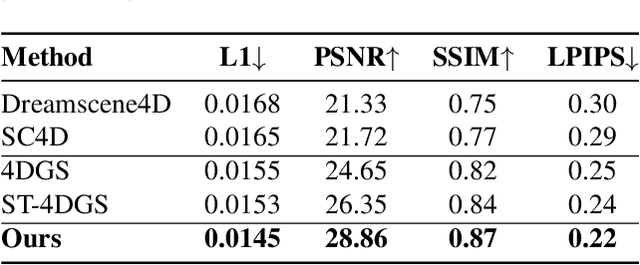
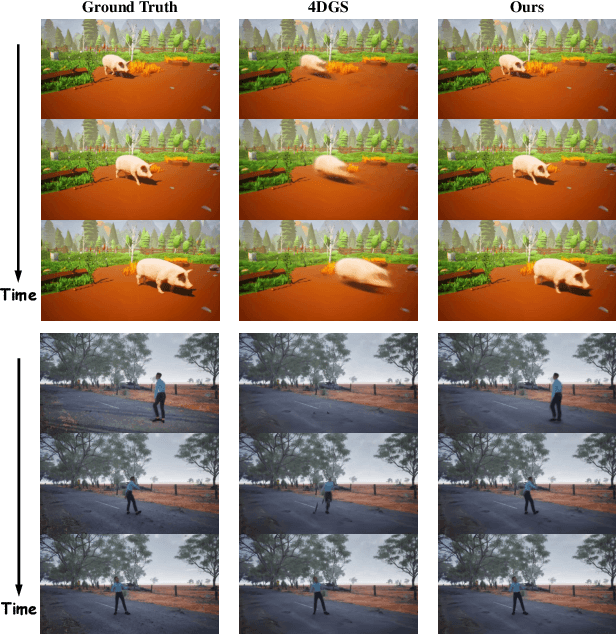
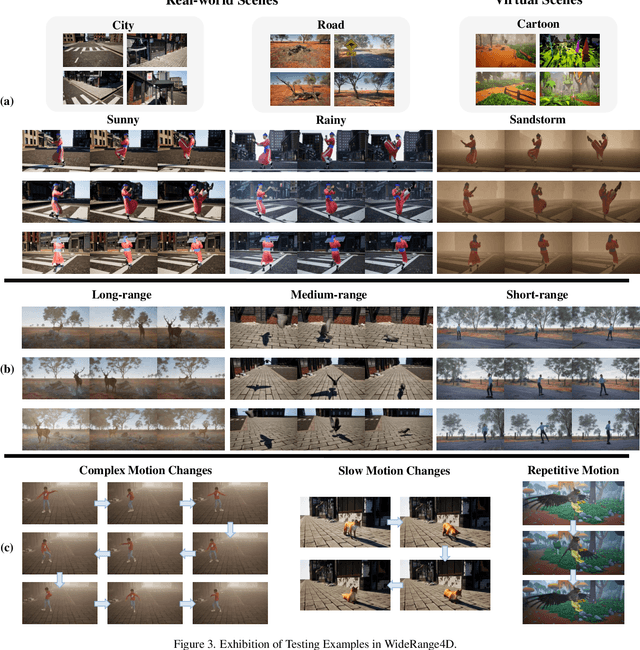
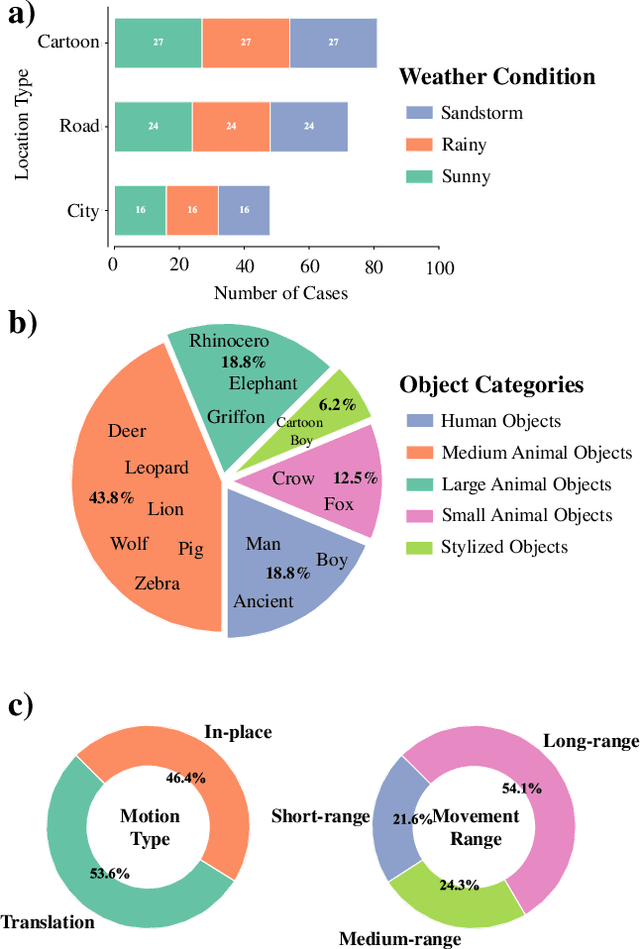
With the rapid development of 3D reconstruction technology, research in 4D reconstruction is also advancing, existing 4D reconstruction methods can generate high-quality 4D scenes. However, due to the challenges in acquiring multi-view video data, the current 4D reconstruction benchmarks mainly display actions performed in place, such as dancing, within limited scenarios. In practical scenarios, many scenes involve wide-range spatial movements, highlighting the limitations of existing 4D reconstruction datasets. Additionally, existing 4D reconstruction methods rely on deformation fields to estimate the dynamics of 3D objects, but deformation fields struggle with wide-range spatial movements, which limits the ability to achieve high-quality 4D scene reconstruction with wide-range spatial movements. In this paper, we focus on 4D scene reconstruction with significant object spatial movements and propose a novel 4D reconstruction benchmark, WideRange4D. This benchmark includes rich 4D scene data with large spatial variations, allowing for a more comprehensive evaluation of the generation capabilities of 4D generation methods. Furthermore, we introduce a new 4D reconstruction method, Progress4D, which generates stable and high-quality 4D results across various complex 4D scene reconstruction tasks. We conduct both quantitative and qualitative comparison experiments on WideRange4D, showing that our Progress4D outperforms existing state-of-the-art 4D reconstruction methods. Project: https://github.com/Gen-Verse/WideRange4D