 Add to Chrome
 Add to Firefox
 Add to Edge
SEP-Attack: A Simple and Effective Paradigm for Transfer-Based Textual Adversarial Attack
May 24, 2026
Despite the strong performance of deep neural networks in modern Web and language applications, they remain vulnerable to adversarial attacks, especially transferable attacks that generate adversarial examples using surrogate models without accessing the victim model. Transferable attacks in the text domain are still under-explored, with only a few studies addressing this challenging issue, often with suboptimal results due to equal treatment of submodels or inaccurate estimation of importance scores. To address these challenges, we propose a simple yet effective paradigm for transfer-based textual adversarial attack, named SEP-Attack. Specifically, we employ the Determinantal Point Process (DPP) to generate diverse surrogate ensemble weights, representing the transferability of submodels. Using these weights, we introduce a new metric to evaluate prediction confidence scores, which in turn are used to calculate word importance scores and generate adversarial candidates. Finally, we quantify the transferability score for each candidate and select the top ones as the final transferable adversarial examples. Experiments conducted on four datasets and two real-world APIs validate the efficacy of SEP-Attack, significantly outperforming state-of-the-art baselines.

SEPTQ: A Simple and Effective Post-Training Quantization Paradigm for Large Language Models
Apr 11, 2026Large language models (LLMs) have shown remarkable performance in various domains, but they are constrained by massive computational and storage costs. Quantization, an effective technique for compressing models to fit resource-limited devices while preserving generative quality, encompasses two primary methods: quantization aware training (QAT) and post-training quantization (PTQ). QAT involves additional retraining or fine-tuning, thus inevitably resulting in high training cost and making it unsuitable for LLMs. Consequently, PTQ has become the research hotspot in recent quantization methods. However, existing PTQ methods usually rely on various complex computation procedures and suffer from considerable performance degradation under low-bit quantization settings. To alleviate the above issues, we propose a simple and effective post-training quantization paradigm for LLMs, named SEPTQ. Specifically, SEPTQ first calculates the importance score for each element in the weight matrix and determines the quantization locations in a static global manner. Then it utilizes the mask matrix which represents the important locations to quantize and update the associated weights column-by-column until the appropriate quantized weight matrix is obtained. Compared with previous methods, SEPTQ simplifies the post-training quantization procedure into only two steps, and considers the effectiveness and efficiency simultaneously. Experimental results on various datasets across a suite of models ranging from millions to billions in different quantization bit-levels demonstrate that SEPTQ significantly outperforms other strong baselines, especially in low-bit quantization scenarios.
RUQuant: Towards Refining Uniform Quantization for Large Language Models
Apr 05, 2026The increasing size and complexity of large language models (LLMs) have raised significant challenges in deployment efficiency, particularly under resource constraints. Post-training quantization (PTQ) has emerged as a practical solution by compressing models without requiring retraining. While existing methods focus on uniform quantization schemes for both weights and activations, they often suffer from substantial accuracy degradation due to the non-uniform nature of activation distributions. In this work, we revisit the activation quantization problem from a theoretical perspective grounded in the Lloyd-Max optimality conditions. We identify the core issue as the non-uniform distribution of activations within the quantization interval, which causes the optimal quantization point under the Lloyd-Max criterion to shift away from the midpoint of the interval. To address this issue, we propose a two-stage orthogonal transformation method, RUQuant. In the first stage, activations are divided into blocks. Each block is mapped to uniformly sampled target vectors using composite orthogonal matrices, which are constructed from Householder reflections and Givens rotations. In the second stage, a global Householder reflection is fine-tuned to further minimize quantization error using Transformer output discrepancies. Empirical results show that our method achieves near-optimal quantization performance without requiring model fine-tuning: RUQuant achieves 99.8% of full-precision accuracy with W6A6 and 97% with W4A4 quantization for a 13B LLM, within approximately one minute. A fine-tuned variant yields even higher accuracy, demonstrating the effectiveness and scalability of our approach.
M3D-BFS: a Multi-stage Dynamic Fusion Strategy for Sample-Adaptive Multi-Modal Brain Network Analysis
Apr 02, 2026Multi-modal fusion is of great significance in neuroscience which integrates information from different modalities and can achieve better performance than uni-modal methods in downstream tasks. Current multi-modal fusion methods in brain networks, which mainly focus on structural connectivity (SC) and functional connectivity (FC) modalities, are static in nature. They feed different samples into the same model with identical computation, ignoring inherent difference between input samples. This lack of sample adaptation hinders model's further performance. To this end, we innovatively propose a multi-stage dynamic fusion strategy (M3D-BFS) for sample-adaptive multi-modal brain network analysis. Unlike other static fusion methods, we design different mixture-of-experts (MoEs) for uni- and multi-modal representations where modules can adaptively change as input sample changes during inference. To alleviate issue of MoE where training of experts may be collapsed, we divide our method into 3 stages. We first train uni-modal encoders respectively, then pretrain single experts of MoEs before finally finetuning the whole model. A multi-modal disentanglement loss is designed to enhance the final representations. To the best of our knowledge, this is the first work for dynamic fusion for multi-modal brain network analysis. Extensive experiments on different real-world datasets demonstrates the superiority of M3D-BFS.
Perceive What Matters: Relevance-Driven Scheduling for Multimodal Streaming Perception
Mar 13, 2026In modern human-robot collaboration (HRC) applications, multiple perception modules jointly extract visual, auditory, and contextual cues to achieve comprehensive scene understanding, enabling the robot to provide appropriate assistance to human agents intelligently. While executing multiple perception modules on a frame-by-frame basis enhances perception quality in offline settings, it inevitably accumulates latency, leading to a substantial decline in system performance in streaming perception scenarios. Recent work in scene understanding, termed Relevance, has established a solid foundation for developing efficient methodologies in HRC. However, modern perception pipelines still face challenges related to information redundancy and suboptimal allocation of computational resources. Drawing inspiration from the Relevance concept and the information sparsity in HRC events, we propose a novel lightweight perception scheduling framework that efficiently leverages output from previous frames to estimate and schedule necessary perception modules in real-time based on scene context. The experimental results demonstrate that the proposed perception scheduling framework effectively reduces computational latency by up to 27.52% compared to conventional parallel perception pipelines, while also achieving a 72.73% improvement in MMPose activation recall. Additionally, the framework demonstrates high keyframe accuracy, achieving rates of up to 98%. The results validate the framework's capability to enhance real-time perception efficiency without significantly compromising accuracy. The framework shows potential as a scalable and systematic solution for multimodal streaming perception systems in HRC.
TAO-Attack: Toward Advanced Optimization-Based Jailbreak Attacks for Large Language Models
Mar 03, 2026Large language models (LLMs) have achieved remarkable success across diverse applications but remain vulnerable to jailbreak attacks, where attackers craft prompts that bypass safety alignment and elicit unsafe responses. Among existing approaches, optimization-based attacks have shown strong effectiveness, yet current methods often suffer from frequent refusals, pseudo-harmful outputs, and inefficient token-level updates. In this work, we propose TAO-Attack, a new optimization-based jailbreak method. TAO-Attack employs a two-stage loss function: the first stage suppresses refusals to ensure the model continues harmful prefixes, while the second stage penalizes pseudo-harmful outputs and encourages the model toward more harmful completions. In addition, we design a direction-priority token optimization (DPTO) strategy that improves efficiency by aligning candidates with the gradient direction before considering update magnitude. Extensive experiments on multiple LLMs demonstrate that TAO-Attack consistently outperforms state-of-the-art methods, achieving higher attack success rates and even reaching 100\% in certain scenarios.
TSC: Topology-Conditioned Stackelberg Coordination for Multi-Agent Reinforcement Learning in Interactive Driving
Feb 27, 2026Safe and efficient autonomous driving in dense traffic is fundamentally a decentralized multi-agent coordination problem, where interactions at conflict points such as merging and weaving must be resolved reliably under partial observability. With only local and incomplete cues, interaction patterns can change rapidly, often causing unstable behaviors such as oscillatory yielding or unsafe commitments. Existing multi-agent reinforcement learning (MARL) approaches either adopt synchronous decision-making, which exacerbate non-stationarity, or depend on centralized sequencing mechanisms that scale poorly as traffic density increases. To address these limitations, we propose Topology-conditioned Stackelberg Coordination (TSC), a learning framework for decentralized interactive driving under communication-free execution, which extracts a time-varying directed priority graph from braid-inspired weaving relations between trajectories, thereby defining local leader-follower dependencies without constructing a global order of play. Conditioned on this graph, TSC endogenously factorizes dense interactions into graph-local Stackelberg subgames and, under centralized training and decentralized execution (CTDE), learns a sequential coordination policy that anticipates leaders via action prediction and trains followers through action-conditioned value learning to approximate local best responses, improving training stability and safety in dense traffic. Experiments across four dense traffic scenarios show that TSC achieves superior performance over representative MARL baselines across key metrics, most notably reducing collisions while maintaining competitive traffic efficiency and control smoothness.
Eye Movement Feature-Guided Signal De-Drifting in Electrooculography Systems
Sep 09, 2025Electrooculography (EOG) is widely used for gaze tracking in Human-Robot Collaboration (HRC). However, baseline drift caused by low-frequency noise significantly impacts the accuracy of EOG signals, creating challenges for further sensor fusion. This paper presents an Eye Movement Feature-Guided De-drift (FGD) method for mitigating drift artifacts in EOG signals. The proposed approach leverages active eye-movement feature recognition to reconstruct the feature-extracted EOG baseline and adaptively correct signal drift while preserving the morphological integrity of the EOG waveform. The FGD is evaluated using both simulation data and real-world data, achieving a significant reduction in mean error. The average error is reduced to 0.896{\deg} in simulation, representing a 36.29% decrease, and to 1.033{\deg} in real-world data, corresponding to a 26.53% reduction. Despite additional and unpredictable noise in real-world data, the proposed method consistently outperforms conventional de-drifting techniques, demonstrating its effectiveness in practical applications such as enhancing human performance augmentation.
Top-K Maximum Intensity Projection Priors for 3D Liver Vessel Segmentation
Mar 05, 2025Liver-vessel segmentation is an essential task in the pre-operative planning of liver resection. State-of-the-art 2D or 3D convolution-based methods focusing on liver vessel segmentation on 2D CT cross-sectional views, which do not take into account the global liver-vessel topology. To maintain this global vessel topology, we rely on the underlying physics used in the CT reconstruction process, and apply this to liver-vessel segmentation. Concretely, we introduce the concept of top-k maximum intensity projections, which mimics the CT reconstruction by replacing the integral along each projection direction, with keeping the top-k maxima along each projection direction. We use these top-k maximum projections to condition a diffusion model and generate 3D liver-vessel trees. We evaluate our 3D liver-vessel segmentation on the 3D-ircadb-01 dataset, and achieve the highest Dice coefficient, intersection-over-union (IoU), and Sensitivity scores compared to prior work.
Reinforcement Learning with Curriculum-inspired Adaptive Direct Policy Guidance for Truck Dispatching
Feb 28, 2025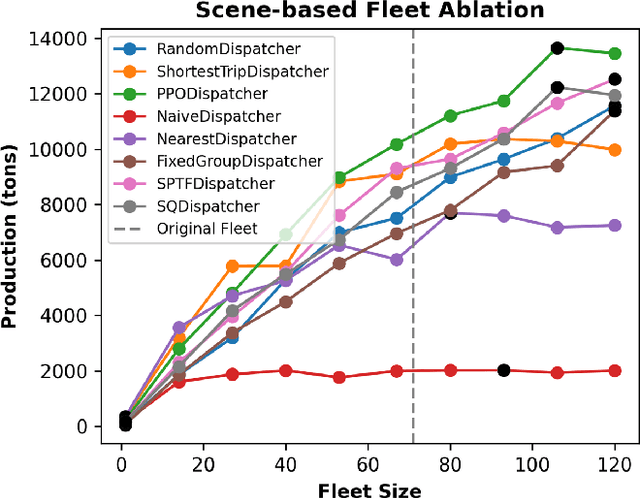
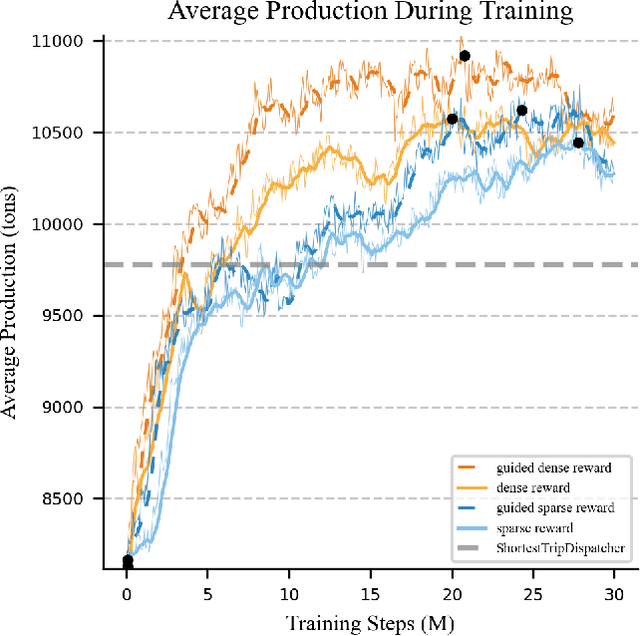
Efficient truck dispatching via Reinforcement Learning (RL) in open-pit mining is often hindered by reliance on complex reward engineering and value-based methods. This paper introduces Curriculum-inspired Adaptive Direct Policy Guidance, a novel curriculum learning strategy for policy-based RL to address these issues. We adapt Proximal Policy Optimization (PPO) for mine dispatching's uneven decision intervals using time deltas in Temporal Difference and Generalized Advantage Estimation, and employ a Shortest Processing Time teacher policy for guided exploration via policy regularization and adaptive guidance. Evaluations in OpenMines demonstrate our approach yields a 10% performance gain and faster convergence over standard PPO across sparse and dense reward settings, showcasing improved robustness to reward design. This direct policy guidance method provides a general and effective curriculum learning technique for RL-based truck dispatching, enabling future work on advanced architectures.