 Add to Chrome
 Add to Firefox
 Add to Edge
Towards General Language-Conditioned Latent Safety Filters
Jul 31, 2026
Robot policies are becoming increasingly general, with vision-language-action (VLA) models enabling a single policy to execute diverse tasks specified in natural language. Safe deployment, however, requires adapting not only to new tasks but also to varying safety requirements across users, environments, and applications. Existing safety filters remain largely constraint-specific and thus must be redesigned or relearned when safety requirements change. In this paper, we investigate language-conditioned safety filtering, in which a Hamilton-Jacobi safety actor and critic are conditioned on language-specified constraints. We evaluate this formulation across pick-and-place, table-wiping, and block-stacking tasks in the vision-based setting, examining its ability to enforce language-specified constraints and transfer to unseen constraint instances within the evaluated constraint families. Our experiments provide evidence that language-conditioned safety filters reduce constraint violations and exhibit partial transfer to unseen constraint instances.

HARD-KV: Head-Adaptive Regularization for Decoding-time KV Compression
Jun 27, 2026Long-context LLM inference faces a fundamental conflict: head-adaptive compression algorithms (e.g., Top-$p$ nucleus sampling) offer superior accuracy by dynamically fluctuating memory budgets, yet modern inference engines (e.g., vLLM) demand rigid, static memory patterns to leverage CUDA Graphs and PagedAttention. We resolve this ``Static-Dynamic'' mismatch with HARD-KV, a unified framework that that bridges dynamic selection with rigid system constraints. HARD-KV introduces a Cascade Cache hierarchy, managing the token lifecycle across dense, sparse, and condensed tiers. Crucially, we propose a Logits Calibration mechanism that normalizes diverse importance metrics into a unified probability space, enabling consistent Top-$p$ budgeting across heterogeneous heads. To bridge the efficiency gap, we offer a system-level solution, which rewrites fragmented, dynamic indices into contiguous physical layouts compatible with high-performance inference engine. Extensive experiments on math-reasoning benchmarks (AIME, U-Math) verify that HARD-KV achieves up to 2$\times$ throughput improvement over static baselines while maintaining high-fidelity generation in 10k+ token scenarios. Code is available at https://github.com/SuDIS-ZJU/HARDInfer.
DiARC: Distinguishing Positive and Negative Samples Helps Improving ARC-like Reasoning Ability of Large Language Models
Jun 26, 2026The Abstraction and Reasoning Corpus (ARC) contains tasks that require summarizing patterns from limited grid samples and predicting output grids. Recently, many large language model based approaches have attempted to transform it into a text-based reasoning task. However, methods based on open-source models have generally yielded unsatisfactory results, while those relying on closed-source models are too costly. Current efforts mainly focus on data augmentation, constructing ARC-like data for more comprehensive supervised fine-tuning. In this work, we argue that solving ARC-like problems requires not only positive sample supervision but also the ability to improve model reasoning by distinguishing negative samples. To this end, we draw on the idea of preference alignment and propose DiARC, a method that constructs preference pairs to enable the model to distinguish between them. Specifically, we propose three ways to construct negative samples, including output-level visual transformations, DSL-level rule inversion, and task-specific rule editing. The resulting negative samples provide informative near-miss alternatives while keeping the observed demonstrations unchanged. Experimental results across multiple ARC-like benchmarks show that DiARC consistently improves performance over baseline models. The code is released at https://github.com/szu-tera/DiARC.
\textsc{DiARC}: Distinguishing Positive and Negative Samples Helps Improving ARC-like Reasoning Ability of Large Language Models
Jun 25, 2026The Abstraction and Reasoning Corpus (ARC;~\citealp{chollet2019measure}) contains tasks that require summarizing patterns from limited grid samples and predicting output grids. Recently, many large language model based approaches have attempted to transform it into a text-based reasoning task. However, methods based on open-source models have generally yielded unsatisfactory results, while those relying on closed-source models are too costly. Current efforts mainly focus on data augmentation, constructing ARC-like data for more comprehensive supervised fine-tuning. In this work, we argue that solving ARC-like problems requires not only \textit{positive} sample supervision but also the ability to improve model reasoning by distinguishing \textit{negative} samples. To this end, we draw on the idea of preference alignment and propose \textsc{DiARC}, a method that constructs preference pairs to enable the model to distinguish between them. Specifically, we propose three ways to construct negative samples, including output-level visual transformations, DSL-level rule inversion, and task-specific rule editing. The resulting negative samples provide informative near-miss alternatives while keeping the observed demonstrations unchanged. Experimental results across multiple ARC-like benchmarks show that \textsc{DiARC} consistently improves performance over baseline models. The code is released at https://github.com/szu-tera/DiARC.
Potential-Guided Flow Matching for Vision-Language-Action Policy Improvement
Jun 03, 2026Large vision-language-action (VLA) policies are increasingly trained as conditional generative models over action chunks. Yet deployment produces mixed-quality experience-successful demonstrations, partial completions, recoverable mistakes, and failures-that is difficult to use with standard imitation. Full behavior cloning (BC) imitates failures, filtered BC discards useful sub-trajectories, and offline reinforcement learning adds a large critic. We introduce ForesightFlow, a self-guided flow-matching policy that augments each generated action chunk with a learned success-potential trajectory. The same flow proposes and scores candidate actions, enabling best-of-$K$ inference without an external critic. The key issue is that policy improvement and value calibration require different supervision: advantage weighting should emphasize high-quality actions, but applying the same weights to potential coordinates suppresses failure gradients and creates overconfident scores. We address this with decoupled advantage-weighted flow matching, applying exponentiated advantage weights only to action velocities while training potential velocities uniformly. We further derive a one-step boundary estimator for conditional flow matching, allowing advantage computation with a single stop-gradient forward pass. Across five BEHAVIOR-1K simulation tasks and five real-world bimanual tasks, ForesightFlow improves over imitation baselines, matches the strongest separate-critic baseline in simulation success, improves real-world success, and reduces training compute by $38\%$. Ablations show that decoupling prevents value hallucination, the one-step estimator preserves candidate-ranking fidelity, and self-guided sampling improves long-horizon execution.
SMAC: Spatial-Modal Joint Modeling and Adaptive Representation Collapse for Multimodal Object Tracking
Jun 02, 2026Multimodal multi-object tracking (MOT) under complex illumination remains challenging due to insufficient joint modeling of spatial and modal features and the limited adaptability of fixed fusion strategies. To address these issues, this paper proposes a spatial-modal convolution fusion and distillation-prompt-based multimodal MOT framework. A spatial-modal fusion backbone is first constructed, where a Basic module performs spatial feature extraction and modal interaction via decoupled 3D convolution, while a Mixed module models nonlinear cross-modal correlations through amplitude-phase decomposition. In addition, a representation collapse network is designed for adaptive multimodal fusion. A Distillation Prompt Guidance (DPG) module generates dynamic modal weights under teacher supervision, and a Global Modal Difference Aggregation (GMDA) module preserves discriminative information during multimodal representation collapse. Extensive experiments on the UniRTL dataset demonstrate the effectiveness of the proposed method. The proposed tracker achieves 63.31 HOTA and 79.21 MOTA on the RNT modality, outperforming several state-of-the-art methods while maintaining favorable inference efficiency. The source code and pretrained models are publicly available at https://github.com/QitaiSun/SMAC.
Evaluating Uplift Modeling under Structural Biases: Insights into Metric Stability and Model Robustness
Mar 21, 2026In personalized marketing, uplift models estimate incremental effects by modeling how customer behavior changes under alternative treatments. However, real-world data often exhibit biases - such as selection bias, spillover effects, and unobserved confounding - which adversely affect both estimation accuracy and metric validity. Despite the importance of bias-aware assessment, a lack of systematic studies persists. To bridge this gap, we design a systematic benchmarking framework. Unlike standard predictive tasks, real-world uplift datasets lack counterfactual ground truth, rendering direct metric validation infeasible. Therefore, a semi-synthetic approach serves as a critical enabler for systematic benchmarking, effectively bridging the gap by retaining real-world feature dependencies while providing the ground truth needed to isolate structural biases. Our investigations reveal that: (i) uplift targeting and prediction can manifest as distinct objectives, where proficiency in one does not ensure efficacy in the other; (ii) while many models exhibit inconsistent performance under diverse biases, TARNet shows notable robustness, providing insights for subsequent model design; (iii) evaluation metric stability is linked to mathematical alignment with the ATE, suggesting that ATE-approximating metrics yield more consistent model rankings under structural data imperfections. These findings suggest the need for more robust uplift models and metrics. Code will be released upon acceptance.
Hierarchy of extreme-event predictability in turbulence revealed by machine learning
Mar 14, 2026Extreme-event predictability in turbulence is strongly state dependent, yet event-by-event predictability horizons are difficult to quantify without access to governing equations or costly perturbation ensembles. Here we train an autoregressive conditional diffusion model on direct numerical simulations of the two-dimensional Kolmogorov flow and use a CRPS-based skill score to define an event-wise predictability horizon. Enstrophy extremes exhibit a pronounced hierarchy: forecast skill persists from $\approx 1$ to $> 4$ Lyapunov times across events. Spectral filtering shows that these horizons are controlled predominantly by large-scale structures. Extremes are preceded by intense strain cores organizing quadrupolar vortex packets, whose lifetime sharply separates long- from short-horizon events. These results identify coherent-structure persistence as a governing mechanism for the predictability of turbulence extremes and provide a data-driven route to diagnose predictability limits from observations.
Hepato-LLaVA: An Expert MLLM with Sparse Topo-Pack Attention for Hepatocellular Pathology Analysis on Whole Slide Images
Feb 26, 2026Hepatocellular Carcinoma diagnosis relies heavily on the interpretation of gigapixel Whole Slide Images. However, current computational approaches are constrained by fixed-resolution processing mechanisms and inefficient feature aggregation, which inevitably lead to either severe information loss or high feature redundancy. To address these challenges, we propose Hepato-LLaVA, a specialized Multi-modal Large Language Model designed for fine-grained hepatocellular pathology analysis. We introduce a novel Sparse Topo-Pack Attention mechanism that explicitly models 2D tissue topology. This mechanism effectively aggregates local diagnostic evidence into semantic summary tokens while preserving global context. Furthermore, to overcome the lack of multi-scale data, we present HepatoPathoVQA, a clinically grounded dataset comprising 33K hierarchically structured question-answer pairs validated by expert pathologists. Our experiments demonstrate that Hepato-LLaVA achieves state-of-the-art performance on HCC diagnosis and captioning tasks, significantly outperforming existing methods. Our code and implementation details are available at https://pris-cv.github.io/Hepto-LLaVA/.
Single-View Shape Completion for Robotic Grasping in Clutter
Dec 18, 2025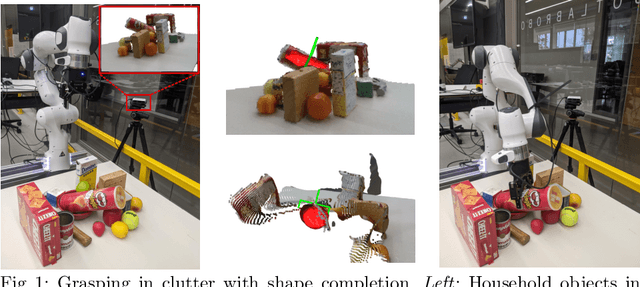
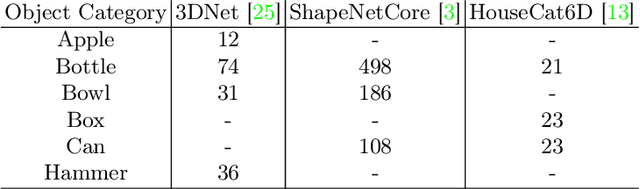
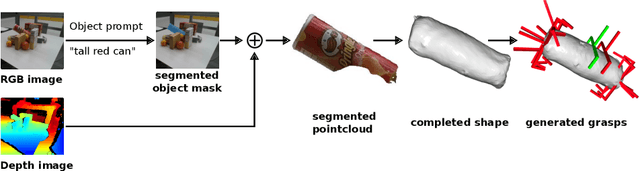
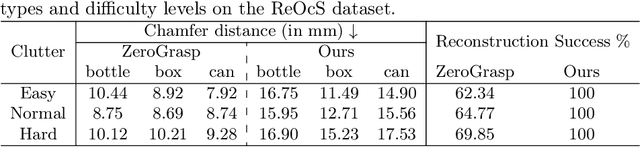
In vision-based robot manipulation, a single camera view can only capture one side of objects of interest, with additional occlusions in cluttered scenes further restricting visibility. As a result, the observed geometry is incomplete, and grasp estimation algorithms perform suboptimally. To address this limitation, we leverage diffusion models to perform category-level 3D shape completion from partial depth observations obtained from a single view, reconstructing complete object geometries to provide richer context for grasp planning. Our method focuses on common household items with diverse geometries, generating full 3D shapes that serve as input to downstream grasp inference networks. Unlike prior work, which primarily considers isolated objects or minimal clutter, we evaluate shape completion and grasping in realistic clutter scenarios with household objects. In preliminary evaluations on a cluttered scene, our approach consistently results in better grasp success rates than a naive baseline without shape completion by 23% and over a recent state of the art shape completion approach by 19%. Our code is available at https://amm.aass.oru.se/shape-completion-grasping/.