 Add to Chrome
 Add to Firefox
 Add to Edge
SpineReport: Automated 3D Quantification and Reporting of Lumbar Spine Degeneration on MRI
Jun 08, 2026
Lumbar spine conditions are a leading cause of disability worldwide, yet reliable quantification of degeneration from MRI remains challenging. In clinical practice, analysis is predominantly performed in two dimensions (2D), as manual three-dimensional (3D) assessment is time-consuming. However, 2D measurements suffer from limited reproducibility, particularly when anatomical structures are not aligned with the imaging plane. Existing automated approaches are often restricted to 2D, rely on discrete grading, or lack robustness and interpretability. We introduce SpineReport, an open-source, fully automated framework for comprehensive 3D morphometric analysis of lumbar spine MRI. Leveraging robust anatomical segmentations, the method extracts quantitative metrics from key structures, including the spinal canal, spinal cord, vertebrae, intervertebral discs, and foramina. These include both morphological and signal-based features, enabling cross-subject and longitudinal assessment. SpineReport further generates subject-specific reports that allow comparison with cohort distributions, improving interpretability and objective characterization of spinal morphology. Clinical relevance was evaluated against radiologist-reported severity grades for central canal, lateral recess, and foraminal stenosis. Metrics showed strong associations with central canal stenosis severity, with T2-weighted CSF signal providing the highest performance (AUC = 0.95). Canal AP diameter and area ratios also demonstrated strong correlations and high discriminative ability (AUC > 0.80). For lateral recess stenosis, associations were moderate, with lateral CSF signal being the most informative (AUC = 0.73). No significant associations were observed for foraminal stenosis despite robust region-of-interest extraction. SpineReport is released as an open-access tool: https://ivadomed.github.io/SpineReport/

Optimization in Sparse 2D to Dense 3D Weakly Supervised Learning: Application to Multi-Label Segmentation of Large ex vivo MRI Data
May 12, 2026INTRODUCTION | Fully supervised 3D segmentation of high-resolution ex vivo MRI is limited by the prohibitive cost of volumetric annotation, forcing reliance on sparse 2D slices. Weakly supervised Sparse-to-Dense frameworks bridge this gap, but guidelines remain ambiguous regarding human-centric visual enhancements and transferring optimization strategies across dimensions. We analyze divergent regularization needs for multi-class segmentation of high-resolution ex vivo spinal cord MRI. METHODS | We used 9.4T MRI of multiple sclerosis spinal cords (>104,000 slices) with sparse annotations (428 slices). A 2D Teacher trained on sparse slices generated dense pseudo-labels to train a 3D Student. We systematically evaluated the impact of human-centric preprocessing, spatial augmentation, and soft-label regularization on both architectures. RESULTS | We identified a critical divergence in training dynamics. The 2D Teacher required strong spatial augmentation and soft-labeling to overcome data scarcity, improving White Matter Lesion Dice scores by >11 points. However, propagating these techniques to the 3D Student degraded its performance. Furthermore, human-centric preprocessing (e.g., CLAHE) disrupted global statistical cues, dropping Gray Matter Lesion Dice scores by ~25 points. DISCUSSION | Our study highlights a perception divergence (human-centric contrast enhancement harms machine models) and a regularization conflict across dimensions. 3D architectures trained on dense pseudo-labels exhibit fundamentally different optimization landscapes than 2D counterparts and require distinct, conservative regularization. Code and models: https://github.com/ivadomed/model_seg_sc-gm-lesion_human_ms_exvivo_t2star.
One Sequence to Segment Them All: Efficient Data Augmentation for CT and MRI Cross-Domain 3D Spine Segmentation
May 04, 2026Deep learning-based medical image segmentation is increasingly used to support clinical diagnosis and develop new treatment strategies. However, model performance remains limited by the scarcity of high-quality annotated data and insufficient generalization across imaging protocols. This limitation is particularly evident in MRI and CT, where models are typically trained on a single acquisition sequence and exhibit reduced robustness when applied to unseen sequences or contrasts. Although data augmentation is widely used to improve general robustness on medical images, its impact on cross-modality generalization has not been quantitatively explored. In this work, we study a targeted set of data augmentation techniques designed to improve cross-modality transfer. We train three spine segmentation models, each on a single-modality/sequence dataset, and evaluate them across seven out-of-distribution datasets (spanning CT and MRI), reflecting a realistic single-sequence training and multi-sequence/contrast/modality deployment scenario. Our results demonstrate substantial performance gains on unseen domains (average Dice gain of 155 %) while preserving in-domain accuracy (average Dice decrease of 0.008 %), including effective transfer between CT and MRI. To mitigate the computational cost typically associated with strong data augmentation, we implement GPU-optimized augmentations that maintain, and even improve, training efficiency by approximately 10 %. We release our approach as an open-source toolbox, enabling seamless integration into commonly used frameworks such as nnUNet and MONAI. These augmentations significantly enhance robustness to heterogeneous clinical imaging scenarios without compromising training speed.
Monitoring morphometric drift in lifelong learning segmentation of the spinal cord
May 02, 2025Morphometric measures derived from spinal cord segmentations can serve as diagnostic and prognostic biomarkers in neurological diseases and injuries affecting the spinal cord. While robust, automatic segmentation methods to a wide variety of contrasts and pathologies have been developed over the past few years, whether their predictions are stable as the model is updated using new datasets has not been assessed. This is particularly important for deriving normative values from healthy participants. In this study, we present a spinal cord segmentation model trained on a multisite $(n=75)$ dataset, including 9 different MRI contrasts and several spinal cord pathologies. We also introduce a lifelong learning framework to automatically monitor the morphometric drift as the model is updated using additional datasets. The framework is triggered by an automatic GitHub Actions workflow every time a new model is created, recording the morphometric values derived from the model's predictions over time. As a real-world application of the proposed framework, we employed the spinal cord segmentation model to update a recently-introduced normative database of healthy participants containing commonly used measures of spinal cord morphometry. Results showed that: (i) our model outperforms previous versions and pathology-specific models on challenging lumbar spinal cord cases, achieving an average Dice score of $0.95 \pm 0.03$; (ii) the automatic workflow for monitoring morphometric drift provides a quick feedback loop for developing future segmentation models; and (iii) the scaling factor required to update the database of morphometric measures is nearly constant among slices across the given vertebral levels, showing minimum drift between the current and previous versions of the model monitored by the framework. The model is freely available in Spinal Cord Toolbox v7.0.
Rootlets-based registration to the spinal cord PAM50 template
Apr 30, 2025
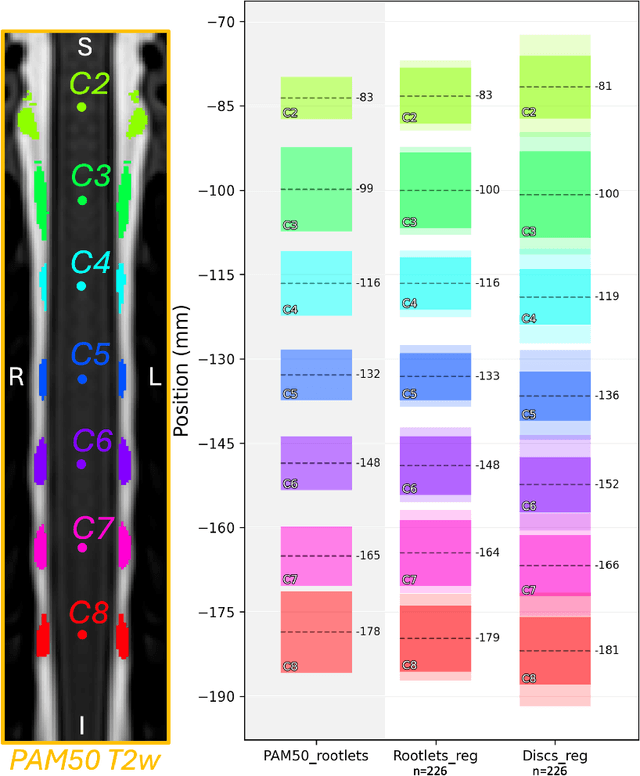
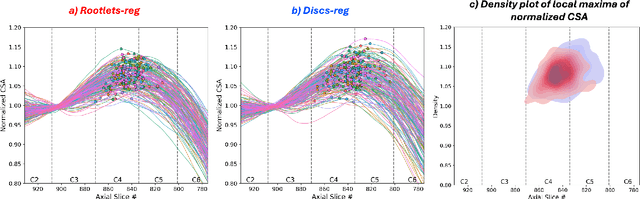
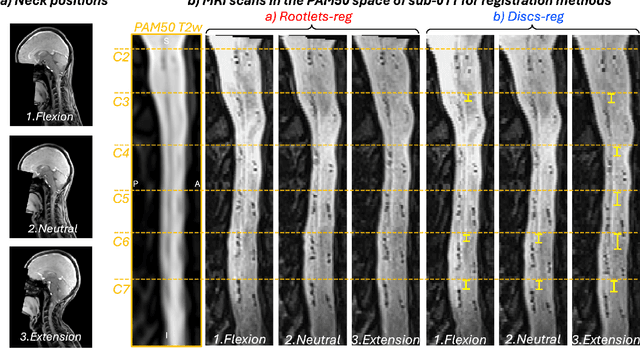
Spinal cord functional MRI studies require precise localization of spinal levels for reliable voxelwise group analyses. Traditional template-based registration of the spinal cord uses intervertebral discs for alignment. However, substantial anatomical variability across individuals exists between vertebral and spinal levels. This study proposes a novel registration approach that leverages spinal nerve rootlets to improve alignment accuracy and reproducibility across individuals. We developed a registration method leveraging dorsal cervical rootlets segmentation and aligning them non-linearly with the PAM50 spinal cord template. Validation was performed on a multi-subject, multi-site dataset (n=267, 44 sites) and a multi-subject dataset with various neck positions (n=10, 3 sessions). We further validated the method on task-based functional MRI (n=23) to compare group-level activation maps using rootlet-based registration to traditional disc-based methods. Rootlet-based registration showed superior alignment across individuals compared to the traditional disc-based method. Notably, rootlet positions were more stable across neck positions. Group-level analysis of task-based functional MRI using rootlet-based increased Z scores and activation cluster size compared to disc-based registration (number of active voxels from 3292 to 7978). Rootlet-based registration enhances both inter- and intra-subject anatomical alignment and yields better spatial normalization for group-level fMRI analyses. Our findings highlight the potential of rootlet-based registration to improve the precision and reliability of spinal cord neuroimaging group analysis.
Unpaired Modality Translation for Pseudo Labeling of Histology Images
Dec 03, 2024The segmentation of histological images is critical for various biomedical applications, yet the lack of annotated data presents a significant challenge. We propose a microscopy pseudo labeling pipeline utilizing unsupervised image translation to address this issue. Our method generates pseudo labels by translating between labeled and unlabeled domains without requiring prior annotation in the target domain. We evaluate two pseudo labeling strategies across three image domains increasingly dissimilar from the labeled data, demonstrating their effectiveness. Notably, our method achieves a mean Dice score of $0.736 \pm 0.005$ on a SEM dataset using the tutoring path, which involves training a segmentation model on synthetic data created by translating the labeled dataset (TEM) to the target modality (SEM). This approach aims to accelerate the annotation process by providing high-quality pseudo labels as a starting point for manual refinement.
Multi-Domain Data Aggregation for Axon and Myelin Segmentation in Histology Images
Sep 17, 2024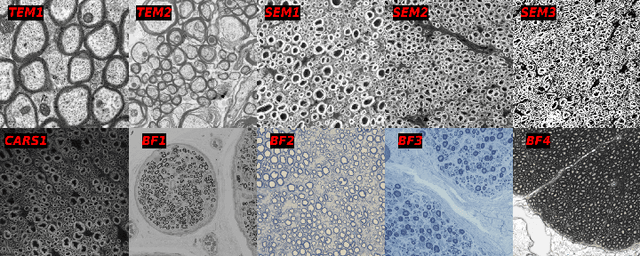


Quantifying axon and myelin properties (e.g., axon diameter, myelin thickness, g-ratio) in histology images can provide useful information about microstructural changes caused by neurodegenerative diseases. Automatic tissue segmentation is an important tool for these datasets, as a single stained section can contain up to thousands of axons. Advances in deep learning have made this task quick and reliable with minimal overhead, but a deep learning model trained by one research group will hardly ever be usable by other groups due to differences in their histology training data. This is partly due to subject diversity (different body parts, species, genetics, pathologies) and also to the range of modern microscopy imaging techniques resulting in a wide variability of image features (i.e., contrast, resolution). There is a pressing need to make AI accessible to neuroscience researchers to facilitate and accelerate their workflow, but publicly available models are scarce and poorly maintained. Our approach is to aggregate data from multiple imaging modalities (bright field, electron microscopy, Raman spectroscopy) and species (mouse, rat, rabbit, human), to create an open-source, durable tool for axon and myelin segmentation. Our generalist model makes it easier for researchers to process their data and can be fine-tuned for better performance on specific domains. We study the benefits of different aggregation schemes. This multi-domain segmentation model performs better than single-modality dedicated learners (p=0.03077), generalizes better on out-of-distribution data and is easier to use and maintain. Importantly, we package the segmentation tool into a well-maintained open-source software ecosystem (see https://github.com/axondeepseg/axondeepseg).
SCIsegV2: A Universal Tool for Segmentation of Intramedullary Lesions in Spinal Cord Injury
Jul 24, 2024Spinal cord injury (SCI) is a devastating incidence leading to permanent paralysis and loss of sensory-motor functions potentially resulting in the formation of lesions within the spinal cord. Imaging biomarkers obtained from magnetic resonance imaging (MRI) scans can predict the functional recovery of individuals with SCI and help choose the optimal treatment strategy. Currently, most studies employ manual quantification of these MRI-derived biomarkers, which is a subjective and tedious task. In this work, we propose (i) a universal tool for the automatic segmentation of intramedullary SCI lesions, dubbed \texttt{SCIsegV2}, and (ii) a method to automatically compute the width of the tissue bridges from the segmented lesion. Tissue bridges represent the spared spinal tissue adjacent to the lesion, which is associated with functional recovery in SCI patients. The tool was trained and validated on a heterogeneous dataset from 7 sites comprising patients from different SCI phases (acute, sub-acute, and chronic) and etiologies (traumatic SCI, ischemic SCI, and degenerative cervical myelopathy). Tissue bridges quantified automatically did not significantly differ from those computed manually, suggesting that the proposed automatic tool can be used to derive relevant MRI biomarkers. \texttt{SCIsegV2} and the automatic tissue bridges computation are open-source and available in Spinal Cord Toolbox (v6.4 and above) via the \texttt{sct\_deepseg -task seg\_sc\_lesion\_t2w\_sci} and \texttt{sct\_analyze\_lesion} functions, respectively.
Automatic Segmentation of the Spinal Cord Nerve Rootlets
Feb 01, 2024Precise identification of spinal nerve rootlets is relevant to delineate spinal levels for the study of functional activity in the spinal cord. The goal of this study was to develop an automatic method for the semantic segmentation of spinal nerve rootlets from T2-weighted magnetic resonance imaging (MRI) scans. Images from two open-access MRI datasets were used to train a 3D multi-class convolutional neural network using an active learning approach to segment C2-C8 dorsal nerve rootlets. Each output class corresponds to a spinal level. The method was tested on 3T T2-weighted images from datasets unseen during training to assess inter-site, inter-session, and inter-resolution variability. The test Dice score was 0.67 +- 0.16 (mean +- standard deviation across rootlets levels), suggesting a good performance. The method also demonstrated low inter-vendor and inter-site variability (coefficient of variation <= 1.41 %), as well as low inter-session variability (coefficient of variation <= 1.30 %) indicating stable predictions across different MRI vendors, sites, and sessions. The proposed methodology is open-source and readily available in the Spinal Cord Toolbox (SCT) v6.2 and higher.
Towards contrast-agnostic soft segmentation of the spinal cord
Oct 23, 2023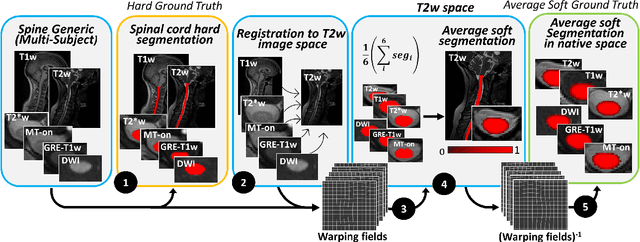
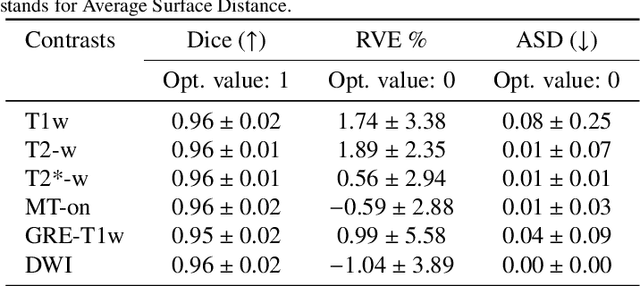
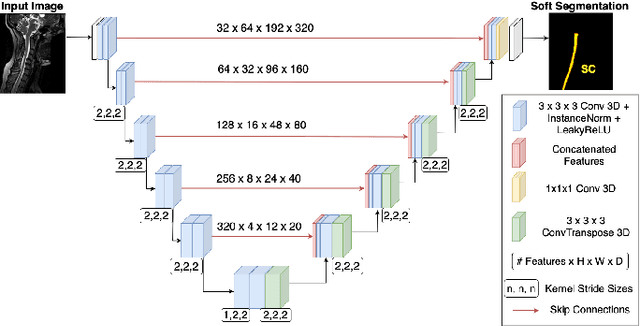
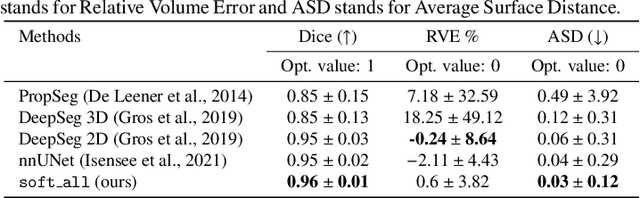
Spinal cord segmentation is clinically relevant and is notably used to compute spinal cord cross-sectional area (CSA) for the diagnosis and monitoring of cord compression or neurodegenerative diseases such as multiple sclerosis. While several semi and automatic methods exist, one key limitation remains: the segmentation depends on the MRI contrast, resulting in different CSA across contrasts. This is partly due to the varying appearance of the boundary between the spinal cord and the cerebrospinal fluid that depends on the sequence and acquisition parameters. This contrast-sensitive CSA adds variability in multi-center studies where protocols can vary, reducing the sensitivity to detect subtle atrophies. Moreover, existing methods enhance the CSA variability by training one model per contrast, while also producing binary masks that do not account for partial volume effects. In this work, we present a deep learning-based method that produces soft segmentations of the spinal cord. Using the Spine Generic Public Database of healthy participants ($\text{n}=267$; $\text{contrasts}=6$), we first generated participant-wise soft ground truth (GT) by averaging the binary segmentations across all 6 contrasts. These soft GT, along with a regression-based loss function, were then used to train a UNet model for spinal cord segmentation. We evaluated our model against state-of-the-art methods and performed ablation studies involving different GT mask types, loss functions, and contrast-specific models. Our results show that using the soft average segmentations along with a regression loss function reduces CSA variability ($p < 0.05$, Wilcoxon signed-rank test). The proposed spinal cord segmentation model generalizes better than the state-of-the-art contrast-specific methods amongst unseen datasets, vendors, contrasts, and pathologies (compression, lesions), while accounting for partial volume effects.