 Add to Chrome
 Add to Firefox
 Add to Edge
Fund2Persona: A Framework for Building and Refining Financial Advisor Personas from Fund Disclosure Data
Jun 30, 2026
Demand for personalized financial advising is growing, but consistent advisor expertise is difficult to obtain, scale, and encode in LLM systems. Simple persona prompts rarely specify how a financial advisor should reason and often drift toward generic recommendations. We propose Fund2Persona, a framework that grounds financial-advisor personas in fund disclosures, holdings transitions, market context, and manager commentary, then refines them through an agentic actor--scorer--patcher loop. We evaluate the resulting personas on held-out holdings-transition reconstruction and manager-commentary alignment, where they better recover portfolio decisions and grounded manager interpretation than generic baselines. We further study two downstream diagnostics: market-scenario generation, where persona retrieval broadens plausible investment views beyond repeated generic rollouts, and advisory dialogues grounded in investor profiles, where matched personas give more specific and useful advice than a generic advisor. These results suggest that fund-data-grounded financial-advisor personas can make manager-specific investment expertise portable rather than merely changing an LLM's surface style.

When Summaries Distort Decisions: Information Fidelity in LLM-Compressed Financial Analysis
Jun 28, 2026Financial decision-makers face more information than they can directly inspect, making context compression necessary. Yet when large language models (LLMs) compress financial source material, they can alter the investment judgment supported by the original source. We frame this problem as information fidelity: compression loses fidelity when it changes the decision induced by the source. In agentic systems, such losses may recur across intermediate steps and amplify throughout the decision process. Across financial filings and earnings-call transcripts, we find that LLM-based compression can produce fluent and factually plausible compressed contexts that nevertheless alter downstream decisions. We analyze two diagnostic patterns associated with fidelity loss: decontextualization, where salient evidence is retained but separated from the caveats and contextual qualifiers needed for correct interpretation, and model dependency, where different compressors expose different views of the same source. We then propose Agentic Context Compression, which generates multiple candidate compressions and audits their disagreements against the original source. Our results suggest that financial compression should be evaluated not only by efficiency or factuality, but also by its ability to preserve decision-relevant context.
Evaluating LLMs in Finance Requires Explicit Bias Consideration
Feb 15, 2026Large Language Models (LLMs) are increasingly integrated into financial workflows, but evaluation practice has not kept up. Finance-specific biases can inflate performance, contaminate backtests, and make reported results useless for any deployment claim. We identify five recurring biases in financial LLM applications. They include look-ahead bias, survivorship bias, narrative bias, objective bias, and cost bias. These biases break financial tasks in distinct ways and they often compound to create an illusion of validity. We reviewed 164 papers from 2023 to 2025 and found that no single bias is discussed in more than 28 percent of studies. This position paper argues that bias in financial LLM systems requires explicit attention and that structural validity should be enforced before any result is used to support a deployment claim. We propose a Structural Validity Framework and an evaluation checklist with minimal requirements for bias diagnosis and future system design. The material is available at https://github.com/Eleanorkong/Awesome-Financial-LLM-Bias-Mitigation.
Cross-Sectional Asset Retrieval via Future-Aligned Soft Contrastive Learning
Feb 11, 2026Asset retrieval--finding similar assets in a financial universe--is central to quantitative investment decision-making. Existing approaches define similarity through historical price patterns or sector classifications, but such backward-looking criteria provide no guarantee about future behavior. We argue that effective asset retrieval should be future-aligned: the retrieved assets should be those most likely to exhibit correlated future returns. To this end, we propose Future-Aligned Soft Contrastive Learning (FASCL), a representation learning framework whose soft contrastive loss uses pairwise future return correlations as continuous supervision targets. We further introduce an evaluation protocol designed to directly assess whether retrieved assets share similar future trajectories. Experiments on 4,229 US equities demonstrate that FASCL consistently outperforms 13 baselines across all future-behavior metrics. The source code will be available soon.
Your AI, Not Your View: The Bias of LLMs in Investment Analysis
Jul 28, 2025In finance, Large Language Models (LLMs) face frequent knowledge conflicts due to discrepancies between pre-trained parametric knowledge and real-time market data. These conflicts become particularly problematic when LLMs are deployed in real-world investment services, where misalignment between a model's embedded preferences and those of the financial institution can lead to unreliable recommendations. Yet little research has examined what investment views LLMs actually hold. We propose an experimental framework to investigate such conflicts, offering the first quantitative analysis of confirmation bias in LLM-based investment analysis. Using hypothetical scenarios with balanced and imbalanced arguments, we extract models' latent preferences and measure their persistence. Focusing on sector, size, and momentum, our analysis reveals distinct, model-specific tendencies. In particular, we observe a consistent preference for large-cap stocks and contrarian strategies across most models. These preferences often harden into confirmation bias, with models clinging to initial judgments despite counter-evidence.
Structuring the Unstructured: A Multi-Agent System for Extracting and Querying Financial KPIs and Guidance
May 25, 2025Extracting structured and quantitative insights from unstructured financial filings is essential in investment research, yet remains time-consuming and resource-intensive. Conventional approaches in practice rely heavily on labor-intensive manual processes, limiting scalability and delaying the research workflow. In this paper, we propose an efficient and scalable method for accurately extracting quantitative insights from unstructured financial documents, leveraging a multi-agent system composed of large language models. Our proposed multi-agent system consists of two specialized agents: the \emph{Extraction Agent} and the \emph{Text-to-SQL Agent}. The \textit{Extraction Agent} automatically identifies key performance indicators from unstructured financial text, standardizes their formats, and verifies their accuracy. On the other hand, the \textit{Text-to-SQL Agent} generates executable SQL statements from natural language queries, allowing users to access structured data accurately without requiring familiarity with the database schema. Through experiments, we demonstrate that our proposed system effectively transforms unstructured text into structured data accurately and enables precise retrieval of key information. First, we demonstrate that our system achieves approximately 95\% accuracy in transforming financial filings into structured data, matching the performance level typically attained by human annotators. Second, in a human evaluation of the retrieval task -- where natural language queries are used to search information from structured data -- 91\% of the responses were rated as correct by human evaluators. In both evaluations, our system generalizes well across financial document types, consistently delivering reliable performance.
FinDER: Financial Dataset for Question Answering and Evaluating Retrieval-Augmented Generation
Apr 22, 2025In the fast-paced financial domain, accurate and up-to-date information is critical to addressing ever-evolving market conditions. Retrieving this information correctly is essential in financial Question-Answering (QA), since many language models struggle with factual accuracy in this domain. We present FinDER, an expert-generated dataset tailored for Retrieval-Augmented Generation (RAG) in finance. Unlike existing QA datasets that provide predefined contexts and rely on relatively clear and straightforward queries, FinDER focuses on annotating search-relevant evidence by domain experts, offering 5,703 query-evidence-answer triplets derived from real-world financial inquiries. These queries frequently include abbreviations, acronyms, and concise expressions, capturing the brevity and ambiguity common in the realistic search behavior of professionals. By challenging models to retrieve relevant information from large corpora rather than relying on readily determined contexts, FinDER offers a more realistic benchmark for evaluating RAG systems. We further present a comprehensive evaluation of multiple state-of-the-art retrieval models and Large Language Models, showcasing challenges derived from a realistic benchmark to drive future research on truthful and precise RAG in the financial domain.
Linq-Embed-Mistral Technical Report
Dec 04, 2024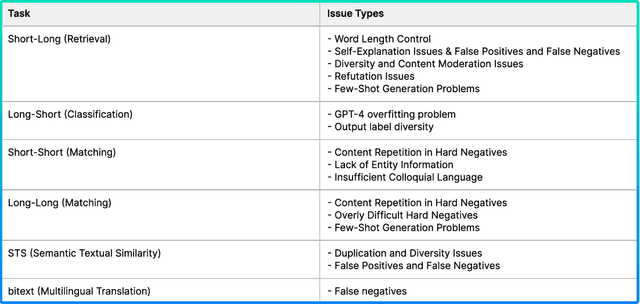
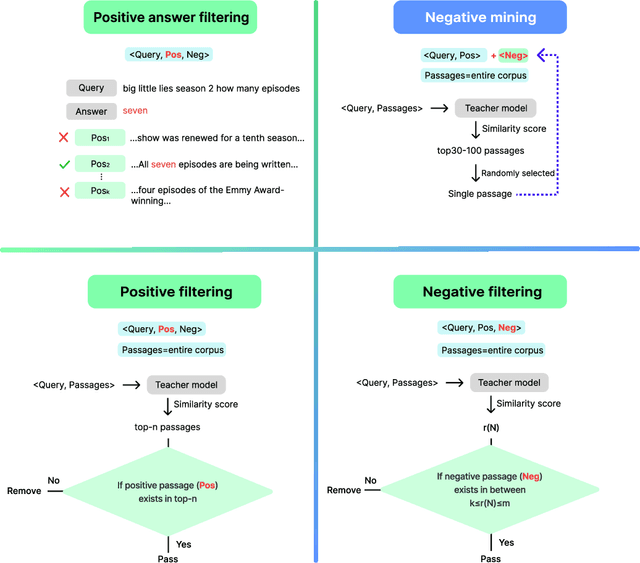

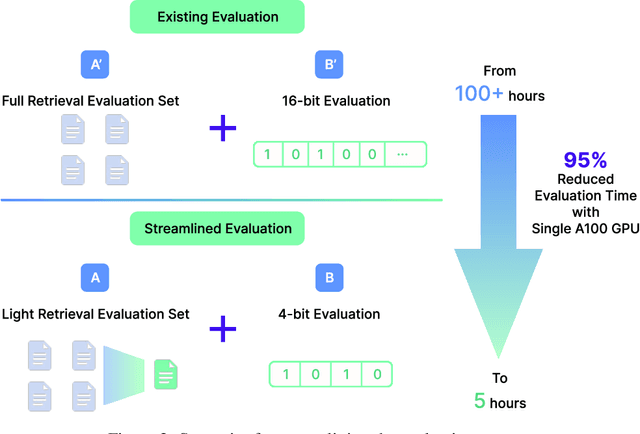
This report explores the enhancement of text retrieval performance using advanced data refinement techniques. We develop Linq-Embed-Mistral\footnote{\url{https://huggingface.co/Linq-AI-Research/Linq-Embed-Mistral}} by building on the E5-mistral and Mistral-7B-v0.1 models, focusing on sophisticated data crafting, data filtering, and negative mining methods, which are highly tailored to each task, applied to both existing benchmark dataset and highly tailored synthetic dataset generated via large language models (LLMs). Linq-Embed-Mistral excels in the MTEB benchmarks (as of May 29, 2024), achieving an average score of 68.2 across 56 datasets, and ranks 1st among all models for retrieval tasks on the MTEB leaderboard with a performance score of 60.2. This performance underscores its superior capability in enhancing search precision and reliability. Our contributions include advanced data refinement methods that significantly improve model performance on benchmark and synthetic datasets, techniques for homogeneous task ordering and mixed task fine-tuning to enhance model generalization and stability, and a streamlined evaluation process using 4-bit precision and a light retrieval evaluation set, which accelerates validation without sacrificing accuracy.
Improving Multi-lingual Alignment Through Soft Contrastive Learning
May 28, 2024Making decent multi-lingual sentence representations is critical to achieve high performances in cross-lingual downstream tasks. In this work, we propose a novel method to align multi-lingual embeddings based on the similarity of sentences measured by a pre-trained mono-lingual embedding model. Given translation sentence pairs, we train a multi-lingual model in a way that the similarity between cross-lingual embeddings follows the similarity of sentences measured at the mono-lingual teacher model. Our method can be considered as contrastive learning with soft labels defined as the similarity between sentences. Our experimental results on five languages show that our contrastive loss with soft labels far outperforms conventional contrastive loss with hard labels in various benchmarks for bitext mining tasks and STS tasks. In addition, our method outperforms existing multi-lingual embeddings including LaBSE, for Tatoeba dataset. The code is available at https://github.com/YAI12xLinq-B/IMASCL
Re-Ex: Revising after Explanation Reduces the Factual Errors in LLM Responses
Feb 27, 2024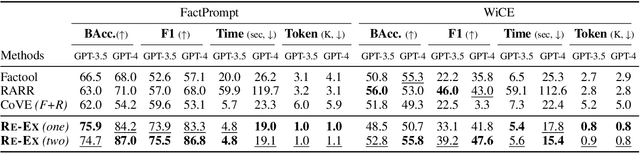
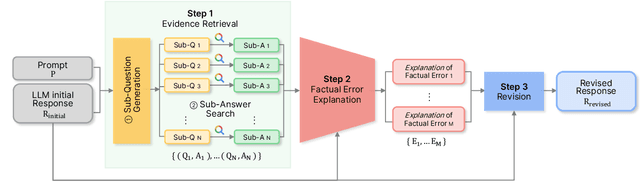
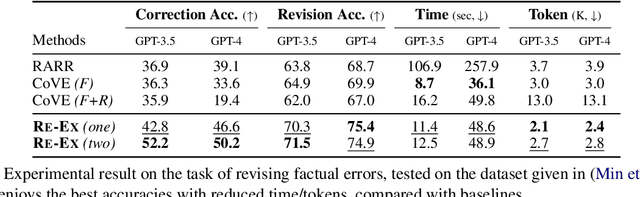
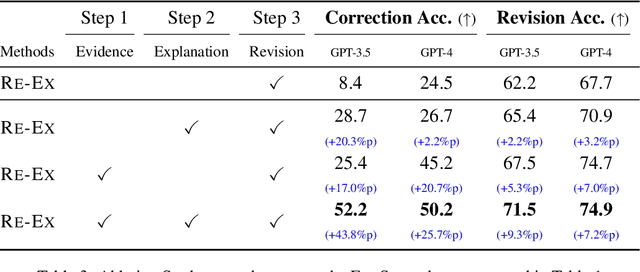
Mitigating hallucination issues is one of the main challenges of LLMs we need to overcome, in order to reliably use them in real-world scenarios. Recently, various methods are proposed to check the factual errors in the LLM-generated texts and revise them accordingly, to reduce the hallucination issue. In this paper, we propose Re-Ex, a method of revising LLM-generated texts, which introduces a novel step dubbed as the factual error explanation step. Re-Ex revises the initial response of LLMs using 3-steps: first, external tools are used to get the evidences on the factual errors in the response; second, LLMs are instructed to explain the problematic parts of the response based on the evidences gathered in the first step; finally, LLMs revise the response using the explanation obtained in the second step. In addition to the explanation step, we propose new prompting techniques to reduce the amount of tokens and wall-clock time required for the response revision process. Compared with existing methods including Factool, CoVE, and RARR, Re-Ex provides better revision performance with less time and fewer tokens in multiple benchmarks.