 Add to Chrome
 Add to Firefox
 Add to Edge
An Open-Source Monitoring Framework for Data Exploration and Progress Tracking in Multi-Center Radiology Studies
Jun 15, 2026
Multi-center studies are crucial for advancing medical and radiological research. Data exploration, collaboration discovery, and study progress monitoring are essential for maximizing their potential. However, in practice these processes often rely on manual communication and shared tables, which quickly become outdated and hinder efficient coordination in large distributed studies. This highlights the need for dedicated monitoring solutions that provide transparent and up-to-date insights into study progress. We propose a lightweight, open-source monitoring architecture for multi-center studies based on the widely used Grafana-Prometheus stack. The framework collects aggregated monitoring metrics from distributed study sites and visualizes them through configurable dashboards. As a real-world deployment example, the framework is integrated into the medical imaging platform Kaapana and evaluated within a large multi-center research network. By deploying our solution within the Germany-wide RACOON consortium, we demonstrate its ability to enable privacy-preserving data exploration and study progress monitoring across all 38 German university clinics. The monitoring framework supports transparent coordination of distributed research activities and can facilitate more efficient management of large-scale multi-center studies. The source code and Kaapana integration are publicly available at https://github.com/MIC-DKFZ/study-monitoring-kaapana.

Federated Medical Image Segmentation under Real-World Label Noise: A Benchmark Suite for Noisy Label Learning Method Selection
Jun 15, 2026While federated learning (FL) enables collaborative medical image segmentation without centralizing sensitive data, real-world deployment is frequently complicated by cross-site label imperfections such as contour disagreement, missing or additional structures, and confused labels. Federated noisy label learning (FNLL) aims to mitigate these effects, yet remains underused in practice as existing evidence is largely based on synthetic noise, simplified settings, and limited real-world noisy evaluation. We address this gap by introducing a benchmark suite that combines diverse real-world noisy datasets, deployment-relevant client-noise scenarios, and label-noise-targeted evaluation to support systematic FNLL assessment and informed method selection. The suite combines curated real-world noisy medical image segmentation datasets from diverse sources with a comprehensive federated segmentation framework including various client-noise scenarios and noise-targeted evaluation. The presented suite provides a realistic and discriminative basis for FNLL evaluation in medical image segmentation and establishes a reusable foundation for fair benchmarking, dataset-specific label-noise characterization, and future method development under realistic federated settings. Code is available at https://github.com/MIC-DKFZ/FedSegNoiseBench.
Exploiting Longitudinal Context in Clinician-Verified Interactive Lesion Tracking
May 22, 2026Tracking tumor lesions across serial CT scans is essential for oncological response assessment. Existing automated methods face a fundamental trade-off: end-to-end trackers achieve high automation but offer no opportunity to correct silent tracking failures, while decoupled registration-segmentation pipelines permit user verification yet discard the lesion's prior appearance, limiting accuracy in ambiguous cases. In this work, we propose a Verified Tracking paradigm: a clinician verifies a registration-proposed prompt, which the model leverages alongside the baseline lesion appearance to resolve segmentation ambiguities. We present a unified framework combining early spatial prompt fusion with latent temporal difference weighting for longitudinally-informed segmentation. To address data scarcity, we leverage large-scale synthetic pretraining, proving essential for exploiting longitudinal context, improving performance by up to 4.5 Dice points over training from scratch. Our approach secured first place in the MICCAI autoPET IV challenge. We further curate and release PanTrack, a new longitudinal pancreatic cancer benchmark, to assess out-of-distribution generalization. Experiments show that our model outperforms prior work in both fully automatic and the proposed verified tracking setting offering a clinically safe middle ground between automation and control. Code, model and dataset will be released at https://github.com/MIC-DKFZ/LongiSeg
Better than Average: Spatially-Aware Aggregation of Segmentation Uncertainty Improves Downstream Performance
Mar 31, 2026Uncertainty Quantification (UQ) is crucial for ensuring the reliability of automated image segmentations in safety-critical domains like biomedical image analysis or autonomous driving. In segmentation, UQ generates pixel-wise uncertainty scores that must be aggregated into image-level scores for downstream tasks like Out-of-Distribution (OoD) or failure detection. Despite routine use of aggregation strategies, their properties and impact on downstream task performance have not yet been comprehensively studied. Global Average is the default choice, yet it does not account for spatial and structural features of segmentation uncertainty. Alternatives like patch-, class- and threshold-based strategies exist, but lack systematic comparison, leading to inconsistent reporting and unclear best practices. We address this gap by (1) formally analyzing properties, limitations, and pitfalls of common strategies; (2) proposing novel strategies that incorporate spatial uncertainty structure and (3) benchmarking their performance on OoD and failure detection across ten datasets that vary in image geometry and structure. We find that aggregators leveraging spatial structure yield stronger performance in both downstream tasks studied. However, the performance of individual aggregators depends heavily on dataset characteristics, so we (4) propose a meta-aggregator that integrates multiple aggregators and performs robustly across datasets.
Multimodal classification of Radiation-Induced Contrast Enhancements and tumor recurrence using deep learning
Mar 12, 2026The differentiation between tumor recurrence and radiation-induced contrast enhancements in post-treatment glioblastoma patients remains a major clinical challenge. Existing approaches rely on clinically sparsely available diffusion MRI or do not consider radiation maps, which are gaining increasing interest in the tumor board for this differentiation. We introduce RICE-NET, a multimodal 3D deep learning model that integrates longitudinal MRI data with radiotherapy dose distributions for automated lesion classification using conventional T1-weighted MRI data. Using a cohort of 92 patients, the model achieved an F1 score of 0.92 on an independent test set. During extensive ablation experiments, we quantified the contribution of each timepoint and modality and showed that reliable classification largely depends on the radiation map. Occlusion-based interpretability analyses further confirmed the model's focus on clinically relevant regions. These findings highlight the potential of multimodal deep learning to enhance diagnostic accuracy and support clinical decision-making in neuro-oncology.
Beyond Benchmarks of IUGC: Rethinking Requirements of Deep Learning Methods for Intrapartum Ultrasound Biometry from Fetal Ultrasound Videos
Feb 13, 2026A substantial proportion (45\%) of maternal deaths, neonatal deaths, and stillbirths occur during the intrapartum phase, with a particularly high burden in low- and middle-income countries. Intrapartum biometry plays a critical role in monitoring labor progression; however, the routine use of ultrasound in resource-limited settings is hindered by a shortage of trained sonographers. To address this challenge, the Intrapartum Ultrasound Grand Challenge (IUGC), co-hosted with MICCAI 2024, was launched. The IUGC introduces a clinically oriented multi-task automatic measurement framework that integrates standard plane classification, fetal head-pubic symphysis segmentation, and biometry, enabling algorithms to exploit complementary task information for more accurate estimation. Furthermore, the challenge releases the largest multi-center intrapartum ultrasound video dataset to date, comprising 774 videos (68,106 frames) collected from three hospitals, providing a robust foundation for model training and evaluation. In this study, we present a comprehensive overview of the challenge design, review the submissions from eight participating teams, and analyze their methods from five perspectives: preprocessing, data augmentation, learning strategy, model architecture, and post-processing. In addition, we perform a systematic analysis of the benchmark results to identify key bottlenecks, explore potential solutions, and highlight open challenges for future research. Although encouraging performance has been achieved, our findings indicate that the field remains at an early stage, and further in-depth investigation is required before large-scale clinical deployment. All benchmark solutions and the complete dataset have been publicly released to facilitate reproducible research and promote continued advances in automatic intrapartum ultrasound biometry.
Finally Outshining the Random Baseline: A Simple and Effective Solution for Active Learning in 3D Biomedical Imaging
Jan 20, 2026Active learning (AL) has the potential to drastically reduce annotation costs in 3D biomedical image segmentation, where expert labeling of volumetric data is both time-consuming and expensive. Yet, existing AL methods are unable to consistently outperform improved random sampling baselines adapted to 3D data, leaving the field without a reliable solution. We introduce Class-stratified Scheduled Power Predictive Entropy (ClaSP PE), a simple and effective query strategy that addresses two key limitations of standard uncertainty-based AL methods: class imbalance and redundancy in early selections. ClaSP PE combines class-stratified querying to ensure coverage of underrepresented structures and log-scale power noising with a decaying schedule to enforce query diversity in early-stage AL and encourage exploitation later. In our evaluation on 24 experimental settings using four 3D biomedical datasets within the comprehensive nnActive benchmark, ClaSP PE is the only method that generally outperforms improved random baselines in terms of both segmentation quality with statistically significant gains, whilst remaining annotation efficient. Furthermore, we explicitly simulate the real-world application by testing our method on four previously unseen datasets without manual adaptation, where all experiment parameters are set according to predefined guidelines. The results confirm that ClaSP PE robustly generalizes to novel tasks without requiring dataset-specific tuning. Within the nnActive framework, we present compelling evidence that an AL method can consistently outperform random baselines adapted to 3D segmentation, in terms of both performance and annotation efficiency in a realistic, close-to-production scenario. Our open-source implementation and clear deployment guidelines make it readily applicable in practice. Code is at https://github.com/MIC-DKFZ/nnActive.
MedNeXt-v2: Scaling 3D ConvNeXts for Large-Scale Supervised Representation Learning in Medical Image Segmentation
Dec 19, 2025Large-scale supervised pretraining is rapidly reshaping 3D medical image segmentation. However, existing efforts focus primarily on increasing dataset size and overlook the question of whether the backbone network is an effective representation learner at scale. In this work, we address this gap by revisiting ConvNeXt-based architectures for volumetric segmentation and introducing MedNeXt-v2, a compound-scaled 3D ConvNeXt that leverages improved micro-architecture and data scaling to deliver state-of-the-art performance. First, we show that routinely used backbones in large-scale pretraining pipelines are often suboptimal. Subsequently, we use comprehensive backbone benchmarking prior to scaling and demonstrate that stronger from scratch performance reliably predicts stronger downstream performance after pretraining. Guided by these findings, we incorporate a 3D Global Response Normalization module and use depth, width, and context scaling to improve our architecture for effective representation learning. We pretrain MedNeXt-v2 on 18k CT volumes and demonstrate state-of-the-art performance when fine-tuning across six challenging CT and MR benchmarks (144 structures), showing consistent gains over seven publicly released pretrained models. Beyond improvements, our benchmarking of these models also reveals that stronger backbones yield better results on similar data, representation scaling disproportionately benefits pathological segmentation, and that modality-specific pretraining offers negligible benefit once full finetuning is applied. In conclusion, our results establish MedNeXt-v2 as a strong backbone for large-scale supervised representation learning in 3D Medical Image Segmentation. Our code and pretrained models are made available with the official nnUNet repository at: https://www.github.com/MIC-DKFZ/nnUNet
CRONOS: Continuous Time Reconstruction for 4D Medical Longitudinal Series
Dec 18, 2025Forecasting how 3D medical scans evolve over time is important for disease progression, treatment planning, and developmental assessment. Yet existing models either rely on a single prior scan, fixed grid times, or target global labels, which limits voxel-level forecasting under irregular sampling. We present CRONOS, a unified framework for many-to-one prediction from multiple past scans that supports both discrete (grid-based) and continuous (real-valued) timestamps in one model, to the best of our knowledge the first to achieve continuous sequence-to-image forecasting for 3D medical data. CRONOS learns a spatio-temporal velocity field that transports context volumes toward a target volume at an arbitrary time, while operating directly in 3D voxel space. Across three public datasets spanning Cine-MRI, perfusion CT, and longitudinal MRI, CRONOS outperforms other baselines, while remaining computationally competitive. We will release code and evaluation protocols to enable reproducible, multi-dataset benchmarking of multi-context, continuous-time forecasting.
Kaapana: A Comprehensive Open-Source Platform for Integrating AI in Medical Imaging Research Environments
Dec 10, 2025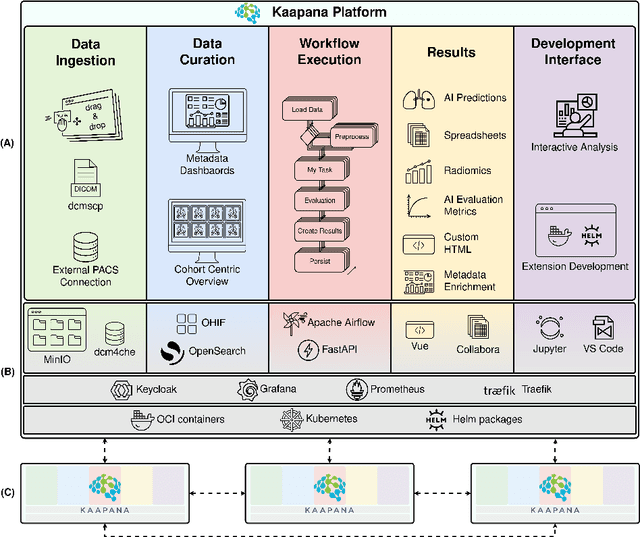
Developing generalizable AI for medical imaging requires both access to large, multi-center datasets and standardized, reproducible tooling within research environments. However, leveraging real-world imaging data in clinical research environments is still hampered by strict regulatory constraints, fragmented software infrastructure, and the challenges inherent in conducting large-cohort multicentre studies. This leads to projects that rely on ad-hoc toolchains that are hard to reproduce, difficult to scale beyond single institutions and poorly suited for collaboration between clinicians and data scientists. We present Kaapana, a comprehensive open-source platform for medical imaging research that is designed to bridge this gap. Rather than building single-use, site-specific tooling, Kaapana provides a modular, extensible framework that unifies data ingestion, cohort curation, processing workflows and result inspection under a common user interface. By bringing the algorithm to the data, it enables institutions to keep control over their sensitive data while still participating in distributed experimentation and model development. By integrating flexible workflow orchestration with user-facing applications for researchers, Kaapana reduces technical overhead, improves reproducibility and enables conducting large-scale, collaborative, multi-centre imaging studies. We describe the core concepts of the platform and illustrate how they can support diverse use cases, from local prototyping to nation-wide research networks. The open-source codebase is available at https://github.com/kaapana/kaapana