 Add to Chrome
 Add to Firefox
 Add to Edge
CACER: Clinical Concept Annotations for Cancer Events and Relations
Sep 05, 2024
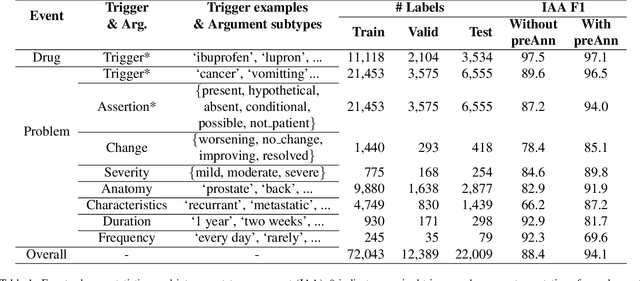
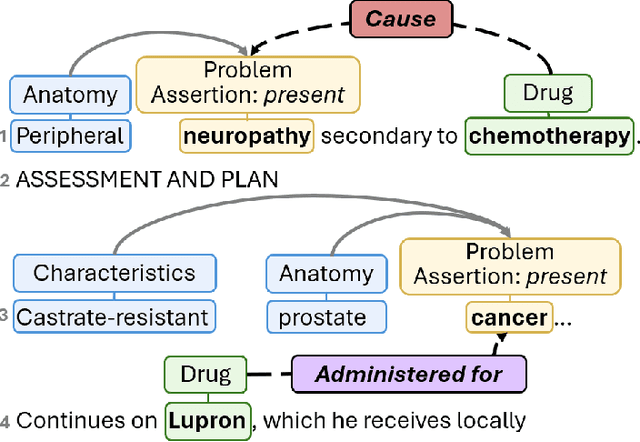
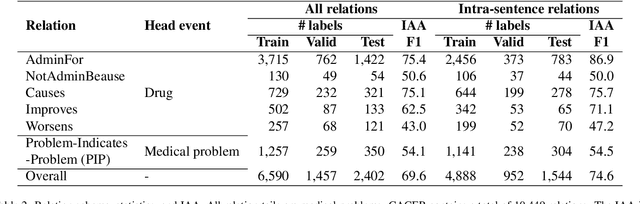
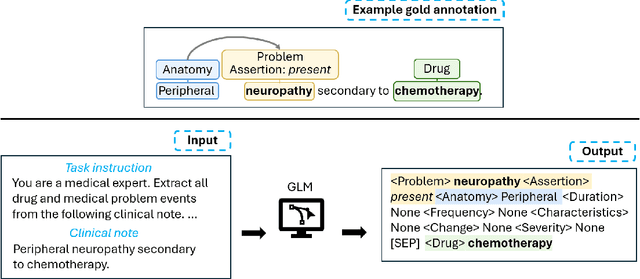
Clinical notes contain unstructured representations of patient histories, including the relationships between medical problems and prescription drugs. To investigate the relationship between cancer drugs and their associated symptom burden, we extract structured, semantic representations of medical problem and drug information from the clinical narratives of oncology notes. We present Clinical Concept Annotations for Cancer Events and Relations (CACER), a novel corpus with fine-grained annotations for over 48,000 medical problems and drug events and 10,000 drug-problem and problem-problem relations. Leveraging CACER, we develop and evaluate transformer-based information extraction (IE) models such as BERT, Flan-T5, Llama3, and GPT-4 using fine-tuning and in-context learning (ICL). In event extraction, the fine-tuned BERT and Llama3 models achieved the highest performance at 88.2-88.0 F1, which is comparable to the inter-annotator agreement (IAA) of 88.4 F1. In relation extraction, the fine-tuned BERT, Flan-T5, and Llama3 achieved the highest performance at 61.8-65.3 F1. GPT-4 with ICL achieved the worst performance across both tasks. The fine-tuned models significantly outperformed GPT-4 in ICL, highlighting the importance of annotated training data and model optimization. Furthermore, the BERT models performed similarly to Llama3. For our task, LLMs offer no performance advantage over the smaller BERT models. The results emphasize the need for annotated training data to optimize models. Multiple fine-tuned transformer models achieved performance comparable to IAA for several extraction tasks.
* This is a pre-copy-editing, author-produced PDF of an article accepted for publication in JAMIA following peer review. The definitive publisher-authenticated version is available online at https://academic.oup.com/jamia/advance-article/doi/10.1093/jamia/ocae231/7748302

Global-Local Collaborative Inference with LLM for Lidar-Based Open-Vocabulary Detection
Jul 12, 2024Open-Vocabulary Detection (OVD) is the task of detecting all interesting objects in a given scene without predefined object classes. Extensive work has been done to deal with the OVD for 2D RGB images, but the exploration of 3D OVD is still limited. Intuitively, lidar point clouds provide 3D information, both object level and scene level, to generate trustful detection results. However, previous lidar-based OVD methods only focus on the usage of object-level features, ignoring the essence of scene-level information. In this paper, we propose a Global-Local Collaborative Scheme (GLIS) for the lidar-based OVD task, which contains a local branch to generate object-level detection result and a global branch to obtain scene-level global feature. With the global-local information, a Large Language Model (LLM) is applied for chain-of-thought inference, and the detection result can be refined accordingly. We further propose Reflected Pseudo Labels Generation (RPLG) to generate high-quality pseudo labels for supervision and Background-Aware Object Localization (BAOL) to select precise object proposals. Extensive experiments on ScanNetV2 and SUN RGB-D demonstrate the superiority of our methods. Code is released at https://github.com/GradiusTwinbee/GLIS.
Mobility VLA: Multimodal Instruction Navigation with Long-Context VLMs and Topological Graphs
Jul 10, 2024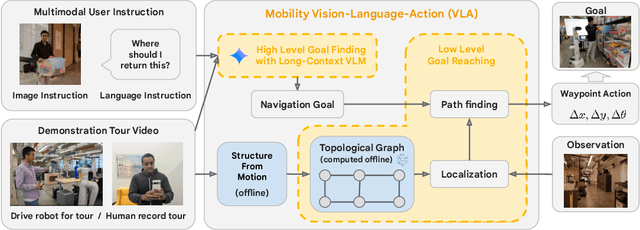

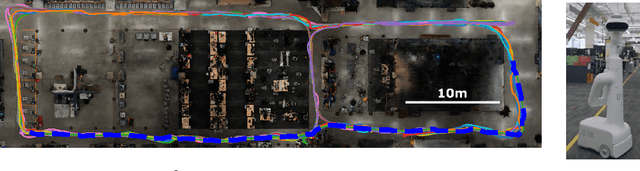

An elusive goal in navigation research is to build an intelligent agent that can understand multimodal instructions including natural language and image, and perform useful navigation. To achieve this, we study a widely useful category of navigation tasks we call Multimodal Instruction Navigation with demonstration Tours (MINT), in which the environment prior is provided through a previously recorded demonstration video. Recent advances in Vision Language Models (VLMs) have shown a promising path in achieving this goal as it demonstrates capabilities in perceiving and reasoning about multimodal inputs. However, VLMs are typically trained to predict textual output and it is an open research question about how to best utilize them in navigation. To solve MINT, we present Mobility VLA, a hierarchical Vision-Language-Action (VLA) navigation policy that combines the environment understanding and common sense reasoning power of long-context VLMs and a robust low-level navigation policy based on topological graphs. The high-level policy consists of a long-context VLM that takes the demonstration tour video and the multimodal user instruction as input to find the goal frame in the tour video. Next, a low-level policy uses the goal frame and an offline constructed topological graph to generate robot actions at every timestep. We evaluated Mobility VLA in a 836m^2 real world environment and show that Mobility VLA has a high end-to-end success rates on previously unsolved multimodal instructions such as "Where should I return this?" while holding a plastic bin.
Find Parent then Label Children: A Two-stage Taxonomy Completion Method with Pre-trained Language Model
Jun 25, 2024Taxonomies, which organize domain concepts into hierarchical structures, are crucial for building knowledge systems and downstream applications. As domain knowledge evolves, taxonomies need to be continuously updated to include new concepts. Previous approaches have mainly focused on adding concepts to the leaf nodes of the existing hierarchical tree, which does not fully utilize the taxonomy's knowledge and is unable to update the original taxonomy structure (usually involving non-leaf nodes). In this paper, we propose a two-stage method called ATTEMPT for taxonomy completion. Our method inserts new concepts into the correct position by finding a parent node and labeling child nodes. Specifically, by combining local nodes with prompts to generate natural sentences, we take advantage of pre-trained language models for hypernym/hyponymy recognition. Experimental results on two public datasets (including six domains) show that ATTEMPT performs best on both taxonomy completion and extension tasks, surpassing existing methods.
VADER: Visual Affordance Detection and Error Recovery for Multi Robot Human Collaboration
May 25, 2024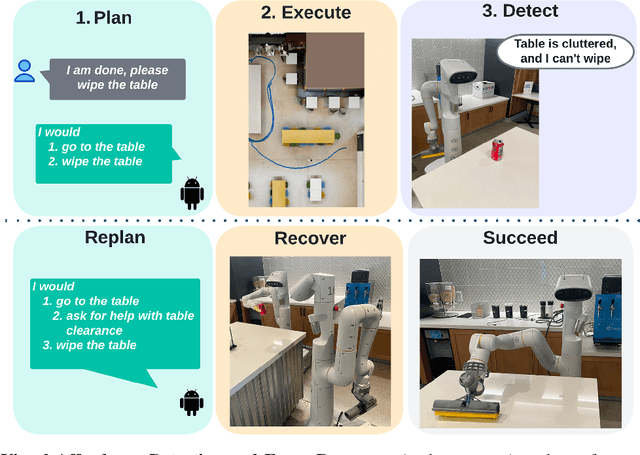
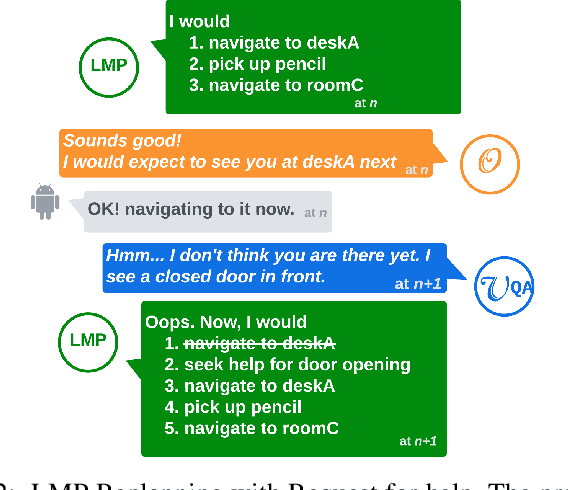
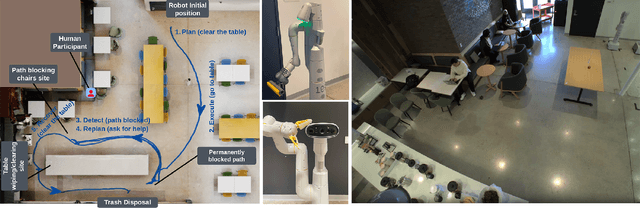
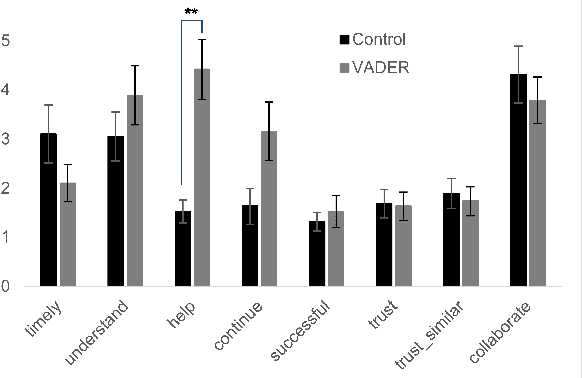
Robots today can exploit the rich world knowledge of large language models to chain simple behavioral skills into long-horizon tasks. However, robots often get interrupted during long-horizon tasks due to primitive skill failures and dynamic environments. We propose VADER, a plan, execute, detect framework with seeking help as a new skill that enables robots to recover and complete long-horizon tasks with the help of humans or other robots. VADER leverages visual question answering (VQA) modules to detect visual affordances and recognize execution errors. It then generates prompts for a language model planner (LMP) which decides when to seek help from another robot or human to recover from errors in long-horizon task execution. We show the effectiveness of VADER with two long-horizon robotic tasks. Our pilot study showed that VADER is capable of performing complex long-horizon tasks by asking for help from another robot to clear a table. Our user study showed that VADER is capable of performing complex long-horizon tasks by asking for help from a human to clear a path. We gathered feedback from people (N=19) about the performance of the VADER performance vs. a robot that did not ask for help. https://google-vader.github.io/
GenCHiP: Generating Robot Policy Code for High-Precision and Contact-Rich Manipulation Tasks
Apr 09, 2024


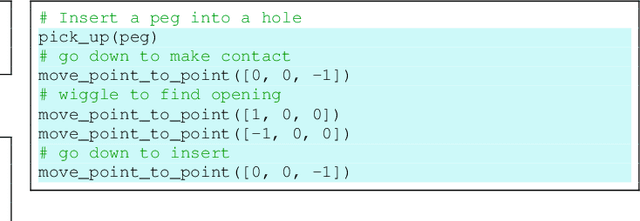
Large Language Models (LLMs) have been successful at generating robot policy code, but so far these results have been limited to high-level tasks that do not require precise movement. It is an open question how well such approaches work for tasks that require reasoning over contact forces and working within tight success tolerances. We find that, with the right action space, LLMs are capable of successfully generating policies for a variety of contact-rich and high-precision manipulation tasks, even under noisy conditions, such as perceptual errors or grasping inaccuracies. Specifically, we reparameterize the action space to include compliance with constraints on the interaction forces and stiffnesses involved in reaching a target pose. We validate this approach on subtasks derived from the Functional Manipulation Benchmark (FMB) and NIST Task Board Benchmarks. Exposing this action space alongside methods for estimating object poses improves policy generation with an LLM by greater than 3x and 4x when compared to non-compliant action spaces
Extracting Social Determinants of Health from Pediatric Patient Notes Using Large Language Models: Novel Corpus and Methods
Apr 04, 2024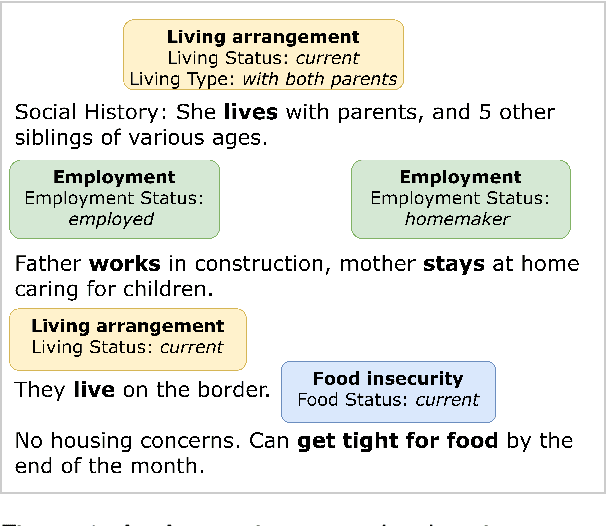
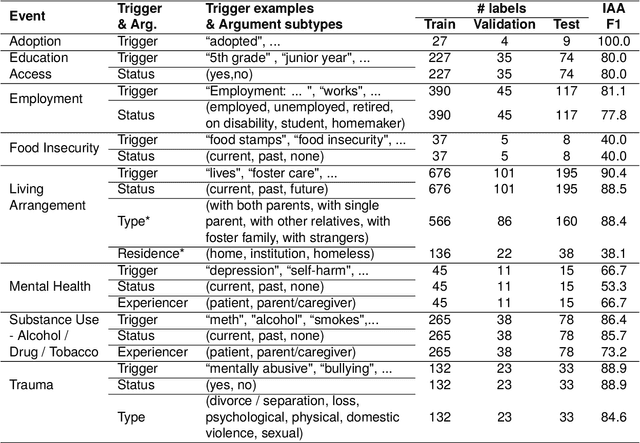
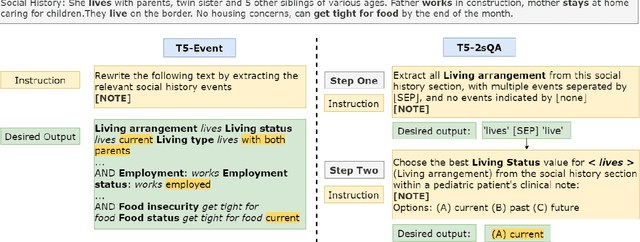
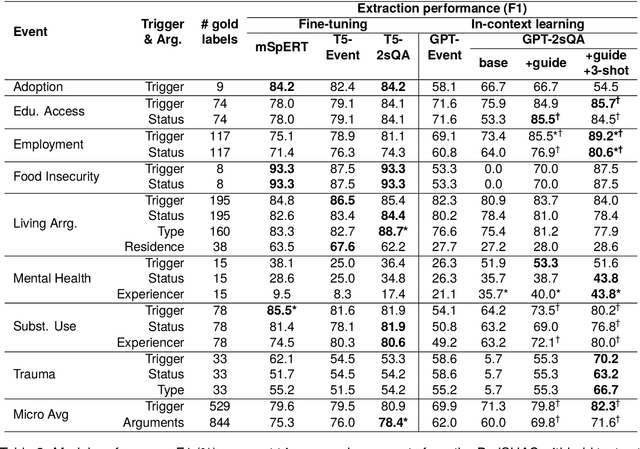
Social determinants of health (SDoH) play a critical role in shaping health outcomes, particularly in pediatric populations where interventions can have long-term implications. SDoH are frequently studied in the Electronic Health Record (EHR), which provides a rich repository for diverse patient data. In this work, we present a novel annotated corpus, the Pediatric Social History Annotation Corpus (PedSHAC), and evaluate the automatic extraction of detailed SDoH representations using fine-tuned and in-context learning methods with Large Language Models (LLMs). PedSHAC comprises annotated social history sections from 1,260 clinical notes obtained from pediatric patients within the University of Washington (UW) hospital system. Employing an event-based annotation scheme, PedSHAC captures ten distinct health determinants to encompass living and economic stability, prior trauma, education access, substance use history, and mental health with an overall annotator agreement of 81.9 F1. Our proposed fine-tuning LLM-based extractors achieve high performance at 78.4 F1 for event arguments. In-context learning approaches with GPT-4 demonstrate promise for reliable SDoH extraction with limited annotated examples, with extraction performance at 82.3 F1 for event triggers.
CoNVOI: Context-aware Navigation using Vision Language Models in Outdoor and Indoor Environments
Mar 22, 2024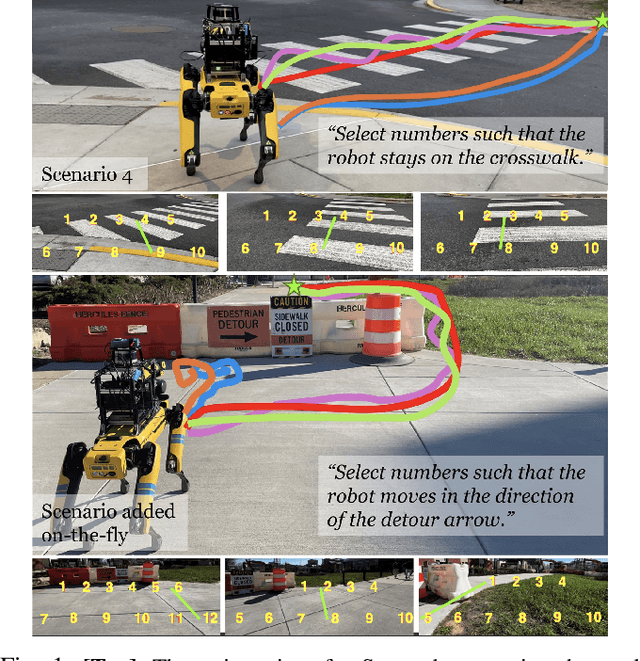
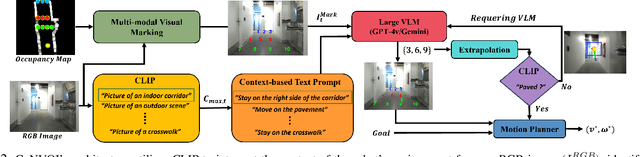
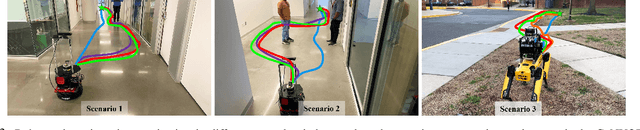
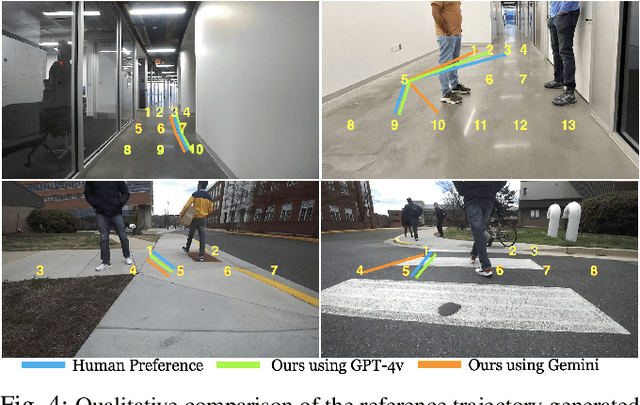
We present ConVOI, a novel method for autonomous robot navigation in real-world indoor and outdoor environments using Vision Language Models (VLMs). We employ VLMs in two ways: first, we leverage their zero-shot image classification capability to identify the context or scenario (e.g., indoor corridor, outdoor terrain, crosswalk, etc) of the robot's surroundings, and formulate context-based navigation behaviors as simple text prompts (e.g. ``stay on the pavement"). Second, we utilize their state-of-the-art semantic understanding and logical reasoning capabilities to compute a suitable trajectory given the identified context. To this end, we propose a novel multi-modal visual marking approach to annotate the obstacle-free regions in the RGB image used as input to the VLM with numbers, by correlating it with a local occupancy map of the environment. The marked numbers ground image locations in the real-world, direct the VLM's attention solely to navigable locations, and elucidate the spatial relationships between them and terrains depicted in the image to the VLM. Next, we query the VLM to select numbers on the marked image that satisfy the context-based behavior text prompt, and construct a reference path using the selected numbers. Finally, we propose a method to extrapolate the reference trajectory when the robot's environmental context has not changed to prevent unnecessary VLM queries. We use the reference trajectory to guide a motion planner, and demonstrate that it leads to human-like behaviors (e.g. not cutting through a group of people, using crosswalks, etc.) in various real-world indoor and outdoor scenarios.
MicroDiffusion: Implicit Representation-Guided Diffusion for 3D Reconstruction from Limited 2D Microscopy Projections
Mar 16, 2024Volumetric optical microscopy using non-diffracting beams enables rapid imaging of 3D volumes by projecting them axially to 2D images but lacks crucial depth information. Addressing this, we introduce MicroDiffusion, a pioneering tool facilitating high-quality, depth-resolved 3D volume reconstruction from limited 2D projections. While existing Implicit Neural Representation (INR) models often yield incomplete outputs and Denoising Diffusion Probabilistic Models (DDPM) excel at capturing details, our method integrates INR's structural coherence with DDPM's fine-detail enhancement capabilities. We pretrain an INR model to transform 2D axially-projected images into a preliminary 3D volume. This pretrained INR acts as a global prior guiding DDPM's generative process through a linear interpolation between INR outputs and noise inputs. This strategy enriches the diffusion process with structured 3D information, enhancing detail and reducing noise in localized 2D images. By conditioning the diffusion model on the closest 2D projection, MicroDiffusion substantially enhances fidelity in resulting 3D reconstructions, surpassing INR and standard DDPM outputs with unparalleled image quality and structural fidelity. Our code and dataset are available at https://github.com/UCSC-VLAA/MicroDiffusion.
BEHAVIOR-1K: A Human-Centered, Embodied AI Benchmark with 1,000 Everyday Activities and Realistic Simulation
Mar 14, 2024


We present BEHAVIOR-1K, a comprehensive simulation benchmark for human-centered robotics. BEHAVIOR-1K includes two components, guided and motivated by the results of an extensive survey on "what do you want robots to do for you?". The first is the definition of 1,000 everyday activities, grounded in 50 scenes (houses, gardens, restaurants, offices, etc.) with more than 9,000 objects annotated with rich physical and semantic properties. The second is OMNIGIBSON, a novel simulation environment that supports these activities via realistic physics simulation and rendering of rigid bodies, deformable bodies, and liquids. Our experiments indicate that the activities in BEHAVIOR-1K are long-horizon and dependent on complex manipulation skills, both of which remain a challenge for even state-of-the-art robot learning solutions. To calibrate the simulation-to-reality gap of BEHAVIOR-1K, we provide an initial study on transferring solutions learned with a mobile manipulator in a simulated apartment to its real-world counterpart. We hope that BEHAVIOR-1K's human-grounded nature, diversity, and realism make it valuable for embodied AI and robot learning research. Project website: https://behavior.stanford.edu.