 Add to Chrome
 Add to Firefox
 Add to Edge
Geometry-Aware State Space Model: A New Paradigm for Whole-Slide Image Representation
May 06, 2026
Accurate analysis of histopathological images is critical for disease diagnosis and treatment planning. Whole-slide images (WSIs), which digitize tissue specimens at gigapixel resolution, are fundamental to this process but require aggregating thousands of patches for slide-level predictions. Multiple Instance Learning (MIL) tackles this challenge with a two-stage paradigm, decoupling tile-level embedding and slide-level prediction. However, most existing methods implicitly embed patch representations in homogeneous Euclidean spaces, overlooking the hierarchical organization and regional heterogeneity of pathological tissues. This limits current models' ability to capture global tissue architecture and fine-grained cellular morphology. To address this limitation, we introduce a hybrid hyperbolic-Euclidean representation that embeds WSI features in dual geometric spaces, enabling complementary modeling of hierarchical tissue structures and local morphological details. Building on this formulation, we develop BatMIL, a WSI classification framework that leverages both geometric spaces. To model long-range dependencies among thousands of patches, we employ a structured state space sequence model (S4) backbone that encodes patch sequences with linear computational complexity. Furthermore, to account for regional heterogeneity, we introduce a chunk-level mixture-of-experts (MoE) module that groups patches into regions and dynamically routes them to specialized subnetworks, improving representational capacity while reducing redundant computation. Extensive experiments on seven WSI datasets spanning six cancer types demonstrate that BatMIL consistently outperforms state-of-the-art MIL approaches in slide-level classification tasks. These results indicate that geometry-aware representation learning offers a promising direction for next-generation computational pathology.

Affordances Enable Partial World Modeling with LLMs
Feb 11, 2026Full models of the world require complex knowledge of immense detail. While pre-trained large models have been hypothesized to contain similar knowledge due to extensive pre-training on vast amounts of internet scale data, using them directly in a search procedure is inefficient and inaccurate. Conversely, partial models focus on making high quality predictions for a subset of state and actions: those linked through affordances that achieve user intents~\citep{khetarpal2020can}. Can we posit large models as partial world models? We provide a formal answer to this question, proving that agents achieving task-agnostic, language-conditioned intents necessarily possess predictive partial-world models informed by affordances. In the multi-task setting, we introduce distribution-robust affordances and show that partial models can be extracted to significantly improve search efficiency. Empirical evaluations in tabletop robotics tasks demonstrate that our affordance-aware partial models reduce the search branching factor and achieve higher rewards compared to full world models.
Evaluating Gemini Robotics Policies in a Veo World Simulator
Dec 11, 2025Generative world models hold significant potential for simulating interactions with visuomotor policies in varied environments. Frontier video models can enable generation of realistic observations and environment interactions in a scalable and general manner. However, the use of video models in robotics has been limited primarily to in-distribution evaluations, i.e., scenarios that are similar to ones used to train the policy or fine-tune the base video model. In this report, we demonstrate that video models can be used for the entire spectrum of policy evaluation use cases in robotics: from assessing nominal performance to out-of-distribution (OOD) generalization, and probing physical and semantic safety. We introduce a generative evaluation system built upon a frontier video foundation model (Veo). The system is optimized to support robot action conditioning and multi-view consistency, while integrating generative image-editing and multi-view completion to synthesize realistic variations of real-world scenes along multiple axes of generalization. We demonstrate that the system preserves the base capabilities of the video model to enable accurate simulation of scenes that have been edited to include novel interaction objects, novel visual backgrounds, and novel distractor objects. This fidelity enables accurately predicting the relative performance of different policies in both nominal and OOD conditions, determining the relative impact of different axes of generalization on policy performance, and performing red teaming of policies to expose behaviors that violate physical or semantic safety constraints. We validate these capabilities through 1600+ real-world evaluations of eight Gemini Robotics policy checkpoints and five tasks for a bimanual manipulator.
Identifying Imaging Follow-Up in Radiology Reports: A Comparative Analysis of Traditional ML and LLM Approaches
Nov 14, 2025Large language models (LLMs) have shown considerable promise in clinical natural language processing, yet few domain-specific datasets exist to rigorously evaluate their performance on radiology tasks. In this work, we introduce an annotated corpus of 6,393 radiology reports from 586 patients, each labeled for follow-up imaging status, to support the development and benchmarking of follow-up adherence detection systems. Using this corpus, we systematically compared traditional machine-learning classifiers, including logistic regression (LR), support vector machines (SVM), Longformer, and a fully fine-tuned Llama3-8B-Instruct, with recent generative LLMs. To evaluate generative LLMs, we tested GPT-4o and the open-source GPT-OSS-20B under two configurations: a baseline (Base) and a task-optimized (Advanced) setting that focused inputs on metadata, recommendation sentences, and their surrounding context. A refined prompt for GPT-OSS-20B further improved reasoning accuracy. Performance was assessed using precision, recall, and F1 scores with 95% confidence intervals estimated via non-parametric bootstrapping. Inter-annotator agreement was high (F1 = 0.846). GPT-4o (Advanced) achieved the best performance (F1 = 0.832), followed closely by GPT-OSS-20B (Advanced; F1 = 0.828). LR and SVM also performed strongly (F1 = 0.776 and 0.775), underscoring that while LLMs approach human-level agreement through prompt optimization, interpretable and resource-efficient models remain valuable baselines.
Reasoning Models Reason Well, Until They Don't
Oct 25, 2025Large language models (LLMs) have shown significant progress in reasoning tasks. However, recent studies show that transformers and LLMs fail catastrophically once reasoning problems exceed modest complexity. We revisit these findings through the lens of large reasoning models (LRMs) -- LLMs fine-tuned with incentives for step-by-step argumentation and self-verification. LRM performance on graph and reasoning benchmarks such as NLGraph seem extraordinary, with some even claiming they are capable of generalized reasoning and innovation in reasoning-intensive fields such as mathematics, physics, medicine, and law. However, by more carefully scaling the complexity of reasoning problems, we show existing benchmarks actually have limited complexity. We develop a new dataset, the Deep Reasoning Dataset (DeepRD), along with a generative process for producing unlimited examples of scalable complexity. We use this dataset to evaluate model performance on graph connectivity and natural language proof planning. We find that the performance of LRMs drop abruptly at sufficient complexity and do not generalize. We also relate our LRM results to the distributions of the complexities of large, real-world knowledge graphs, interaction graphs, and proof datasets. We find the majority of real-world examples fall inside the LRMs' success regime, yet the long tails expose substantial failure potential. Our analysis highlights the near-term utility of LRMs while underscoring the need for new methods that generalize beyond the complexity of examples in the training distribution.
MORQA: Benchmarking Evaluation Metrics for Medical Open-Ended Question Answering
Sep 15, 2025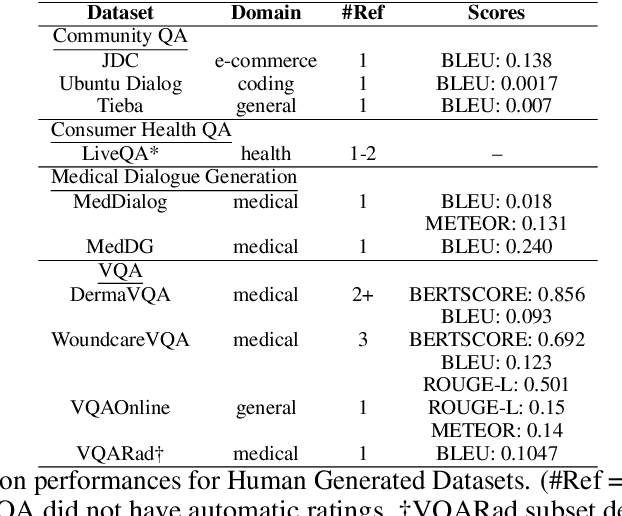
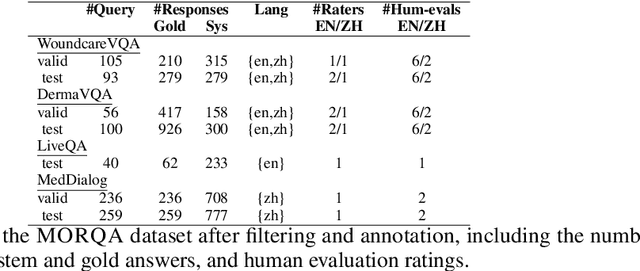

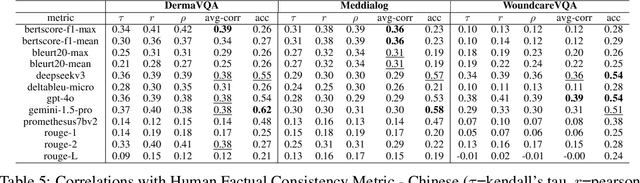
Evaluating natural language generation (NLG) systems in the medical domain presents unique challenges due to the critical demands for accuracy, relevance, and domain-specific expertise. Traditional automatic evaluation metrics, such as BLEU, ROUGE, and BERTScore, often fall short in distinguishing between high-quality outputs, especially given the open-ended nature of medical question answering (QA) tasks where multiple valid responses may exist. In this work, we introduce MORQA (Medical Open-Response QA), a new multilingual benchmark designed to assess the effectiveness of NLG evaluation metrics across three medical visual and text-based QA datasets in English and Chinese. Unlike prior resources, our datasets feature 2-4+ gold-standard answers authored by medical professionals, along with expert human ratings for three English and Chinese subsets. We benchmark both traditional metrics and large language model (LLM)-based evaluators, such as GPT-4 and Gemini, finding that LLM-based approaches significantly outperform traditional metrics in correlating with expert judgments. We further analyze factors driving this improvement, including LLMs' sensitivity to semantic nuances and robustness to variability among reference answers. Our results provide the first comprehensive, multilingual qualitative study of NLG evaluation in the medical domain, highlighting the need for human-aligned evaluation methods. All datasets and annotations will be publicly released to support future research.
Bridging Perception and Action: Spatially-Grounded Mid-Level Representations for Robot Generalization
Jun 06, 2025In this work, we investigate how spatially grounded auxiliary representations can provide both broad, high-level grounding as well as direct, actionable information to improve policy learning performance and generalization for dexterous tasks. We study these mid-level representations across three critical dimensions: object-centricity, pose-awareness, and depth-awareness. We use these interpretable mid-level representations to train specialist encoders via supervised learning, then feed them as inputs to a diffusion policy to solve dexterous bimanual manipulation tasks in the real world. We propose a novel mixture-of-experts policy architecture that combines multiple specialized expert models, each trained on a distinct mid-level representation, to improve policy generalization. This method achieves an average success rate that is 11% higher than a language-grounded baseline and 24 percent higher than a standard diffusion policy baseline on our evaluation tasks. Furthermore, we find that leveraging mid-level representations as supervision signals for policy actions within a weighted imitation learning algorithm improves the precision with which the policy follows these representations, yielding an additional performance increase of 10%. Our findings highlight the importance of grounding robot policies not only with broad perceptual tasks but also with more granular, actionable representations. For further information and videos, please visit https://mid-level-moe.github.io.
PointArena: Probing Multimodal Grounding Through Language-Guided Pointing
May 15, 2025Pointing serves as a fundamental and intuitive mechanism for grounding language within visual contexts, with applications spanning robotics, assistive technologies, and interactive AI systems. While recent multimodal models have started to support pointing capabilities, existing benchmarks typically focus only on referential object localization tasks. We introduce PointArena, a comprehensive platform for evaluating multimodal pointing across diverse reasoning scenarios. PointArena comprises three components: (1) Point-Bench, a curated dataset containing approximately 1,000 pointing tasks across five reasoning categories; (2) Point-Battle, an interactive, web-based arena facilitating blind, pairwise model comparisons, which has already gathered over 4,500 anonymized votes; and (3) Point-Act, a real-world robotic manipulation system allowing users to directly evaluate multimodal model pointing capabilities in practical settings. We conducted extensive evaluations of both state-of-the-art open-source and proprietary multimodal models. Results indicate that Molmo-72B consistently outperforms other models, though proprietary models increasingly demonstrate comparable performance. Additionally, we find that supervised training specifically targeting pointing tasks significantly enhances model performance. Across our multi-stage evaluation pipeline, we also observe strong correlations, underscoring the critical role of precise pointing capabilities in enabling multimodal models to effectively bridge abstract reasoning with concrete, real-world actions. Project page: https://pointarena.github.io/
Chain-of-Modality: Learning Manipulation Programs from Multimodal Human Videos with Vision-Language-Models
Apr 17, 2025Learning to perform manipulation tasks from human videos is a promising approach for teaching robots. However, many manipulation tasks require changing control parameters during task execution, such as force, which visual data alone cannot capture. In this work, we leverage sensing devices such as armbands that measure human muscle activities and microphones that record sound, to capture the details in the human manipulation process, and enable robots to extract task plans and control parameters to perform the same task. To achieve this, we introduce Chain-of-Modality (CoM), a prompting strategy that enables Vision Language Models to reason about multimodal human demonstration data -- videos coupled with muscle or audio signals. By progressively integrating information from each modality, CoM refines a task plan and generates detailed control parameters, enabling robots to perform manipulation tasks based on a single multimodal human video prompt. Our experiments show that CoM delivers a threefold improvement in accuracy for extracting task plans and control parameters compared to baselines, with strong generalization to new task setups and objects in real-world robot experiments. Videos and code are available at https://chain-of-modality.github.io
A Scoping Review of Natural Language Processing in Addressing Medically Inaccurate Information: Errors, Misinformation, and Hallucination
Apr 16, 2025Objective: This review aims to explore the potential and challenges of using Natural Language Processing (NLP) to detect, correct, and mitigate medically inaccurate information, including errors, misinformation, and hallucination. By unifying these concepts, the review emphasizes their shared methodological foundations and their distinct implications for healthcare. Our goal is to advance patient safety, improve public health communication, and support the development of more reliable and transparent NLP applications in healthcare. Methods: A scoping review was conducted following PRISMA guidelines, analyzing studies from 2020 to 2024 across five databases. Studies were selected based on their use of NLP to address medically inaccurate information and were categorized by topic, tasks, document types, datasets, models, and evaluation metrics. Results: NLP has shown potential in addressing medically inaccurate information on the following tasks: (1) error detection (2) error correction (3) misinformation detection (4) misinformation correction (5) hallucination detection (6) hallucination mitigation. However, challenges remain with data privacy, context dependency, and evaluation standards. Conclusion: This review highlights the advancements in applying NLP to tackle medically inaccurate information while underscoring the need to address persistent challenges. Future efforts should focus on developing real-world datasets, refining contextual methods, and improving hallucination management to ensure reliable and transparent healthcare applications.