 Add to Chrome
 Add to Firefox
 Add to Edge
MEM: Multi-Scale Embodied Memory for Vision Language Action Models
Mar 04, 2026
Conventionally, memory in end-to-end robotic learning involves inputting a sequence of past observations into the learned policy. However, in complex multi-stage real-world tasks, the robot's memory must represent past events at multiple levels of granularity: from long-term memory that captures abstracted semantic concepts (e.g., a robot cooking dinner should remember which stages of the recipe are already done) to short-term memory that captures recent events and compensates for occlusions (e.g., a robot remembering the object it wants to pick up once its arm occludes it). In this work, our main insight is that an effective memory architecture for long-horizon robotic control should combine multiple modalities to capture these different levels of abstraction. We introduce Multi-Scale Embodied Memory (MEM), an approach for mixed-modal long-horizon memory in robot policies. MEM combines video-based short-horizon memory, compressed via a video encoder, with text-based long-horizon memory. Together, they enable robot policies to perform tasks that span up to fifteen minutes, like cleaning up a kitchen, or preparing a grilled cheese sandwich. Additionally, we find that memory enables MEM policies to intelligently adapt manipulation strategies in-context.

Steerable Vision-Language-Action Policies for Embodied Reasoning and Hierarchical Control
Feb 13, 2026Pretrained vision-language models (VLMs) can make semantic and visual inferences across diverse settings, providing valuable common-sense priors for robotic control. However, effectively grounding this knowledge in robot behaviors remains an open challenge. Prior methods often employ a hierarchical approach where VLMs reason over high-level commands to be executed by separate low-level policies, e.g., vision-language-action models (VLAs). The interface between VLMs and VLAs is usually natural language task instructions, which fundamentally limits how much VLM reasoning can steer low-level behavior. We thus introduce Steerable Policies: VLAs trained on rich synthetic commands at various levels of abstraction, like subtasks, motions, and grounded pixel coordinates. By improving low-level controllability, Steerable Policies can unlock pretrained knowledge in VLMs, enabling improved task generalization. We demonstrate this benefit by controlling our Steerable Policies with both a learned high-level embodied reasoner and an off-the-shelf VLM prompted to reason over command abstractions via in-context learning. Across extensive real-world manipulation experiments, these two novel methods outperform prior embodied reasoning VLAs and VLM-based hierarchical baselines, including on challenging generalization and long-horizon tasks. Website: steerable-policies.github.io
RoboReward: General-Purpose Vision-Language Reward Models for Robotics
Jan 08, 2026A well-designed reward is critical for effective reinforcement learning-based policy improvement. In real-world robotics, obtaining such rewards typically requires either labor-intensive human labeling or brittle, handcrafted objectives. Vision-language models (VLMs) have shown promise as automatic reward models, yet their effectiveness on real robot tasks is poorly understood. In this work, we aim to close this gap by introducing (1) RoboReward, a robotics reward dataset and benchmark built on large-scale real-robot corpora from Open X-Embodiment (OXE) and RoboArena, and (2) vision-language reward models trained on this dataset (RoboReward 4B/8B). Because OXE is success-heavy and lacks failure examples, we propose a negative examples data augmentation pipeline that generates calibrated negative and near-misses via counterfactual relabeling of successful episodes and temporal clipping to create partial-progress outcomes from the same videos. Using this framework, we build a large training and evaluation dataset spanning diverse tasks and embodiments to test whether state-of-the-art VLMs can reliably provide rewards for robot learning. Our evaluation of open and proprietary VLMs finds that no model excels across tasks, highlighting substantial room for improvement. We then train general-purpose 4B- and 8B-parameter models that outperform much larger VLMs in assigning rewards for short-horizon robotic tasks. Finally, we deploy the 8B model in real-robot reinforcement learning and find that it improves policy learning over Gemini Robotics-ER 1.5 while narrowing the gap to RL training with human-provided rewards. We release the full dataset, trained reward models, and evaluation suite on our website to advance the development of general-purpose reward models in robotics: https://crfm.stanford.edu/helm/robo-reward-bench (project website).
Emergence of Human to Robot Transfer in Vision-Language-Action Models
Dec 27, 2025Vision-language-action (VLA) models can enable broad open world generalization, but require large and diverse datasets. It is appealing to consider whether some of this data can come from human videos, which cover diverse real-world situations and are easy to obtain. However, it is difficult to train VLAs with human videos alone, and establishing a mapping between humans and robots requires manual engineering and presents a major research challenge. Drawing inspiration from advances in large language models, where the ability to learn from diverse supervision emerges with scale, we ask whether a similar phenomenon holds for VLAs that incorporate human video data. We introduce a simple co-training recipe, and find that human-to-robot transfer emerges once the VLA is pre-trained on sufficient scenes, tasks, and embodiments. Our analysis suggests that this emergent capability arises because diverse pretraining produces embodiment-agnostic representations for human and robot data. We validate these findings through a series of experiments probing human to robot skill transfer and find that with sufficiently diverse robot pre-training our method can nearly double the performance on generalization settings seen only in human data.
Robust Finetuning of Vision-Language-Action Robot Policies via Parameter Merging
Dec 18, 2025Generalist robot policies, trained on large and diverse datasets, have demonstrated the ability to generalize across a wide spectrum of behaviors, enabling a single policy to act in varied real-world environments. However, they still fall short on new tasks not covered in the training data. When finetuned on limited demonstrations of a new task, these policies often overfit to the specific demonstrations--not only losing their prior abilities to solve a wide variety of generalist tasks but also failing to generalize within the new task itself. In this work, we aim to develop a method that preserves the generalization capabilities of the generalist policy during finetuning, allowing a single policy to robustly incorporate a new skill into its repertoire. Our goal is a single policy that both learns to generalize to variations of the new task and retains the broad competencies gained from pretraining. We show that this can be achieved through a simple yet effective strategy: interpolating the weights of a finetuned model with that of the pretrained model. We show, across extensive simulated and real-world experiments, that such model merging produces a single model that inherits the generalist abilities of the base model and learns to solve the new task robustly, outperforming both the pretrained and finetuned model on out-of-distribution variations of the new task. Moreover, we show that model merging performance scales with the amount of pretraining data, and enables continual acquisition of new skills in a lifelong learning setting, without sacrificing previously learned generalist abilities.
PolaRiS: Scalable Real-to-Sim Evaluations for Generalist Robot Policies
Dec 18, 2025A significant challenge for robot learning research is our ability to accurately measure and compare the performance of robot policies. Benchmarking in robotics is historically challenging due to the stochasticity, reproducibility, and time-consuming nature of real-world rollouts. This challenge is exacerbated for recent generalist policies, which has to be evaluated across a wide variety of scenes and tasks. Evaluation in simulation offers a scalable complement to real world evaluations, but the visual and physical domain gap between existing simulation benchmarks and the real world has made them an unreliable signal for policy improvement. Furthermore, building realistic and diverse simulated environments has traditionally required significant human effort and expertise. To bridge the gap, we introduce Policy Evaluation and Environment Reconstruction in Simulation (PolaRiS), a scalable real-to-sim framework for high-fidelity simulated robot evaluation. PolaRiS utilizes neural reconstruction methods to turn short video scans of real-world scenes into interactive simulation environments. Additionally, we develop a simple simulation data co-training recipe that bridges remaining real-to-sim gaps and enables zero-shot evaluation in unseen simulation environments. Through extensive paired evaluations between simulation and the real world, we demonstrate that PolaRiS evaluations provide a much stronger correlation to real world generalist policy performance than existing simulated benchmarks. Its simplicity also enables rapid creation of diverse simulated environments. As such, this work takes a step towards distributed and democratized evaluation for the next generation of robotic foundation models.
$π^{*}_{0.6}$: a VLA That Learns From Experience
Nov 19, 2025We study how vision-language-action (VLA) models can improve through real-world deployments via reinforcement learning (RL). We present a general-purpose method, RL with Experience and Corrections via Advantage-conditioned Policies (RECAP), that provides for RL training of VLAs via advantage conditioning. Our method incorporates heterogeneous data into the self-improvement process, including demonstrations, data from on-policy collection, and expert teleoperated interventions provided during autonomous execution. RECAP starts by pre-training a generalist VLA with offline RL, which we call $π^{*}_{0.6}$, that can then be specialized to attain high performance on downstream tasks through on-robot data collection. We show that the $π^{*}_{0.6}$ model trained with the full RECAP method can fold laundry in real homes, reliably assemble boxes, and make espresso drinks using a professional espresso machine. On some of the hardest tasks, RECAP more than doubles task throughput and roughly halves the task failure rate.
Knowledge Insulating Vision-Language-Action Models: Train Fast, Run Fast, Generalize Better
May 29, 2025Vision-language-action (VLA) models provide a powerful approach to training control policies for physical systems, such as robots, by combining end-to-end learning with transfer of semantic knowledge from web-scale vision-language model (VLM) training. However, the constraints of real-time control are often at odds with the design of VLMs: the most powerful VLMs have tens or hundreds of billions of parameters, presenting an obstacle to real-time inference, and operate on discrete tokens rather than the continuous-valued outputs that are required for controlling robots. To address this challenge, recent VLA models have used specialized modules for efficient continuous control, such as action experts or continuous output heads, which typically require adding new untrained parameters to the pretrained VLM backbone. While these modules improve real-time and control capabilities, it remains an open question whether they preserve or degrade the semantic knowledge contained in the pretrained VLM, and what effect they have on the VLA training dynamics. In this paper, we study this question in the context of VLAs that include a continuous diffusion or flow matching action expert, showing that naively including such experts significantly harms both training speed and knowledge transfer. We provide an extensive analysis of various design choices, their impact on performance and knowledge transfer, and propose a technique for insulating the VLM backbone during VLA training that mitigates this issue. Videos are available at https://pi.website/research/knowledge_insulation.
Training Strategies for Efficient Embodied Reasoning
May 13, 2025Robot chain-of-thought reasoning (CoT) -- wherein a model predicts helpful intermediate representations before choosing actions -- provides an effective method for improving the generalization and performance of robot policies, especially vision-language-action models (VLAs). While such approaches have been shown to improve performance and generalization, they suffer from core limitations, like needing specialized robot reasoning data and slow inference speeds. To design new robot reasoning approaches that address these issues, a more complete characterization of why reasoning helps policy performance is critical. We hypothesize several mechanisms by which robot reasoning improves policies -- (1) better representation learning, (2) improved learning curricularization, and (3) increased expressivity -- then devise simple variants of robot CoT reasoning to isolate and test each one. We find that learning to generate reasonings does lead to better VLA representations, while attending to the reasonings aids in actually leveraging these features for improved action prediction. Our results provide us with a better understanding of why CoT reasoning helps VLAs, which we use to introduce two simple and lightweight alternative recipes for robot reasoning. Our proposed approaches achieve significant performance gains over non-reasoning policies, state-of-the-art results on the LIBERO-90 benchmark, and a 3x inference speedup compared to standard robot reasoning.
$π_{0.5}$: a Vision-Language-Action Model with Open-World Generalization
Apr 22, 2025
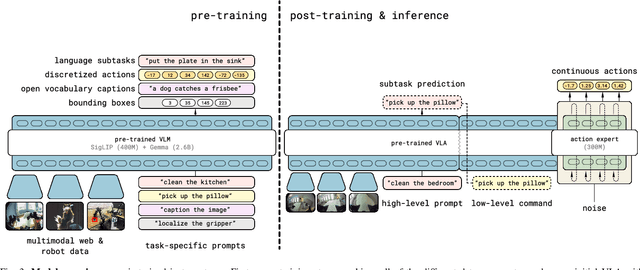
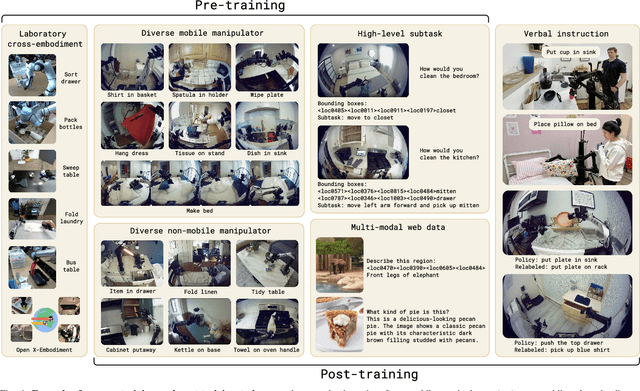
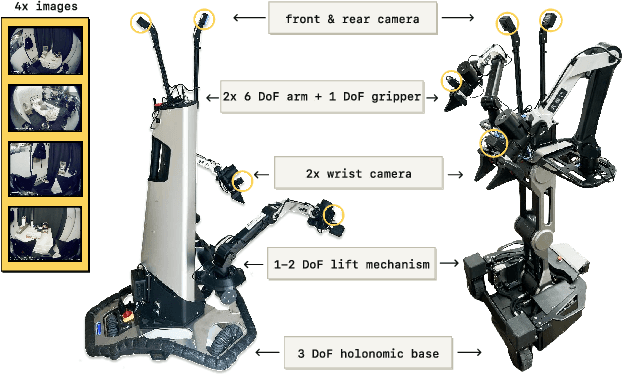
In order for robots to be useful, they must perform practically relevant tasks in the real world, outside of the lab. While vision-language-action (VLA) models have demonstrated impressive results for end-to-end robot control, it remains an open question how far such models can generalize in the wild. We describe $\pi_{0.5}$, a new model based on $\pi_{0}$ that uses co-training on heterogeneous tasks to enable broad generalization. $\pi_{0.5}$\ uses data from multiple robots, high-level semantic prediction, web data, and other sources to enable broadly generalizable real-world robotic manipulation. Our system uses a combination of co-training and hybrid multi-modal examples that combine image observations, language commands, object detections, semantic subtask prediction, and low-level actions. Our experiments show that this kind of knowledge transfer is essential for effective generalization, and we demonstrate for the first time that an end-to-end learning-enabled robotic system can perform long-horizon and dexterous manipulation skills, such as cleaning a kitchen or bedroom, in entirely new homes.