 Add to Chrome
 Add to Firefox
 Add to Edge
Simulator and Experience Enhanced Diffusion Model for Comprehensive ECG Generation
Nov 13, 2025
Cardiovascular disease (CVD) is a leading cause of mortality worldwide. Electrocardiograms (ECGs) are the most widely used non-invasive tool for cardiac assessment, yet large, well-annotated ECG corpora are scarce due to cost, privacy, and workflow constraints. Generating ECGs can be beneficial for the mechanistic understanding of cardiac electrical activity, enable the construction of large, heterogeneous, and unbiased datasets, and facilitate privacy-preserving data sharing. Generating realistic ECG signals from clinical context is important yet underexplored. Recent work has leveraged diffusion models for text-to-ECG generation, but two challenges remain: (i) existing methods often overlook the physiological simulator knowledge of cardiac activity; and (ii) they ignore broader, experience-based clinical knowledge grounded in real-world practice. To address these gaps, we propose SE-Diff, a novel physiological simulator and experience enhanced diffusion model for comprehensive ECG generation. SE-Diff integrates a lightweight ordinary differential equation (ODE)-based ECG simulator into the diffusion process via a beat decoder and simulator-consistent constraints, injecting mechanistic priors that promote physiologically plausible waveforms. In parallel, we design an LLM-powered experience retrieval-augmented strategy to inject clinical knowledge, providing more guidance for ECG generation. Extensive experiments on real-world ECG datasets demonstrate that SE-Diff improves both signal fidelity and text-ECG semantic alignment over baselines, proving its superiority for text-to-ECG generation. We further show that the simulator-based and experience-based knowledge also benefit downstream ECG classification.

fastbmRAG: A Fast Graph-Based RAG Framework for Efficient Processing of Large-Scale Biomedical Literature
Nov 13, 2025Large language models (LLMs) are rapidly transforming various domains, including biomedicine and healthcare, and demonstrate remarkable potential from scientific research to new drug discovery. Graph-based retrieval-augmented generation (RAG) systems, as a useful application of LLMs, can improve contextual reasoning through structured entity and relationship identification from long-context knowledge, e.g. biomedical literature. Even though many advantages over naive RAGs, most of graph-based RAGs are computationally intensive, which limits their application to large-scale dataset. To address this issue, we introduce fastbmRAG, an fast graph-based RAG optimized for biomedical literature. Utilizing well organized structure of biomedical papers, fastbmRAG divides the construction of knowledge graph into two stages, first drafting graphs using abstracts; and second, refining them using main texts guided by vector-based entity linking, which minimizes redundancy and computational load. Our evaluations demonstrate that fastbmRAG is over 10x faster than existing graph-RAG tools and achieve superior coverage and accuracy to input knowledge. FastbmRAG provides a fast solution for quickly understanding, summarizing, and answering questions about biomedical literature on a large scale. FastbmRAG is public available in https://github.com/menggf/fastbmRAG.
FedCure: Mitigating Participation Bias in Semi-Asynchronous Federated Learning with Non-IID Data
Nov 13, 2025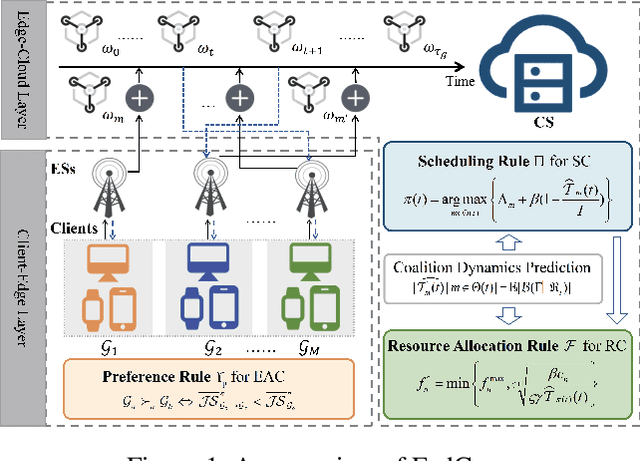
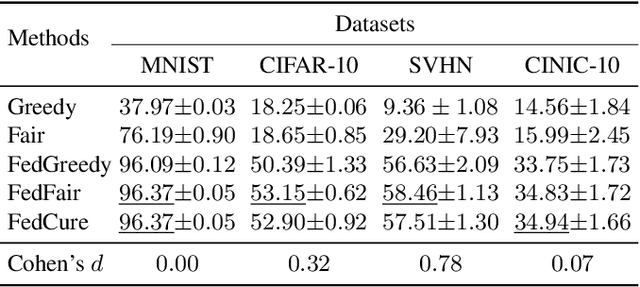
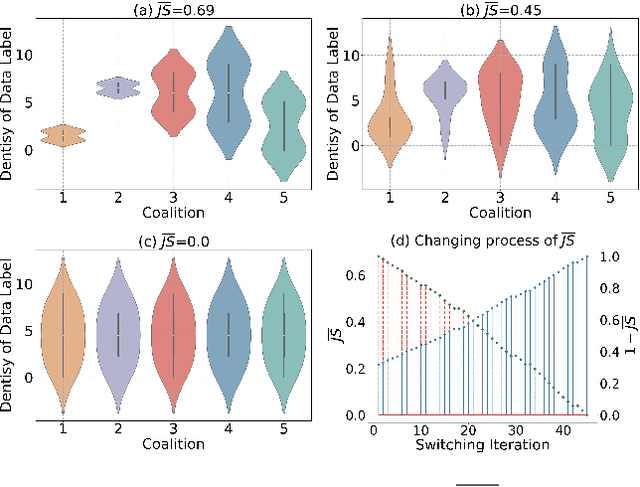
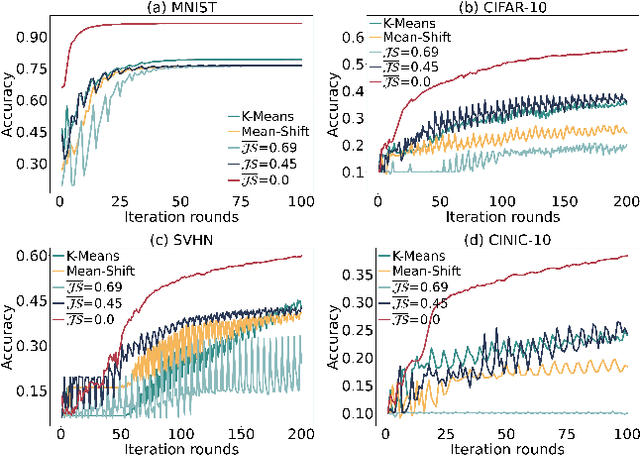
While semi-asynchronous federated learning (SAFL) combines the efficiency of synchronous training with the flexibility of asynchronous updates, it inherently suffers from participation bias, which is further exacerbated by non-IID data distributions. More importantly, hierarchical architecture shifts participation from individual clients to client groups, thereby further intensifying this issue. Despite notable advancements in SAFL research, most existing works still focus on conventional cloud-end architectures while largely overlooking the critical impact of non-IID data on scheduling across the cloud-edge-client hierarchy. To tackle these challenges, we propose FedCure, an innovative semi-asynchronous Federated learning framework that leverages coalition construction and participation-aware scheduling to mitigate participation bias with non-IID data. Specifically, FedCure operates through three key rules: (1) a preference rule that optimizes coalition formation by maximizing collective benefits and establishing theoretically stable partitions to reduce non-IID-induced performance degradation; (2) a scheduling rule that integrates the virtual queue technique with Bayesian-estimated coalition dynamics, mitigating efficiency loss while ensuring mean rate stability; and (3) a resource allocation rule that enhances computational efficiency by optimizing client CPU frequencies based on estimated coalition dynamics while satisfying delay requirements. Comprehensive experiments on four real-world datasets demonstrate that FedCure improves accuracy by up to 5.1x compared with four state-of-the-art baselines, while significantly enhancing efficiency with the lowest coefficient of variation 0.0223 for per-round latency and maintaining long-term balance across diverse scenarios.
BioVerge: A Comprehensive Benchmark and Study of Self-Evaluating Agents for Biomedical Hypothesis Generation
Nov 12, 2025Hypothesis generation in biomedical research has traditionally centered on uncovering hidden relationships within vast scientific literature, often using methods like Literature-Based Discovery (LBD). Despite progress, current approaches typically depend on single data types or predefined extraction patterns, which restricts the discovery of novel and complex connections. Recent advances in Large Language Model (LLM) agents show significant potential, with capabilities in information retrieval, reasoning, and generation. However, their application to biomedical hypothesis generation has been limited by the absence of standardized datasets and execution environments. To address this, we introduce BioVerge, a comprehensive benchmark, and BioVerge Agent, an LLM-based agent framework, to create a standardized environment for exploring biomedical hypothesis generation at the frontier of existing scientific knowledge. Our dataset includes structured and textual data derived from historical biomedical hypotheses and PubMed literature, organized to support exploration by LLM agents. BioVerge Agent utilizes a ReAct-based approach with distinct Generation and Evaluation modules that iteratively produce and self-assess hypothesis proposals. Through extensive experimentation, we uncover key insights: 1) different architectures of BioVerge Agent influence exploration diversity and reasoning strategies; 2) structured and textual information sources each provide unique, critical contexts that enhance hypothesis generation; and 3) self-evaluation significantly improves the novelty and relevance of proposed hypotheses.
A General Method for Proving Networks Universal Approximation Property
Nov 11, 2025Deep learning architectures are highly diverse. To prove their universal approximation properties, existing works typically rely on model-specific proofs. Generally, they construct a dedicated mathematical formulation for each architecture (e.g., fully connected networks, CNNs, or Transformers) and then prove their universal approximability. However, this approach suffers from two major limitations: first, every newly proposed architecture often requires a completely new proof from scratch; second, these proofs are largely isolated from one another, lacking a common analytical foundation. This not only incurs significant redundancy but also hinders unified theoretical understanding across different network families. To address these issues, this paper proposes a general and modular framework for proving universal approximation. We define a basic building block (comprising one or multiple layers) that possesses the universal approximation property as a Universal Approximation Module (UAM). Under this condition, we show that any deep network composed of such modules inherently retains the universal approximation property. Moreover, the overall approximation process can be interpreted as a progressive refinement across modules. This perspective not only unifies the analysis of diverse architectures but also enables a step-by-step understanding of how expressive power evolves through the network.
RaLD: Generating High-Resolution 3D Radar Point Clouds with Latent Diffusion
Nov 10, 2025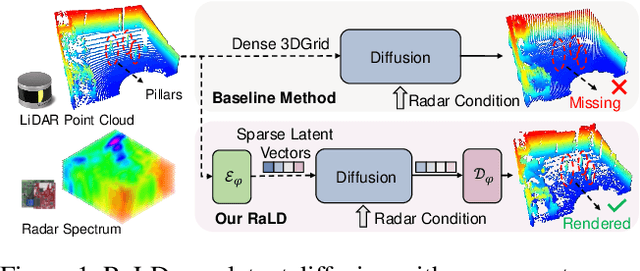
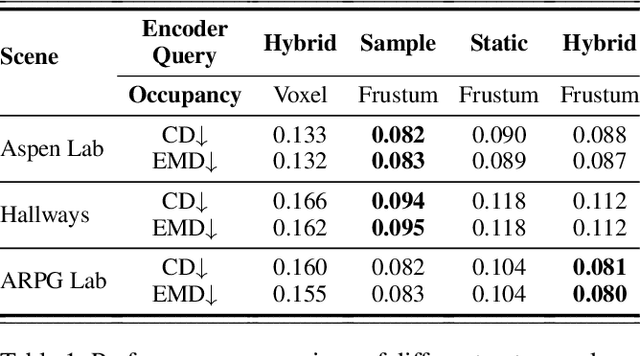

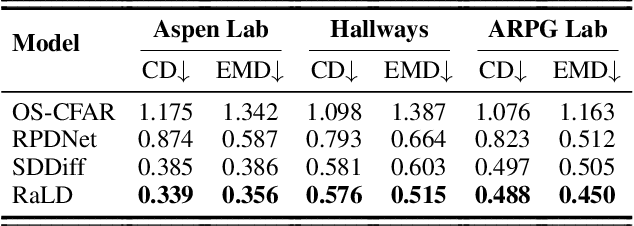
Millimeter-wave radar offers a promising sensing modality for autonomous systems thanks to its robustness in adverse conditions and low cost. However, its utility is significantly limited by the sparsity and low resolution of radar point clouds, which poses challenges for tasks requiring dense and accurate 3D perception. Despite that recent efforts have shown great potential by exploring generative approaches to address this issue, they often rely on dense voxel representations that are inefficient and struggle to preserve structural detail. To fill this gap, we make the key observation that latent diffusion models (LDMs), though successful in other modalities, have not been effectively leveraged for radar-based 3D generation due to a lack of compatible representations and conditioning strategies. We introduce RaLD, a framework that bridges this gap by integrating scene-level frustum-based LiDAR autoencoding, order-invariant latent representations, and direct radar spectrum conditioning. These insights lead to a more compact and expressive generation process. Experiments show that RaLD produces dense and accurate 3D point clouds from raw radar spectrums, offering a promising solution for robust perception in challenging environments.
Ambiguity-aware Truncated Flow Matching for Ambiguous Medical Image Segmentation
Nov 10, 2025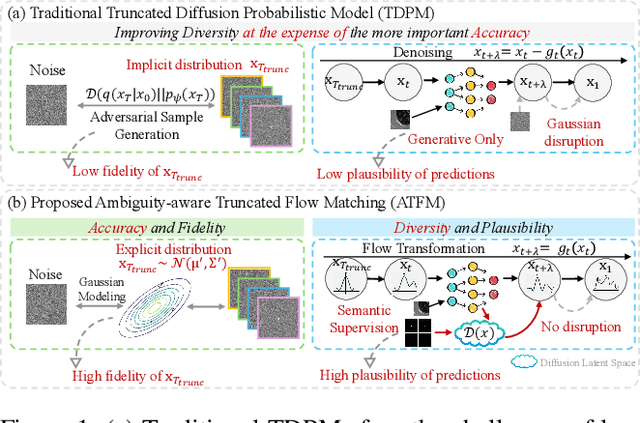
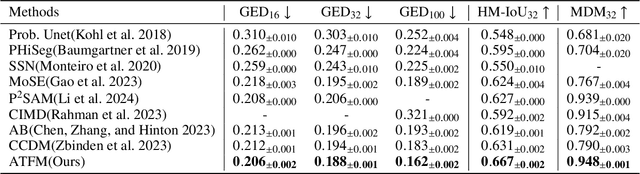
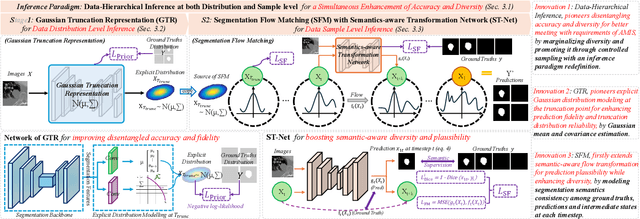
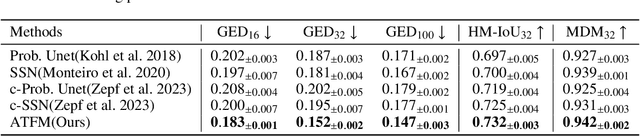
A simultaneous enhancement of accuracy and diversity of predictions remains a challenge in ambiguous medical image segmentation (AMIS) due to the inherent trade-offs. While truncated diffusion probabilistic models (TDPMs) hold strong potential with a paradigm optimization, existing TDPMs suffer from entangled accuracy and diversity of predictions with insufficient fidelity and plausibility. To address the aforementioned challenges, we propose Ambiguity-aware Truncated Flow Matching (ATFM), which introduces a novel inference paradigm and dedicated model components. Firstly, we propose Data-Hierarchical Inference, a redefinition of AMIS-specific inference paradigm, which enhances accuracy and diversity at data-distribution and data-sample level, respectively, for an effective disentanglement. Secondly, Gaussian Truncation Representation (GTR) is introduced to enhance both fidelity of predictions and reliability of truncation distribution, by explicitly modeling it as a Gaussian distribution at $T_{\text{trunc}}$ instead of using sampling-based approximations.Thirdly, Segmentation Flow Matching (SFM) is proposed to enhance the plausibility of diverse predictions by extending semantic-aware flow transformation in Flow Matching (FM). Comprehensive evaluations on LIDC and ISIC3 datasets demonstrate that ATFM outperforms SOTA methods and simultaneously achieves a more efficient inference. ATFM improves GED and HM-IoU by up to $12\%$ and $7.3\%$ compared to advanced methods.
MambaOVSR: Multiscale Fusion with Global Motion Modeling for Chinese Opera Video Super-Resolution
Nov 09, 2025
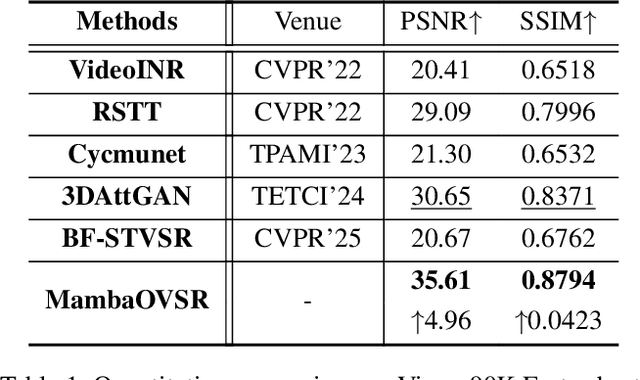
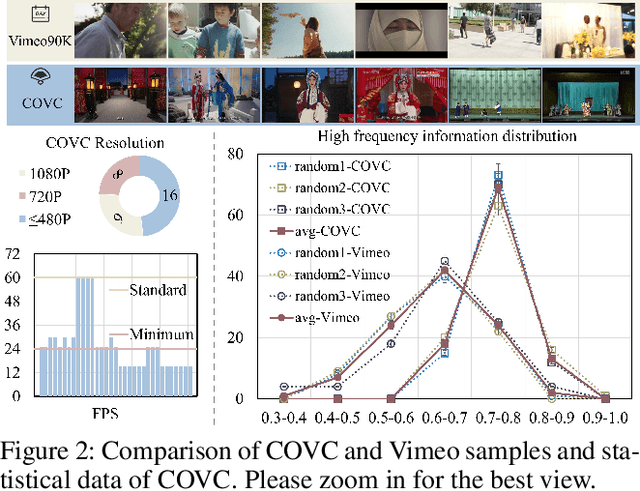
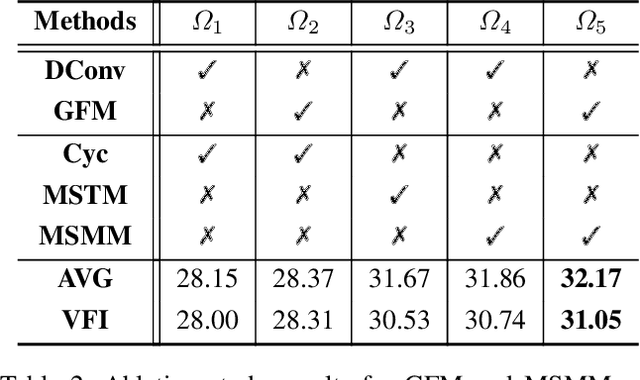
Chinese opera is celebrated for preserving classical art. However, early filming equipment limitations have degraded videos of last-century performances by renowned artists (e.g., low frame rates and resolution), hindering archival efforts. Although space-time video super-resolution (STVSR) has advanced significantly, applying it directly to opera videos remains challenging. The scarcity of datasets impedes the recovery of high frequency details, and existing STVSR methods lack global modeling capabilities, compromising visual quality when handling opera's characteristic large motions. To address these challenges, we pioneer a large scale Chinese Opera Video Clip (COVC) dataset and propose the Mamba-based multiscale fusion network for space-time Opera Video Super-Resolution (MambaOVSR). Specifically, MambaOVSR involves three novel components: the Global Fusion Module (GFM) for motion modeling through a multiscale alternating scanning mechanism, and the Multiscale Synergistic Mamba Module (MSMM) for alignment across different sequence lengths. Additionally, our MambaVR block resolves feature artifacts and positional information loss during alignment. Experimental results on the COVC dataset show that MambaOVSR significantly outperforms the SOTA STVSR method by an average of 1.86 dB in terms of PSNR. Dataset and Code will be publicly released.
Tiny Model, Big Logic: Diversity-Driven Optimization Elicits Large-Model Reasoning Ability in VibeThinker-1.5B
Nov 09, 2025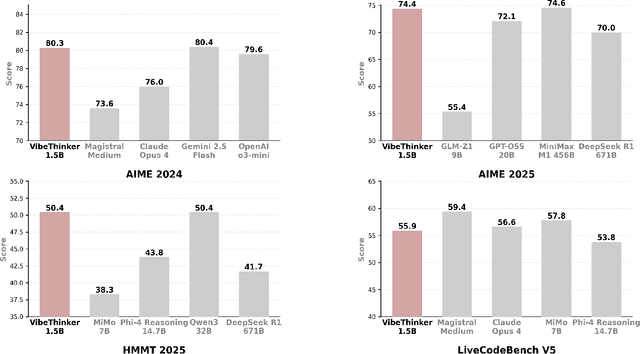

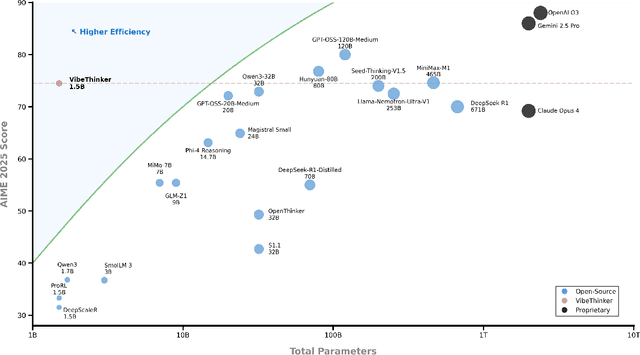
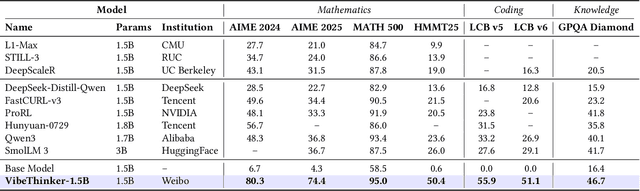
Challenging the prevailing consensus that small models inherently lack robust reasoning, this report introduces VibeThinker-1.5B, a 1.5B-parameter dense model developed via our Spectrum-to-Signal Principle (SSP). This challenges the prevailing approach of scaling model parameters to enhance capabilities, as seen in models like DeepSeek R1 (671B) and Kimi k2 (>1T). The SSP framework first employs a Two-Stage Diversity-Exploring Distillation (SFT) to generate a broad spectrum of solutions, followed by MaxEnt-Guided Policy Optimization (RL) to amplify the correct signal. With a total training cost of only $7,800, VibeThinker-1.5B demonstrates superior reasoning capabilities compared to closed-source models like Magistral Medium and Claude Opus 4, and performs on par with open-source models like GPT OSS-20B Medium. Remarkably, it surpasses the 400x larger DeepSeek R1 on three math benchmarks: AIME24 (80.3 vs. 79.8), AIME25 (74.4 vs. 70.0), and HMMT25 (50.4 vs. 41.7). This is a substantial improvement over its base model (6.7, 4.3, and 0.6, respectively). On LiveCodeBench V6, it scores 51.1, outperforming Magistral Medium's 50.3 and its base model's 0.0. These findings demonstrate that small models can achieve reasoning capabilities comparable to large models, drastically reducing training and inference costs and thereby democratizing advanced AI research.
Compressive Sensing Photoacoustic Imaging Receiver with Matrix-Vector-Multiplication SAR ADC
Nov 09, 2025Wearable photoacoustic imaging devices hold great promise for continuous health monitoring and point-of-care diagnostics. However, the large data volume generated by high-density transducer arrays presents a major challenge for realizing compact and power-efficient wearable systems. This paper presents a photoacoustic imaging receiver (RX) that embeds compressive sensing directly into the hardware to address this bottleneck. The RX integrates 16 AFEs and four matrix-vector-multiplication (MVM) SAR ADCs that perform energy- and area-efficient analog-domain compression. The architecture achieves a 4-8x reduction in output data rate while preserving low-loss full-array information. The MVM SAR ADC executes passive and accurate MVM using user-defined programmable ternary weights. Two signal reconstruction methods are implemented: (1) an optimization approach using the fast iterative shrinkage-thresholding algorithm, and (2) a learning-based approach employing implicit neural representation. Fabricated in 65 nm CMOS, the chip achieves an ADC's SNDR of 57.5 dB at 20.41 MS/s, with an AFE input-referred noise of 3.5 nV/sqrt(Hz). MVM linearity measurements show R^2 > 0.999 across a wide range of weights and input amplitudes. The system is validated through phantom imaging experiments, demonstrating high-fidelity image reconstruction under up to 8x compression. The RX consumes 5.83 mW/channel and supports a general ternary-weighted measurement matrix, offering a compelling solution for next-generation miniaturized, wearable PA imaging systems.