 Add to Chrome
 Add to Firefox
 Add to Edge
Plover: Steering GUI Agents through Plan-Centric Interaction
Jul 16, 2026
Graphical user interface (GUI) automation remains challenging in real-world environments, where dynamic layouts, unexpected dialogs, and evolving interface states can cause autonomous agents to drift from user intent. Recent vision-based multimodal agents improve flexibility by operating directly over screenshots and natural language instructions, but planning and adaptation often remain internal, limiting users' ability to inspect, supervise, or correct system behavior. We present Plover, a plan-centric vision-based GUI automation system that externalizes task plans and replanning as persistent, inspectable, and revisable artifacts. Through a planner--executor architecture, Plover supports explicit supervision of evolving execution, localized correction through editable plans, natural-language guidance, and screenshot-grounded interventions, while preserving prior progress during repair. A formative study with six participants informed the interaction design. We then evaluate Plover through benchmark failure-case repair and scenario-based workflow analyses. Our results show that many autonomous GUI-agent failures are structurally repairable when plans remain visible and interventions are localized, and that explicit replanning helps make GUI automation more transparent, controllable, and adaptable.

Gecko: An Efficient Neural Architecture Inherently Processing Sequences with Arbitrary Lengths
Jan 10, 2026Designing a unified neural network to efficiently and inherently process sequential data with arbitrary lengths is a central and challenging problem in sequence modeling. The design choices in Transformer, including quadratic complexity and weak length extrapolation, have limited their ability to scale to long sequences. In this work, we propose Gecko, a neural architecture that inherits the design of Mega and Megalodon (exponential moving average with gated attention), and further introduces multiple technical components to improve its capability to capture long range dependencies, including timestep decay normalization, sliding chunk attention mechanism, and adaptive working memory. In a controlled pretraining comparison with Llama2 and Megalodon in the scale of 7 billion parameters and 2 trillion training tokens, Gecko achieves better efficiency and long-context scalability. Gecko reaches a training loss of 1.68, significantly outperforming Llama2-7B (1.75) and Megalodon-7B (1.70), and landing close to Llama2-13B (1.67). Notably, without relying on any context-extension techniques, Gecko exhibits inherent long-context processing and retrieval capabilities, stably handling sequences of up to 4 million tokens and retrieving information from contexts up to $4\times$ longer than its attention window. Code: https://github.com/XuezheMax/gecko-llm
MegaCOIN: Enhancing Medium-Grained Color Perception for Vision-Language Models
Dec 05, 2024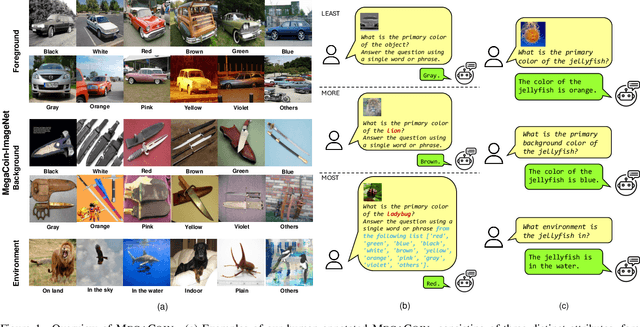
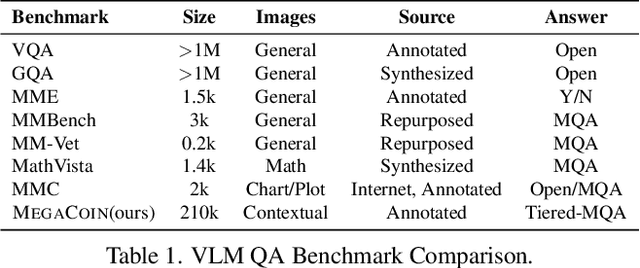
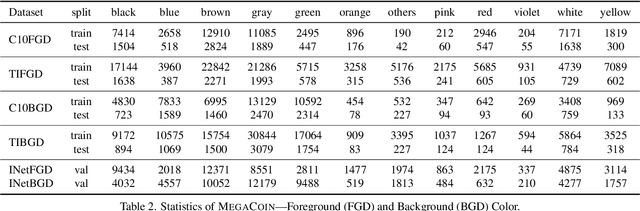
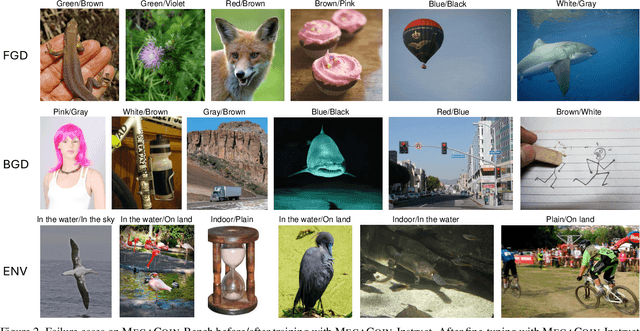
In vision-language models (VLMs), the ability to perceive and interpret color and physical environment is crucial for achieving contextually accurate understanding and interaction. However, despite advances in multimodal modeling, there remains a significant lack of specialized datasets that rigorously evaluate a model's capacity to discern subtle color variations and spatial context -- critical elements for situational comprehension and reliable deployment across real-world applications. Toward that goal, we curate MegaCOIN, a high-quality, human-labeled dataset based on \emph{real} images with various contextual attributes. MegaCOIN consists of two parts: MegaCOIN-Instruct, which serves as a supervised fine-tuning (SFT) dataset for VLMs; and MegaCOIN-Bench, an annotated test set that can be used as a stand-alone QA dataset. MegaCOIN~provides three annotated features for 220,000 real images: foreground color, background color, and description of an object's physical environment, constituting 660k human annotations. In addition, MegaCOIN can be applied to benchmark domain generalization (DG) algorithms. We explore benchmarking DG methods in the linear probing setup for VLM and show some new insights. Last but not least, we show that VLMs, including GPT-4o, have subpar color recognition capabilities, and fine-tuning with MegaCOIN can result in improved performance on visual evaluation tasks. In certain cases, MegaCOIN fine-tuned small-scale opensource models such as LLaVA and Bunny can outperform closed-source GPT-4o. We hope the utilities of MegaCOIN can shed light on the directions VLMs can improve and provide a more complex platform for domain generalization algorithms.
MIDDAG: Where Does Our News Go? Investigating Information Diffusion via Community-Level Information Pathways
Oct 04, 2023We present MIDDAG, an intuitive, interactive system that visualizes the information propagation paths on social media triggered by COVID-19-related news articles accompanied by comprehensive insights including user/community susceptibility level, as well as events and popular opinions raised by the crowd while propagating the information. Besides discovering information flow patterns among users, we construct communities among users and develop the propagation forecasting capability, enabling tracing and understanding of how information is disseminated at a higher level.