 Add to Chrome
 Add to Firefox
 Add to Edge
ARES: Automated Rubric Synthesis for Scalable LLM Reinforcement Learning
May 25, 2026
Rubric-based rewards offer a promising way to extend reinforcement learning (RL) for large language models beyond tasks with automatically verifiable answers. However, scaling rubric-based RL remains challenging: existing approaches often rely on expert-written rubrics and manually constructed question sets, while fixed task-level rubrics may fail to capture the evaluation requirements of individual questions. We propose ARES (Automated Rubric synthEsis for Scalable RL), a framework for automatically constructing rubric-based RL data at scale. Starting from raw pretraining documents, ARES converts source knowledge into self-contained question-answer pairs and co-generates question-specific weighted rubrics, enabling instance-level reward supervision for open-ended responses. To improve diversity and quality, ARES conditions generation on domain labels and persona information, and applies validation filters for question self-containment, answer faithfulness, and rubric validity. Using ARES, we construct 100K rubric-annotated instances across ten domains. Experiments on seven benchmarks show that rubric-based RL trained with ARES, outperforms continual pretraining, supervised fine-tuning, and binary-reward RL, with the largest gains on multi-dimensional open-ended tasks such as healthcare and instruction following.

SAGE: Scalable Automated Robustness Augmentation for LLM Knowledge Evaluation
May 12, 2026Large Language Models (LLMs) achieve strong performance on standard knowledge evaluation benchmarks, yet recent work shows that their knowledge capabilities remain brittle under question variants that test the same knowledge in different forms. Robustness augmentation of existing knowledge evaluation benchmarks is therefore necessary, but current LLM-assisted generate-then-verify pipelines are costly and difficult to scale due to low-yield variant generation and unreliable variant verification. We propose SAGE (Scalable Automated Generation of Robustness BEnchmarks), a framework for scalable robustness augmentation of knowledge evaluation benchmarks using fine-tuned smaller models. SAGE consists of VariantQual, a rubric-based verifier trained on human-labeled seed data, and VariantGen, a variant generator initialized with supervised fine-tuning and further optimized with reinforcement learning using VariantQual as the reward model. Experiments on HellaSwag show that SAGE constructs a large-scale robustness-augmented benchmark with quality comparable to the human-annotated HellaSwag-Pro at substantially lower cost, while the fine-tuned models further generalize to MMLU without benchmark-specific fine-tuning.
Qwen-Image-2.0 Technical Report
May 11, 2026We present Qwen-Image-2.0, an omni-capable image generation foundation model that unifies high-fidelity generation and precise image editing within a single framework. Despite recent progress, existing models still struggle with ultra-long text rendering, multilingual typography, high-resolution photorealism, robust instruction following, and efficient deployment, especially in text-rich and compositionally complex scenarios. Qwen-Image-2.0 addresses these challenges by coupling Qwen3-VL as the condition encoder with a Multimodal Diffusion Transformer for joint condition-target modeling, supported by large-scale data curation and a customized multi-stage training pipeline. This enables strong multimodal understanding while preserving flexible generation and editing capabilities. The model supports instructions of up to 1K tokens for generating text-rich content such as slides, posters, infographics, and comics, while significantly improving multilingual text fidelity and typography. It also enhances photorealistic generation with richer details, more realistic textures, and coherent lighting, and follows complex prompts more reliably across diverse styles. Extensive human evaluations show that Qwen-Image-2.0 substantially outperforms previous Qwen-Image models in both generation and editing, marking a step toward more general, reliable, and practical image generation foundation models.
Outcome Accuracy is Not Enough: Aligning the Reasoning Process of Reward Models
Feb 04, 2026Generative Reward Models (GenRMs) and LLM-as-a-Judge exhibit deceptive alignment by producing correct judgments for incorrect reasons, as they are trained and evaluated to prioritize Outcome Accuracy, which undermines their ability to generalize during RLHF. We introduce Rationale Consistency, a fine-grained metric that quantifies the alignment between the model's reasoning process and human judgment. Our evaluation of frontier models reveals that rationale consistency effectively discriminates among state-of-the-art models and detects deceptive alignment, while outcome accuracy falls short in both respects. To mitigate this gap, we introduce a hybrid signal that combines rationale consistency with outcome accuracy for GenRM training. Our training method achieves state-of-the-art performance on RM-Bench (87.1%) and JudgeBench (82%), surpassing outcome-only baselines by an average of 5%. Using RM during RLHF, our method effectively improves performance as demonstrated on Arena Hard v2, notably yielding a 7% improvement in creative writing tasks. Further analysis confirms that our method escapes the deceptive alignment trap, effectively reversing the decline in rationale consistency observed in outcome-only training.
Qwen3Guard Technical Report
Oct 16, 2025As large language models (LLMs) become more capable and widely used, ensuring the safety of their outputs is increasingly critical. Existing guardrail models, though useful in static evaluation settings, face two major limitations in real-world applications: (1) they typically output only binary "safe/unsafe" labels, which can be interpreted inconsistently across diverse safety policies, rendering them incapable of accommodating varying safety tolerances across domains; and (2) they require complete model outputs before performing safety checks, making them fundamentally incompatible with streaming LLM inference, thereby preventing timely intervention during generation and increasing exposure to harmful partial outputs. To address these challenges, we present Qwen3Guard, a series of multilingual safety guardrail models with two specialized variants: Generative Qwen3Guard, which casts safety classification as an instruction-following task to enable fine-grained tri-class judgments (safe, controversial, unsafe); and Stream Qwen3Guard, which introduces a token-level classification head for real-time safety monitoring during incremental text generation. Both variants are available in three sizes (0.6B, 4B, and 8B parameters) and support up to 119 languages and dialects, providing comprehensive, scalable, and low-latency safety moderation for global LLM deployments. Evaluated across English, Chinese, and multilingual benchmarks, Qwen3Guard achieves state-of-the-art performance in both prompt and response safety classification. All models are released under the Apache 2.0 license for public use.
RMTBench: Benchmarking LLMs Through Multi-Turn User-Centric Role-Playing
Jul 27, 2025Recent advancements in Large Language Models (LLMs) have shown outstanding potential for role-playing applications. Evaluating these capabilities is becoming crucial yet remains challenging. Existing benchmarks mostly adopt a \textbf{character-centric} approach, simplify user-character interactions to isolated Q&A tasks, and fail to reflect real-world applications. To address this limitation, we introduce RMTBench, a comprehensive \textbf{user-centric} bilingual role-playing benchmark featuring 80 diverse characters and over 8,000 dialogue rounds. RMTBench includes custom characters with detailed backgrounds and abstract characters defined by simple traits, enabling evaluation across various user scenarios. Our benchmark constructs dialogues based on explicit user motivations rather than character descriptions, ensuring alignment with practical user applications. Furthermore, we construct an authentic multi-turn dialogue simulation mechanism. With carefully selected evaluation dimensions and LLM-based scoring, this mechanism captures the complex intention of conversations between the user and the character. By shifting focus from character background to user intention fulfillment, RMTBench bridges the gap between academic evaluation and practical deployment requirements, offering a more effective framework for assessing role-playing capabilities in LLMs. All code and datasets will be released soon.
MTR-Bench: A Comprehensive Benchmark for Multi-Turn Reasoning Evaluation
May 26, 2025Recent advances in Large Language Models (LLMs) have shown promising results in complex reasoning tasks. However, current evaluations predominantly focus on single-turn reasoning scenarios, leaving interactive tasks largely unexplored. We attribute it to the absence of comprehensive datasets and scalable automatic evaluation protocols. To fill these gaps, we present MTR-Bench for LLMs' Multi-Turn Reasoning evaluation. Comprising 4 classes, 40 tasks, and 3600 instances, MTR-Bench covers diverse reasoning capabilities, fine-grained difficulty granularity, and necessitates multi-turn interactions with the environments. Moreover, MTR-Bench features fully-automated framework spanning both dataset constructions and model evaluations, which enables scalable assessment without human interventions. Extensive experiments reveal that even the cutting-edge reasoning models fall short of multi-turn, interactive reasoning tasks. And the further analysis upon these results brings valuable insights for future research in interactive AI systems.
Qwen3 Technical Report
May 14, 2025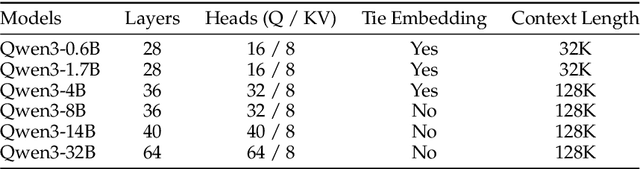
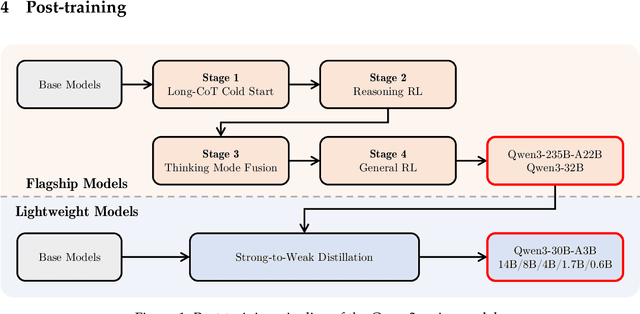

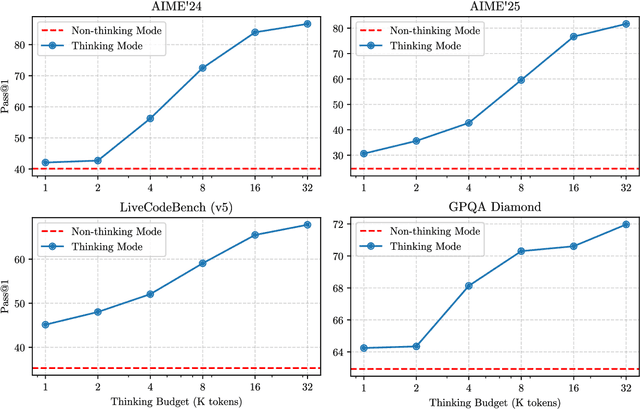
In this work, we present Qwen3, the latest version of the Qwen model family. Qwen3 comprises a series of large language models (LLMs) designed to advance performance, efficiency, and multilingual capabilities. The Qwen3 series includes models of both dense and Mixture-of-Expert (MoE) architectures, with parameter scales ranging from 0.6 to 235 billion. A key innovation in Qwen3 is the integration of thinking mode (for complex, multi-step reasoning) and non-thinking mode (for rapid, context-driven responses) into a unified framework. This eliminates the need to switch between different models--such as chat-optimized models (e.g., GPT-4o) and dedicated reasoning models (e.g., QwQ-32B)--and enables dynamic mode switching based on user queries or chat templates. Meanwhile, Qwen3 introduces a thinking budget mechanism, allowing users to allocate computational resources adaptively during inference, thereby balancing latency and performance based on task complexity. Moreover, by leveraging the knowledge from the flagship models, we significantly reduce the computational resources required to build smaller-scale models, while ensuring their highly competitive performance. Empirical evaluations demonstrate that Qwen3 achieves state-of-the-art results across diverse benchmarks, including tasks in code generation, mathematical reasoning, agent tasks, etc., competitive against larger MoE models and proprietary models. Compared to its predecessor Qwen2.5, Qwen3 expands multilingual support from 29 to 119 languages and dialects, enhancing global accessibility through improved cross-lingual understanding and generation capabilities. To facilitate reproducibility and community-driven research and development, all Qwen3 models are publicly accessible under Apache 2.0.
PolyMath: Evaluating Mathematical Reasoning in Multilingual Contexts
Apr 30, 2025In this paper, we introduce PolyMath, a multilingual mathematical reasoning benchmark covering 18 languages and 4 easy-to-hard difficulty levels. Our benchmark ensures difficulty comprehensiveness, language diversity, and high-quality translation, making it a highly discriminative multilingual mathematical benchmark in the era of reasoning LLMs. We conduct a comprehensive evaluation for advanced LLMs and find that even Qwen-3-235B-A22B-Thinking and Gemini-2.5-pro, achieve only 54.6 and 52.2 benchmark scores, with about 40% accuracy under the highest level From a language perspective, our benchmark reveals several key challenges of LLMs in multilingual reasoning: (1) Reasoning performance varies widely across languages for current LLMs; (2) Input-output language consistency is low in reasoning LLMs and may be correlated with performance; (3) The thinking length differs significantly by language for current LLMs. Additionally, we demonstrate that controlling the output language in the instructions has the potential to affect reasoning performance, especially for some low-resource languages, suggesting a promising direction for improving multilingual capabilities in LLMs.
HellaSwag-Pro: A Large-Scale Bilingual Benchmark for Evaluating the Robustness of LLMs in Commonsense Reasoning
Feb 17, 2025Large language models (LLMs) have shown remarkable capabilities in commonsense reasoning; however, some variations in questions can trigger incorrect responses. Do these models truly understand commonsense knowledge, or just memorize expression patterns? To investigate this question, we present the first extensive robustness evaluation of LLMs in commonsense reasoning. We introduce HellaSwag-Pro, a large-scale bilingual benchmark consisting of 11,200 cases, by designing and compiling seven types of question variants. To construct this benchmark, we propose a two-stage method to develop Chinese HellaSwag, a finely annotated dataset comprising 12,000 instances across 56 categories. We conduct extensive experiments on 41 representative LLMs, revealing that these LLMs are far from robust in commonsense reasoning. Furthermore, this robustness varies depending on the language in which the LLM is tested. This work establishes a high-quality evaluation benchmark, with extensive experiments offering valuable insights to the community in commonsense reasoning for LLMs.