 Add to Chrome
 Add to Firefox
 Add to Edge
WILDTRACE: Benchmarking Natural Evidence Trails in Long-Context Reasoning
Jul 10, 2026
Answering complex questions over long documents frequently requires integrating evidence that the source itself disperses naturally across distant passages. In an incident report, the operating condition, design flaw, and missed safety check that jointly explain a disaster may appear dozens of sections apart; in a novel, a character's true motive may surface only through scenes far removed from the moment it becomes relevant. This source-internal evidence integration is central to real-world long-document analysis, yet existing benchmarks largely sidestep it. Needle probes, planted facts, and reverse-engineered multi-hop chains embed evidence that may differ from the host text in distribution, placement, or register, making it unclear whether strong performance reflects genuine source reasoning or distributional artifacts. We introduce WILDTRACE, a benchmark of 481 tasks over 214 naturally occurring long-form sources such as technical incident reports and lesser-known literary narratives, where all evidence trails arise from the document's own causal, temporal, and narrative logic. Drawing on Pearl's causal hierarchy and prior multi-hop reasoning typologies, we define seven source-internal evidence geometries that characterize the distinct relational demands of analytical reading in long documents. A source-first construction pipeline mines candidate trails from document structure before writing questions; each item then undergoes multi-stage validation covering clue necessity, answer groundedness, rubric fidelity, contamination resistance and answerability. As models are increasingly entrusted with real-world high-stakes analytical tasks, this gap between accessing information and reasoning over naturally dispersed evidence emerges as a defining challenge for the next stage of long-context research.

Qwen-AgentWorld: Language World Models for General Agents
Jun 23, 2026A world model predicts environment dynamics based on current observations and actions, serving as a core cognitive mechanism for reasoning and planning. In this work, we investigate how world modeling based on language models can further push the boundaries of general agents. (i) We first focus on building foundation models for agentic environment simulation. We introduce Qwen-AgentWorld-35B-A3B and Qwen-AgentWorld-397B-A17B, the first language world models capable of simulating agentic environments covering 7 domains via long chain-of-thought reasoning. Leveraging more than 10M environment interaction trajectories of 7 domains in real-world environments, we develop Qwen-AgentWorld through a three-stage training pipeline: CPT injects general-purpose world modeling capabilities from the state transition dynamics and augmented professional corpora, SFT activates next-state-prediction reasoning, and RL sharpens simulation fidelity through a tailored framework with hybrid rubric-and-rule rewards. To evaluate language world models, we present AgentWorldBench, a comprehensive benchmark constructed from real-world interactions of 5 frontier models on 9 established benchmarks. Empirical results demonstrate that Qwen-AgentWorld significantly outperforms existing frontier models. (ii) Beyond foundation models, we further investigate two complementary paradigms through which world modeling enhances general agents. First, as a decoupled environment simulator, Qwen-AgentWorld supports scalable and controllable simulation of thousands of real-world environments for agentic RL, yielding gains that surpass real-environment training alone. Second, as a unified agent foundation model, world-model training acts as a highly effective warm-up that improves downstream performance across 7 agentic benchmarks. Code: https://github.com/QwenLM/Qwen-AgentWorld
AgentBeats: Agentifying Agent Assessment for Openness, Standardization, and Reproducibility
Jun 11, 2026Agent systems are advancing quickly across domains, but their evaluation remains fragmented. Most benchmarks rely on fixed, LLM-centric harnesses that require heavy integration, create test-production mismatch, and limit fair comparison across diverse agent designs. The root problem is the lack of an open, agent-agnostic assessment interface. We advocate Agentified Agent Assessment (AAA), where evaluation is performed by judge agents and all participants interact through standardized protocols: A2A for task management and MCP for tool access. Conventional benchmarking defines two separate interfaces, one for the benchmark and one for the agent, while AAA only needs one; this yields a generic, unified framework that separates assessment logic from agent implementation and enables reproducible, interoperable, and multi-agent evaluation. We further introduce AgentBeats as a concrete realization of AAA: we identify five practical operation modes that make standardized assessment compatible with real-world constraints on openness, privacy, and reproducibility. To evaluate our design at scale, we conduct two studies: a five-month open competition that drew 298 judge agents across 12 categories together with 467 subject agents from independent participants, showing that AAA applies across a heterogeneous range of benchmarks; and a case study on coding agents that confirms agentified evaluation preserves fidelity with the public record while surfacing previously missing head-to-head results, yielding research insights about agent design. Combining a community-scale field study and a controlled coding case study, we verify that AAA delivers coverage, practicality, and fidelity across heterogeneous scenarios at scale. Together, AAA and AgentBeats offer a clear path toward open, standardized, and reproducible agent assessment.
Agents' Last Exam
Jun 03, 2026Recent AI systems have achieved strong results on a wide range of benchmarks, yet these gains have not translated into economically meaningful deployment across many professional domains. We argue that this gap is largely an evaluation problem: widely used benchmarks lack sustained performance measurement on real and economically valuable workflows. This paper introduces Agents' Last Exam (ALE), a benchmark designed to evaluate AI agents on long-horizon, economically valuable, real-world tasks with verifiable outcomes. Developed in collaboration with 250+ industry experts, ALE covers non-physical industries defined with reference to O*NET / SOC 2018 (the U.S. federal occupational taxonomy). It is organized around a task taxonomy with 55 subfields grouped into 13 industry clusters covering 1K+ tasks. Current results show that the hardest tier remains far from saturated: across mainstream harness and backbone configurations, the average full pass rate is 2.6%. ALE is designed as a living benchmark: its task pool grows continuously as new workflows and industries are onboarded. More broadly, ALE is intended not merely as another leaderboard, but as an instrument for closing the gap between benchmark success and GDP-relevant impact.
CyberGym-E2E: Scalable Real-World Benchmark for AI Agents' End-to-End Cybersecurity Capabilities
Jun 03, 2026AI has the potential to transform cybersecurity by enabling systems that can autonomously detect, analyze, and remediate software vulnerabilities. However, existing cybersecurity evaluations of AI systems are limited in scale or scope, and fail to capture the end-to-end lifecycle of real-world software vulnerability discovery and remediation. To address this gap, we propose CyberGym-E2E, a large-scale and realistic end-to-end cybersecurity benchmark that comprehensively evaluates AI agents' abilities across the full lifecycle of vulnerability discovery, PoC generation, and patch generation. CyberGym-E2E is comprehensive and scalable, as we build an automated, agent-enhanced pipeline for transforming open-source vulnerability data into realistic evaluation environments. Currently, the benchmark consists of 920 real-world vulnerabilities across 139 different open-source projects.
Are Agents Ready to Teach? A Multi-Stage Benchmark for Real-World Teaching Workflows
May 14, 2026Language agents are increasingly deployed in complex professional workflows, with tutoring emerging as a particularly high-stakes capability that remains largely unmeasured in existing benchmarks. Effective tutor agents require more than producing correct answers or executing accurate tool calls: a robust tutor must diagnose learner state, adapt support over time, make pedagogically justified decisions grounded in educational evidence, and execute interventions within realistic learning-management systems. We introduce EduAgentBench, a source-grounded benchmark for holistically evaluating tutor agents across the full scope of teaching work. It contains 150 quality-controlled tasks across three capability surfaces: professional pedagogical judgment, situated multi-turn tutoring, and Canvas-style teaching workflow completion. Tasks are constructed through a pedagogical-insight-driven pipeline and evaluated with complementary verification signals and human review. Across a comprehensive evaluation of frontier models, our findings reveal that current models are generally capable of bounded pedagogical judgment, but still fall short of professional teaching standards in situated tutoring and autonomous teaching-workflow execution. To our knowledge, EduAgentBench is the first theory-grounded and realistic benchmark for evaluating the holistic teaching capability of tutor agents, providing a measurement foundation for developing future tutor agents that can support realistic teaching work.
OccuBench: Evaluating AI Agents on Real-World Professional Tasks via Language World Models
Apr 13, 2026AI agents are expected to perform professional work across hundreds of occupational domains (from emergency department triage to nuclear reactor safety monitoring to customs import processing), yet existing benchmarks can only evaluate agents in the few domains where public environments exist. We introduce OccuBench, a benchmark covering 100 real-world professional task scenarios across 10 industry categories and 65 specialized domains, enabled by Language World Models (LWMs) that simulate domain-specific environments through LLM-driven tool response generation. Our multi-agent synthesis pipeline automatically produces evaluation instances with guaranteed solvability, calibrated difficulty, and document-grounded diversity. OccuBench evaluates agents along two complementary dimensions: task completion across professional domains and environmental robustness under controlled fault injection (explicit errors, implicit data degradation, and mixed faults). We evaluate 15 frontier models across 8 model families and find that: (1) no single model dominates all industries, as each has a distinct occupational capability profile; (2) implicit faults (truncated data, missing fields) are harder than both explicit errors (timeouts, 500s) and mixed faults, because they lack overt error signals and require the agent to independently detect data degradation; (3) larger models, newer generations, and higher reasoning effort consistently improve performance. GPT-5.2 improves by 27.5 points from minimal to maximum reasoning effort; and (4) strong agents are not necessarily strong environment simulators. Simulator quality is critical for LWM-based evaluation reliability. OccuBench provides the first systematic cross-industry evaluation of AI agents on professional occupational tasks.
WebWorld: A Large-Scale World Model for Web Agent Training
Feb 16, 2026Web agents require massive trajectories to generalize, yet real-world training is constrained by network latency, rate limits, and safety risks. We introduce \textbf{WebWorld} series, the first open-web simulator trained at scale. While existing simulators are restricted to closed environments with thousands of trajectories, WebWorld leverages a scalable data pipeline to train on 1M+ open-web interactions, supporting reasoning, multi-format data, and long-horizon simulations of 30+ steps. For intrinsic evaluation, we introduce WebWorld-Bench with dual metrics spanning nine dimensions, where WebWorld achieves simulation performance comparable to Gemini-3-Pro. For extrinsic evaluation, Qwen3-14B trained on WebWorld-synthesized trajectories improves by +9.2\% on WebArena, reaching performance comparable to GPT-4o. WebWorld enables effective inference-time search, outperforming GPT-5 as a world model. Beyond web simulation, WebWorld exhibits cross-domain generalization to code, GUI, and game environments, providing a replicable recipe for world model construction.
DeepPlanning: Benchmarking Long-Horizon Agentic Planning with Verifiable Constraints
Jan 26, 2026While agent evaluation has shifted toward long-horizon tasks, most benchmarks still emphasize local, step-level reasoning rather than the global constrained optimization (e.g., time and financial budgets) that demands genuine planning ability. Meanwhile, existing LLM planning benchmarks underrepresent the active information gathering and fine-grained local constraints typical of real-world settings. To address this, we introduce DeepPlanning, a challenging benchmark for practical long-horizon agent planning. It features multi-day travel planning and multi-product shopping tasks that require proactive information acquisition, local constrained reasoning, and global constrained optimization. Evaluations on DeepPlanning show that even frontier agentic LLMs struggle with these problems, highlighting the importance of reliable explicit reasoning patterns and parallel tool use for achieving better effectiveness-efficiency trade-offs. Error analysis further points to promising directions for improving agentic LLMs over long planning horizons. We open-source the code and data to support future research.
One Model to Critique Them All: Rewarding Agentic Tool-Use via Efficient Reasoning
Oct 30, 2025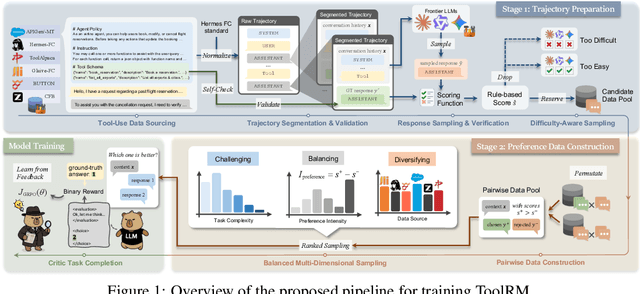

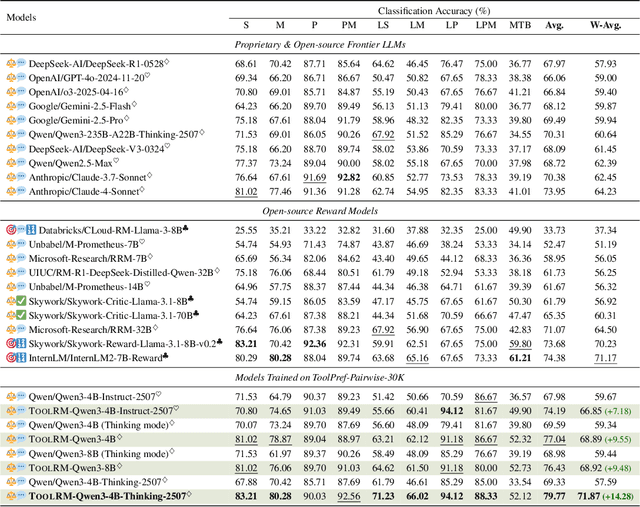
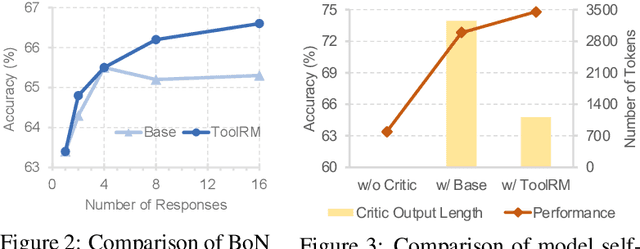
Reward models (RMs) play a critical role in aligning large language models (LLMs) with human preferences. Yet in the domain of tool learning, the lack of RMs specifically designed for function-calling tasks has limited progress toward more capable agentic AI. We introduce ToolRM, a family of lightweight generative RMs tailored for general tool-use scenarios. To build these models, we propose a novel pipeline that constructs pairwise preference data using rule-based scoring and multidimensional sampling. This yields ToolPref-Pairwise-30K, a diverse, balanced, and challenging dataset of critique tasks that supports reinforcement learning with verifiable feedback. To evaluate tool-use RMs, we also introduce TRBench$_{BFCL}$, a benchmark built on the agentic evaluation suite BFCL. Trained on our constructed data, models from the Qwen3-4B/8B series achieve up to 14.28% higher accuracy, substantially outperforming frontier models such as Claude 4 and OpenAI o3 in pairwise reward judgments. Beyond training objectives, ToolRM generalizes to broader critique tasks, including Best-of-N sampling and self-correction. Experiments on ACEBench highlight its effectiveness and efficiency, enabling inference-time scaling and reducing output token usage by over 66%. We release data and model checkpoints to facilitate future research.