 Add to Chrome
 Add to Firefox
 Add to Edge
OOD-GraphLLM: Graph Large Language Model for Out-of-Distribution Generalized Drug Synergy Prediction
May 28, 2026
Drug synergy prediction (DSP) aims to identify efficacious drug combinations under various cellular contexts with different targets. However, the continual emergence of novel compounds results in variations in molecular scaffolds and sizes, causing drug synergy data to exhibit out-of-distribution (O.O.D.) shifts with respect to topological structure. Existing works rely on in-distribution (I.D.) assumption, failing to handle the O.O.D. shifts. To solve this problem, we study out-of-distribution generalized drug synergy prediction through a graph large language model for the first time. Nevertheless, O.O.D. generalized DSP is highly non-trivial, posing several challenges: i) how to discover structurally relevant and irrelevant molecular representations with respect to cell targets; ii) how to find the optimal graph neural architectures that accurately calculate molecular representations; and iii) how to jointly leverage molecular structural and semantic information in LLMs. To address these challenges, we propose OOD-GraphLLM, a novel graphLLM framework which is able to accurately predict drug synergy under O.O.D. settings via jointly optimizing molecular graph representation and biomedical semantic language representations in a unified manner. Furthermore, we finetune DrugSyn-LLM, a biomedical LLM, and employ a retrieval-augmented biomedical instruction tuning strategy to align molecular topological information and molecular semantic information with language-based reasoning for O.O.D. generalized DSP. Both the source code (https://github.com/EkkoXiao/Bio-GraphLLM) and released model (https://mn.cs.tsinghua.edu.cn/bio-graphllm/) are publicly available, where users are allowed to download model resources and interactively use the system through a web interface.

Towards Context-Invariant Safety Alignment for Large Language Models
May 20, 2026Preference-based post-training aligns LLMs with human intent, yet safety behavior often remains brittle. A model may refuse a harmful request in a standard prompt but comply when the same intent is wrapped in adversarial wording. We suggest that robust safety requires context-invariant alignment, where behavior depends on the underlying intent rather than surface form. Enforcing invariance is difficult in alignment because not all training signals are equally trustworthy; for some prompt variants we can obtain verifiable feedback (e.g., multiple-choice), while for open-ended variants we typically rely on noisy, gameable reward proxies (e.g., learned judges). As a result, standard symmetric invariance regularizers can reduce cross-context discrepancies by lowering performance on reliable variants instead of improving open-ended robustness. To address this, we introduce Anchor Invariance Regularization (AIR), which treats verifiable prompts as anchors and uses a stop-gradient target to regularize only the open-ended variants toward the anchor performance. AIR is implemented as a plug-in auxiliary loss and combined with group-based preference optimization (e.g., GRPO) via heterogeneous prompt grouping. Across Safety, Moral Reasoning, and Math, AIR improves context invariance, boosting in-distribution group accuracy by 12.71% and out-of-distribution consistency by 33.49%, making safety constraints robust to adversarial framings.
OpenRT: An Open-Source Red Teaming Framework for Multimodal LLMs
Jan 04, 2026The rapid integration of Multimodal Large Language Models (MLLMs) into critical applications is increasingly hindered by persistent safety vulnerabilities. However, existing red-teaming benchmarks are often fragmented, limited to single-turn text interactions, and lack the scalability required for systematic evaluation. To address this, we introduce OpenRT, a unified, modular, and high-throughput red-teaming framework designed for comprehensive MLLM safety evaluation. At its core, OpenRT architects a paradigm shift in automated red-teaming by introducing an adversarial kernel that enables modular separation across five critical dimensions: model integration, dataset management, attack strategies, judging methods, and evaluation metrics. By standardizing attack interfaces, it decouples adversarial logic from a high-throughput asynchronous runtime, enabling systematic scaling across diverse models. Our framework integrates 37 diverse attack methodologies, spanning white-box gradients, multi-modal perturbations, and sophisticated multi-agent evolutionary strategies. Through an extensive empirical study on 20 advanced models (including GPT-5.2, Claude 4.5, and Gemini 3 Pro), we expose critical safety gaps: even frontier models fail to generalize across attack paradigms, with leading models exhibiting average Attack Success Rates as high as 49.14%. Notably, our findings reveal that reasoning models do not inherently possess superior robustness against complex, multi-turn jailbreaks. By open-sourcing OpenRT, we provide a sustainable, extensible, and continuously maintained infrastructure that accelerates the development and standardization of AI safety.
A Rigorous Benchmark with Multidimensional Evaluation for Deep Research Agents: From Answers to Reports
Oct 02, 2025Artificial intelligence is undergoing the paradigm shift from closed language models to interconnected agent systems capable of external perception and information integration. As a representative embodiment, Deep Research Agents (DRAs) systematically exhibit the capabilities for task decomposition, cross-source retrieval, multi-stage reasoning, and structured output, which markedly enhance performance on complex and open-ended tasks. However, existing benchmarks remain deficient in evaluation dimensions, response formatting, and scoring mechanisms, limiting their capacity to assess such systems effectively. This paper introduces a rigorous benchmark and a multidimensional evaluation framework tailored to DRAs and report-style responses. The benchmark comprises 214 expert-curated challenging queries distributed across 10 broad thematic domains, each accompanied by manually constructed reference bundles to support composite evaluation. The framework enables comprehensive evaluation of long-form reports generated by DRAs, incorporating integrated scoring metrics for semantic quality, topical focus, and retrieval trustworthiness. Extensive experimentation confirms the superior performance of mainstream DRAs over web-search-tool-augmented reasoning models, yet reveals considerable scope for further improvement. This study provides a robust foundation for capability assessment, architectural refinement, and paradigm advancement in DRA systems.
Visual-CoG: Stage-Aware Reinforcement Learning with Chain of Guidance for Text-to-Image Generation
Aug 25, 2025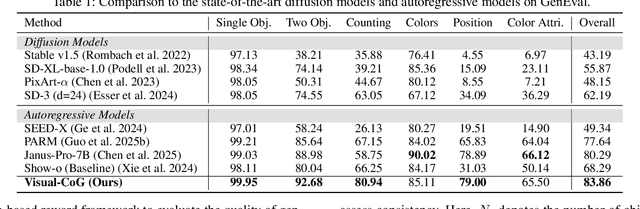
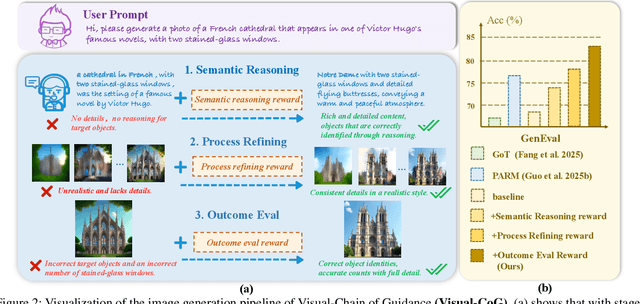
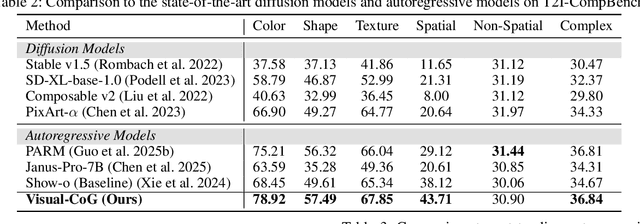
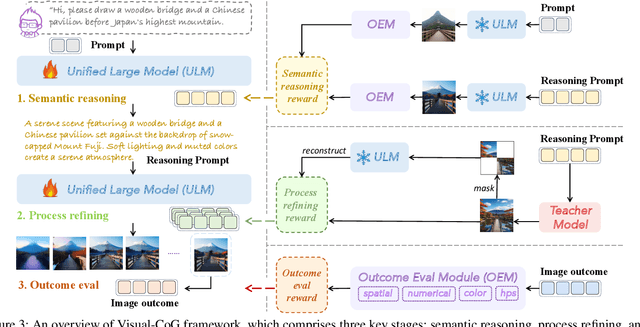
Despite the promising progress of recent autoregressive models in text-to-image (T2I) generation, their ability to handle multi-attribute and ambiguous prompts remains limited. To address these limitations, existing works have applied chain-of-thought (CoT) to enable stage-aware visual synthesis and employed reinforcement learning (RL) to improve reasoning capabilities. However, most models provide reward signals only at the end of the generation stage. This monolithic final-only guidance makes it difficult to identify which stages contribute positively to the final outcome and may lead to suboptimal policies. To tackle this issue, we propose a Visual-Chain of Guidance (Visual-CoG) paradigm consisting of three stages: semantic reasoning, process refining, and outcome evaluation, with stage-aware rewards providing immediate guidance throughout the image generation pipeline. We further construct a visual cognition benchmark, VisCog-Bench, which comprises four subtasks to evaluate the effectiveness of semantic reasoning. Comprehensive evaluations on GenEval, T2I-CompBench, and the proposed VisCog-Bench show improvements of 15%, 5%, and 19%, respectively, demonstrating the superior performance of the proposed Visual-CoG. We will release all the resources soon.
SafeWork-R1: Coevolving Safety and Intelligence under the AI-45$^{\circ}$ Law
Jul 24, 2025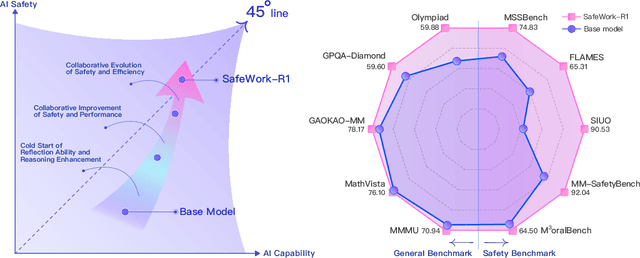
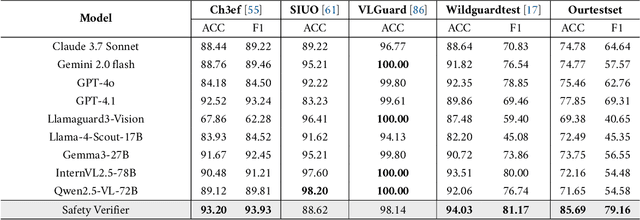
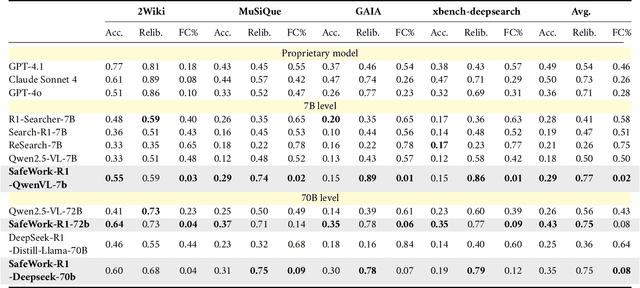
We introduce SafeWork-R1, a cutting-edge multimodal reasoning model that demonstrates the coevolution of capabilities and safety. It is developed by our proposed SafeLadder framework, which incorporates large-scale, progressive, safety-oriented reinforcement learning post-training, supported by a suite of multi-principled verifiers. Unlike previous alignment methods such as RLHF that simply learn human preferences, SafeLadder enables SafeWork-R1 to develop intrinsic safety reasoning and self-reflection abilities, giving rise to safety `aha' moments. Notably, SafeWork-R1 achieves an average improvement of $46.54\%$ over its base model Qwen2.5-VL-72B on safety-related benchmarks without compromising general capabilities, and delivers state-of-the-art safety performance compared to leading proprietary models such as GPT-4.1 and Claude Opus 4. To further bolster its reliability, we implement two distinct inference-time intervention methods and a deliberative search mechanism, enforcing step-level verification. Finally, we further develop SafeWork-R1-InternVL3-78B, SafeWork-R1-DeepSeek-70B, and SafeWork-R1-Qwen2.5VL-7B. All resulting models demonstrate that safety and capability can co-evolve synergistically, highlighting the generalizability of our framework in building robust, reliable, and trustworthy general-purpose AI.
SafeVid: Toward Safety Aligned Video Large Multimodal Models
May 17, 2025As Video Large Multimodal Models (VLMMs) rapidly advance, their inherent complexity introduces significant safety challenges, particularly the issue of mismatched generalization where static safety alignments fail to transfer to dynamic video contexts. We introduce SafeVid, a framework designed to instill video-specific safety principles in VLMMs. SafeVid uniquely transfers robust textual safety alignment capabilities to the video domain by employing detailed textual video descriptions as an interpretive bridge, facilitating LLM-based rule-driven safety reasoning. This is achieved through a closed-loop system comprising: 1) generation of SafeVid-350K, a novel 350,000-pair video-specific safety preference dataset; 2) targeted alignment of VLMMs using Direct Preference Optimization (DPO); and 3) comprehensive evaluation via our new SafeVidBench benchmark. Alignment with SafeVid-350K significantly enhances VLMM safety, with models like LLaVA-NeXT-Video demonstrating substantial improvements (e.g., up to 42.39%) on SafeVidBench. SafeVid provides critical resources and a structured approach, demonstrating that leveraging textual descriptions as a conduit for safety reasoning markedly improves the safety alignment of VLMMs. We have made SafeVid-350K dataset (https://huggingface.co/datasets/yxwang/SafeVid-350K) publicly available.
A Mousetrap: Fooling Large Reasoning Models for Jailbreak with Chain of Iterative Chaos
Feb 19, 2025Large Reasoning Models (LRMs) have significantly advanced beyond traditional Large Language Models (LLMs) with their exceptional logical reasoning capabilities, yet these improvements introduce heightened safety risks. When subjected to jailbreak attacks, their ability to generate more targeted and organized content can lead to greater harm. Although some studies claim that reasoning enables safer LRMs against existing LLM attacks, they overlook the inherent flaws within the reasoning process itself. To address this gap, we propose the first jailbreak attack targeting LRMs, exploiting their unique vulnerabilities stemming from the advanced reasoning capabilities. Specifically, we introduce a Chaos Machine, a novel component to transform attack prompts with diverse one-to-one mappings. The chaos mappings iteratively generated by the machine are embedded into the reasoning chain, which strengthens the variability and complexity and also promotes a more robust attack. Based on this, we construct the Mousetrap framework, which makes attacks projected into nonlinear-like low sample spaces with mismatched generalization enhanced. Also, due to the more competing objectives, LRMs gradually maintain the inertia of unpredictable iterative reasoning and fall into our trap. Success rates of the Mousetrap attacking o1-mini, claude-sonnet and gemini-thinking are as high as 96%, 86% and 98% respectively on our toxic dataset Trotter. On benchmarks such as AdvBench, StrongREJECT, and HarmBench, attacking claude-sonnet, well-known for its safety, Mousetrap can astonishingly achieve success rates of 87.5%, 86.58% and 93.13% respectively. Attention: This paper contains inappropriate, offensive and harmful content.
JAQ: Joint Efficient Architecture Design and Low-Bit Quantization with Hardware-Software Co-Exploration
Jan 09, 2025


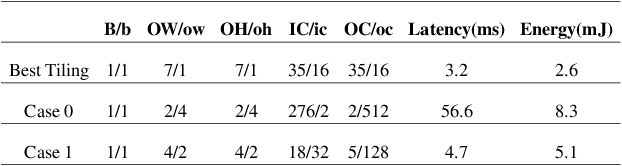
The co-design of neural network architectures, quantization precisions, and hardware accelerators offers a promising approach to achieving an optimal balance between performance and efficiency, particularly for model deployment on resource-constrained edge devices. In this work, we propose the JAQ Framework, which jointly optimizes the three critical dimensions. However, effectively automating the design process across the vast search space of those three dimensions poses significant challenges, especially when pursuing extremely low-bit quantization. Specifical, the primary challenges include: (1) Memory overhead in software-side: Low-precision quantization-aware training can lead to significant memory usage due to storing large intermediate features and latent weights for back-propagation, potentially causing memory exhaustion. (2) Search time-consuming in hardware-side: The discrete nature of hardware parameters and the complex interplay between compiler optimizations and individual operators make the accelerator search time-consuming. To address these issues, JAQ mitigates the memory overhead through a channel-wise sparse quantization (CSQ) scheme, selectively applying quantization to the most sensitive components of the model during optimization. Additionally, JAQ designs BatchTile, which employs a hardware generation network to encode all possible tiling modes, thereby speeding up the search for the optimal compiler mapping strategy. Extensive experiments demonstrate the effectiveness of JAQ, achieving approximately 7% higher Top-1 accuracy on ImageNet compared to previous methods and reducing the hardware search time per iteration to 0.15 seconds.
JoyVASA: Portrait and Animal Image Animation with Diffusion-Based Audio-Driven Facial Dynamics and Head Motion Generation
Nov 14, 2024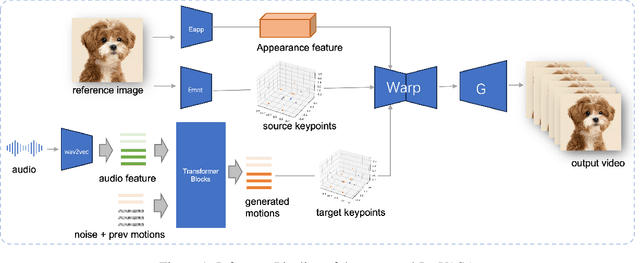
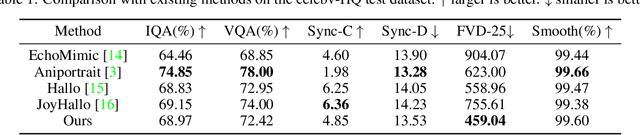
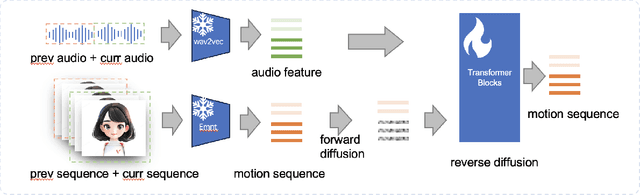
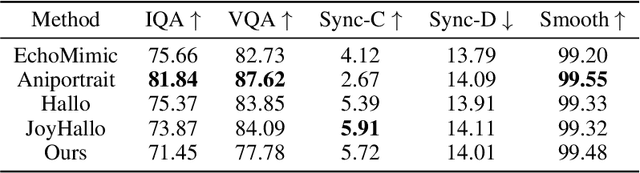
Audio-driven portrait animation has made significant advances with diffusion-based models, improving video quality and lipsync accuracy. However, the increasing complexity of these models has led to inefficiencies in training and inference, as well as constraints on video length and inter-frame continuity. In this paper, we propose JoyVASA, a diffusion-based method for generating facial dynamics and head motion in audio-driven facial animation. Specifically, in the first stage, we introduce a decoupled facial representation framework that separates dynamic facial expressions from static 3D facial representations. This decoupling allows the system to generate longer videos by combining any static 3D facial representation with dynamic motion sequences. Then, in the second stage, a diffusion transformer is trained to generate motion sequences directly from audio cues, independent of character identity. Finally, a generator trained in the first stage uses the 3D facial representation and the generated motion sequences as inputs to render high-quality animations. With the decoupled facial representation and the identity-independent motion generation process, JoyVASA extends beyond human portraits to animate animal faces seamlessly. The model is trained on a hybrid dataset of private Chinese and public English data, enabling multilingual support. Experimental results validate the effectiveness of our approach. Future work will focus on improving real-time performance and refining expression control, further expanding the applications in portrait animation. The code will be available at: https://jdhalgo.github.io/JoyVASA.