 Add to Chrome
 Add to Firefox
 Add to Edge
WILDTRACE: Benchmarking Natural Evidence Trails in Long-Context Reasoning
Jul 10, 2026
Answering complex questions over long documents frequently requires integrating evidence that the source itself disperses naturally across distant passages. In an incident report, the operating condition, design flaw, and missed safety check that jointly explain a disaster may appear dozens of sections apart; in a novel, a character's true motive may surface only through scenes far removed from the moment it becomes relevant. This source-internal evidence integration is central to real-world long-document analysis, yet existing benchmarks largely sidestep it. Needle probes, planted facts, and reverse-engineered multi-hop chains embed evidence that may differ from the host text in distribution, placement, or register, making it unclear whether strong performance reflects genuine source reasoning or distributional artifacts. We introduce WILDTRACE, a benchmark of 481 tasks over 214 naturally occurring long-form sources such as technical incident reports and lesser-known literary narratives, where all evidence trails arise from the document's own causal, temporal, and narrative logic. Drawing on Pearl's causal hierarchy and prior multi-hop reasoning typologies, we define seven source-internal evidence geometries that characterize the distinct relational demands of analytical reading in long documents. A source-first construction pipeline mines candidate trails from document structure before writing questions; each item then undergoes multi-stage validation covering clue necessity, answer groundedness, rubric fidelity, contamination resistance and answerability. As models are increasingly entrusted with real-world high-stakes analytical tasks, this gap between accessing information and reasoning over naturally dispersed evidence emerges as a defining challenge for the next stage of long-context research.

Are Agents Ready to Teach? A Multi-Stage Benchmark for Real-World Teaching Workflows
May 14, 2026Language agents are increasingly deployed in complex professional workflows, with tutoring emerging as a particularly high-stakes capability that remains largely unmeasured in existing benchmarks. Effective tutor agents require more than producing correct answers or executing accurate tool calls: a robust tutor must diagnose learner state, adapt support over time, make pedagogically justified decisions grounded in educational evidence, and execute interventions within realistic learning-management systems. We introduce EduAgentBench, a source-grounded benchmark for holistically evaluating tutor agents across the full scope of teaching work. It contains 150 quality-controlled tasks across three capability surfaces: professional pedagogical judgment, situated multi-turn tutoring, and Canvas-style teaching workflow completion. Tasks are constructed through a pedagogical-insight-driven pipeline and evaluated with complementary verification signals and human review. Across a comprehensive evaluation of frontier models, our findings reveal that current models are generally capable of bounded pedagogical judgment, but still fall short of professional teaching standards in situated tutoring and autonomous teaching-workflow execution. To our knowledge, EduAgentBench is the first theory-grounded and realistic benchmark for evaluating the holistic teaching capability of tutor agents, providing a measurement foundation for developing future tutor agents that can support realistic teaching work.
Qwen-Scope: Turning Sparse Features into Development Tools for Large Language Models
May 12, 2026Large language models have achieved remarkable capabilities across diverse tasks, yet their internal decision-making processes remain largely opaque, limiting our ability to inspect, control, and systematically improve them. This opacity motivates a growing body of research in mechanistic interpretability, with sparse autoencoders (SAEs) emerging as one of the most promising tools for decomposing model activations into sparse, interpretable feature representations. We introduce Qwen-Scope, an open-source suite of SAEs built on the Qwen model family, comprising 14 groups of SAEs across 7 model variants from the Qwen3 and Qwen3.5 series, covering both dense and mixture-of-expert architectures. Built on top of these SAEs, we show that SAEs can go beyond post-hoc analysis to serve as practical interfaces for model development along four directions: (i) inference-time steering, where SAE feature directions control language, concepts, and preferences without modifying model weights; (ii) evaluation analysis, where activated SAE features provide a representation-level proxy for benchmark redundancy and capability coverage; (iii) data-centric workflows, where SAE features support multilingual toxicity classification and safety-oriented data synthesis; and (iv) post-training optimization, where SAE-derived signals are incorporated into supervised fine-tuning and reinforcement learning objectives to mitigate undesirable behaviors such as code-switching and repetition. Together, these results demonstrate that SAEs can serve not only as post-hoc analysis tools, but also as reusable representation-level interfaces for diagnosing, controlling, evaluating, and improving large language models. By open-sourcing Qwen-Scope, we aim to support mechanistic research and accelerate practical workflows that connect model internals to downstream behavior.
Qwen-Image-2.0 Technical Report
May 11, 2026We present Qwen-Image-2.0, an omni-capable image generation foundation model that unifies high-fidelity generation and precise image editing within a single framework. Despite recent progress, existing models still struggle with ultra-long text rendering, multilingual typography, high-resolution photorealism, robust instruction following, and efficient deployment, especially in text-rich and compositionally complex scenarios. Qwen-Image-2.0 addresses these challenges by coupling Qwen3-VL as the condition encoder with a Multimodal Diffusion Transformer for joint condition-target modeling, supported by large-scale data curation and a customized multi-stage training pipeline. This enables strong multimodal understanding while preserving flexible generation and editing capabilities. The model supports instructions of up to 1K tokens for generating text-rich content such as slides, posters, infographics, and comics, while significantly improving multilingual text fidelity and typography. It also enhances photorealistic generation with richer details, more realistic textures, and coherent lighting, and follows complex prompts more reliably across diverse styles. Extensive human evaluations show that Qwen-Image-2.0 substantially outperforms previous Qwen-Image models in both generation and editing, marking a step toward more general, reliable, and practical image generation foundation models.
Qwen3Guard Technical Report
Oct 16, 2025As large language models (LLMs) become more capable and widely used, ensuring the safety of their outputs is increasingly critical. Existing guardrail models, though useful in static evaluation settings, face two major limitations in real-world applications: (1) they typically output only binary "safe/unsafe" labels, which can be interpreted inconsistently across diverse safety policies, rendering them incapable of accommodating varying safety tolerances across domains; and (2) they require complete model outputs before performing safety checks, making them fundamentally incompatible with streaming LLM inference, thereby preventing timely intervention during generation and increasing exposure to harmful partial outputs. To address these challenges, we present Qwen3Guard, a series of multilingual safety guardrail models with two specialized variants: Generative Qwen3Guard, which casts safety classification as an instruction-following task to enable fine-grained tri-class judgments (safe, controversial, unsafe); and Stream Qwen3Guard, which introduces a token-level classification head for real-time safety monitoring during incremental text generation. Both variants are available in three sizes (0.6B, 4B, and 8B parameters) and support up to 119 languages and dialects, providing comprehensive, scalable, and low-latency safety moderation for global LLM deployments. Evaluated across English, Chinese, and multilingual benchmarks, Qwen3Guard achieves state-of-the-art performance in both prompt and response safety classification. All models are released under the Apache 2.0 license for public use.
Qwen2 Technical Report
Jul 16, 2024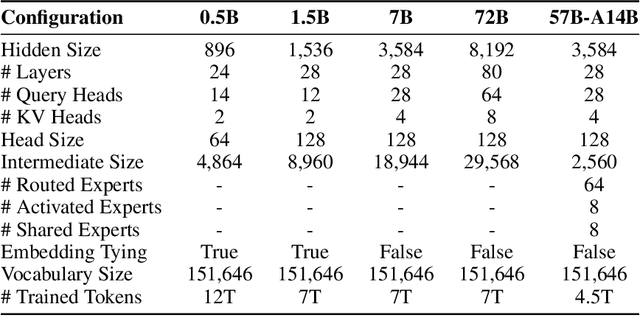
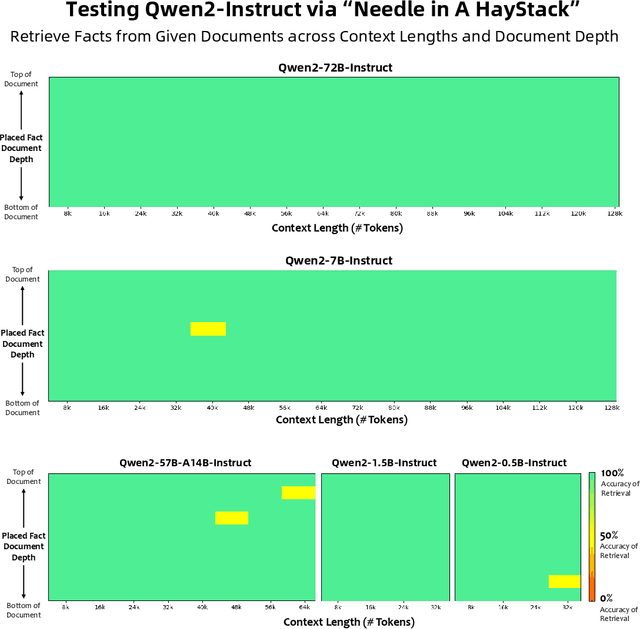
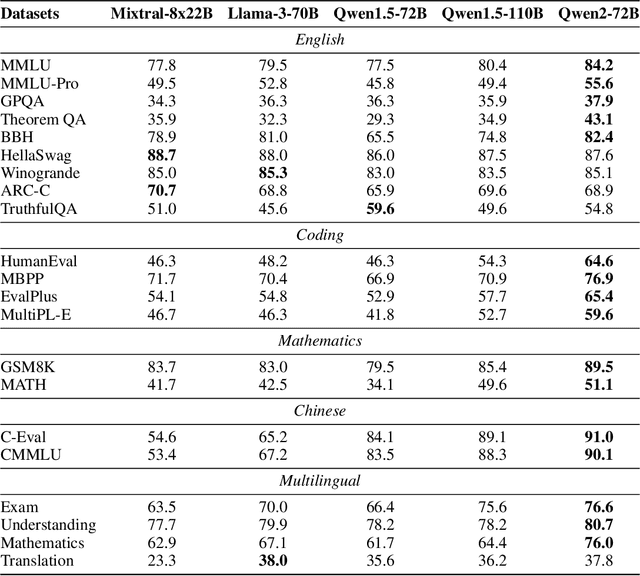
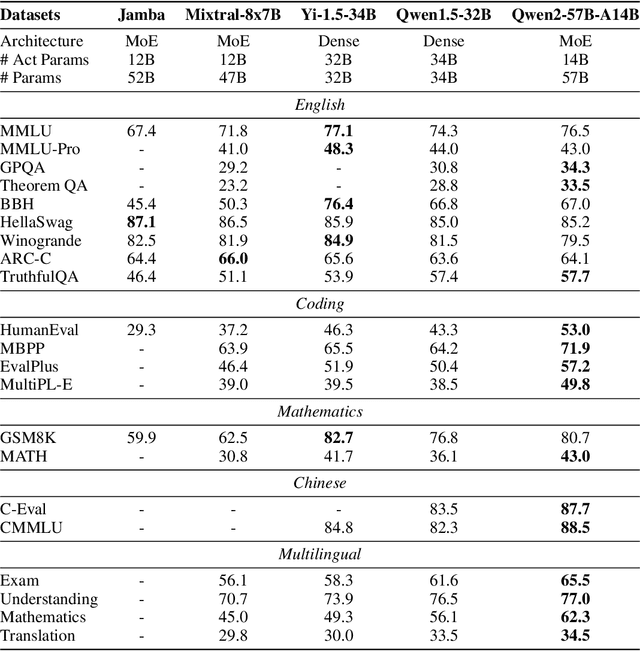
This report introduces the Qwen2 series, the latest addition to our large language models and large multimodal models. We release a comprehensive suite of foundational and instruction-tuned language models, encompassing a parameter range from 0.5 to 72 billion, featuring dense models and a Mixture-of-Experts model. Qwen2 surpasses most prior open-weight models, including its predecessor Qwen1.5, and exhibits competitive performance relative to proprietary models across diverse benchmarks on language understanding, generation, multilingual proficiency, coding, mathematics, and reasoning. The flagship model, Qwen2-72B, showcases remarkable performance: 84.2 on MMLU, 37.9 on GPQA, 64.6 on HumanEval, 89.5 on GSM8K, and 82.4 on BBH as a base language model. The instruction-tuned variant, Qwen2-72B-Instruct, attains 9.1 on MT-Bench, 48.1 on Arena-Hard, and 35.7 on LiveCodeBench. Moreover, Qwen2 demonstrates robust multilingual capabilities, proficient in approximately 30 languages, spanning English, Chinese, Spanish, French, German, Arabic, Russian, Korean, Japanese, Thai, Vietnamese, and more, underscoring its versatility and global reach. To foster community innovation and accessibility, we have made the Qwen2 model weights openly available on Hugging Face and ModelScope, and the supplementary materials including example code on GitHub. These platforms also include resources for quantization, fine-tuning, and deployment, facilitating a wide range of applications and research endeavors.
Qwen Technical Report
Sep 28, 2023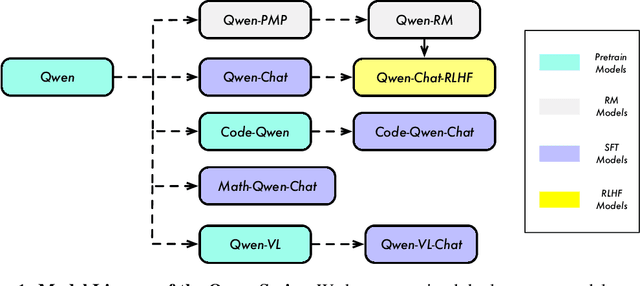

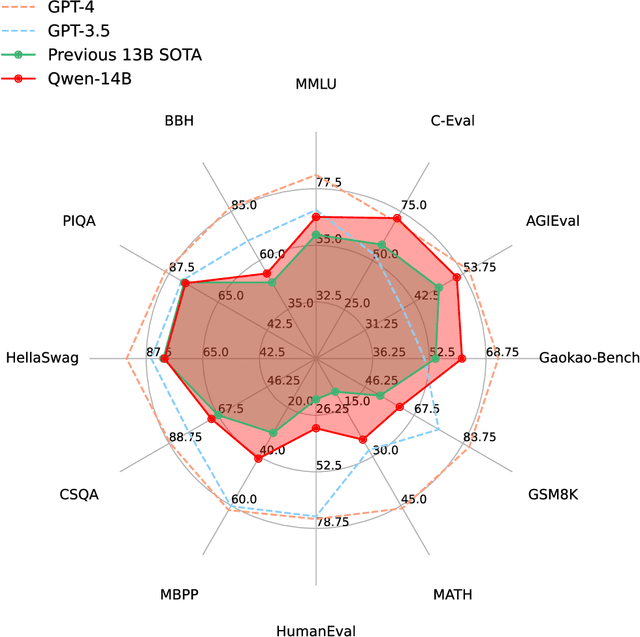
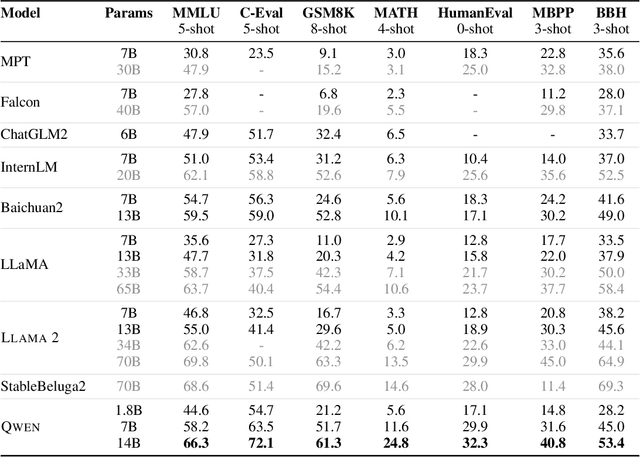
Large language models (LLMs) have revolutionized the field of artificial intelligence, enabling natural language processing tasks that were previously thought to be exclusive to humans. In this work, we introduce Qwen, the first installment of our large language model series. Qwen is a comprehensive language model series that encompasses distinct models with varying parameter counts. It includes Qwen, the base pretrained language models, and Qwen-Chat, the chat models finetuned with human alignment techniques. The base language models consistently demonstrate superior performance across a multitude of downstream tasks, and the chat models, particularly those trained using Reinforcement Learning from Human Feedback (RLHF), are highly competitive. The chat models possess advanced tool-use and planning capabilities for creating agent applications, showcasing impressive performance even when compared to bigger models on complex tasks like utilizing a code interpreter. Furthermore, we have developed coding-specialized models, Code-Qwen and Code-Qwen-Chat, as well as mathematics-focused models, Math-Qwen-Chat, which are built upon base language models. These models demonstrate significantly improved performance in comparison with open-source models, and slightly fall behind the proprietary models.
M6: A Chinese Multimodal Pretrainer
Mar 02, 2021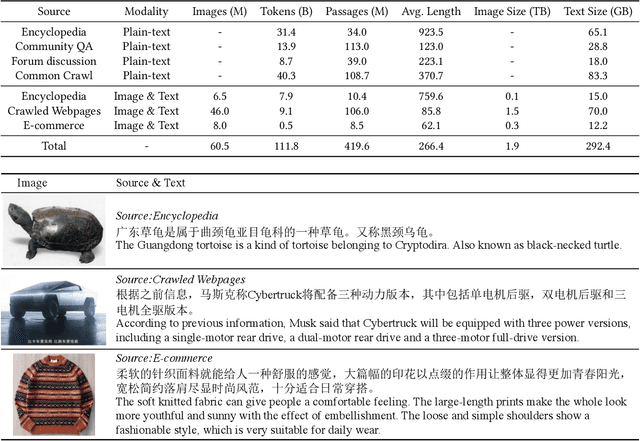
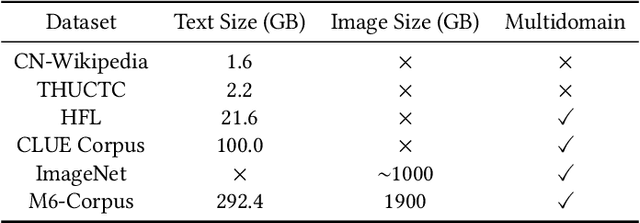
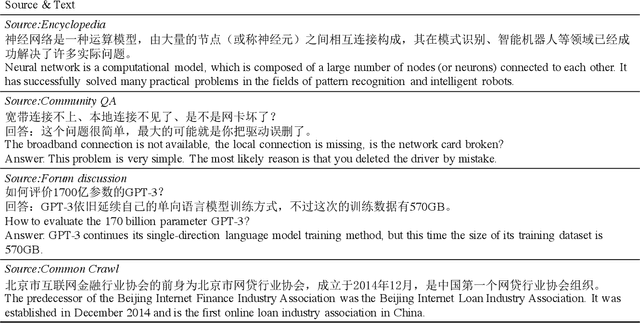
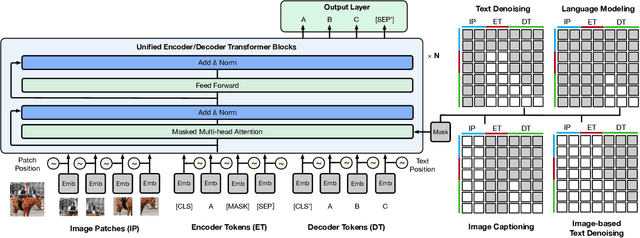
In this work, we construct the largest dataset for multimodal pretraining in Chinese, which consists of over 1.9TB images and 292GB texts that cover a wide range of domains. We propose a cross-modal pretraining method called M6, referring to Multi-Modality to Multi-Modality Multitask Mega-transformer, for unified pretraining on the data of single modality and multiple modalities. We scale the model size up to 10 billion and 100 billion parameters, and build the largest pretrained model in Chinese. We apply the model to a series of downstream applications, and demonstrate its outstanding performance in comparison with strong baselines. Furthermore, we specifically design a downstream task of text-guided image generation, and show that the finetuned M6 can create high-quality images with high resolution and abundant details.