 Add to Chrome
 Add to Firefox
 Add to Edge
Labor Migration Modeling through Large-scale Job Query Data
Oct 03, 2024
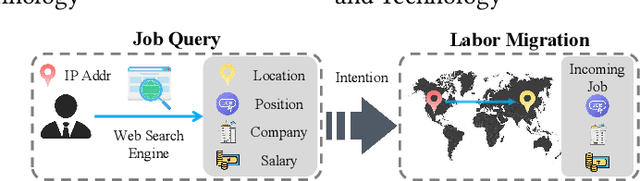

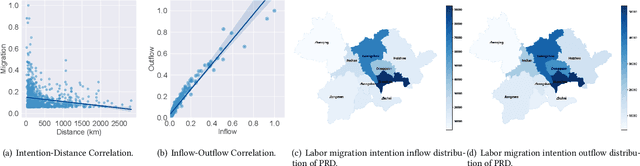
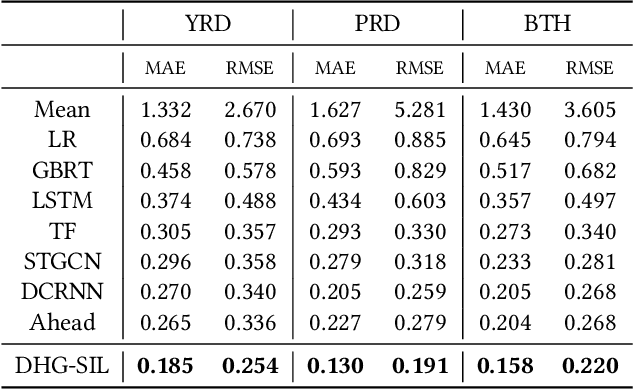
Accurate and timely modeling of labor migration is crucial for various urban governance and commercial tasks, such as local policy-making and business site selection. However, existing studies on labor migration largely rely on limited survey data with statistical methods, which fail to deliver timely and fine-grained insights for time-varying regional trends. To this end, we propose a deep learning-based spatial-temporal labor migration analysis framework, DHG-SIL, by leveraging large-scale job query data. Specifically, we first acquire labor migration intention as a proxy of labor migration via job queries from one of the world's largest search engines. Then, a Disprepant Homophily co-preserved Graph Convolutional Network (DH-GCN) and an interpretable temporal module are respectively proposed to capture cross-city and sequential labor migration dependencies. Besides, we introduce four interpretable variables to quantify city migration properties, which are co-optimized with city representations via tailor-designed contrastive losses. Extensive experiments on three real-world datasets demonstrate the superiority of our DHG-SIL. Notably, DHG-SIL has been deployed as a core component of a cooperative partner's intelligent human resource system, and the system supported a series of city talent attraction reports.

CreDes: Causal Reasoning Enhancement and Dual-End Searching for Solving Long-Range Reasoning Problems using LLMs
Oct 02, 2024Large language models (LLMs) have demonstrated limitations in handling combinatorial optimization problems involving long-range reasoning, partially due to causal hallucinations and huge search space. As for causal hallucinations, i.e., the inconsistency between reasoning and corresponding state transition, this paper introduces the Causal Relationship Enhancement (CRE) mechanism combining cause-effect interventions and the Individual Treatment Effect (ITE) to guarantee the solid causal rightness between each step of reasoning and state transition. As for the long causal range and huge search space limiting the performances of existing models featuring single-direction search, a Dual-End Searching (DES) approach is proposed to seek solutions by simultaneously starting from both the initial and goal states on the causal probability tree. By integrating CRE and DES (CreDes), our model has realized simultaneous multi-step reasoning, circumventing the inefficiencies from cascading multiple one-step reasoning like the Chain-of-Thought (CoT). Experiments demonstrate that CreDes significantly outperforms existing State-Of-The-Art (SOTA) solutions in long-range reasoning tasks in terms of both accuracy and time efficiency.
Convergence-aware Clustered Federated Graph Learning Framework for Collaborative Inter-company Labor Market Forecasting
Sep 29, 2024
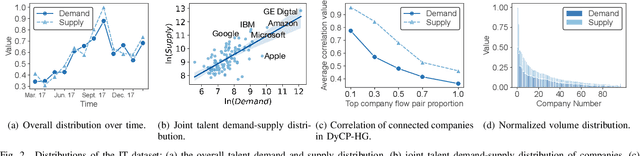
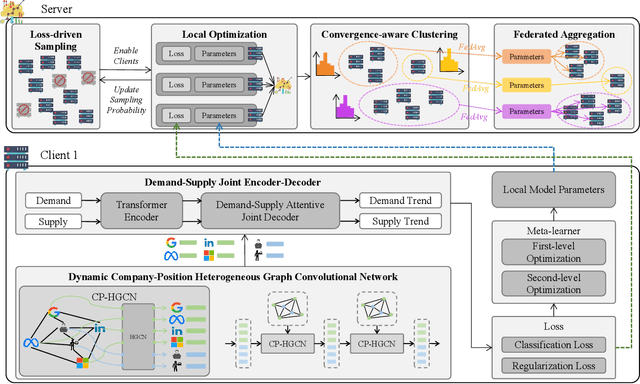
Labor market forecasting on talent demand and supply is essential for business management and economic development. With accurate and timely forecasts, employers can adapt their recruitment strategies to align with the evolving labor market, and employees can have proactive career path planning according to future demand and supply. However, previous studies ignore the interconnection between demand-supply sequences among different companies and positions for predicting variations. Moreover, companies are reluctant to share their private human resource data for global labor market analysis due to concerns over jeopardizing competitive advantage, security threats, and potential ethical or legal violations. To this end, in this paper, we formulate the Federated Labor Market Forecasting (FedLMF) problem and propose a Meta-personalized Convergence-aware Clustered Federated Learning (MPCAC-FL) framework to provide accurate and timely collaborative talent demand and supply prediction in a privacy-preserving way. First, we design a graph-based sequential model to capture the inherent correlation between demand and supply sequences and company-position pairs. Second, we adopt meta-learning techniques to learn effective initial model parameters that can be shared across companies, allowing personalized models to be optimized for forecasting company-specific demand and supply, even when companies have heterogeneous data. Third, we devise a Convergence-aware Clustering algorithm to dynamically divide companies into groups according to model similarity and apply federated aggregation in each group. The heterogeneity can be alleviated for more stable convergence and better performance. Extensive experiments demonstrate that MPCAC-FL outperforms compared baselines on three real-world datasets and achieves over 97% of the state-of-the-art model, i.e., DH-GEM, without exposing private company data.
HSTFL: A Heterogeneous Federated Learning Framework for Misaligned Spatiotemporal Forecasting
Sep 27, 2024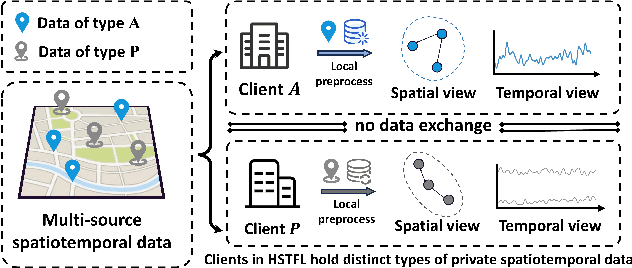
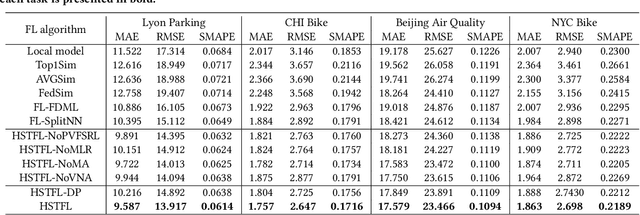
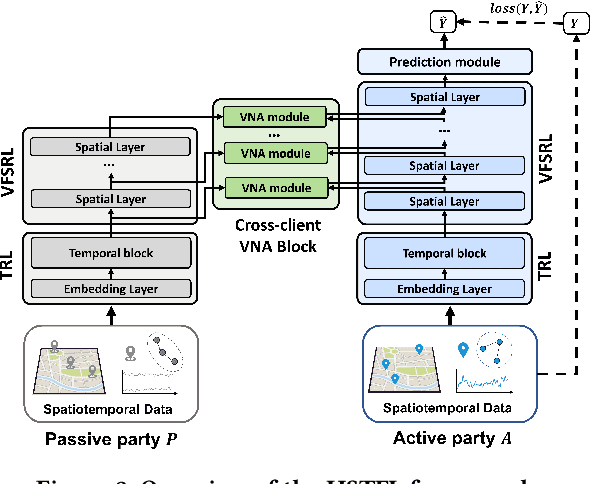
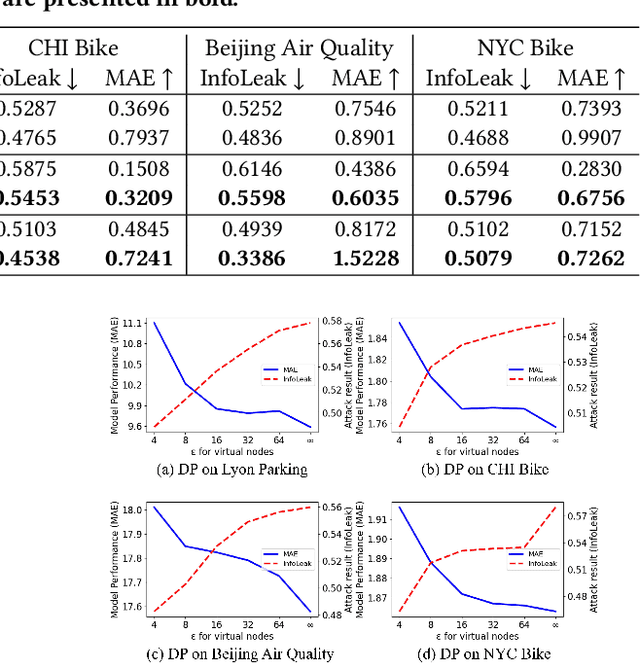
Spatiotemporal forecasting has emerged as an indispensable building block of diverse smart city applications, such as intelligent transportation and smart energy management. Recent advancements have uncovered that the performance of spatiotemporal forecasting can be significantly improved by integrating knowledge in geo-distributed time series data from different domains, \eg enhancing real-estate appraisal with human mobility data; joint taxi and bike demand predictions. While effective, existing approaches assume a centralized data collection and exploitation environment, overlooking the privacy and commercial interest concerns associated with data owned by different parties. In this paper, we investigate multi-party collaborative spatiotemporal forecasting without direct access to multi-source private data. However, this task is challenging due to 1) cross-domain feature heterogeneity and 2) cross-client geographical heterogeneity, where standard horizontal or vertical federated learning is inapplicable. To this end, we propose a Heterogeneous SpatioTemporal Federated Learning (HSTFL) framework to enable multiple clients to collaboratively harness geo-distributed time series data from different domains while preserving privacy. Specifically, we first devise vertical federated spatiotemporal representation learning to locally preserve spatiotemporal dependencies among individual participants and generate effective representations for heterogeneous data. Then we propose a cross-client virtual node alignment block to incorporate cross-client spatiotemporal dependencies via a multi-level knowledge fusion scheme. Extensive privacy analysis and experimental evaluations demonstrate that HSTFL not only effectively resists inference attacks but also provides a significant improvement against various baselines.
Erase then Rectify: A Training-Free Parameter Editing Approach for Cost-Effective Graph Unlearning
Sep 25, 2024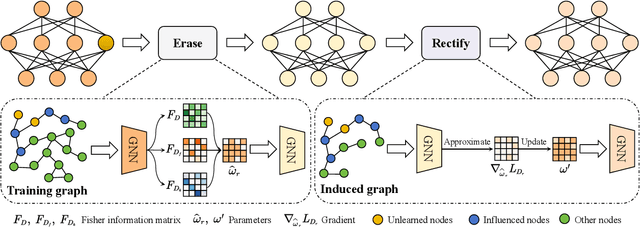

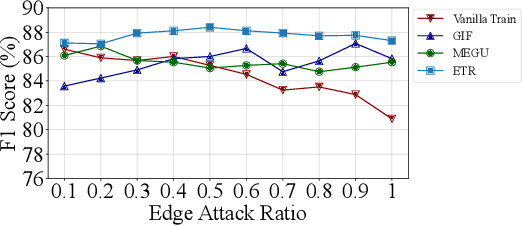
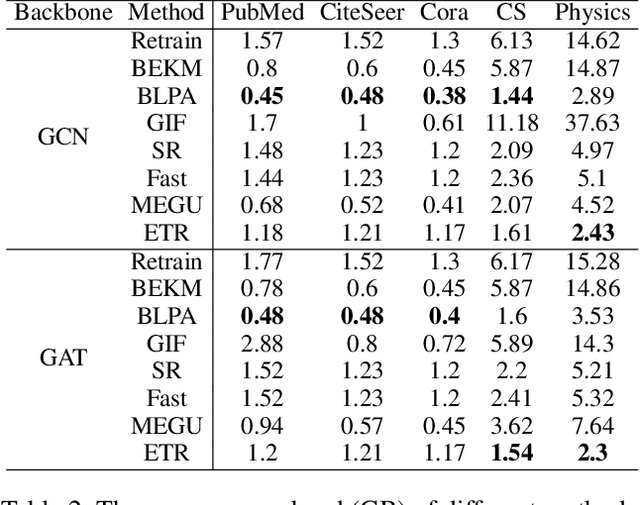
Graph unlearning, which aims to eliminate the influence of specific nodes, edges, or attributes from a trained Graph Neural Network (GNN), is essential in applications where privacy, bias, or data obsolescence is a concern. However, existing graph unlearning techniques often necessitate additional training on the remaining data, leading to significant computational costs, particularly with large-scale graphs. To address these challenges, we propose a two-stage training-free approach, Erase then Rectify (ETR), designed for efficient and scalable graph unlearning while preserving the model utility. Specifically, we first build a theoretical foundation showing that masking parameters critical for unlearned samples enables effective unlearning. Building on this insight, the Erase stage strategically edits model parameters to eliminate the impact of unlearned samples and their propagated influence on intercorrelated nodes. To further ensure the GNN's utility, the Rectify stage devises a gradient approximation method to estimate the model's gradient on the remaining dataset, which is then used to enhance model performance. Overall, ETR achieves graph unlearning without additional training or full training data access, significantly reducing computational overhead and preserving data privacy. Extensive experiments on seven public datasets demonstrate the consistent superiority of ETR in model utility, unlearning efficiency, and unlearning effectiveness, establishing it as a promising solution for real-world graph unlearning challenges.
GraphLoRA: Structure-Aware Contrastive Low-Rank Adaptation for Cross-Graph Transfer Learning
Sep 25, 2024


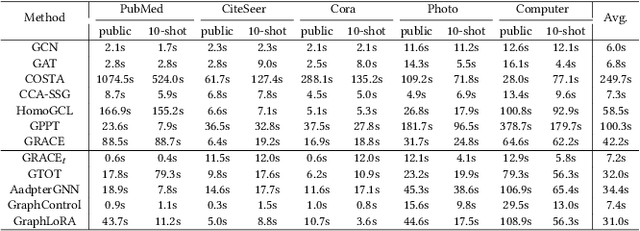
Graph Neural Networks (GNNs) have demonstrated remarkable proficiency in handling a range of graph analytical tasks across various domains, such as e-commerce and social networks. Despite their versatility, GNNs face significant challenges in transferability, limiting their utility in real-world applications. Existing research in GNN transfer learning overlooks discrepancies in distribution among various graph datasets, facing challenges when transferring across different distributions. How to effectively adopt a well-trained GNN to new graphs with varying feature and structural distributions remains an under-explored problem. Taking inspiration from the success of Low-Rank Adaptation (LoRA) in adapting large language models to various domains, we propose GraphLoRA, an effective and parameter-efficient method for transferring well-trained GNNs to diverse graph domains. Specifically, we first propose a Structure-aware Maximum Mean Discrepancy (SMMD) to align divergent node feature distributions across source and target graphs. Moreover, we introduce low-rank adaptation by injecting a small trainable GNN alongside the pre-trained one, effectively bridging structural distribution gaps while mitigating the catastrophic forgetting. Additionally, a structure-aware regularization objective is proposed to enhance the adaptability of the pre-trained GNN to target graph with scarce supervision labels. Extensive experiments on six real-world datasets demonstrate the effectiveness of GraphLoRA against eleven baselines by tuning only 20% of parameters, even across disparate graph domains. The code is available at https://anonymous.4open.science/r/GraphLoRA.
AutoSTF: Decoupled Neural Architecture Search for Cost-Effective Automated Spatio-Temporal Forecasting
Sep 25, 2024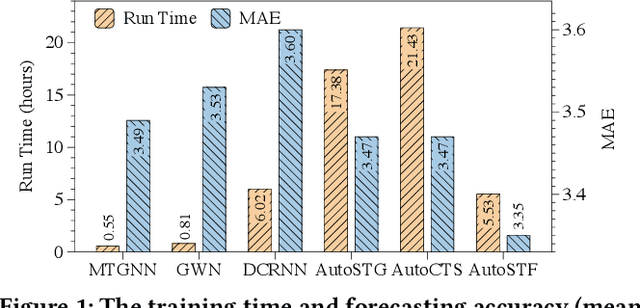

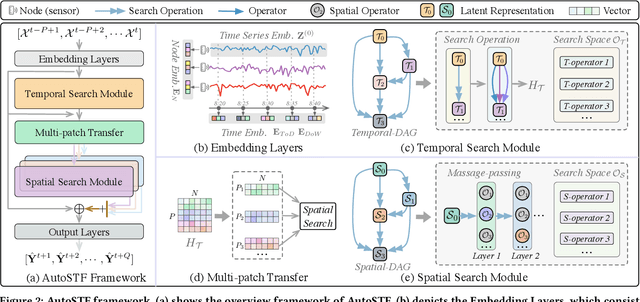

Spatio-temporal forecasting is a critical component of various smart city applications, such as transportation optimization, energy management, and socio-economic analysis. Recently, several automated spatio-temporal forecasting methods have been proposed to automatically search the optimal neural network architecture for capturing complex spatio-temporal dependencies. However, the existing automated approaches suffer from expensive neural architecture search overhead, which hinders their practical use and the further exploration of diverse spatio-temporal operators in a finer granularity. In this paper, we propose AutoSTF, a decoupled automatic neural architecture search framework for cost-effective automated spatio-temporal forecasting. From the efficiency perspective, we first decouple the mixed search space into temporal space and spatial space and respectively devise representation compression and parameter-sharing schemes to mitigate the parameter explosion. The decoupled spatio-temporal search not only expedites the model optimization process but also leaves new room for more effective spatio-temporal dependency modeling. From the effectiveness perspective, we propose a multi-patch transfer module to jointly capture multi-granularity temporal dependencies and extend the spatial search space to enable finer-grained layer-wise spatial dependency search. Extensive experiments on eight datasets demonstrate the superiority of AutoSTF in terms of both accuracy and efficiency. Specifically, our proposed method achieves up to 13.48x speed-up compared to state-of-the-art automatic spatio-temporal forecasting methods while maintaining the best forecasting accuracy.
Spatial-Temporal Mixture-of-Graph-Experts for Multi-Type Crime Prediction
Sep 24, 2024

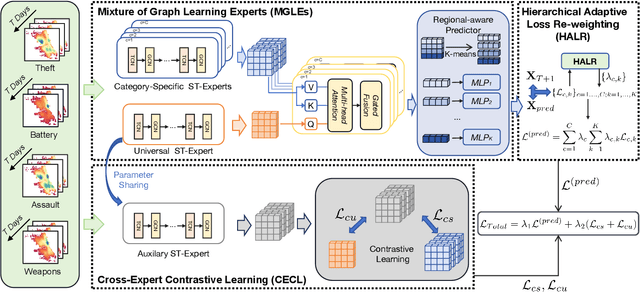
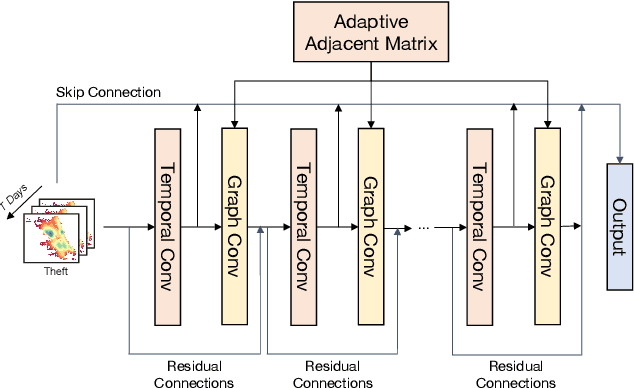
As various types of crime continue to threaten public safety and economic development, predicting the occurrence of multiple types of crimes becomes increasingly vital for effective prevention measures. Although extensive efforts have been made, most of them overlook the heterogeneity of different crime categories and fail to address the issue of imbalanced spatial distribution. In this work, we propose a Spatial-Temporal Mixture-of-Graph-Experts (ST-MoGE) framework for collective multiple-type crime prediction. To enhance the model's ability to identify diverse spatial-temporal dependencies and mitigate potential conflicts caused by spatial-temporal heterogeneity of different crime categories, we introduce an attentive-gated Mixture-of-Graph-Experts (MGEs) module to capture the distinctive and shared crime patterns of each crime category. Then, we propose Cross-Expert Contrastive Learning(CECL) to update the MGEs and force each expert to focus on specific pattern modeling, thereby reducing blending and redundancy. Furthermore, to address the issue of imbalanced spatial distribution, we propose a Hierarchical Adaptive Loss Re-weighting (HALR) approach to eliminate biases and insufficient learning of data-scarce regions. To evaluate the effectiveness of our methods, we conduct comprehensive experiments on two real-world crime datasets and compare our results with twelve advanced baselines. The experimental results demonstrate the superiority of our methods.
Large Language Model Enhanced Hard Sample Identification for Denoising Recommendation
Sep 16, 2024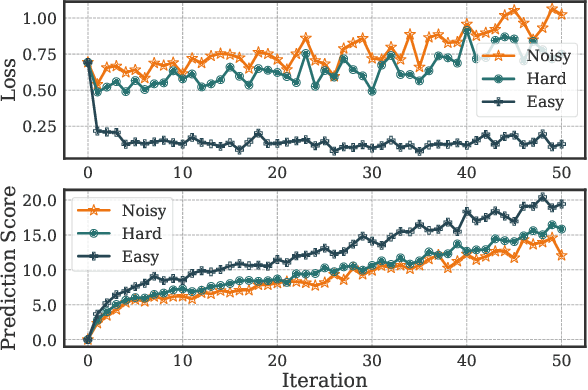
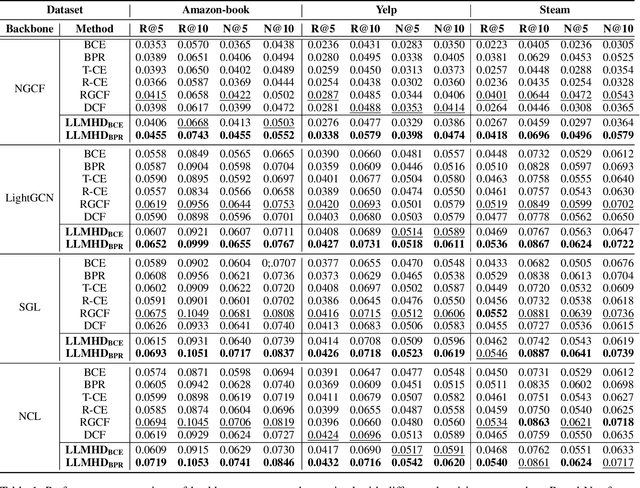
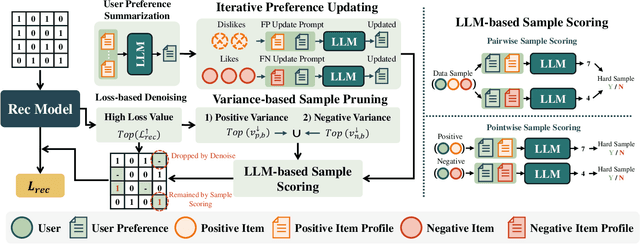
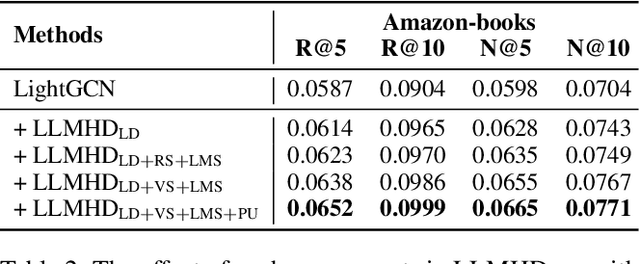
Implicit feedback, often used to build recommender systems, unavoidably confronts noise due to factors such as misclicks and position bias. Previous studies have attempted to alleviate this by identifying noisy samples based on their diverged patterns, such as higher loss values, and mitigating the noise through sample dropping or reweighting. Despite the progress, we observe existing approaches struggle to distinguish hard samples and noise samples, as they often exhibit similar patterns, thereby limiting their effectiveness in denoising recommendations. To address this challenge, we propose a Large Language Model Enhanced Hard Sample Denoising (LLMHD) framework. Specifically, we construct an LLM-based scorer to evaluate the semantic consistency of items with the user preference, which is quantified based on summarized historical user interactions. The resulting scores are used to assess the hardness of samples for the pointwise or pairwise training objectives. To ensure efficiency, we introduce a variance-based sample pruning strategy to filter potential hard samples before scoring. Besides, we propose an iterative preference update module designed to continuously refine summarized user preference, which may be biased due to false-positive user-item interactions. Extensive experiments on three real-world datasets and four backbone recommenders demonstrate the effectiveness of our approach.
Frequency-Position-Fluid Antenna Array for Ultra-dense Connectivity in Terahertz Beamforming Systems
Sep 02, 2024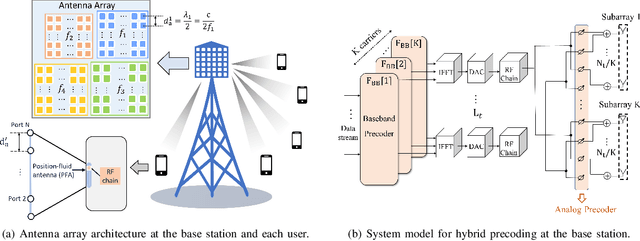
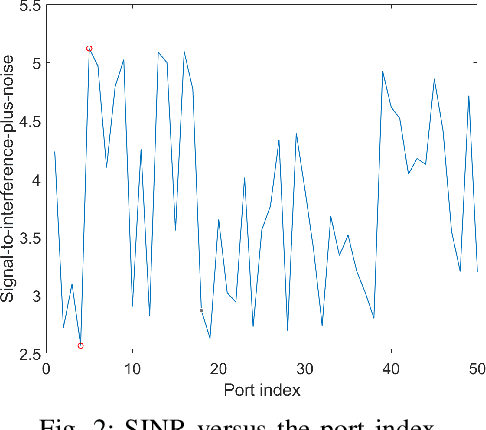

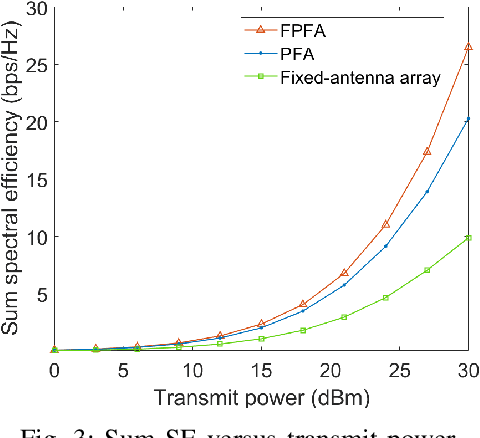
The position-fluid antenna (PFA) architecture has become one of the appealing technologies to support ubiquitous connectivity demand in next-generation wireless systems. Specifically, allowing the antenna to adjust its physical position to one of the predefined ports within a fixed region can introduce additional spatial diversity and improve the signal-to-interference-plus-noise ratio (SINR). In addition, frequency diversity is also widely-explored through frequency interleaving in the terahertz (THz) band. However, the operating bandwidth of one antenna is usually limited to 10% of the central frequency, which imposes a waste of the ultra-broad bandwidth in the THz band. In light of this, a frequency-position-fluid antenna (FPFA) system is proposed in this paper to facilitate ultra-dense connectivity. Specifically, antennas with non-overlapping operating frequency ranges are deployed at the base station (BS) to expand the total available bandwidth and provide frequency domain diversity, while the PFA-enabled users are capable of providing the spatial domain diversity. The channel model is first derived, based on which a channel correlation-based frequency allocation strategy is proposed. Then, a minimum-projection-based port selection algorithm is developed with singular-value-decomposition (SVD) precoders. Simulation results show that the proposed FPFA architecture exhibits steady performance with an increasing number of users, and outperforms the PFA and the fixed-antenna system in ultra-dense user deployment.